Philippine politics and governance
Is a set of related beliefs about political
theory and policy held by an individual,
group of individuals or a social class.
Political ideologies form the basis of how
they view the world around them and the
proper role of government in the world
(Heywood 2003)
Ideologies provide an explanation for
problems that confronts modern
societies by providing futuristic visions.
Ideology is an action-oriented.
Ideologies mobilize a large number of
people.
Skeptical of authority and rejects all involuntary,
coercive forms of hierarchy.
Rejection of the government.
To anarchist, government is evil oppressive.
Endorses direct democracy and call for
continuous popular participation and radical
decentralization.
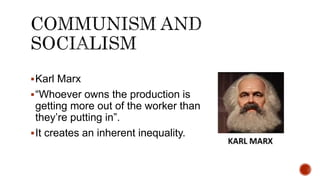
Karl Marx
“Whoever owns the production is
getting more out of the worker than
they’re putting in”.
It creates an inherent inequality.
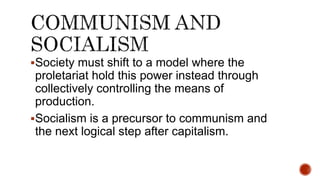
Society must shift to a model where the
proletariat hold this power instead through
collectively controlling the means of
production.
Socialism is a precursor to communism and
the next logical step after capitalism.
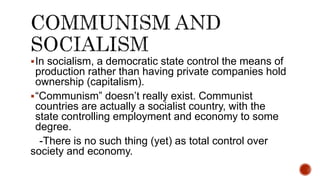
In socialism, a democratic state control the means of
production rather than having private companies hold
ownership (capitalism).
“Communism” doesn’t really exist. Communist
countries are actually a socialist country, with the
state controlling employment and economy to some
degree.
-There is no such thing (yet) as total control over
society and economy.
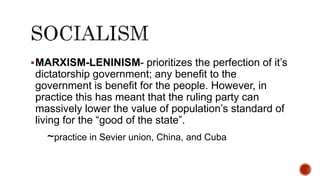
MARXISM-LENINISM- prioritizes the perfection of it’s
dictatorship government; any benefit to the
government is benefit for the people. However, in
practice this has meant that the ruling party can
massively lower the value of population’s standard of
living for the “good of the state”.
~practice in Sevier union, China, and Cuba
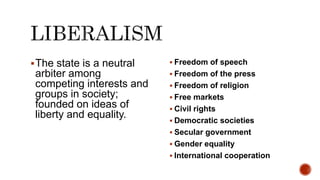
The state is a neutral
arbiter among
competing interests and
groups in society;
founded on ideas of
liberty and equality.
 Freedom of speech
 Freedom of the press
 Freedom of religion
 Free markets
 Civil rights
 Democratic societies
 Secular government
 Gender equality
 International cooperation
John Locke “Father of liberalism”
Rejects social and political norms of hereditary
privilege, state religion, absolute monarchy, and
the divine rights of the kings.
Each man has a natural right to life, liberty, and
property.
 The state is linked to providing
authority and discipline and to
protect society from chaos and
disorder.
 Seeks to preserve institutions
emphasizing stability and
continuity.
 Conservatism reject the
optimistic view that human
beings can be morally improved
through political and social
change.
Tradition
Human imperfection
Organic society
Hierarchy
Authority
Property rights
 Born out of the idea that rational
democracies would lead to
serve crisis and weaknesses.
 It promises to create the rebirth
of a new, stronger, and greater
society, stripped of all
weaknesses.
 The state as a supreme ethical
ideal, reflecting the
undifferentiated interests of the
national community, hence their
belief in totalitarianism.
 Follows strict doctrine:
1st- it attempts of unity country
under a single banner.
Nationalism includes the concept
of “racial” or “cultural” purity.
. 2nd- total control of society and
people by the state called
totalitarianism. People must only
believe in a single party ruling
elite, a dictator. Doesn’t believe in
pluralism.
Intensely supportive of violence to achieve political
means.
Adolf Hitler (Germany)
Benito Mussolini (Italy)

Political-ideologies (1).pptx

  • 1.
  • 2.
    Is a setof related beliefs about political theory and policy held by an individual, group of individuals or a social class. Political ideologies form the basis of how they view the world around them and the proper role of government in the world (Heywood 2003)
  • 3.
    Ideologies provide anexplanation for problems that confronts modern societies by providing futuristic visions. Ideology is an action-oriented. Ideologies mobilize a large number of people.
  • 4.
    Skeptical of authorityand rejects all involuntary, coercive forms of hierarchy. Rejection of the government. To anarchist, government is evil oppressive. Endorses direct democracy and call for continuous popular participation and radical decentralization.
  • 5.
    Karl Marx “Whoever ownsthe production is getting more out of the worker than they’re putting in”. It creates an inherent inequality.
  • 6.
    Society must shiftto a model where the proletariat hold this power instead through collectively controlling the means of production. Socialism is a precursor to communism and the next logical step after capitalism.
  • 7.
    In socialism, ademocratic state control the means of production rather than having private companies hold ownership (capitalism). “Communism” doesn’t really exist. Communist countries are actually a socialist country, with the state controlling employment and economy to some degree. -There is no such thing (yet) as total control over society and economy.
  • 8.
    MARXISM-LENINISM- prioritizes theperfection of it’s dictatorship government; any benefit to the government is benefit for the people. However, in practice this has meant that the ruling party can massively lower the value of population’s standard of living for the “good of the state”. ~practice in Sevier union, China, and Cuba
  • 9.
    The state isa neutral arbiter among competing interests and groups in society; founded on ideas of liberty and equality.  Freedom of speech  Freedom of the press  Freedom of religion  Free markets  Civil rights  Democratic societies  Secular government  Gender equality  International cooperation
  • 10.
    John Locke “Fatherof liberalism” Rejects social and political norms of hereditary privilege, state religion, absolute monarchy, and the divine rights of the kings. Each man has a natural right to life, liberty, and property.
  • 11.
     The stateis linked to providing authority and discipline and to protect society from chaos and disorder.  Seeks to preserve institutions emphasizing stability and continuity.  Conservatism reject the optimistic view that human beings can be morally improved through political and social change. Tradition Human imperfection Organic society Hierarchy Authority Property rights
  • 12.
     Born outof the idea that rational democracies would lead to serve crisis and weaknesses.  It promises to create the rebirth of a new, stronger, and greater society, stripped of all weaknesses.  The state as a supreme ethical ideal, reflecting the undifferentiated interests of the national community, hence their belief in totalitarianism.  Follows strict doctrine: 1st- it attempts of unity country under a single banner. Nationalism includes the concept of “racial” or “cultural” purity. . 2nd- total control of society and people by the state called totalitarianism. People must only believe in a single party ruling elite, a dictator. Doesn’t believe in pluralism.
  • 13.
    Intensely supportive ofviolence to achieve political means. Adolf Hitler (Germany) Benito Mussolini (Italy)