21st Century Literature from the Philippines and the
World
Quarter 2 : Module 1 Lesson 1
MARXISM LITERARY CRITICISM
Lecturer: Mam Kat
Specific Objectives:
1. Define and explain Marxist criticism and its
key concepts.
2. Analyze a narrative of class struggle in a
given text.
3. Write a critical analysis of the reading text
using the Marxist literary criticism.
Before you start your
learning adventure,
please try to answer first
the task below. This task
will give you an overview
of what you will learn as
you go along the way to
this module.
Talk to your neighbor
Activity 1
Match each of the
following terms with the
correct definition.
Write the letter of your
answer on a separate
sheet of paper.
Share with the Class
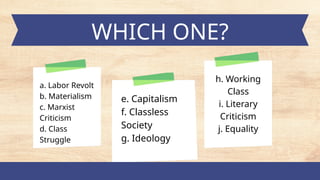
WHICH ONE?
a. Labor Revolt
b. Materialism
c. Marxist
Criticism
d. Class
Struggle
h. Working
Class
i. Literary
Criticism
j. Equality
e. Capitalism
f. Classless
Society
g. Ideology
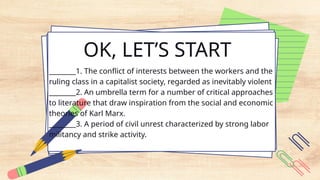
OK, LET’S START
________1. The conflict of interests between the workers and the
ruling class in a capitalist society, regarded as inevitably violent
________2. An umbrella term for a number of critical approaches
to literature that draw inspiration from the social and economic
theories of Karl Marx.
________3. A period of civil unrest characterized by strong labor
militancy and strike activity.
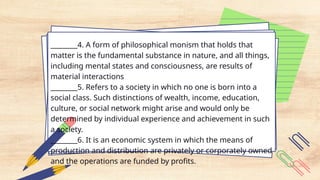
________4. A form of philosophical monism that holds that
matter is the fundamental substance in nature, and all things,
including mental states and consciousness, are results of
material interactions
________5. Refers to a society in which no one is born into a
social class. Such distinctions of wealth, income, education,
culture, or social network might arise and would only be
determined by individual experience and achievement in such
a society.
________6. It is an economic system in which the means of
production and distribution are privately or corporately owned
and the operations are funded by profits.
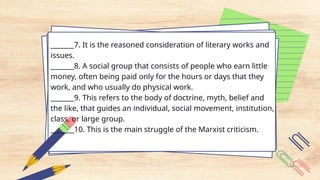
_______7. It is the reasoned consideration of literary works and
issues.
_______8. A social group that consists of people who earn little
money, often being paid only for the hours or days that they
work, and who usually do physical work.
_______9. This refers to the body of doctrine, myth, belief and
the like, that guides an individual, social movement, institution,
class, or large group.
_______10. This is the main struggle of the Marxist criticism.
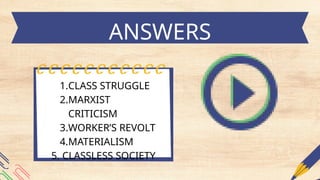
ANSWERS
1.CLASS STRUGGLE
2.MARXIST
CRITICISM
3.WORKER’S REVOLT
4.MATERIALISM
5. CLASSLESS SOCIETY
ANSWERS
6. CAPITALISM
7. LITERARY CRITICISM
8. WORKING CLASS
9. IDEOLOGY
10. EQUALITY
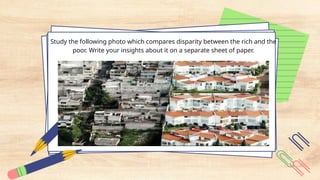
Study the following photo which compares disparity between the rich and the
poor. Write your insights about it on a separate sheet of paper.
How do you critique a piece of
literature?
LET’S STUDY
• Class struggle is ever present in our
world. Even in first world countries, this
issue still exists.
• It becomes a hot topic in the well-
known literary text such as “Dialogue
on Poverty” by Yomanoue no Okura ,
“Literature for the Masses” by
MaoZedong and even teleseryes like
“Ang Probinsyano”.
What is Marxist Criticism / Marxism?
•A type of literary criticism based on
the writings of German
philosopher Karl Marx .
•It is a critical approach to literature
which shows the relationship
between literature and the social—
mainly economic— conditions
under which it was produced.
What is Marxist Criticism /
Marxism?
• Originally, Marxist critics focused on literary
representations of workers and working classes.
• Like cultural criticism, Marxist literary
criticism offers critiques of the “canon” and focuses on the
ways in which culture and power intersect; for a Marxist
critic, literature both reproduces existing power relations
and offers a space where they can be contested and
redefined.
• Important 20th-century Marxist literary critics include
Georg Lucáks, Antonio Gramsci, Louis
Althusser,Terry Eagleton, Raymond Williams, and Frederic
Jameson.
• Some of the key concepts of Marxism include
worker's uprising , materialism, class struggle,
effect of capitalism, classless society, ideology, and
working class.
• In short, here we have to bear one thing in mind
that Marxism is the scientific study of society and
literature is a particular reflection of it.
• Therefore, Marxism has everything to do with
literature.
• Literature is an outcome of the active participation
of the writers in the socio-political, and economic
life of the people.
• After all, a writer is a human being
who has compassion and love for
people. He gets moved by the
sufferings of other men and reflects
class-struggle, revolt, humanism,
social realism, sense of optimism for
the rise of a new, happy world as the
common feelings of mass society.
• Marxist criticism is concerned with
differences between economic classes &
implications of capitalist system, such as
the continuing conflicts between the
working class and the elite. Hence, it
attempts to reveal that the ultimate
source of people’s experience is the
socio-economic system .
• The common aspects looked into when
using Marxist criticism are as follows:
1.Social class as represented in the work
2. Social class of the writer /creator
3. Social class of the characters
4. Conflicts and interactions between
economic classes.
How to use Marxism
in Analyzing Literary
text?
There is no prescribed structure
in writing Marxist analysis of
literature, but the following parts
are almost always present
INTRODUCTION:
a. Title of the book/article/work
b. Writer’s Name
c. Thesis statement
BODY:
a. Major findings, claims, ideas, or
messages
b. You may address the following
questions:
1. Whom does it benefit if the work or
effort is accepted/successful/believed,
etc.?
2. What is the social class of the
author?
3. Which class does the work claim to
represent?
4.What values does it reinforce?
5. What values does it subvert?
6. What conflict can be seen between
the values the work champions and
those it portrays?
7. What social classes do the
characters represent?
8. How do characters from
different classes interact or
conflict?
Read and study the sample short Marxist criticism of “Dead Stars” below,
a classic Filipino short story by Paz Marquez Benitez
The imbalanced societal power play is evident in
the short story in the form of treatment of the
characters based on their class. This is most
easily evident in the conversation between
Alfredo and his fiancée, Esperanza, about Calixta,
their note-carrier who grew up in the latter’s
family.
Read and study the sample short Marxist criticism of “Dead Stars” below,
a classic Filipino short story by Paz Marquez Benitez
The scene depicts a parallelism in the
circumstance of Alfredo and his new love,
Julia, and Calixta and her live-in partner.
However, while no one blatantly frowns upon
the budding relationship between Alfredo
and Julia, except for some whispered rumors
that reach Esperanza, Calixta is dubbed “
ungrateful” to her master for doing such an
act
Read and study the sample short Marxist criticism of “Dead Stars” below,
a classic Filipino short story by Paz Marquez Benitez
Alfredo does not have to answer to anyone
for his unfaithfulness, but Calixta is
responsible not only for what her family
might think, but also for the members of her
master’s family. Despite the same
circumstances, the two people are regarded
differently based on their positions in life.
Read and study the sample short Marxist criticism of “Dead Stars” below,
a classic Filipino short story by Paz Marquez Benitez
The imbalanced societal power play is evident in the short story in the form of
treatment of the characters based on their class. This is most easily evident in the
conversation between Alfredo and his fiancée, Esperanza, about Calixta, their
note-carrier who grew up in the latter’s family. The scene depicts a parallelism in
the circumstance of Alfredo and his new love, Julia, and Calixta and her live-in
partner. However, while no one blatantly frowns upon the budding relationship
between Alfredo and Julia, except for some whispered rumors that reach
Esperanza, Calixta is dubbed “ ungrateful” to her master for doing such an act
Alfredo does not have to answer to anyone for his unfaithfulness, but Calixta is
responsible not only for what her family might think, but also for the members of
her master’s family. Despite the same circumstances, the two people are regarded
differently based on their positions in life.
tempt a Landscape Starter
CLASS-BASED TREATMENT ON CHARACTERS
The passage highlights how characters are
treated differently based on their class. Alfredo,
who is presumably of higher social standing, and
Calixta, a note-carrier and servant, are involved
in romantic relationships outside of societal
norms. However, they experience vastly
different judgments.
tempt a Landscape Starter
PARALLELISM BETWEEN RELATIONSHIPS
Alfredo’s romantic relationship with Julia is paralleled
with Calixta's relationship with her live-in partner.
Both relationships challenge societal expectations,
but Alfredo, a man of higher status, does not face
serious repercussions for his infidelity. On the other
hand, Calixta, being of lower class and a servant,
faces harsher judgment.
tempt a Landscape Starter
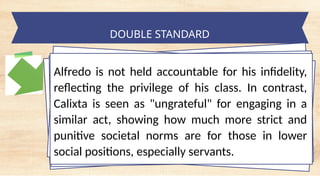
DOUBLE STANDARD
Alfredo is not held accountable for his infidelity,
reflecting the privilege of his class. In contrast,
Calixta is seen as "ungrateful" for engaging in a
similar act, showing how much more strict and
punitive societal norms are for those in lower
social positions, especially servants.
tempt a Landscape Starter
POWER DYNAMICS
The imbalance in how these characters are
treated reflects deeper societal power structures
where people of lower classes (like Calixta) are
more vulnerable to criticism and are expected to
adhere more strictly to moral standards. Alfredo's
higher status shields him from such scrutiny.
tempt a Landscape Starter
Group activity
In this task, you will create a role-play scene that demonstrates
class-based treatment, rooted in the principles of Marxist literary
criticism. Marxist criticism focuses on class struggles, the power
dynamics between the bourgeoisie (ruling class) and the proletariat
(working class), and how material conditions shape human
experience. In your scene, characters should exhibit behaviors or
dialogue that reflect the tension between social classes, with
particular attention to how the ruling class maintains control over
the working class.
tempt a Landscape Starter
Group activity
Your scene should:
1. Depict a clear social hierarchy between the characters.
2. Illustrate how the upper class exploits or oppresses the
working class.
3. Use dialogue to emphasize the unequal power dynamics,
highlighting key themes of Marxist criticism like alienation,
exploitation, or commodification of labor.
4. Maintain grammatical accuracy and coherence throughout
the dialogue.
tempt a Landscape Starter
SAMPLE
*Setting: A luxurious office at the top of a tall building.
The CEO, Mr. Hastings (bourgeoisie), is seated at his
grand desk, while Clara (proletariat), a junior office
worker, nervously enters the room.*
tempt a Landscape Starter
Mr. Hastings: (without looking up) You’re late, Clara.
Again.
Clara: (nervously) I’m sorry, sir. I missed the bus this
morning. It won’t happen again.
Mr. Hastings: (scoffing) The bus? You know, I never
understood why people like you rely on public
transportation. If you invested more wisely, maybe you
wouldn’t have these problems.
Clara: (fidgeting) I try, sir. But with my wages, it’s hard to
save enough to—
tempt a Landscape Starter
Mr. Hastings: (interrupting) Save? That’s your problem
right there. You think like a worker. Always scraping by.
You should be thinking about growth. Opportunity. If you
want to make something of yourself, you need to push
harder. I didn’t get here by taking the bus and worrying
about wages.
Clara: (quietly) I work hard, Mr. Hastings. But no matter
how hard I try, it feels like I’m always falling behind.
Rent’s going up, and food prices—
tempt a Landscape Starter
Mr. Hastings: (waving his hand dismissively) Excuses. You
people always have excuses. You get what you deserve, Clara. If
you want more, work more. That’s how the system works. It’s
fair.
Clara: (hesitant) But... it’s not fair. No matter how hard we
work, it feels like we’re just keeping your business afloat while
we struggle to survive.
Mr. Hastings: (leaning back, smirking) That’s how it’s always
been. It’s the natural order of things. People like me innovate,
lead, and take risks. People like you follow orders. That’s how
the world works, Clara. And it’s not going to change.
In this scene, the CEO’s dismissive and condescending
attitude toward Clara reflects the class struggle central
to Marxist literary criticism. Mr. Hastings embodies the
bourgeoisie’s belief in meritocracy and the inherent
fairness of capitalism, while Clara’s experience reflects
the alienation and exploitation faced by the working
class
UPUAN BY GLOCK 9
GROUPINGS
1. Identify the characters
 Who do you think the person sitting in the “upuan”
represents?
 Who are the powerless or oppressed in the song?
2. Power and class dynamics
 How does the song illustrate the power dynamics
between ruling class and the working class?
 Point out specific lyrics that reflect class conflict or
inequality.
3. Exploitation and Alienation
 Discuss how the person in the “upuan” is alienated by
the experiences of the marginalized people
 How do the lyrics suggest that the UPPER class is
exploiting the LOWER class?
4. Relating to Society
 Can you relate the issues in the song to real life
societal condition?
 Do you see similar power struggles in your own
community or country?
Check your understanding!
After learning different passages, answer the following questions in your
answer sheet.
1. What is Marxist criticism?
2. Where did Marxism come from?
3. .What are the key concepts of Marxism?
4. Who are the important 20th century Marxist literary critics?
5. What is the relationship between Marxism & literature?
6. What is the significance of Marxism to literary criticism?
7. How are the key concepts of Marxism correlated with literature?
8. What are the basic parts of Marxist critical analysis?
Let’s Practice!
Read and understand the poem below, then critic and analyze it by answering the
questions that follows:
The Dialogue of the Poor and Destitute
by Yomanoue no Okura
In amongst the wind
Rain falls at night,
And in amongst the rain
Falls snow:
With nothing to do
For I am cold,
Let’s Practice!
Read and understand the poem below, then critic and analyze it by answering the
questions that follows:
A hard cake of salt
I take and nibble,
With sake lees in hot water
To sip upon;
Coughing,
Nose running constantly;
Nothing to speak of,
My beard as I stroke it
“Apart from me
There’s no one!”
Let’s Practice!
Read and understand the poem below, then critic and analyze it by answering the
questions that follows:
A hard cake of salt
I take and nibble,
With sake lees in hot water
To sip upon;
Coughing,
Nose running constantly;
Nothing to speak of,
My beard as I stroke it
“Apart from me
There’s no one!”
Let’s Practice!
Read and understand the poem below, then critic and analyze it by answering the
questions that follows:
Say I in my pride, but
As I am cold,
Hemp blankets
I pull up around my head;
Sleeveless jackets,
All I have,
I put on, one on top another;
Yet though the night is cold –
Even more than I –
A poor man,
Let’s Practice!
Read and understand the poem below, then critic and analyze it by answering the
questions that follows:
With mother and father
Starving and numb,
Wife and children
Begging weeping;
At such a time
What is he to do?
As he passes through the world.
Heaven and earth,
Are wide, they say, yet
For me
Let’s Practice!
Read and understand the poem below, then critic and analyze it by answering the
questions that follows:
Are they not cramped?
The sun and moon
Shine bright, they say, yet
For me
Do they shine at all?
Are all men
Or only me this way?
Let’s Practice!
Read and understand the poem below, then critic and analyze it by answering the
questions that follows:
By chance
I was born a man and
Like other men
I am made, but
An unpadded
Sleeveless jacket
Like algae
Frayed and drooping
In rags alone
Hangs from my shoulders, and
In this low-roofed hut,
Let’s Practice!
Read and understand the poem below, then critic and analyze it by answering the
questions that follows:
This bent and crooked hut,
Straight on the ground
Straw’s spread;
My mother and father
Deep inside;
My wife and children
On the edge
Huddle together and
Moan sadly;
Let’s Practice!
Read and understand the poem below, then critic and analyze it by answering the
questions that follows:
From the stove
No smoke rises and
In the rice pot
A spider’s spun its web;
Cooking rice
Is something we’ve forgotten;
When we’re as ground thrushes
Here cheeping,
“To make a point of
Taking a short measure
Let’s Practice!
Read and understand the poem below, then critic and analyze it by answering the
questions that follows:
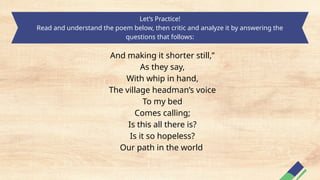
And making it shorter still,”
As they say,
With whip in hand,
The village headman’s voice
To my bed
Comes calling;
Is this all there is?
Is it so hopeless?
Our path in the world
Comprehension Check :
On a separate sheet of paper, write a short Marxist critical
analysis of the poem above, use the following questions as your
guide:
1.What is the title of the poem?
2.Who is the author?
3.What is the theme of poem?
4.What is the social class of the author?
5.Which class does the work claim to represent?
Comprehension Check :
On a separate sheet of paper, write a short Marxist critical analysis of the
poem above, use the following questions as your guide:
6. What values does it reinforce?
7. What values does it subvert?
8. What conflict can be seen between the values the
work champions and those it portrays?
9. How do characters from different classes interact or
conflict?
10. What social classes do the characters represent?
11. What is the scholarly or literary value of the reading
text?
GUESS THE WORD
Write the word that makes the most sense in the blank, using the words
below. Each word will be used only one time. Use a separate sheet of
paper for your answers.
Spit Tingling Wiggling Lawns
Glimmering Zip Thingies Cruise
Shacks Peeking
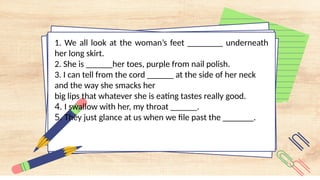
1. We all look at the woman’s feet ________ underneath
her long skirt.
2. She is ______her toes, purple from nail polish.
3. I can tell from the cord ______ at the side of her neck
and the way she smacks her
big lips that whatever she is eating tastes really good.
4. I swallow with her, my throat ______.
5. They just glance at us when we file past the _______.
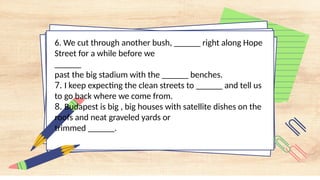
6. We cut through another bush, ______ right along Hope
Street for a while before we
______
past the big stadium with the ______ benches.
7. I keep expecting the clean streets to ______ and tell us
to go back where we come from.
8. Budapest is big , big houses with satellite dishes on the
roofs and neat graveled yards or
trimmed ______.
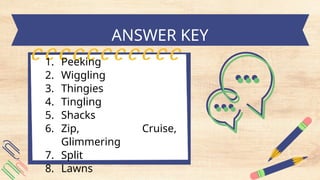
1. Peeking
2. Wiggling
3. Thingies
4. Tingling
5. Shacks
6. Zip, Cruise,
Glimmering
7. Split
8. Lawns
ANSWER KEY

21ST MODULE 1 LESSON 1 senior high school.pptx

  • 1.
    21st Century Literaturefrom the Philippines and the World Quarter 2 : Module 1 Lesson 1 MARXISM LITERARY CRITICISM Lecturer: Mam Kat
  • 2.
    Specific Objectives: 1. Defineand explain Marxist criticism and its key concepts. 2. Analyze a narrative of class struggle in a given text. 3. Write a critical analysis of the reading text using the Marxist literary criticism.
  • 3.
    Before you startyour learning adventure, please try to answer first the task below. This task will give you an overview of what you will learn as you go along the way to this module. Talk to your neighbor
  • 4.
    Activity 1 Match eachof the following terms with the correct definition. Write the letter of your answer on a separate sheet of paper. Share with the Class
  • 5.
    WHICH ONE? a. LaborRevolt b. Materialism c. Marxist Criticism d. Class Struggle h. Working Class i. Literary Criticism j. Equality e. Capitalism f. Classless Society g. Ideology
  • 6.
    OK, LET’S START ________1.The conflict of interests between the workers and the ruling class in a capitalist society, regarded as inevitably violent ________2. An umbrella term for a number of critical approaches to literature that draw inspiration from the social and economic theories of Karl Marx. ________3. A period of civil unrest characterized by strong labor militancy and strike activity.
  • 7.
    ________4. A formof philosophical monism that holds that matter is the fundamental substance in nature, and all things, including mental states and consciousness, are results of material interactions ________5. Refers to a society in which no one is born into a social class. Such distinctions of wealth, income, education, culture, or social network might arise and would only be determined by individual experience and achievement in such a society. ________6. It is an economic system in which the means of production and distribution are privately or corporately owned and the operations are funded by profits.
  • 8.
    _______7. It isthe reasoned consideration of literary works and issues. _______8. A social group that consists of people who earn little money, often being paid only for the hours or days that they work, and who usually do physical work. _______9. This refers to the body of doctrine, myth, belief and the like, that guides an individual, social movement, institution, class, or large group. _______10. This is the main struggle of the Marxist criticism.
  • 9.
  • 10.
    ANSWERS 6. CAPITALISM 7. LITERARYCRITICISM 8. WORKING CLASS 9. IDEOLOGY 10. EQUALITY
  • 11.
    Study the followingphoto which compares disparity between the rich and the poor. Write your insights about it on a separate sheet of paper.
  • 12.
    How do youcritique a piece of literature?
  • 13.
    LET’S STUDY • Classstruggle is ever present in our world. Even in first world countries, this issue still exists. • It becomes a hot topic in the well- known literary text such as “Dialogue on Poverty” by Yomanoue no Okura , “Literature for the Masses” by MaoZedong and even teleseryes like “Ang Probinsyano”.
  • 14.
    What is MarxistCriticism / Marxism? •A type of literary criticism based on the writings of German philosopher Karl Marx . •It is a critical approach to literature which shows the relationship between literature and the social— mainly economic— conditions under which it was produced.
  • 15.
    What is MarxistCriticism / Marxism? • Originally, Marxist critics focused on literary representations of workers and working classes. • Like cultural criticism, Marxist literary criticism offers critiques of the “canon” and focuses on the ways in which culture and power intersect; for a Marxist critic, literature both reproduces existing power relations and offers a space where they can be contested and redefined. • Important 20th-century Marxist literary critics include Georg Lucáks, Antonio Gramsci, Louis Althusser,Terry Eagleton, Raymond Williams, and Frederic Jameson.
  • 16.
    • Some ofthe key concepts of Marxism include worker's uprising , materialism, class struggle, effect of capitalism, classless society, ideology, and working class. • In short, here we have to bear one thing in mind that Marxism is the scientific study of society and literature is a particular reflection of it. • Therefore, Marxism has everything to do with literature. • Literature is an outcome of the active participation of the writers in the socio-political, and economic life of the people.
  • 17.
    • After all,a writer is a human being who has compassion and love for people. He gets moved by the sufferings of other men and reflects class-struggle, revolt, humanism, social realism, sense of optimism for the rise of a new, happy world as the common feelings of mass society.
  • 18.
    • Marxist criticismis concerned with differences between economic classes & implications of capitalist system, such as the continuing conflicts between the working class and the elite. Hence, it attempts to reveal that the ultimate source of people’s experience is the socio-economic system .
  • 19.
    • The commonaspects looked into when using Marxist criticism are as follows: 1.Social class as represented in the work 2. Social class of the writer /creator 3. Social class of the characters 4. Conflicts and interactions between economic classes.
  • 20.
    How to useMarxism in Analyzing Literary text? There is no prescribed structure in writing Marxist analysis of literature, but the following parts are almost always present INTRODUCTION: a. Title of the book/article/work b. Writer’s Name c. Thesis statement
  • 21.
    BODY: a. Major findings,claims, ideas, or messages b. You may address the following questions: 1. Whom does it benefit if the work or effort is accepted/successful/believed, etc.? 2. What is the social class of the author?
  • 22.
    3. Which classdoes the work claim to represent? 4.What values does it reinforce? 5. What values does it subvert? 6. What conflict can be seen between the values the work champions and those it portrays?
  • 23.
    7. What socialclasses do the characters represent? 8. How do characters from different classes interact or conflict?
  • 24.
    Read and studythe sample short Marxist criticism of “Dead Stars” below, a classic Filipino short story by Paz Marquez Benitez The imbalanced societal power play is evident in the short story in the form of treatment of the characters based on their class. This is most easily evident in the conversation between Alfredo and his fiancée, Esperanza, about Calixta, their note-carrier who grew up in the latter’s family.
  • 25.
    Read and studythe sample short Marxist criticism of “Dead Stars” below, a classic Filipino short story by Paz Marquez Benitez The scene depicts a parallelism in the circumstance of Alfredo and his new love, Julia, and Calixta and her live-in partner. However, while no one blatantly frowns upon the budding relationship between Alfredo and Julia, except for some whispered rumors that reach Esperanza, Calixta is dubbed “ ungrateful” to her master for doing such an act
  • 26.
    Read and studythe sample short Marxist criticism of “Dead Stars” below, a classic Filipino short story by Paz Marquez Benitez Alfredo does not have to answer to anyone for his unfaithfulness, but Calixta is responsible not only for what her family might think, but also for the members of her master’s family. Despite the same circumstances, the two people are regarded differently based on their positions in life.
  • 27.
    Read and studythe sample short Marxist criticism of “Dead Stars” below, a classic Filipino short story by Paz Marquez Benitez The imbalanced societal power play is evident in the short story in the form of treatment of the characters based on their class. This is most easily evident in the conversation between Alfredo and his fiancée, Esperanza, about Calixta, their note-carrier who grew up in the latter’s family. The scene depicts a parallelism in the circumstance of Alfredo and his new love, Julia, and Calixta and her live-in partner. However, while no one blatantly frowns upon the budding relationship between Alfredo and Julia, except for some whispered rumors that reach Esperanza, Calixta is dubbed “ ungrateful” to her master for doing such an act Alfredo does not have to answer to anyone for his unfaithfulness, but Calixta is responsible not only for what her family might think, but also for the members of her master’s family. Despite the same circumstances, the two people are regarded differently based on their positions in life.
  • 28.
    tempt a LandscapeStarter CLASS-BASED TREATMENT ON CHARACTERS The passage highlights how characters are treated differently based on their class. Alfredo, who is presumably of higher social standing, and Calixta, a note-carrier and servant, are involved in romantic relationships outside of societal norms. However, they experience vastly different judgments.
  • 29.
    tempt a LandscapeStarter PARALLELISM BETWEEN RELATIONSHIPS Alfredo’s romantic relationship with Julia is paralleled with Calixta's relationship with her live-in partner. Both relationships challenge societal expectations, but Alfredo, a man of higher status, does not face serious repercussions for his infidelity. On the other hand, Calixta, being of lower class and a servant, faces harsher judgment.
  • 30.
    tempt a LandscapeStarter DOUBLE STANDARD Alfredo is not held accountable for his infidelity, reflecting the privilege of his class. In contrast, Calixta is seen as "ungrateful" for engaging in a similar act, showing how much more strict and punitive societal norms are for those in lower social positions, especially servants.
  • 31.
    tempt a LandscapeStarter POWER DYNAMICS The imbalance in how these characters are treated reflects deeper societal power structures where people of lower classes (like Calixta) are more vulnerable to criticism and are expected to adhere more strictly to moral standards. Alfredo's higher status shields him from such scrutiny.
  • 32.
    tempt a LandscapeStarter Group activity In this task, you will create a role-play scene that demonstrates class-based treatment, rooted in the principles of Marxist literary criticism. Marxist criticism focuses on class struggles, the power dynamics between the bourgeoisie (ruling class) and the proletariat (working class), and how material conditions shape human experience. In your scene, characters should exhibit behaviors or dialogue that reflect the tension between social classes, with particular attention to how the ruling class maintains control over the working class.
  • 33.
    tempt a LandscapeStarter Group activity Your scene should: 1. Depict a clear social hierarchy between the characters. 2. Illustrate how the upper class exploits or oppresses the working class. 3. Use dialogue to emphasize the unequal power dynamics, highlighting key themes of Marxist criticism like alienation, exploitation, or commodification of labor. 4. Maintain grammatical accuracy and coherence throughout the dialogue.
  • 34.
    tempt a LandscapeStarter SAMPLE *Setting: A luxurious office at the top of a tall building. The CEO, Mr. Hastings (bourgeoisie), is seated at his grand desk, while Clara (proletariat), a junior office worker, nervously enters the room.*
  • 35.
    tempt a LandscapeStarter Mr. Hastings: (without looking up) You’re late, Clara. Again. Clara: (nervously) I’m sorry, sir. I missed the bus this morning. It won’t happen again. Mr. Hastings: (scoffing) The bus? You know, I never understood why people like you rely on public transportation. If you invested more wisely, maybe you wouldn’t have these problems. Clara: (fidgeting) I try, sir. But with my wages, it’s hard to save enough to—
  • 36.
    tempt a LandscapeStarter Mr. Hastings: (interrupting) Save? That’s your problem right there. You think like a worker. Always scraping by. You should be thinking about growth. Opportunity. If you want to make something of yourself, you need to push harder. I didn’t get here by taking the bus and worrying about wages. Clara: (quietly) I work hard, Mr. Hastings. But no matter how hard I try, it feels like I’m always falling behind. Rent’s going up, and food prices—
  • 37.
    tempt a LandscapeStarter Mr. Hastings: (waving his hand dismissively) Excuses. You people always have excuses. You get what you deserve, Clara. If you want more, work more. That’s how the system works. It’s fair. Clara: (hesitant) But... it’s not fair. No matter how hard we work, it feels like we’re just keeping your business afloat while we struggle to survive. Mr. Hastings: (leaning back, smirking) That’s how it’s always been. It’s the natural order of things. People like me innovate, lead, and take risks. People like you follow orders. That’s how the world works, Clara. And it’s not going to change.
  • 38.
    In this scene,the CEO’s dismissive and condescending attitude toward Clara reflects the class struggle central to Marxist literary criticism. Mr. Hastings embodies the bourgeoisie’s belief in meritocracy and the inherent fairness of capitalism, while Clara’s experience reflects the alienation and exploitation faced by the working class
  • 39.
    UPUAN BY GLOCK9 GROUPINGS 1. Identify the characters  Who do you think the person sitting in the “upuan” represents?  Who are the powerless or oppressed in the song?
  • 40.
    2. Power andclass dynamics  How does the song illustrate the power dynamics between ruling class and the working class?  Point out specific lyrics that reflect class conflict or inequality.
  • 41.
    3. Exploitation andAlienation  Discuss how the person in the “upuan” is alienated by the experiences of the marginalized people  How do the lyrics suggest that the UPPER class is exploiting the LOWER class?
  • 42.
    4. Relating toSociety  Can you relate the issues in the song to real life societal condition?  Do you see similar power struggles in your own community or country?
  • 43.
    Check your understanding! Afterlearning different passages, answer the following questions in your answer sheet. 1. What is Marxist criticism? 2. Where did Marxism come from? 3. .What are the key concepts of Marxism? 4. Who are the important 20th century Marxist literary critics? 5. What is the relationship between Marxism & literature? 6. What is the significance of Marxism to literary criticism? 7. How are the key concepts of Marxism correlated with literature? 8. What are the basic parts of Marxist critical analysis?
  • 44.
    Let’s Practice! Read andunderstand the poem below, then critic and analyze it by answering the questions that follows: The Dialogue of the Poor and Destitute by Yomanoue no Okura In amongst the wind Rain falls at night, And in amongst the rain Falls snow: With nothing to do For I am cold,
  • 45.
    Let’s Practice! Read andunderstand the poem below, then critic and analyze it by answering the questions that follows: A hard cake of salt I take and nibble, With sake lees in hot water To sip upon; Coughing, Nose running constantly; Nothing to speak of, My beard as I stroke it “Apart from me There’s no one!”
  • 46.
    Let’s Practice! Read andunderstand the poem below, then critic and analyze it by answering the questions that follows: A hard cake of salt I take and nibble, With sake lees in hot water To sip upon; Coughing, Nose running constantly; Nothing to speak of, My beard as I stroke it “Apart from me There’s no one!”
  • 47.
    Let’s Practice! Read andunderstand the poem below, then critic and analyze it by answering the questions that follows: Say I in my pride, but As I am cold, Hemp blankets I pull up around my head; Sleeveless jackets, All I have, I put on, one on top another; Yet though the night is cold – Even more than I – A poor man,
  • 48.
    Let’s Practice! Read andunderstand the poem below, then critic and analyze it by answering the questions that follows: With mother and father Starving and numb, Wife and children Begging weeping; At such a time What is he to do? As he passes through the world. Heaven and earth, Are wide, they say, yet For me
  • 49.
    Let’s Practice! Read andunderstand the poem below, then critic and analyze it by answering the questions that follows: Are they not cramped? The sun and moon Shine bright, they say, yet For me Do they shine at all? Are all men Or only me this way?
  • 50.
    Let’s Practice! Read andunderstand the poem below, then critic and analyze it by answering the questions that follows: By chance I was born a man and Like other men I am made, but An unpadded Sleeveless jacket Like algae Frayed and drooping In rags alone Hangs from my shoulders, and In this low-roofed hut,
  • 51.
    Let’s Practice! Read andunderstand the poem below, then critic and analyze it by answering the questions that follows: This bent and crooked hut, Straight on the ground Straw’s spread; My mother and father Deep inside; My wife and children On the edge Huddle together and Moan sadly;
  • 52.
    Let’s Practice! Read andunderstand the poem below, then critic and analyze it by answering the questions that follows: From the stove No smoke rises and In the rice pot A spider’s spun its web; Cooking rice Is something we’ve forgotten; When we’re as ground thrushes Here cheeping, “To make a point of Taking a short measure
  • 53.
    Let’s Practice! Read andunderstand the poem below, then critic and analyze it by answering the questions that follows: And making it shorter still,” As they say, With whip in hand, The village headman’s voice To my bed Comes calling; Is this all there is? Is it so hopeless? Our path in the world
  • 54.
    Comprehension Check : Ona separate sheet of paper, write a short Marxist critical analysis of the poem above, use the following questions as your guide: 1.What is the title of the poem? 2.Who is the author? 3.What is the theme of poem? 4.What is the social class of the author? 5.Which class does the work claim to represent?
  • 55.
    Comprehension Check : Ona separate sheet of paper, write a short Marxist critical analysis of the poem above, use the following questions as your guide: 6. What values does it reinforce? 7. What values does it subvert? 8. What conflict can be seen between the values the work champions and those it portrays? 9. How do characters from different classes interact or conflict? 10. What social classes do the characters represent? 11. What is the scholarly or literary value of the reading text?
  • 56.
    GUESS THE WORD Writethe word that makes the most sense in the blank, using the words below. Each word will be used only one time. Use a separate sheet of paper for your answers. Spit Tingling Wiggling Lawns Glimmering Zip Thingies Cruise Shacks Peeking
  • 57.
    1. We alllook at the woman’s feet ________ underneath her long skirt. 2. She is ______her toes, purple from nail polish. 3. I can tell from the cord ______ at the side of her neck and the way she smacks her big lips that whatever she is eating tastes really good. 4. I swallow with her, my throat ______. 5. They just glance at us when we file past the _______.
  • 58.
    6. We cutthrough another bush, ______ right along Hope Street for a while before we ______ past the big stadium with the ______ benches. 7. I keep expecting the clean streets to ______ and tell us to go back where we come from. 8. Budapest is big , big houses with satellite dishes on the roofs and neat graveled yards or trimmed ______.
  • 59.
    1. Peeking 2. Wiggling 3.Thingies 4. Tingling 5. Shacks 6. Zip, Cruise, Glimmering 7. Split 8. Lawns ANSWER KEY