POLITICS , GOVERRNANCE
AND
CITIZENSHIP
What is
political
culture?
What is culture?
CULTURE is way of life of
people.
> Passed on from one generation to
another by learning
Political Culture
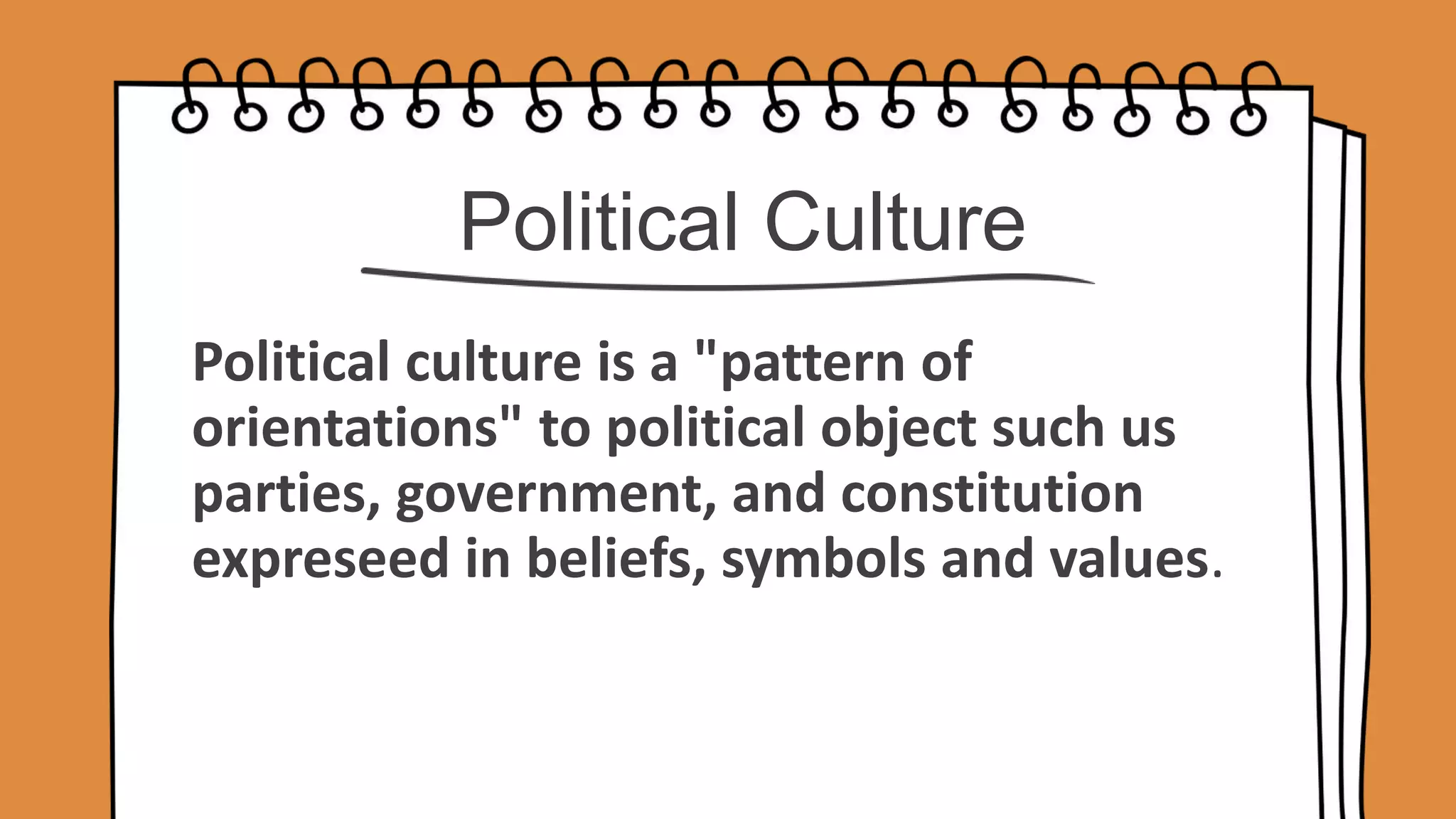
Political culture is a "pattern of
orientations" to political object such us
parties, government, and constitution
expreseed in beliefs, symbols and values.
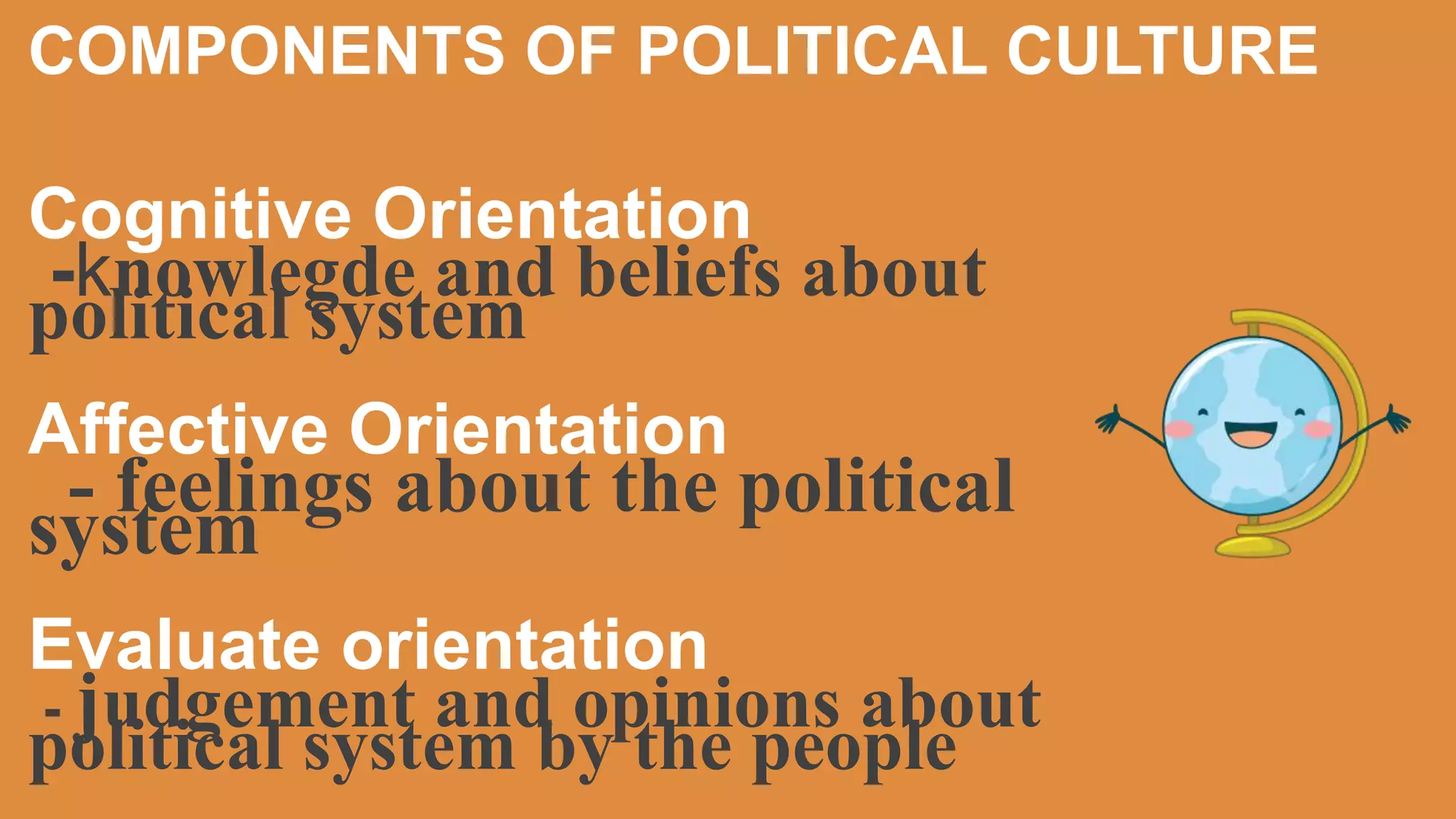
COMPONENTS OF POLITICAL CULTURE
Cognitive Orientation
-knowlegde and beliefs about
political system
Affective Orientation
- feelings about the political
system
Evaluate orientation
- judgement and opinions about
political system by the people
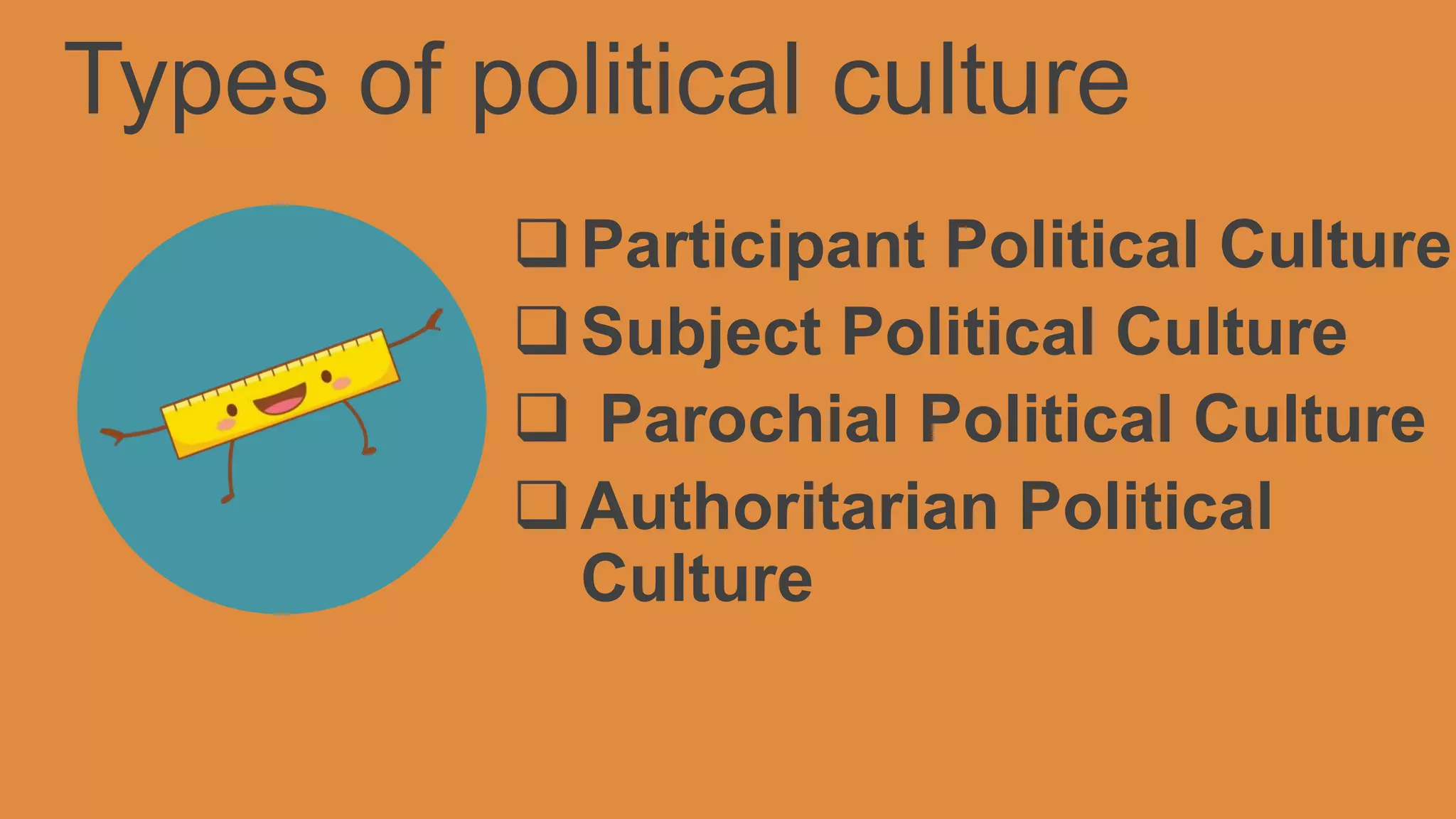
Types of political culture
Participant Political Culture
Subject Political Culture
 Parochial Political Culture
Authoritarian Political
Culture
POLITICAL
PARTCIPATION
 is any activity that
shapes, affects, or
involves the political
sphere.
Three types of Participation:
Conventional Participation
 Activities that we expect of good
citizens.
Unconventional Participation
 Activities that are legal but often
considered inappropriate.
Illegal Participation
Activities that
break the law.
Why People Participate ?
People participate in politics out of a
sense of the following:
Idealism: Some participate
because they believe strongly in a
particular idea.
Responsibility: For many,
participation is a responsibility of
democratic citizenship.
Self-Interest: A person might
work to promote issues and causes
that personally profit that person.
Enjoyment:Some simply enjoy
public activity, either because of
the activity itself or because of
the friends they make while
politically engaged.
The Paradox of
Participation
Rational choice theorists have
argued that participation,
particularly voting, is irrational.
POLITICAL
SOCIALIZATION
- refers to the process of
becoming a part of the political
culture through acquiring various
beliefs, attitudes, and practices.
INFLUENCES OF POLITICAL
SOCIALIZATION:
Families:
most significant
influence on our
political beliefs
and opinions.
Educational Institution :
- they are places in which we spend a
considerable amount of time and where
we are exposed to new ideas, different
people, and belief systems.
Media:
-influence on our belief because
it is often the way in which we
acquire information about the world.
Political Culture:
Democratic and
Authoritarian
What is
DEMOCRATI
C?
-Rule by the
people
AUTHORITARIAN
A way of governing that values
order and control over personal
freedom.
NATIONAL
IDENTITY
TRUST
POLITICAL
EFFICACY
Political Culture in Democra
Is a person's identity or a
person’s sense of belonging to
one state or to one nation.
NATIONAL IDENTITY
3 Elements of National Identity
1.Civic identity involves the formation and
negotiation of personal and group
identities as they relate to presence, role,
and participation in public life.
2. Cultural identity is a critical piece of
your personal identity.
3.Ethnicity refers to the identification
of a group based on a perceived
cultural distinctiveness that makes the
group into a “people.”
Is the foundation upon which
the legitimacy of democratic
institutions rest.
TRUST
Refers to the feeling that
individual political action does
have, or can have an impact upon
the political process.
POLITICAL EFFICACY
CULTURE "FAMILIES
CHRISTIANITY
ISLAM
CONFUSIANISM
FOUNDATION OF POLITICAL
CULTURE
POLITICAL
CULTURE
Refers to those moral
norms, ideas, values
attitude orientation.
CULTURE “FAMILIES”
It is the primary socialization agency of
society.
A place where we are most likely to be
ourselves
FAMILY ROLES
FATHER – highly valued, authoritative figure,
less involved and provides for the economics
needs of the family.
MOHTER – valued less than males, meets
emotional needs of children but with less
nurturance's than Caucasian mother, perform
domestic chores, bears children
FAMILY VALUES – refers to built on a
hierarchy system.
WORK ETHICS – are devoted to jobs
almost as much as they are devoted to their
families.
RELIGIOUS PRACTICES - come from
variety of religious backgrounds, and based
to the greatly behaviour on religious beliefs.
CHRISTIANITY
 What is the core teaching of
Christianity?
 Why is Jesus called the
Messiah?
 How should Christians live
their lives according to
Christianity teaching?
CHRISTIANITY
Popular religion world-wide
Has the largest member in the whole universe
Starting around the 1st century C.E
Developed by JUDAISM during the reign of the
ROMAN EMPIRE in West Asia.
Dominant Religion
Monothestic religion
SYMBOLS
“KRUS”
Jesus Christ’s victory over
sins when
He died on the cross for the
humanity’s redemption and
salvation.
SYMBOLS
“FISH SYMBOL”
-Is as old as Christianity itself, for it
was used by persecuted Christians as
a “secret code” when meeting other
Christians.
-Greek work ay “ichtys” means (
Iseous Christos Theou Yios Soter) in
other words “Jesus Christ, Son of
GOD, Savior”
HISTORICAL BACKGROUND
ROMAN CATHOLICISM
ORTHODOX CHURCH
PROTESTANTISM
Religious Leaders
Catholic
-they have canon law of the catholic
church.
POPE
ARCHBISHOPS
PRIESTS
CARDINALS
BISHOPS
DEACONS
PERMANENT
TRANSITIONAL
DEITY/ GOD
Christians believed in one GOD.
Omnipotent(all- powerful)
Omniscient (all- knowing)
Omnipresent (all- present)
Omnibenevolent (all-good)
HOLY TRINITY
FATHER
SON
HOLY SPIRIT
TEN COMMANDMENTS
Also called the Decalogue, This is by given of GOD to the people of Israel at Mt. Sinai through
Moses.
THE SEVEN SACRAMENTS
Catholic Church has seven sacraments which considered sign
of inner kindness given by God for Christians to live a genuine
human life,
1. Baptist
2. Confirmation
3. Holy Communion
4. Confession
5. Matrimony
6. Holy orders
7. Anointing of the Sick
Story of Creation and Big Bang Theory
 1ST DAY DARK & LIGHTNESS
 2ND DAY HEAVEN & OCEAN
 3RD DAY EARTH & PLANTS
 4TH DAY SUN, MOON, STARS
 5TH DAY ANIMALS
 6TH DAY ADAN & EBA
 7TH DAY REST OF GOD
WORSHIP AND
OBSERVANCES
ADVENT
LENT
PENTECOST
ISLAM
Silm and Salam which means
“PEACE”
Submission to the one GOD
A Muslim is supposed to live in
peace and harmony with all these
segments.
The youngest religion around
the world
SYMBOLS
HISTORICAL BACKGROUND
Began with the Arabian desert people around early 17th
century C.E.
ALLAH is the name of the GOD
ALLAH is the Creator of all Human Beings
Muslims worship Allah
MUHAMMAD is the messenger of GOD
He was born in 570 C.E. in Makkah, Arabia
He is the last prophet of the GOD to mankind at the age of
40
Muhammad called his religion “ISLAM” means Surrender
to GOD
SACRED SCRIPTURES
QURAN – the Holy Book of Islam that written in
Arabic.
- The sacred writing of the Muslims is
called Quran (or Koran in English) that literally
means “recitation” or “reading”.
- The chapter that compose the Quran are
called surahs while the verses are called ayahs w/c
mean “evidence” or “sign”.
BELIEFS/DOCTRINES
 Islam began as way of life(din) for its
followers w/c God intended for his creation
from the very beginning.
 God had to send several prophets, including
MUSA (moses) and ‘ISA (
THE FIVE PILLARS OF ISLAM
FAITH
PRAYER
ALMS
FASTING
PILGRIMAGE
CONFUCIANISM
PHILOSOPHY RELIGION
WISDOM BELIEFS AND
WORSHIP
INTELLECTUAL
LOGICAL
REASONING
CREATOR
CONTROLLER without
any reasoning
NORMAL
PHILOSOPHER
CONFUCIANISM
Also known as “RUISM” describe as
Tradition
Philosophy
Religion
Humanistic religion
A way of governing or
Simply a way of life
HISTORICAL BACKGROUND
ZHOU DYNASTY – the second historical dynasty
in China.
CONFUCIUS – was a Chinese teacher, editor,
politician, and philosopher of the spring and
autumn period of Chinese History.
- he emphasized personal and
governmental morality, correctness of social
relationships, justice and sincerity.
SACRED SCRIPTURES
The Five Classics was group of Books
which was regarded as early Confucianism
basic text.
- BOOK OF CHANGES
- BOOK OF HISTORY
- BOOK POETRY
- CLASSIC OF RITES
- SPRING AND AUTUMN ANIMALS
THE FIVE CONSTANTS
It is also known as The Five
Virtues, or Wuchang included
the…
- ren or benevolence
- yi or righteousness
- li or propriety
- zhi or knowledge/wisdom
- xin or fidelity
WORSHIP AND OBSERVANCES
The rituals have been classified under
Family Rituals, also known as the “Four
Rites”
Symbolize as the person’s growth and
maturity, also coming of age rites,
marriage ceremonies, mourning rites, and
sacrificial rituals
Subculture and
Political culture
• Ethno-Linguistic Subculture
• Women and Political culture
• A group of people with a culture differ
from the larger culture that they belong
to, known "dominant culture".
• Develops their own norms and values
in regarding cultural, political and
sexual matters
Subculture
Subcultures can be
identified the members:
• Age
• Race
• Ethnicity
• Social class
• Location
• Gender
The qualities that distinguish among
subculture maybe:
• Linguistic
• Aesthethic
• Religious
• Political
• Sexual
• Graphical
Politicalculture
It refers to historically - based, widely
shared beliefs, feelings and values about
the nature of political systems, which can
serve as link between citizens and
government.
Political Ideology
• Itreferstoacodeofbeliefsorviewsabout
governmentsandpoliticsthatmayinfluencethe
waywevoteinorwhetherornotwesupport
certainlegislativeactions.
Political Ideology
• PoliticalCultureissomethingwesharewhile
PoliticalIdeologyissomethingweusetodefine
ourselvesandmakepoliticaldecisions.
Ethno-Linguistic Subculture
or (Ethno-Linguistic group) is a
group that is unified by both
common Ethnicity and language.
SOME COMMON ETHNO-LINGUISTIC GROUPS OF
THE FILIPINO
1.The Tagalogs- the most widespread ethnic
groups, predominate in entire Manila and
mainland in Southern Luzon.
2. Cebuano people - second most widespread ethnic
groups, they are originally native to the province of
Cebu whose primary language is the Cebuano.
SOME COMMON ETHNO-LINGUISTIC GROUPS
OF THE FILIPINO
3. Ilocano- They speak Ilocano and they form the third
largest Ethno-Linguistic groupin in the Philippines
4.Hiligaynon
5. Kapampangan
6. Batangueno
WOMEN AND POLITICAL CULTURE
Women's involvement in government
decision making is giving significant
political visibility to women's rights
worldwide. Although women are not a
homogeneous group, they tend to be
supporters of other women and have
been instrumental in placing women's
issues and concerns on to the
parliamentary agenda.
• Women’s equal participation and leadership
in political and public life are essential to
achieving the Sustainable Development
Goals by 2030. However, data show that
women are underrepresented at all levels of
decision-making worldwide, and that
achieving gender parity in political life is far
off.
-UN WOMEN

POLITICAL CULTURE