Engineering Contradiction
DFT 1012
INVENTIVE PROBLEM
SOLVING
What is parameter?
• Parameter is defined as any
factor that defines a system and
determines (or limits) its
performance
• Parameter typically describes the
characteristics of a system
• A parameter is a “property or
attribute” given to describe a
function of a system – it takes the
point of view of the function
rather than the components
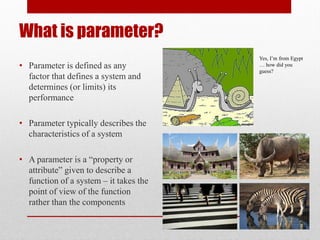
Yes, I’m from Egypt
… how did you
guess?
39 System Parameters
1. Weight of Moving Object
2. Weight of Stationary Object
3. Length (or Angle) of Moving Object
4. Length (or Angle) of Stationary Object
5. Area of Moving Object
6. Area of Stationary Object
7. Volume of Moving Object
8. Volume of Stationary Object
9. Speed
10. Force (a.ka. Torque)
11. Pressure or Stress
12. Shape
13. Stability of the Object’s Composition
14. Strength
15. Duration of Action of Moving Object
16. Duration of Action of Stationary Object
17. Temperature
18. Illumination Intensity
19. Use of Energy by Moving Object
20. Use of Energy by Stationary Object
21. Power
22. Loss of Energy
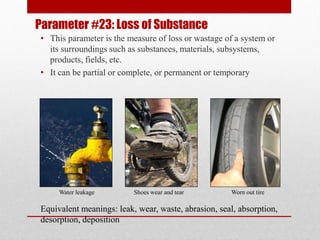
23. Loss of Substance
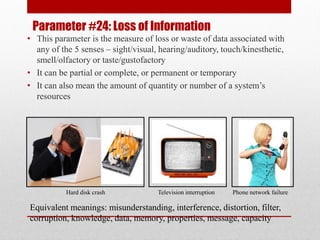
24. Loss of Information
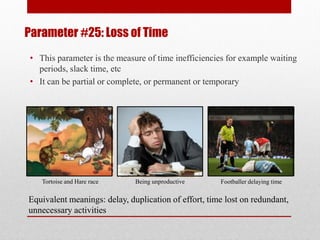
25. Loss of Time
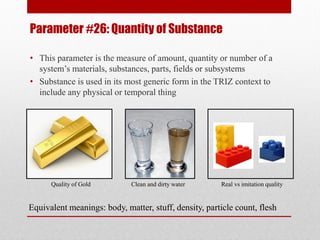
26. Quantity of Substance
27. Reliability (Robustness)
28. Measurement Accuracy
29. Manufacturing Precision (Consistency)
30. Object Affected Harmful Factors
31. Object Generated Harmful Factors
32. Ease of Manufacture (Manufacturability)
33. Ease of Operation
34. Ease of Repair (Repairability)
35. Adaptability or Versatility
36. Device Complexity
37. Difficulty of Detecting and Measuring
38. Extent of Automation
39. Productivity
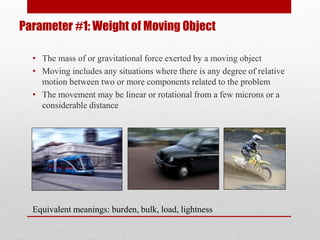
Parameter #1: Weight of Moving Object
• The mass of or gravitational force exerted by a moving object
• Moving includes any situations where there is any degree of relative
motion between two or more components related to the problem
• The movement may be linear or rotational from a few microns or a
considerable distance
Equivalent meanings: burden, bulk, load, lightness
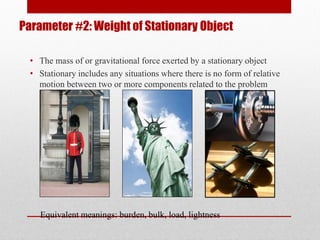
Parameter #2: Weight of Stationary Object
• The mass of or gravitational force exerted by a stationary object
• Stationary includes any situations where there is no form of relative
motion between two or more components related to the problem
Equivalent meanings: burden, bulk, load, lightness
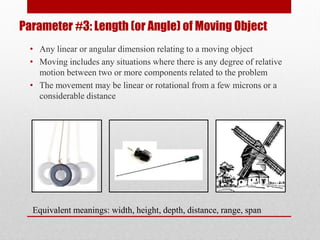
Parameter #3: Length (or Angle) of Moving Object
• Any linear or angular dimension relating to a moving object
• Moving includes any situations where there is any degree of relative
motion between two or more components related to the problem
• The movement may be linear or rotational from a few microns or a
considerable distance
Equivalent meanings: width, height, depth, distance, range, span
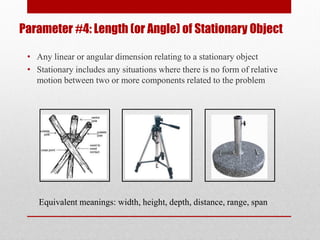
Parameter #4: Length (or Angle) of Stationary Object
• Any linear or angular dimension relating to a stationary object
• Stationary includes any situations where there is no form of relative
motion between two or more components related to the problem
Equivalent meanings: width, height, depth, distance, range, span
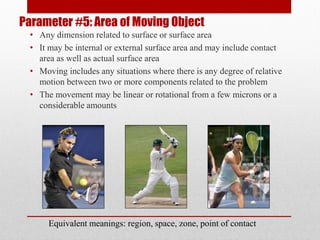
Parameter #5: Area of Moving Object
• Any dimension related to surface or surface area
• It may be internal or external surface area and may include contact
area as well as actual surface area
• Moving includes any situations where there is any degree of relative
motion between two or more components related to the problem
• The movement may be linear or rotational from a few microns or a
considerable amounts
Equivalent meanings: region, space, zone, point of contact
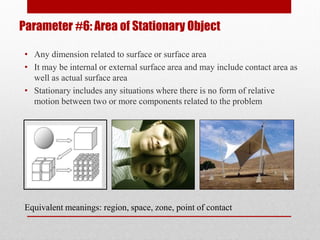
Parameter #6: Area of Stationary Object
• Any dimension related to surface or surface area
• It may be internal or external surface area and may include contact area as
well as actual surface area
• Stationary includes any situations where there is no form of relative
motion between two or more components related to the problem
Equivalent meanings: region, space, zone, point of contact
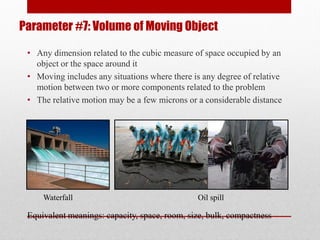
Parameter #7: Volume of Moving Object
• Any dimension related to the cubic measure of space occupied by an
object or the space around it
• Moving includes any situations where there is any degree of relative
motion between two or more components related to the problem
• The relative motion may be a few microns or a considerable distance
Equivalent meanings: capacity, space, room, size, bulk, compactness
Waterfall Oil spill
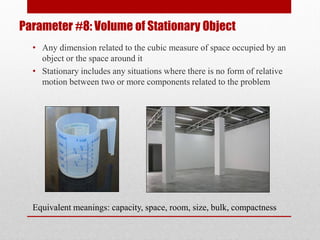
Parameter #8: Volume of Stationary Object
• Any dimension related to the cubic measure of space occupied by an
object or the space around it
• Stationary includes any situations where there is no form of relative
motion between two or more components related to the problem
Equivalent meanings: capacity, space, room, size, bulk, compactness
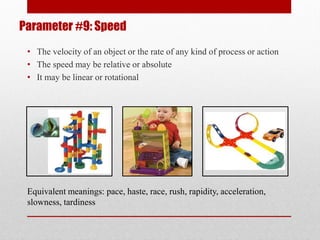
Parameter #9: Speed
• The velocity of an object or the rate of any kind of process or action
• The speed may be relative or absolute
• It may be linear or rotational
Equivalent meanings: pace, haste, race, rush, rapidity, acceleration,
slowness, tardiness
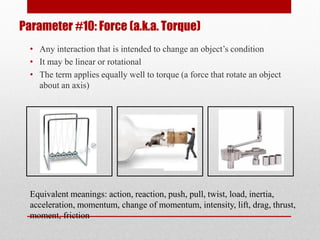
Parameter #10: Force (a.k.a. Torque)
• Any interaction that is intended to change an object’s condition
• It may be linear or rotational
• The term applies equally well to torque (a force that rotate an object
about an axis)
Equivalent meanings: action, reaction, push, pull, twist, load, inertia,
acceleration, momentum, change of momentum, intensity, lift, drag, thrust,
moment, friction
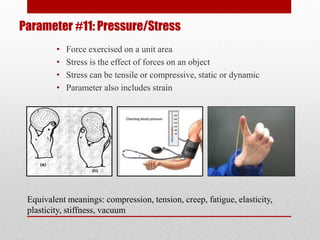
Parameter #11: Pressure/Stress
• Force exercised on a unit area
• Stress is the effect of forces on an object
• Stress can be tensile or compressive, static or dynamic
• Parameter also includes strain
Equivalent meanings: compression, tension, creep, fatigue, elasticity,
plasticity, stiffness, vacuum
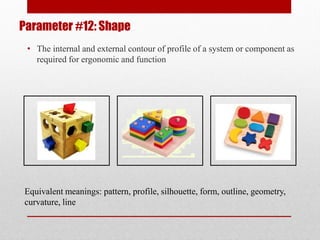
Parameter #12: Shape
• The internal and external contour of profile of a system or component as
required for ergonomic and function
Equivalent meanings: pattern, profile, silhouette, form, outline, geometry,
curvature, line
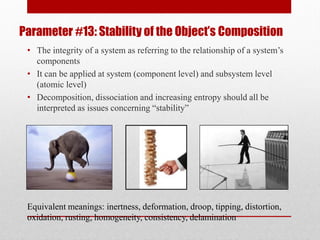
Parameter #13: Stability of the Object’s Composition
• The integrity of a system as referring to the relationship of a system’s
components
• It can be applied at system (component level) and subsystem level
(atomic level)
• Decomposition, dissociation and increasing entropy should all be
interpreted as issues concerning “stability”
Equivalent meanings: inertness, deformation, droop, tipping, distortion,
oxidation, rusting, homogeneity, consistency, delamination
Parameter #14: Strength
• The extent to which an object is able to resist changing in response to
force
• Resistance in breaking – can be elastic limit, plastic limit, or the object’s
ultimate strength
• The parameter can be tensile or compressive, linear or rotational and
includes toughness and hardness
Equivalent meanings: fatigue, creep, bond, join, muscle, droop, distortion,
stillness, rigidity
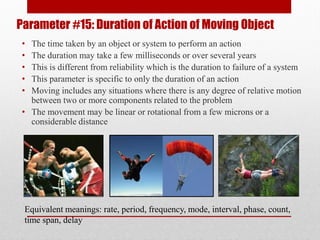
Parameter #15: Duration of Action of Moving Object
• The time taken by an object or system to perform an action
• The duration may take a few milliseconds or over several years
• This is different from reliability which is the duration to failure of a system
• This parameter is specific to only the duration of an action
• Moving includes any situations where there is any degree of relative motion
between two or more components related to the problem
• The movement may be linear or rotational from a few microns or a
considerable distance
Equivalent meanings: rate, period, frequency, mode, interval, phase, count,
time span, delay
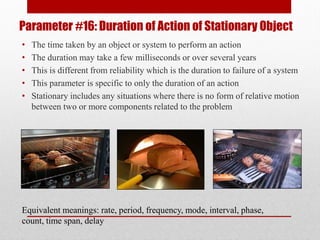
Parameter #16: Duration of Action of Stationary Object
• The time taken by an object or system to perform an action
• The duration may take a few milliseconds or over several years
• This is different from reliability which is the duration to failure of a system
• This parameter is specific to only the duration of an action
• Stationary includes any situations where there is no form of relative motion
between two or more components related to the problem
Equivalent meanings: rate, period, frequency, mode, interval, phase,
count, time span, delay
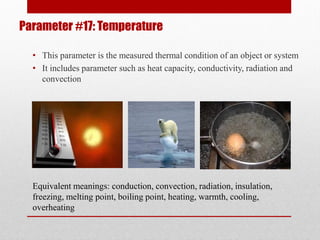
Parameter #17: Temperature
• This parameter is the measured thermal condition of an object or system
• It includes parameter such as heat capacity, conductivity, radiation and
convection
Equivalent meanings: conduction, convection, radiation, insulation,
freezing, melting point, boiling point, heating, warmth, cooling,
overheating
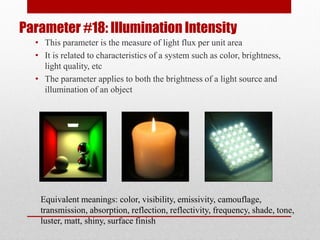
Parameter #18: Illumination Intensity
• This parameter is the measure of light flux per unit area
• It is related to characteristics of a system such as color, brightness,
light quality, etc
• The parameter applies to both the brightness of a light source and
illumination of an object
Equivalent meanings: color, visibility, emissivity, camouflage,
transmission, absorption, reflection, reflectivity, frequency, shade, tone,
luster, matt, shiny, surface finish
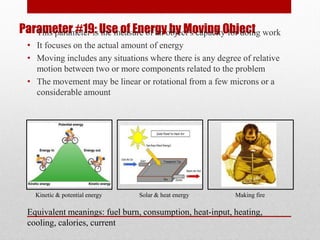
Parameter #19: Use of Energy by Moving Object• This parameter is the measure of an object’s capacity for doing work
• It focuses on the actual amount of energy
• Moving includes any situations where there is any degree of relative
motion between two or more components related to the problem
• The movement may be linear or rotational from a few microns or a
considerable amount
Equivalent meanings: fuel burn, consumption, heat-input, heating,
cooling, calories, current
Kinetic & potential energy Solar & heat energy Making fire
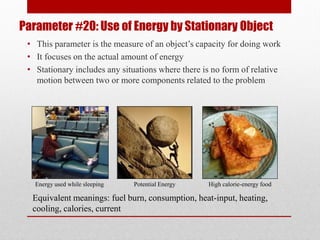
Parameter #20: Use of Energy by Stationary Object
• This parameter is the measure of an object’s capacity for doing work
• It focuses on the actual amount of energy
• Stationary includes any situations where there is no form of relative
motion between two or more components related to the problem
Equivalent meanings: fuel burn, consumption, heat-input, heating,
cooling, calories, current
High calorie-energy foodPotential EnergyEnergy used while sleeping
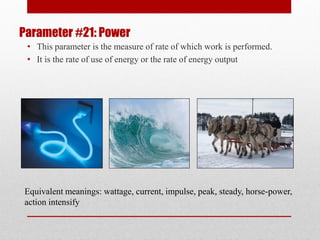
Parameter #21: Power
• This parameter is the measure of rate of which work is performed.
• It is the rate of use of energy or the rate of energy output
Equivalent meanings: wattage, current, impulse, peak, steady, horse-power,
action intensify
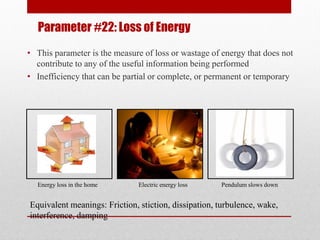
Parameter #22: Loss of Energy
• This parameter is the measure of loss or wastage of energy that does not
contribute to any of the useful information being performed
• Inefficiency that can be partial or complete, or permanent or temporary
Energy loss in the home Electric energy loss Pendulum slows down
Equivalent meanings: Friction, stiction, dissipation, turbulence, wake,
interference, damping
Parameter #23: Loss of Substance
• This parameter is the measure of loss or wastage of a system or
its surroundings such as substances, materials, subsystems,
products, fields, etc.
• It can be partial or complete, or permanent or temporary
Water leakage Shoes wear and tear Worn out tire
Equivalent meanings: leak, wear, waste, abrasion, seal, absorption,
desorption, deposition
Parameter #24: Loss of Information
• This parameter is the measure of loss or waste of data associated with
any of the 5 senses – sight/visual, hearing/auditory, touch/kinesthetic,
smell/olfactory or taste/gustofactory
• It can be partial or complete, or permanent or temporary
• It can also mean the amount of quantity or number of a system’s
resources
Hard disk crash Television interruption Phone network failure
Equivalent meanings: misunderstanding, interference, distortion, filter,
corruption, knowledge, data, memory, properties, message, capacity
Parameter #25: Loss of Time
• This parameter is the measure of time inefficiencies for example waiting
periods, slack time, etc
• It can be partial or complete, or permanent or temporary
Tortoise and Hare race Being unproductive Footballer delaying time
Equivalent meanings: delay, duplication of effort, time lost on redundant,
unnecessary activities
Parameter #26: Quantity of Substance
• This parameter is the measure of amount, quantity or number of a
system’s materials, substances, parts, fields or subsystems
• Substance is used in its most generic form in the TRIZ context to
include any physical or temporal thing
Quality of Gold Clean and dirty water Real vs imitation quality
Equivalent meanings: body, matter, stuff, density, particle count, flesh
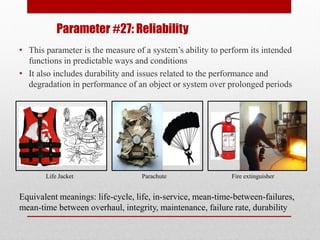
Parameter #27: Reliability
• This parameter is the measure of a system’s ability to perform its intended
functions in predictable ways and conditions
• It also includes durability and issues related to the performance and
degradation in performance of an object or system over prolonged periods
Life Jacket Parachute Fire extinguisher
Equivalent meanings: life-cycle, life, in-service, mean-time-between-failures,
mean-time between overhaul, integrity, maintenance, failure rate, durability
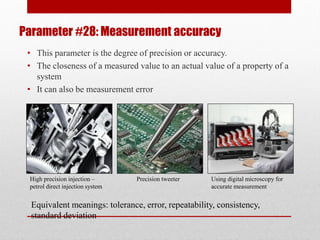
Parameter #28: Measurement accuracy
• This parameter is the degree of precision or accuracy.
• The closeness of a measured value to an actual value of a property of a
system
• It can also be measurement error
High precision injection –
petrol direct injection system
Precision tweeter Using digital microscopy for
accurate measurement
Equivalent meanings: tolerance, error, repeatability, consistency,
standard deviation
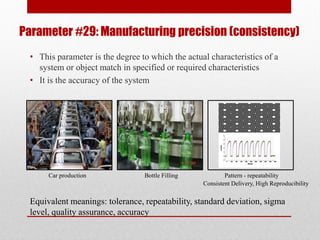
Parameter #29: Manufacturing precision (consistency)
• This parameter is the degree to which the actual characteristics of a
system or object match in specified or required characteristics
• It is the accuracy of the system
Consistent Delivery, High Reproducibility
Pattern - repeatabilityBottle FillingCar production
Equivalent meanings: tolerance, repeatability, standard deviation, sigma
level, quality assurance, accuracy
Parameter #30: Object affected harmful factor
• This parameter is designed as a catch-all for any form of action or
phenomenon in or around a system that manifests itself as a harmful
effect on something in the system
Equivalent meanings: undesired effect, contamination, adhesion, sticking,
weather damage, sun damage, UV damage, warpage, dust ingestion, mold
impact
Wall Peeling
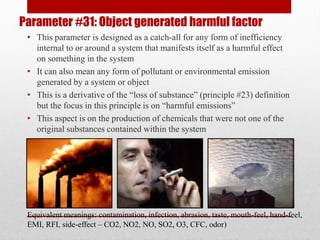
Parameter #31: Object generated harmful factor
• This parameter is designed as a catch-all for any form of inefficiency
internal to or around a system that manifests itself as a harmful effect
on something in the system
• It can also mean any form of pollutant or environmental emission
generated by a system or object
• This is a derivative of the “loss of substance” (principle #23) definition
but the focus in this principle is on “harmful emissions”
• This aspect is on the production of chemicals that were not one of the
original substances contained within the system
Equivalent meanings: contamination, infection, abrasion, taste, mouth-feel, hand-feel,
EMI, RFI, side-effect – CO2, NO2, NO, SO2, O3, CFC, odor)
Parameter #32: Ease of manufacturability
• This parameter is related to manufacturing, fabrication, assembly
issues associated with an object or system
• It can be a measure of ease of manufacturability
Equivalent meanings: design for manufacturability, design for assembly, tool
change, convenience of manufacture, machine-setting time, tool-change
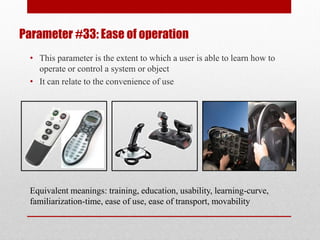
Parameter #33: Ease of operation
• This parameter is the extent to which a user is able to learn how to
operate or control a system or object
• It can relate to the convenience of use
Equivalent meanings: training, education, usability, learning-curve,
familiarization-time, ease of use, ease of transport, movability
Parameter #34: Ease of repair
• This parameter is the quality characteristics such as convenience,
comfort, simplicity and time to repair faults, failures or defects of a
system
• It includes issues associated with need for special tooling or equipment
required to achieve repair
Equivalent meanings: maintenance, accessibility, recoverability,
removability, cleanability, replaceability., modularity, interchangability,
convenience of repair
Steam vacuum
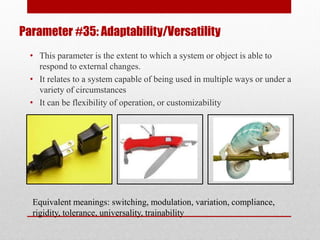
Parameter #35: Adaptability/Versatility
• This parameter is the extent to which a system or object is able to
respond to external changes.
• It relates to a system capable of being used in multiple ways or under a
variety of circumstances
• It can be flexibility of operation, or customizability
Equivalent meanings: switching, modulation, variation, compliance,
rigidity, tolerance, universality, trainability
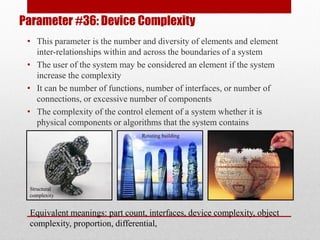
Parameter #36: Device Complexity
• This parameter is the number and diversity of elements and element
inter-relationships within and across the boundaries of a system
• The user of the system may be considered an element if the system
increase the complexity
• It can be number of functions, number of interfaces, or number of
connections, or excessive number of components
• The complexity of the control element of a system whether it is
physical components or algorithms that the system contains
Equivalent meanings: part count, interfaces, device complexity, object
complexity, proportion, differential,
Structural
complexity
Rotating building
Parameter #37: Difficulty of Detecting and Measuring
• This parameter is the difficulty to make measurements on an object
or system
• It can be complex, time consuming and labor consuming inspection
or analysis operations
• It increases the cost of measuring to a satisfactory quality level
• It includes ease of inspection
Equivalent meanings: Accessibility, visibility, location, integrity, ability
to find right parameter to measure
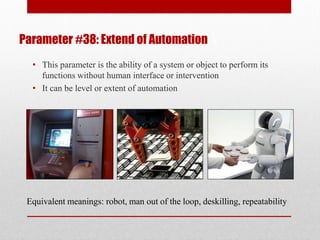
Parameter #38: Extend of Automation
• This parameter is the ability of a system or object to perform its
functions without human interface or intervention
• It can be level or extent of automation
Equivalent meanings: robot, man out of the loop, deskilling, repeatability
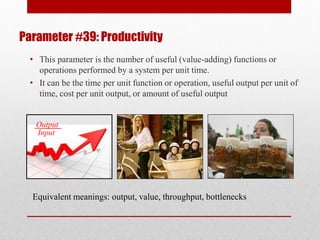
Parameter #39: Productivity
Equivalent meanings: output, value, throughput, bottlenecks
Output
Input
• This parameter is the number of useful (value-adding) functions or
operations performed by a system per unit time.
• It can be the time per unit function or operation, useful output per unit of
time, cost per unit output, or amount of useful output

POLITEKNIK MALAYSIA

  • 1.
  • 2.
    What is parameter? •Parameter is defined as any factor that defines a system and determines (or limits) its performance • Parameter typically describes the characteristics of a system • A parameter is a “property or attribute” given to describe a function of a system – it takes the point of view of the function rather than the components Yes, I’m from Egypt … how did you guess?
  • 3.
    39 System Parameters 1.Weight of Moving Object 2. Weight of Stationary Object 3. Length (or Angle) of Moving Object 4. Length (or Angle) of Stationary Object 5. Area of Moving Object 6. Area of Stationary Object 7. Volume of Moving Object 8. Volume of Stationary Object 9. Speed 10. Force (a.ka. Torque) 11. Pressure or Stress 12. Shape 13. Stability of the Object’s Composition 14. Strength 15. Duration of Action of Moving Object 16. Duration of Action of Stationary Object 17. Temperature 18. Illumination Intensity 19. Use of Energy by Moving Object 20. Use of Energy by Stationary Object 21. Power 22. Loss of Energy 23. Loss of Substance 24. Loss of Information 25. Loss of Time 26. Quantity of Substance 27. Reliability (Robustness) 28. Measurement Accuracy 29. Manufacturing Precision (Consistency) 30. Object Affected Harmful Factors 31. Object Generated Harmful Factors 32. Ease of Manufacture (Manufacturability) 33. Ease of Operation 34. Ease of Repair (Repairability) 35. Adaptability or Versatility 36. Device Complexity 37. Difficulty of Detecting and Measuring 38. Extent of Automation 39. Productivity
  • 4.
    Parameter #1: Weightof Moving Object • The mass of or gravitational force exerted by a moving object • Moving includes any situations where there is any degree of relative motion between two or more components related to the problem • The movement may be linear or rotational from a few microns or a considerable distance Equivalent meanings: burden, bulk, load, lightness
  • 5.
    Parameter #2: Weightof Stationary Object • The mass of or gravitational force exerted by a stationary object • Stationary includes any situations where there is no form of relative motion between two or more components related to the problem Equivalent meanings: burden, bulk, load, lightness
  • 6.
    Parameter #3: Length(or Angle) of Moving Object • Any linear or angular dimension relating to a moving object • Moving includes any situations where there is any degree of relative motion between two or more components related to the problem • The movement may be linear or rotational from a few microns or a considerable distance Equivalent meanings: width, height, depth, distance, range, span
  • 7.
    Parameter #4: Length(or Angle) of Stationary Object • Any linear or angular dimension relating to a stationary object • Stationary includes any situations where there is no form of relative motion between two or more components related to the problem Equivalent meanings: width, height, depth, distance, range, span
  • 8.
    Parameter #5: Areaof Moving Object • Any dimension related to surface or surface area • It may be internal or external surface area and may include contact area as well as actual surface area • Moving includes any situations where there is any degree of relative motion between two or more components related to the problem • The movement may be linear or rotational from a few microns or a considerable amounts Equivalent meanings: region, space, zone, point of contact
  • 9.
    Parameter #6: Areaof Stationary Object • Any dimension related to surface or surface area • It may be internal or external surface area and may include contact area as well as actual surface area • Stationary includes any situations where there is no form of relative motion between two or more components related to the problem Equivalent meanings: region, space, zone, point of contact
  • 10.
    Parameter #7: Volumeof Moving Object • Any dimension related to the cubic measure of space occupied by an object or the space around it • Moving includes any situations where there is any degree of relative motion between two or more components related to the problem • The relative motion may be a few microns or a considerable distance Equivalent meanings: capacity, space, room, size, bulk, compactness Waterfall Oil spill
  • 11.
    Parameter #8: Volumeof Stationary Object • Any dimension related to the cubic measure of space occupied by an object or the space around it • Stationary includes any situations where there is no form of relative motion between two or more components related to the problem Equivalent meanings: capacity, space, room, size, bulk, compactness
  • 12.
    Parameter #9: Speed •The velocity of an object or the rate of any kind of process or action • The speed may be relative or absolute • It may be linear or rotational Equivalent meanings: pace, haste, race, rush, rapidity, acceleration, slowness, tardiness
  • 13.
    Parameter #10: Force(a.k.a. Torque) • Any interaction that is intended to change an object’s condition • It may be linear or rotational • The term applies equally well to torque (a force that rotate an object about an axis) Equivalent meanings: action, reaction, push, pull, twist, load, inertia, acceleration, momentum, change of momentum, intensity, lift, drag, thrust, moment, friction
  • 14.
    Parameter #11: Pressure/Stress •Force exercised on a unit area • Stress is the effect of forces on an object • Stress can be tensile or compressive, static or dynamic • Parameter also includes strain Equivalent meanings: compression, tension, creep, fatigue, elasticity, plasticity, stiffness, vacuum
  • 15.
    Parameter #12: Shape •The internal and external contour of profile of a system or component as required for ergonomic and function Equivalent meanings: pattern, profile, silhouette, form, outline, geometry, curvature, line
  • 16.
    Parameter #13: Stabilityof the Object’s Composition • The integrity of a system as referring to the relationship of a system’s components • It can be applied at system (component level) and subsystem level (atomic level) • Decomposition, dissociation and increasing entropy should all be interpreted as issues concerning “stability” Equivalent meanings: inertness, deformation, droop, tipping, distortion, oxidation, rusting, homogeneity, consistency, delamination
  • 17.
    Parameter #14: Strength •The extent to which an object is able to resist changing in response to force • Resistance in breaking – can be elastic limit, plastic limit, or the object’s ultimate strength • The parameter can be tensile or compressive, linear or rotational and includes toughness and hardness Equivalent meanings: fatigue, creep, bond, join, muscle, droop, distortion, stillness, rigidity
  • 18.
    Parameter #15: Durationof Action of Moving Object • The time taken by an object or system to perform an action • The duration may take a few milliseconds or over several years • This is different from reliability which is the duration to failure of a system • This parameter is specific to only the duration of an action • Moving includes any situations where there is any degree of relative motion between two or more components related to the problem • The movement may be linear or rotational from a few microns or a considerable distance Equivalent meanings: rate, period, frequency, mode, interval, phase, count, time span, delay
  • 19.
    Parameter #16: Durationof Action of Stationary Object • The time taken by an object or system to perform an action • The duration may take a few milliseconds or over several years • This is different from reliability which is the duration to failure of a system • This parameter is specific to only the duration of an action • Stationary includes any situations where there is no form of relative motion between two or more components related to the problem Equivalent meanings: rate, period, frequency, mode, interval, phase, count, time span, delay
  • 20.
    Parameter #17: Temperature •This parameter is the measured thermal condition of an object or system • It includes parameter such as heat capacity, conductivity, radiation and convection Equivalent meanings: conduction, convection, radiation, insulation, freezing, melting point, boiling point, heating, warmth, cooling, overheating
  • 21.
    Parameter #18: IlluminationIntensity • This parameter is the measure of light flux per unit area • It is related to characteristics of a system such as color, brightness, light quality, etc • The parameter applies to both the brightness of a light source and illumination of an object Equivalent meanings: color, visibility, emissivity, camouflage, transmission, absorption, reflection, reflectivity, frequency, shade, tone, luster, matt, shiny, surface finish
  • 22.
    Parameter #19: Useof Energy by Moving Object• This parameter is the measure of an object’s capacity for doing work • It focuses on the actual amount of energy • Moving includes any situations where there is any degree of relative motion between two or more components related to the problem • The movement may be linear or rotational from a few microns or a considerable amount Equivalent meanings: fuel burn, consumption, heat-input, heating, cooling, calories, current Kinetic & potential energy Solar & heat energy Making fire
  • 23.
    Parameter #20: Useof Energy by Stationary Object • This parameter is the measure of an object’s capacity for doing work • It focuses on the actual amount of energy • Stationary includes any situations where there is no form of relative motion between two or more components related to the problem Equivalent meanings: fuel burn, consumption, heat-input, heating, cooling, calories, current High calorie-energy foodPotential EnergyEnergy used while sleeping
  • 24.
    Parameter #21: Power •This parameter is the measure of rate of which work is performed. • It is the rate of use of energy or the rate of energy output Equivalent meanings: wattage, current, impulse, peak, steady, horse-power, action intensify
  • 25.
    Parameter #22: Lossof Energy • This parameter is the measure of loss or wastage of energy that does not contribute to any of the useful information being performed • Inefficiency that can be partial or complete, or permanent or temporary Energy loss in the home Electric energy loss Pendulum slows down Equivalent meanings: Friction, stiction, dissipation, turbulence, wake, interference, damping
  • 26.
    Parameter #23: Lossof Substance • This parameter is the measure of loss or wastage of a system or its surroundings such as substances, materials, subsystems, products, fields, etc. • It can be partial or complete, or permanent or temporary Water leakage Shoes wear and tear Worn out tire Equivalent meanings: leak, wear, waste, abrasion, seal, absorption, desorption, deposition
  • 27.
    Parameter #24: Lossof Information • This parameter is the measure of loss or waste of data associated with any of the 5 senses – sight/visual, hearing/auditory, touch/kinesthetic, smell/olfactory or taste/gustofactory • It can be partial or complete, or permanent or temporary • It can also mean the amount of quantity or number of a system’s resources Hard disk crash Television interruption Phone network failure Equivalent meanings: misunderstanding, interference, distortion, filter, corruption, knowledge, data, memory, properties, message, capacity
  • 28.
    Parameter #25: Lossof Time • This parameter is the measure of time inefficiencies for example waiting periods, slack time, etc • It can be partial or complete, or permanent or temporary Tortoise and Hare race Being unproductive Footballer delaying time Equivalent meanings: delay, duplication of effort, time lost on redundant, unnecessary activities
  • 29.
    Parameter #26: Quantityof Substance • This parameter is the measure of amount, quantity or number of a system’s materials, substances, parts, fields or subsystems • Substance is used in its most generic form in the TRIZ context to include any physical or temporal thing Quality of Gold Clean and dirty water Real vs imitation quality Equivalent meanings: body, matter, stuff, density, particle count, flesh
  • 30.
    Parameter #27: Reliability •This parameter is the measure of a system’s ability to perform its intended functions in predictable ways and conditions • It also includes durability and issues related to the performance and degradation in performance of an object or system over prolonged periods Life Jacket Parachute Fire extinguisher Equivalent meanings: life-cycle, life, in-service, mean-time-between-failures, mean-time between overhaul, integrity, maintenance, failure rate, durability
  • 31.
    Parameter #28: Measurementaccuracy • This parameter is the degree of precision or accuracy. • The closeness of a measured value to an actual value of a property of a system • It can also be measurement error High precision injection – petrol direct injection system Precision tweeter Using digital microscopy for accurate measurement Equivalent meanings: tolerance, error, repeatability, consistency, standard deviation
  • 32.
    Parameter #29: Manufacturingprecision (consistency) • This parameter is the degree to which the actual characteristics of a system or object match in specified or required characteristics • It is the accuracy of the system Consistent Delivery, High Reproducibility Pattern - repeatabilityBottle FillingCar production Equivalent meanings: tolerance, repeatability, standard deviation, sigma level, quality assurance, accuracy
  • 33.
    Parameter #30: Objectaffected harmful factor • This parameter is designed as a catch-all for any form of action or phenomenon in or around a system that manifests itself as a harmful effect on something in the system Equivalent meanings: undesired effect, contamination, adhesion, sticking, weather damage, sun damage, UV damage, warpage, dust ingestion, mold impact Wall Peeling
  • 34.
    Parameter #31: Objectgenerated harmful factor • This parameter is designed as a catch-all for any form of inefficiency internal to or around a system that manifests itself as a harmful effect on something in the system • It can also mean any form of pollutant or environmental emission generated by a system or object • This is a derivative of the “loss of substance” (principle #23) definition but the focus in this principle is on “harmful emissions” • This aspect is on the production of chemicals that were not one of the original substances contained within the system Equivalent meanings: contamination, infection, abrasion, taste, mouth-feel, hand-feel, EMI, RFI, side-effect – CO2, NO2, NO, SO2, O3, CFC, odor)
  • 35.
    Parameter #32: Easeof manufacturability • This parameter is related to manufacturing, fabrication, assembly issues associated with an object or system • It can be a measure of ease of manufacturability Equivalent meanings: design for manufacturability, design for assembly, tool change, convenience of manufacture, machine-setting time, tool-change
  • 36.
    Parameter #33: Easeof operation • This parameter is the extent to which a user is able to learn how to operate or control a system or object • It can relate to the convenience of use Equivalent meanings: training, education, usability, learning-curve, familiarization-time, ease of use, ease of transport, movability
  • 37.
    Parameter #34: Easeof repair • This parameter is the quality characteristics such as convenience, comfort, simplicity and time to repair faults, failures or defects of a system • It includes issues associated with need for special tooling or equipment required to achieve repair Equivalent meanings: maintenance, accessibility, recoverability, removability, cleanability, replaceability., modularity, interchangability, convenience of repair Steam vacuum
  • 38.
    Parameter #35: Adaptability/Versatility •This parameter is the extent to which a system or object is able to respond to external changes. • It relates to a system capable of being used in multiple ways or under a variety of circumstances • It can be flexibility of operation, or customizability Equivalent meanings: switching, modulation, variation, compliance, rigidity, tolerance, universality, trainability

  • 39.
    Parameter #36: DeviceComplexity • This parameter is the number and diversity of elements and element inter-relationships within and across the boundaries of a system • The user of the system may be considered an element if the system increase the complexity • It can be number of functions, number of interfaces, or number of connections, or excessive number of components • The complexity of the control element of a system whether it is physical components or algorithms that the system contains Equivalent meanings: part count, interfaces, device complexity, object complexity, proportion, differential, Structural complexity Rotating building
  • 40.
    Parameter #37: Difficultyof Detecting and Measuring • This parameter is the difficulty to make measurements on an object or system • It can be complex, time consuming and labor consuming inspection or analysis operations • It increases the cost of measuring to a satisfactory quality level • It includes ease of inspection Equivalent meanings: Accessibility, visibility, location, integrity, ability to find right parameter to measure
  • 41.
    Parameter #38: Extendof Automation • This parameter is the ability of a system or object to perform its functions without human interface or intervention • It can be level or extent of automation Equivalent meanings: robot, man out of the loop, deskilling, repeatability
  • 42.
    Parameter #39: Productivity Equivalentmeanings: output, value, throughput, bottlenecks Output Input • This parameter is the number of useful (value-adding) functions or operations performed by a system per unit time. • It can be the time per unit function or operation, useful output per unit of time, cost per unit output, or amount of useful output