What is poetry?
•Poetryis a form of
literary expression that
captures intense
experiences or creative
perceptions of the world
in a musical language.
3.
Distinguishing Characteristics of
Poetry
•Unlike prose which has a
narrator, poetry has a speaker.
–A speaker, or voice, talks to the
reader. The speaker is not
necessarily the poet. It can
also be a fictional person, an
animal or even a thing
4.
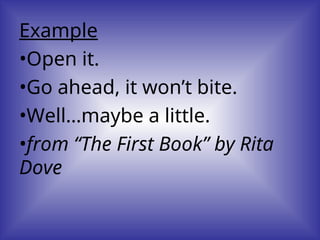
Example
But believe me,son.
I want to be what I used to
be
when I was like you.
from “Once Upon a Time” by
Gabriel Okara
5.
Distinguishing Characteristics of
Poetry
•Poetry is also formatted differently from prose.
– A line is a word or row of words that may or
may not form a complete sentence.
– A stanza is a group of lines forming a unit.
The stanzas in a poem are separated by a
space.
Figures of Speech
•A figure of speech is a word or expression
that is not meant to be read literally.
• A simile is a figure of speech using a
word such as like or as to compare
seemingly unlike things.
Figures of Speech
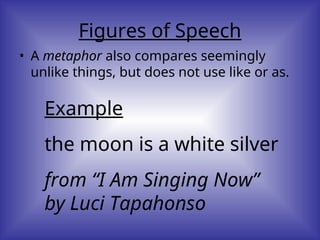
•A metaphor also compares seemingly
unlike things, but does not use like or as.
Example
the moon is a white silver
from “I Am Singing Now”
by Luci Tapahonso
10.
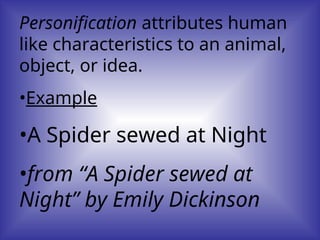
Personification attributes human
likecharacteristics to an animal,
object, or idea.
•Example
•A Spider sewed at Night
•from “A Spider sewed at
Night” by Emily Dickinson
11.
Figures of Speech
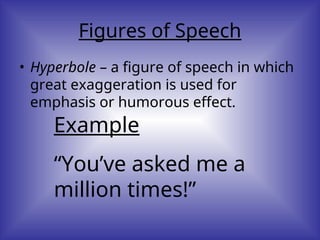
•Hyperbole – a figure of speech in which
great exaggeration is used for
emphasis or humorous effect.
Example
“You’ve asked me a
million times!”
12.
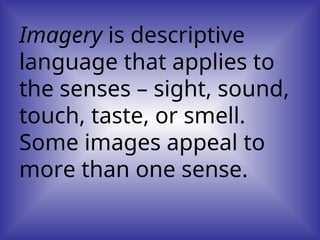
Imagery is descriptive
languagethat applies to
the senses – sight, sound,
touch, taste, or smell.
Some images appeal to
more than one sense.
13.
Sound Devices
• Alliterationis the repetition of consonant
sounds at the beginning of words.
• Assonance is the repetition of vowel
sounds within a line of poetry.
• Onomatopoeia is the use of a word or
phrase, such as “hiss” or “buzz” that
imitates or suggests the sound of what it
describes.
14.
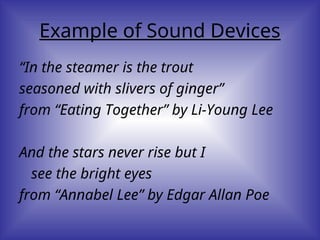
Example of SoundDevices
“In the steamer is the trout
seasoned with slivers of ginger”
from “Eating Together” by Li-Young Lee
And the stars never rise but I
see the bright eyes
from “Annabel Lee” by Edgar Allan Poe
15.
Rhyme
• Rhyme isthe repetition of the same stressed
vowel sound and any succeeding sounds in
two or more words.
• Internal rhyme occurs within a line of poetry.
• End rhyme occurs at the end of lines.
• Rhyme scheme is the pattern of end rhymes
that may be designated by assigning a
different letter of the alphabet to each new
rhyme
16.
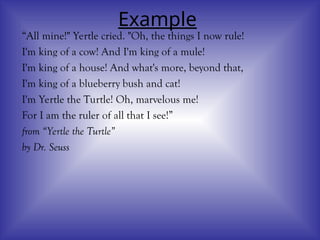
Example
“All mine!" Yertlecried. "Oh, the things I now rule!
I'm king of a cow! And I'm king of a mule!
I'm king of a house! And what's more, beyond that,
I'm king of a blueberry bush and cat!
I'm Yertle the Turtle! Oh, marvelous me!
For I am the ruler of all that I see!”
from “Yertle the Turtle”
by Dr. Seuss
17.
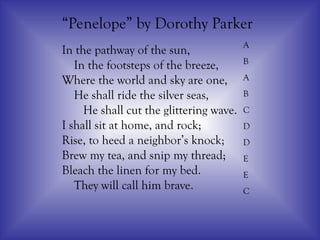
In the pathwayof the sun,
In the footsteps of the breeze,
Where the world and sky are one,
He shall ride the silver seas,
He shall cut the glittering wave.
I shall sit at home, and rock;
Rise, to heed a neighbor’s knock;
Brew my tea, and snip my thread;
Bleach the linen for my bed.
They will call him brave.
“Penelope” by Dorothy Parker
A
B
A
B
C
D
D
E
E
C
18.
Rhythm and Meter
•Rhythm is the pattern of sound created by the
arrangement of stressed and unstressed syllables
in a line. Rhythm can be regular or irregular.
• Meter is a regular pattern of stressed and
unstressed syllables which sets the overall
rhythm of certain poems. Typically, stressed
syllables are marked with / and unstressed
syllables are marked with .
• In order to measure how many syllables are per
line, they are measured in feet. A foot consists
of a certain number of syllables forming part of
a line of verse.
19.
Iambic Pentameter
• Themost common type of meter is called
iambic pentameter
• An iamb is a foot consisting of an initial
unstressed syllable followed by a stressed
syllable. For example, return, displace, to love,
my heart.
• A pentameter is a line of verse containing 5
metrical feet.
20.
Significance of IambicPentameter
• Iambic Pentameter is significant to the study of
poetry because
– 1. It is the closest to our everyday speech
– 2. In addition, it mimics the sound of heart beat; a
sound common to all human beings.
– 3. Finally, one of the most influential writers of our
times uses iambic pentameter in all that he writes –
William Shakespeare.
21.
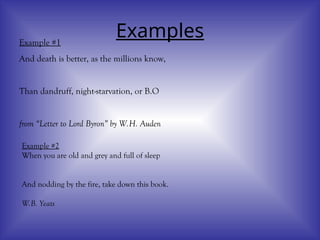
Examples
Example #1
And deathis better, as the millions know,
Than dandruff, night-starvation, or B.O
from “Letter to Lord Byron” by W.H. Auden
Example #2
When you are old and grey and full of sleep
And nodding by the fire, take down this book.
W.B. Yeats
22.
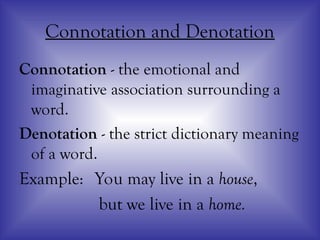
Connotation and Denotation
Connotation- the emotional and
imaginative association surrounding a
word.
Denotation - the strict dictionary meaning
of a word.
Example: You may live in a house,
but we live in a home.
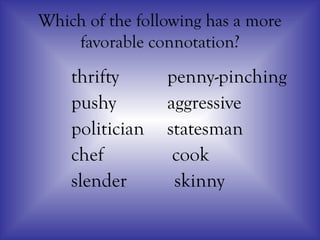
23.
Which of thefollowing has a more
favorable connotation?
thrifty penny-pinching
pushy aggressive
politician statesman
chef cook
slender skinny
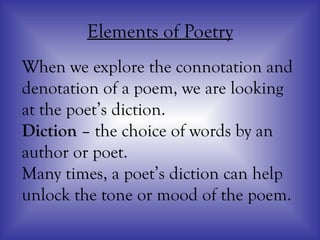
24.
Elements of Poetry
Whenwe explore the connotation and
denotation of a poem, we are looking
at the poet’s diction.
Diction – the choice of words by an
author or poet.
Many times, a poet’s diction can help
unlock the tone or mood of the poem.
25.
Elements of Poetry:Tone and Mood
Although many times we use the words
mood and tone interchangeably, they do
not necessarily mean the same thing.
Tone – a reflection of the poet’s attitude
toward the subject of a poem. Tone can
be serious, sarcastic, humorous, etc.
26.
Mood – thefeeling or atmosphere that
a poet creates. Mood can suggest an
emotion (ex. “excited”) or the quality
of a setting (ex. “calm”, “somber”) In
a poem, mood can be established
through word choice, line length,
rhythm, etc.
27.
Narrative Poetry
•Narrative poetryis verse that tells
a story.
•Two of the major examples of
narrative poetry include:
–Epics – a long narrative poem
on a great and serious subject
that is centered on the actions
of a heroic figure
28.
Ballads – asong or poem that tells a
story. Folk ballads, which typically tell
of an exciting or dramatic event, were
composed by an anonymous singer or
author and passed on by word of mouth
for generations before written down.
Literary ballads are written in imitation
of folk ballads, but usually given an
author.
29.
Dramatic Poetry
• Dramaticpoetry is poetry in which one or more
characters speak.
– Each speaker always addresses a specific listener.
– This listener may be silent (but identifiable), or
the listener may be another character who speaks
in reply.
– Usually the conflict that the speaker is involved
with is either an intense or emotional.
30.
Lyric Poetry
•Lyric poetryis poetry that expresses a
speaker’s personal thoughts and feelings.
–Lyric poems are usually short and
musical.
–This broad category covers many poetic
types and styles, including haikus,
sonnets, free verse and many others.
31.
Haikus
• The traditionalJapanese haiku is an unrhymed
poem that contains exactly 17 syllables,
arranged in 3 lines of 5, 7, 5 syllables each.
• However, when poems written in Japanese are
translated into another language, this pattern is
often lost.
• The purpose of a haiku is to capture a flash of
insight that occurs during a solitary observation
of nature.
32.
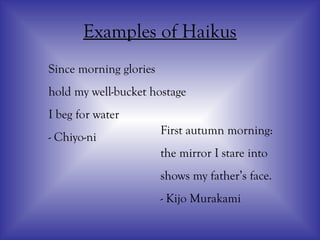
Examples of Haikus
Sincemorning glories
hold my well-bucket hostage
I beg for water
- Chiyo-ni
First autumn morning:
the mirror I stare into
shows my father’s face.
- Kijo Murakami
33.
Sonnets
• Background ofSonnets
– Form invented in Italy.
– Most if not all of Shakespeare’s sonnets are about
love or a theme related to love.
– Sonnets are usually written in a series with each
sonnet a continuous subject to the next. (Sequels in
movies)
34.
Sequence of Sonnets
•Shakespeare wrote 154 sonnets and can be broken up by the
characters they address.
– The Fair Youth: Sonnets 1 – 126 are devoted to a young man of
extreme physical beauty. The first 17 sonnets urge the young man to
pass on his beauty to the next generation through children. From
sonnet 18 on, Shakespeare shifts his viewpoint and writes how the
poetry itself will immortalize the young man and allow his beauty to
carry on.
– The Dark Lady: Sonnets 127 – 154 talk about an irresistible woman of
questionable morals who captivates the young poet. These sonnets
speak of an affair between the speaker and her, but her unfaithfulness
has hurt the speaker.
– The Rival Poet: This character shows up during the fair youth series.
The poet sees the rival poet as someone trying to take his own fame and
the poems refer to his own anxiety and insecurity.
35.
Structure of Sonnets
Thetraditional Elizabethan or Shakespearean
sonnet consists of fourteen lines, made up of
three quatrains (stanzas of 4 lines each) and a
final couplet (two line stanza). Sonnets are
usually written in iambic pentameter. The
quatrains traditionally follow an abab rhyme
scheme, followed by a rhyming couplet.
36.
Example
Sonnet 18
William Shakespeare
ShallI compare thee to a summer's day?
Thou art more lovely and more temperate.
Rough winds do shake the darling buds of May,
And summer's lease hath all too short a date.
Sometime too hot the eye of heaven shines,
And often is his gold complexion dimmed;
And every fair from fair sometime declines,
By chance, or nature's changing course, untrimmed:
But thy eternal summer shall not fade
Nor lose possession of that fair thou ow'st,
Nor shall Death brag thou wand'rest in his shade
When in eternal lines to time thou grow'st.
So long as men can breathe or eyes can see,
So long lives this, and this gives life to thee.
37.
Free Verse
• Freeverse is poetry that has no fixed pattern of
meter, rhyme, line length, or stanza arrangement.
• When writing free verse, a poet is free to vary
the poetic elements to emphasize an idea or
create a tone.
• In writing free verse, a poet may choose to use
repetition or similar grammatical structures to
emphasize and unify the ideas in the poem.
38.
Free Verse
• Whilethe majority of popular poetry today is written
as free verse, the style itself is not new. Walt
Whitman, writing in the 1800’s, created free verse
poetry based on forms found in the King James Bible.
• Modern free verse is concerned with the creation of a
brief, ideal image, not the refined ordered (and
artificial, according to some critics) patterns that other
forms of poetry encompass.
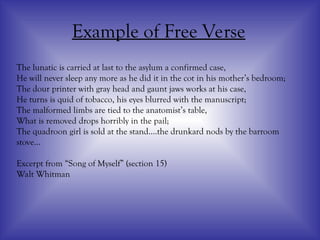
39.
Example of FreeVerse
The lunatic is carried at last to the asylum a confirmed case,
He will never sleep any more as he did it in the cot in his mother’s bedroom;
The dour printer with gray head and gaunt jaws works at his case,
He turns is quid of tobacco, his eyes blurred with the manuscript;
The malformed limbs are tied to the anatomist’s table,
What is removed drops horribly in the pail;
The quadroon girl is sold at the stand….the drunkard nods by the barroom
stove…
Excerpt from “Song of Myself” (section 15)
Walt Whitman