LITERATURE of the
PHILIPPINES and
the WORLD
Let’s Review
Lesson 2 : Poetry of the Archipelago
 Poetry is probably the most sophisticated of all literary genres.
 Poetry is a reflection of the country’s history and changing lifestyles, values, and
situations.
 Poems are full of emotion, so they reflect what Filipinos are feeling at a given
historical period.
 Poems also communicate the people’s hopes for the future
Philippine Poetry: Its Form, Language, and
Speech
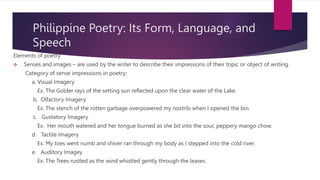
Elements of poetry
 Senses and images – are used by the writer to describe their impressions of their topic or object of writing.
Category of sense impressions in poetry:
a. Visual Imagery
Ex. The Golder rays of the setting sun reflected upon the clear water of the Lake.
b. Olfactory Imagery
Ex. The stench of the rotten garbage overpowered my nostrils when I opened the bin.
c. Gustatory Imagery
Ex. Her mouth watered and her tongue burned as she bit into the sour, peppery mango chow.
d. Tactile Imagery
Ex. My toes went numb and shiver ran through my body as I stepped into the cold river.
e. Auditory Imagey
Ex. The Trees rustled as the wind whistled gently through the leaves
Philippine Poetry: Its Form, Language, and Speech
 Diction – is the denotative and connotative meaning of the words in sentence,
phrase, paragraph, or poem.
 Rhyme Scheme – is the way the author arranges words, meters, lines, and stanzas
to create a coherent sound when the poem is read out loud.
Philippine Poetry: Its Form, Language, and
Speech
Philippine Poetry: Its Form, Language, and
Speech
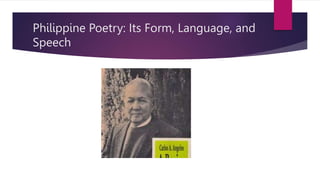
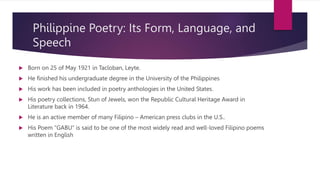
 Born on 25 of May 1921 in Tacloban, Leyte.
 He finished his undergraduate degree in the University of the Philippines
 His work has been included in poetry anthologies in the United States.
 His poetry collections, Stun of Jewels, won the Republic Cultural Heritage Award in
Literature back in 1964.
 He is an active member of many Filipino – American press clubs in the U.S..
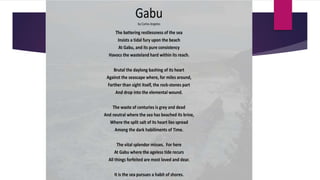
 His Poem “GABU” is said to be one of the most widely read and well-loved Filipino poems
written in English
Philippine Poetry: Its Form, Language, and
Speech
Task 1.
Draw your imagery of “Gabu” as described in the poem on a piece of paper. The find
information about Ilocos and its beaches, and try to guess which beach Carlos
Angeles is talking about by pertaining the poem’s imagery. Compare and contrast
the beach you have envisioned and drawn versus the beach Carlos Angeles has
written about. How are they similar and different? Submit your output in our Google
Class.
Close Reading of Filipino Poetry
 According to the New Criticism school of thought, poetry must have “organic
unity” – everything must be whole for it to be complete.
 This concept means that all parts must be accounted for and discoverable.
 In poetry , this can be done through Close Reading.
 Close Reading is a way for you to analyze the poem by carefully reading and
rereading a text until you have found its interpretation.
Close Reading
 What must you look out for? Find the context of the poem.
a. when it was written?
b. the setting in which it was written
c. the reason it was written
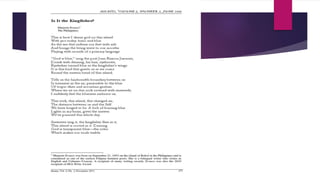
Poem Review
 Marjorie Evasco born in Bohol on 21 September 1953.
 Writes bilingually in English and Cebuano-Visayan
 Considered one of the country’s earliest feminist poet.
 Received numerous awards for her poetry
 In 2010, she received the prestigious South East Asian Write Award (Sea Write)
 She is currently a professor emeritus of De La Salle University - Manila
Essential Learning
 Filipino poetry is unique in its composition.
 Philippines has set itself apart with its own unique brand of poetry that may tackle
themes ranging form love to isolation, racial prejudice, one’s close relationship
with God, natural disasters, and so much more.
 There are ways to interpret poetry such as discussing different elements that are
present. These elements include word choice, form and imagery.
 Look into its organic unity.
 The best way to read the poem , is to READ IT LOUD with proper pronunciation ,
enunciation, and feelings.
Assessment
1. What is organic unity? How is it important in understanding the meaning of the
poem?
2. Why is there a need to read a poem out Loud?
3. What makes Filipino poetry unique?

Phil Lit.pptx

  • 1.
  • 2.
  • 3.
    Lesson 2 :Poetry of the Archipelago  Poetry is probably the most sophisticated of all literary genres.  Poetry is a reflection of the country’s history and changing lifestyles, values, and situations.  Poems are full of emotion, so they reflect what Filipinos are feeling at a given historical period.  Poems also communicate the people’s hopes for the future
  • 4.
    Philippine Poetry: ItsForm, Language, and Speech Elements of poetry  Senses and images – are used by the writer to describe their impressions of their topic or object of writing. Category of sense impressions in poetry: a. Visual Imagery Ex. The Golder rays of the setting sun reflected upon the clear water of the Lake. b. Olfactory Imagery Ex. The stench of the rotten garbage overpowered my nostrils when I opened the bin. c. Gustatory Imagery Ex. Her mouth watered and her tongue burned as she bit into the sour, peppery mango chow. d. Tactile Imagery Ex. My toes went numb and shiver ran through my body as I stepped into the cold river. e. Auditory Imagey Ex. The Trees rustled as the wind whistled gently through the leaves
  • 5.
    Philippine Poetry: ItsForm, Language, and Speech  Diction – is the denotative and connotative meaning of the words in sentence, phrase, paragraph, or poem.  Rhyme Scheme – is the way the author arranges words, meters, lines, and stanzas to create a coherent sound when the poem is read out loud.
  • 6.
    Philippine Poetry: ItsForm, Language, and Speech
  • 7.
    Philippine Poetry: ItsForm, Language, and Speech  Born on 25 of May 1921 in Tacloban, Leyte.  He finished his undergraduate degree in the University of the Philippines  His work has been included in poetry anthologies in the United States.  His poetry collections, Stun of Jewels, won the Republic Cultural Heritage Award in Literature back in 1964.  He is an active member of many Filipino – American press clubs in the U.S..  His Poem “GABU” is said to be one of the most widely read and well-loved Filipino poems written in English
  • 9.
    Philippine Poetry: ItsForm, Language, and Speech Task 1. Draw your imagery of “Gabu” as described in the poem on a piece of paper. The find information about Ilocos and its beaches, and try to guess which beach Carlos Angeles is talking about by pertaining the poem’s imagery. Compare and contrast the beach you have envisioned and drawn versus the beach Carlos Angeles has written about. How are they similar and different? Submit your output in our Google Class.
  • 10.
    Close Reading ofFilipino Poetry  According to the New Criticism school of thought, poetry must have “organic unity” – everything must be whole for it to be complete.  This concept means that all parts must be accounted for and discoverable.  In poetry , this can be done through Close Reading.  Close Reading is a way for you to analyze the poem by carefully reading and rereading a text until you have found its interpretation.
  • 11.
    Close Reading  Whatmust you look out for? Find the context of the poem. a. when it was written? b. the setting in which it was written c. the reason it was written
  • 12.
    Poem Review  MarjorieEvasco born in Bohol on 21 September 1953.  Writes bilingually in English and Cebuano-Visayan  Considered one of the country’s earliest feminist poet.  Received numerous awards for her poetry  In 2010, she received the prestigious South East Asian Write Award (Sea Write)  She is currently a professor emeritus of De La Salle University - Manila
  • 14.
    Essential Learning  Filipinopoetry is unique in its composition.  Philippines has set itself apart with its own unique brand of poetry that may tackle themes ranging form love to isolation, racial prejudice, one’s close relationship with God, natural disasters, and so much more.  There are ways to interpret poetry such as discussing different elements that are present. These elements include word choice, form and imagery.  Look into its organic unity.  The best way to read the poem , is to READ IT LOUD with proper pronunciation , enunciation, and feelings.
  • 15.
    Assessment 1. What isorganic unity? How is it important in understanding the meaning of the poem? 2. Why is there a need to read a poem out Loud? 3. What makes Filipino poetry unique?