
Sujata Bhatt
A Different History
About the poet...
Sujata Bhatt's multicultural
perspectives on language,
culture, art and history surely
originate in her own life
experiences.
Born in India in 1956, her mother
tongue Gujerati, she has studied
in Britain and the USA (at the
famed Iowa Writers Workshop),
taught in Canada, travelled
widely, and now lives and works
in Germany.
• She was born in Ahmedabad in 1956
• Grew up in Pune until 1968
• 1968 – Emigrated to the USA with her family
at the age of 12
• Many of Bhatt's poems have themes of love
and violence.
• She explores issues such as racism and the
interaction between Asian, European, and
North American culture.
Brief Context
“A Different History” explores the relationship between
cultural identity and language. Bhatt was born in India
in 1956, studied in the United Kingdom and United
States, and lives now in Germany.
A Different History
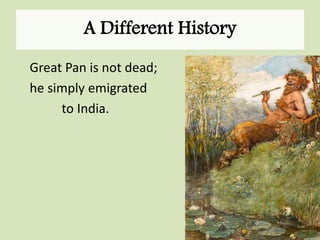
Great Pan is not dead;
he simply emigrated
to India.
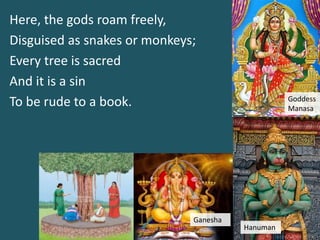
Here, the gods roam freely,
Disguised as snakes or monkeys;
Every tree is sacred
And it is a sin
To be rude to a book. Goddess
Manasa
Hanuman
Ganesha
It is a sin to shove a book aside
with your foot,
a sin to slam books down
hard on a table,
a sin to toss one carelessly
across a room.
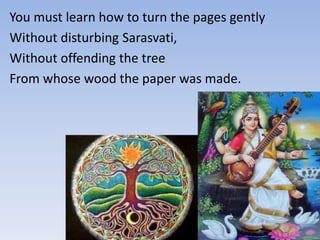
You must learn how to turn the pages gently
Without disturbing Sarasvati,
Without offending the tree
From whose wood the paper was made.
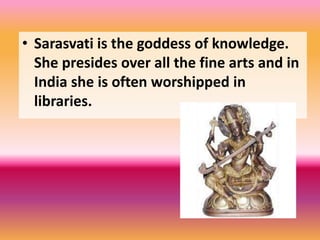
• Sarasvati is the goddess of knowledge.
She presides over all the fine arts and in
India she is often worshipped in
libraries.
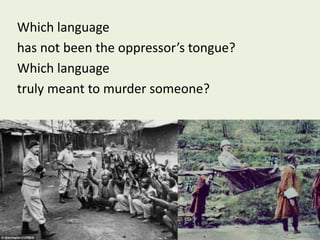
Which language
has not been the oppressor’s tongue?
Which language
truly meant to murder someone?
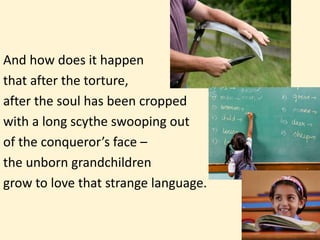
And how does it happen
that after the torture,
after the soul has been cropped
with a long scythe swooping out
of the conqueror’s face –
the unborn grandchildren
grow to love that strange language.
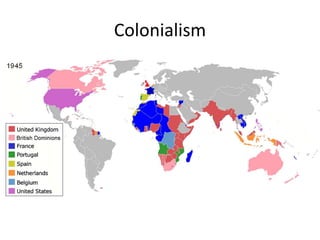
Colonialism
Discussion
What is being compared in the poem?
• Comparison is made between Greek and Indian gods:
‘[Pan] simply emigrated / to India’, and ‘Here [in India],
the gods roam freely’.
 What is the attitude towards books?
• Next the poem focuses on the reverential attitude
towards books in a country where ‘every tree is sacred’.
 Is there a change of mood in the poem?
• A clear shift in mood comes at the start of the second
section with the first rhetorical question which takes us
to the heart of what the poem is about: ‘Which
language / has not been the oppressor’s tongue?’
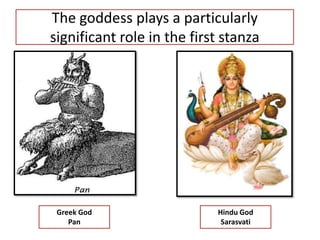
The goddess plays a particularly
significant role in the first stanza
Greek God
Pan
Hindu God
Sarasvati
Tone
Listen to the poem again...
Do you feel that a particular point has been
clarified by the tone of voice in which Bhatt
reads the poem?
Graphology (study of hand-writing style to infer a
person’s character)
The lineation of the poem makes the two
sections of the poem stand out visually.
What differences can you see between the two
Sections? Look both at the content and the
language Bhatt uses.
Language
Look more closely at the language of the first
section (up until ‘from whose wood the paper
was made’).
How does Bhatt use words and phrases to
convey how sacred trees and books are?
Mood / Tone
• Consider more closely the different mood of
the second section, exploring the precise
effects of particular words that you find
striking.
• How do you think these lines should be read?
Is the tone bitter or sad? Does the tone of
voice change at any stage – and, if it does,
why?
Metaphors
• Consider the following metaphors: ‘tongue’
for language, and the soul ‘cropped / with a
long scythe swooping out / of the conqueror’s
face’.
• Probe closely the meanings and effects of the
underlined words.
• How effective do you find the final two lines of
the poem? Do you find anything amusing in
the poem?
Themes
What do you think are the common ideas found
within this poem?
• Identity and language
• Time
• Religion
• Colonisation
• Emigration
Essay Question
• Explore how Bhatt critically conveys her ideas
of language and culture in the poem A
Different History.
• Explore how Bhatt powerfully communicates
the culture of India and loss of language in the
poem A Different History.
OR:

A Different History

  • 1.
  • 2.
    About the poet... SujataBhatt's multicultural perspectives on language, culture, art and history surely originate in her own life experiences. Born in India in 1956, her mother tongue Gujerati, she has studied in Britain and the USA (at the famed Iowa Writers Workshop), taught in Canada, travelled widely, and now lives and works in Germany.
  • 3.
    • She wasborn in Ahmedabad in 1956 • Grew up in Pune until 1968 • 1968 – Emigrated to the USA with her family at the age of 12 • Many of Bhatt's poems have themes of love and violence. • She explores issues such as racism and the interaction between Asian, European, and North American culture.
  • 4.
    Brief Context “A DifferentHistory” explores the relationship between cultural identity and language. Bhatt was born in India in 1956, studied in the United Kingdom and United States, and lives now in Germany.
  • 5.
    A Different History GreatPan is not dead; he simply emigrated to India.
  • 6.
    Here, the godsroam freely, Disguised as snakes or monkeys; Every tree is sacred And it is a sin To be rude to a book. Goddess Manasa Hanuman Ganesha
  • 7.
    It is asin to shove a book aside with your foot, a sin to slam books down hard on a table, a sin to toss one carelessly across a room.
  • 8.
    You must learnhow to turn the pages gently Without disturbing Sarasvati, Without offending the tree From whose wood the paper was made.
  • 9.
    • Sarasvati isthe goddess of knowledge. She presides over all the fine arts and in India she is often worshipped in libraries.
  • 10.
    Which language has notbeen the oppressor’s tongue? Which language truly meant to murder someone?
  • 11.
    And how doesit happen that after the torture, after the soul has been cropped with a long scythe swooping out of the conqueror’s face – the unborn grandchildren grow to love that strange language.
  • 12.
  • 15.
    Discussion What is beingcompared in the poem? • Comparison is made between Greek and Indian gods: ‘[Pan] simply emigrated / to India’, and ‘Here [in India], the gods roam freely’.  What is the attitude towards books? • Next the poem focuses on the reverential attitude towards books in a country where ‘every tree is sacred’.  Is there a change of mood in the poem? • A clear shift in mood comes at the start of the second section with the first rhetorical question which takes us to the heart of what the poem is about: ‘Which language / has not been the oppressor’s tongue?’
  • 16.
    The goddess playsa particularly significant role in the first stanza Greek God Pan Hindu God Sarasvati
  • 17.
    Tone Listen to thepoem again... Do you feel that a particular point has been clarified by the tone of voice in which Bhatt reads the poem?
  • 18.
    Graphology (study ofhand-writing style to infer a person’s character) The lineation of the poem makes the two sections of the poem stand out visually. What differences can you see between the two Sections? Look both at the content and the language Bhatt uses.
  • 19.
    Language Look more closelyat the language of the first section (up until ‘from whose wood the paper was made’). How does Bhatt use words and phrases to convey how sacred trees and books are?
  • 20.
    Mood / Tone •Consider more closely the different mood of the second section, exploring the precise effects of particular words that you find striking. • How do you think these lines should be read? Is the tone bitter or sad? Does the tone of voice change at any stage – and, if it does, why?
  • 21.
    Metaphors • Consider thefollowing metaphors: ‘tongue’ for language, and the soul ‘cropped / with a long scythe swooping out / of the conqueror’s face’. • Probe closely the meanings and effects of the underlined words. • How effective do you find the final two lines of the poem? Do you find anything amusing in the poem?
  • 22.
    Themes What do youthink are the common ideas found within this poem? • Identity and language • Time • Religion • Colonisation • Emigration
  • 23.
    Essay Question • Explorehow Bhatt critically conveys her ideas of language and culture in the poem A Different History. • Explore how Bhatt powerfully communicates the culture of India and loss of language in the poem A Different History. OR: