Euler’s Polyhedron Formula and More!
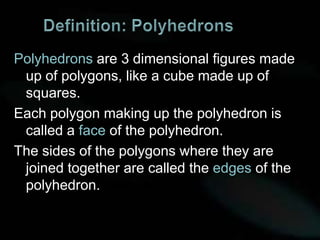
Polyhedrons are 3 dimensional figures made
 up of polygons, like a cube made up of
 squares.
Each polygon making up the polyhedron is
 called a face of the polyhedron.
The sides of the polygons where they are
 joined together are called the edges of the
 polyhedron.
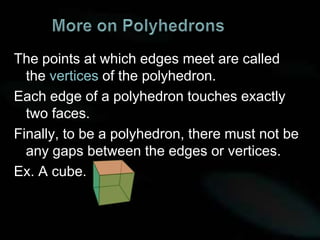
The points at which edges meet are called
  the vertices of the polyhedron.
Each edge of a polyhedron touches exactly
  two faces.
Finally, to be a polyhedron, there must not be
  any gaps between the edges or vertices.
Ex. A cube.
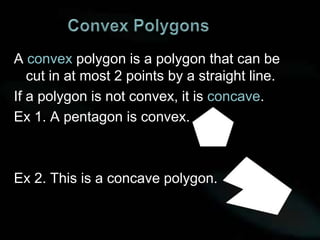
A convex polygon is a polygon that can be
   cut in at most 2 points by a straight line.
If a polygon is not convex, it is concave.
Ex 1. A pentagon is convex.


Ex 2. This is a concave polygon.
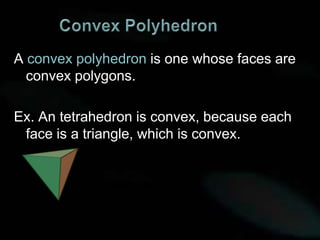
A convex polyhedron is one whose faces are
  convex polygons.

Ex. An tetrahedron is convex, because each
 face is a triangle, which is convex.
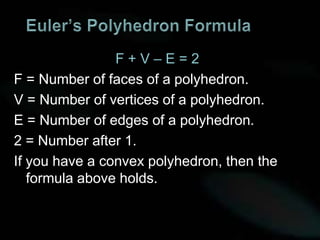
F+V–E=2
F = Number of faces of a polyhedron.
V = Number of vertices of a polyhedron.
E = Number of edges of a polyhedron.
2 = Number after 1.
If you have a convex polyhedron, then the
   formula above holds.
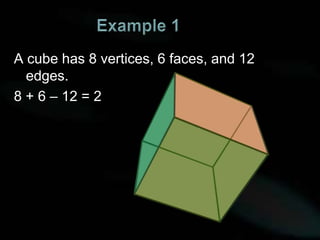
A cube has 8 vertices, 6 faces, and 12
  edges.
8 + 6 – 12 = 2
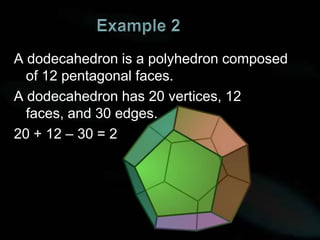
A dodecahedron is a polyhedron composed
  of 12 pentagonal faces.
A dodecahedron has 20 vertices, 12
  faces, and 30 edges.
20 + 12 – 30 = 2
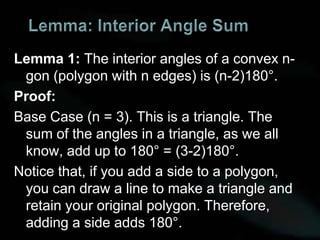
Lemma 1: The interior angles of a convex n-
 gon (polygon with n edges) is (n-2)180°.
Proof:
Base Case (n = 3). This is a triangle. The
 sum of the angles in a triangle, as we all
 know, add up to 180° = (3-2)180°.
Notice that, if you add a side to a polygon,
 you can draw a line to make a triangle and
 retain your original polygon. Therefore,
 adding a side adds 180°.
Induction Step (n → n+1). Assume that this
  formula holds for an n-gon for some
  positive integer n. This means that the sum
  of the angles in this n-gon is (n-2)180°. We
  want to prove that this implies that this
  works for an (n+1)-gon.
Add another side to the n-gon. This adds
  180° to the interior angles. So, (n-2)180° +
  180°=(n+1-2) 180°, as required.
QED
Corollary: The exterior angles of any convex
 n-gon adds to 360°.
Proof:
Take any polygon and extend the lines of
 each edge out. The line is 180°, but the
 inside angle takes away some from that.
Take an n-gon. The sum of the angles of the
 lines extended from each edge will be
 n180°. (Can you finish this?)
QED

Euler Characteristic WIP

  • 1.
  • 2.
    Polyhedrons are 3dimensional figures made up of polygons, like a cube made up of squares. Each polygon making up the polyhedron is called a face of the polyhedron. The sides of the polygons where they are joined together are called the edges of the polyhedron.
  • 3.
    The points atwhich edges meet are called the vertices of the polyhedron. Each edge of a polyhedron touches exactly two faces. Finally, to be a polyhedron, there must not be any gaps between the edges or vertices. Ex. A cube.
  • 4.
    A convex polygonis a polygon that can be cut in at most 2 points by a straight line. If a polygon is not convex, it is concave. Ex 1. A pentagon is convex. Ex 2. This is a concave polygon.
  • 5.
    A convex polyhedronis one whose faces are convex polygons. Ex. An tetrahedron is convex, because each face is a triangle, which is convex.
  • 6.
    F+V–E=2 F = Numberof faces of a polyhedron. V = Number of vertices of a polyhedron. E = Number of edges of a polyhedron. 2 = Number after 1. If you have a convex polyhedron, then the formula above holds.
  • 7.
    A cube has8 vertices, 6 faces, and 12 edges. 8 + 6 – 12 = 2
  • 8.
    A dodecahedron isa polyhedron composed of 12 pentagonal faces. A dodecahedron has 20 vertices, 12 faces, and 30 edges. 20 + 12 – 30 = 2
  • 9.
    Lemma 1: Theinterior angles of a convex n- gon (polygon with n edges) is (n-2)180°. Proof: Base Case (n = 3). This is a triangle. The sum of the angles in a triangle, as we all know, add up to 180° = (3-2)180°. Notice that, if you add a side to a polygon, you can draw a line to make a triangle and retain your original polygon. Therefore, adding a side adds 180°.
  • 10.
    Induction Step (n→ n+1). Assume that this formula holds for an n-gon for some positive integer n. This means that the sum of the angles in this n-gon is (n-2)180°. We want to prove that this implies that this works for an (n+1)-gon. Add another side to the n-gon. This adds 180° to the interior angles. So, (n-2)180° + 180°=(n+1-2) 180°, as required. QED
  • 11.
    Corollary: The exteriorangles of any convex n-gon adds to 360°. Proof: Take any polygon and extend the lines of each edge out. The line is 180°, but the inside angle takes away some from that. Take an n-gon. The sum of the angles of the lines extended from each edge will be n180°. (Can you finish this?) QED