Introduction
Have you ever looked at a stop sign, a tiled floor, or a honeycomb and wondered what all these shapes have in common? They’re polygons!
Polygons are all around us—in buildings, art, nature, and even in video games! In this blog post, we’ll explore what polygons are, how many types exist, how to calculate angles and area, and where we see them in real life. Ready? Let’s dive into the exciting world of polygons!
🔷 What Is a Polygon?
A polygon is a closed 2D shape made by straight lines. These lines are called sides, and they connect to form a closed figure. A polygon must have at least three sides.
👉 Key Points:
Closed shape: It starts and ends at the same point.
Straight lines: No curves.
At least 3 sides: A shape with fewer than 3 sides isn’t a polygon.
✏️ Examples of polygons:
Triangle (3 sides)
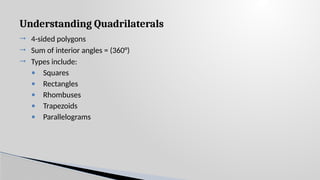
Square or rectangle (4 sides)
Pentagon (5 sides)
Hexagon (6 sides)
Octagon (8 sides)
❌ Not polygons:
A circle (it has no straight sides)
An open figure (not closed)
A shape with curved lines
🧩 Parts of a Polygon
Let’s understand the important parts of a polygon:
Sides – The straight lines that make up the shape.
Vertices – The corners or points where the sides meet.
Angles – Formed where two sides meet.
Example: A triangle has 3 sides, 3 angles, and 3 vertices.
🏷️ Names of Polygons (Based on the Number of Sides)
Sides Name
3 Triangle
4 Quadrilateral (Square, Rectangle)
5 Pentagon
6 Hexagon
7 Heptagon
8 Octagon
9 Nonagon
10 Decagon
You can use the word “n-gon” for any number of sides. For example, a shape with 12 sides is a 12-gon.
🧠 Types of Polygons
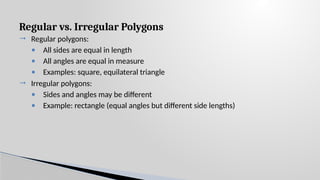
1. Regular and Irregular Polygons
Regular Polygon: All sides and angles are equal.
Example: An equilateral triangle or a square.
Irregular Polygon: Sides and angles are not equal.
Example: A scalene triangle.
2. Convex and Concave Polygons
Convex: All angles are less than 180°. It “bulges out”.
Concave: One or more angles are greater than 180°. It “caves in”.
3. Simple and Complex Polygons
Simple: Sides do not cross each other.
Complex: Sides cross over each other (like a star).
🔢 Interior and Exterior Angles
🔸 Interior Angles
Interior angles are the angles inside the polygon.
To find the sum of all interior angles:
Sum
=
(
�
−
2
)
×
180
∘
Sum=(n−2)×180
∘
Where
�
n is the number of sides.
Polygon Formula Sum of Angles
Triangle (3 − 2) × 180 180°
Quadrilateral (4 − 2) × 180 360°
Pentagon (5 − 2) × 180 540°
Hexagon (6 − 2) × 180 720°
🔸 Exterior Angles
The sum of all exterior angles of any polygon is always:
360
∘
360
∘
Each exterior angle in a regular polygon:
=
360
∘
�
=
n
360
∘
📏 Area and Perimeter
Perimeter:
The perimeter is the total length around the polygon.
Perimeter
=
sum of all sides
Perimeter=sum of all sides
Area:
To find the area, we need different formulas for different polygons.
Triangle:
Area
=
1
2
×
base
×
height
Area=
2
1
×base×height
Square:
Area
=
side
2
Area=side
2
Rectangle:
Area
=
length
×
breadth
Area=le