Logistics Management
System
Session Description:
This session discusses the systems of
managing and mobilizing logistics and supplies
in times of emergency or disaster to where
these are needed most at the right time, with
the right quantity, to the right place and with
the right quality, based on right and accurate
information.
Session Objectives:
By the end of this session, the participants will
be able to:
- Define Logistics Management
- Discuss the scope and purpose of logistics
management
- Discuss Logistic Management Process
Q & A
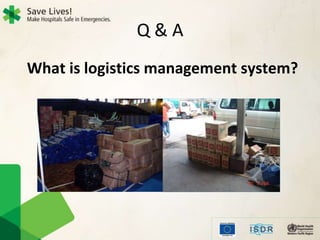
What is logistics management system?
Logistics Management System
1. It is the procurement and delivery of the right
supplies in the right quantity, in the right order,
in good condition at the right place and at the
right time (HEMS, 2007).
2. It is the process of planning, preparing,
implementing and evaluating all logistics
functions in the provision of assistance, as well as
its place in carrying out emergency management
operations.
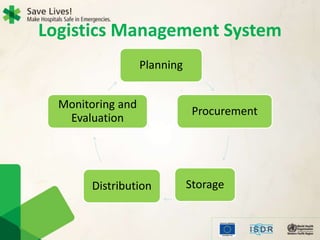
Planning
Procurement
Storage
Distribution
Monitoring and
Evaluation
Logistics Management System
LOGISTICS MANAGEMENT PROCESS
A. PLANNING
Annual Procurement Plan (APP)
This contains list of drugs/medicines, supplies,
equipment and materials to be procured for the
coming year which shall be prepared by the
HEMS Coordinator and signed by the Chief of
Hospital at least a quarter prior to the start of the
succeeding year.
The HEMS Coordinator will have to consider
the following in the preparation of APP:
- Inventory of available stocks including expiration
dates.
- Utilization of the past year.
- Post Incident Evaluation (PIE) of disasters
specifically on logistics.
- All drugs and medicines requisitioned should
be in the Philippine National Drug Formulary
(PNDF).
The HEMS Coordinator will have to
consider the following in the preparation
of APP:
- Projected needs
- Projected emergencies and hazards in the
hospital and catchment areas.
- Leading causes of morbidity and mortality.
- Appropriate storage facilities and back-up.
Supplemental Procurement Plan
In the event of additional needs during
emergencies/disasters, a supplemental
Procurement Plan should be prepared and
submitted.
B. PROCUREMENT
It shall follow pertinent government rules and
regulations (RA 9184 or The Government
Procurement Reform Act) and other DOH policies
relative to procurement.
The hospital can make arrangements with
pharmaceutical companies and other suppliers
during emergencies.
In the event that the hospital’s funds are depleted
because of the ongoing operations, they can request
augmentation from HEMS.
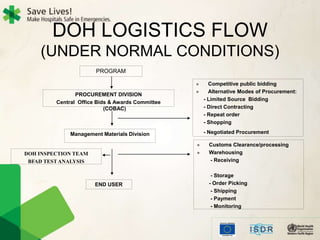
DOH LOGISTICS FLOW
(UNDER NORMAL CONDITIONS)
PROGRAM
PROCUREMENT DIVISION
Central Office Bids & Awards Committee
(COBAC)
 Competitive public bidding
 Alternative Modes of Procurement:
- Limited Source Bidding
- Direct Contracting
- Repeat order
- Shopping
- Negotiated Procurement
Management Materials Division
 Customs Clearance/processing
 Warehousing
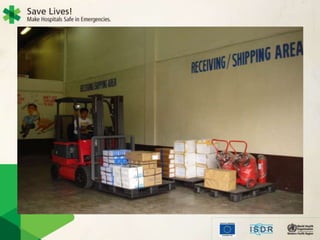
- Receiving
- Storage
- Order Picking
- Shipping
- Payment
- Monitoring
END USER
DOH INSPECTION TEAM
BFAD TEST ANALYSIS
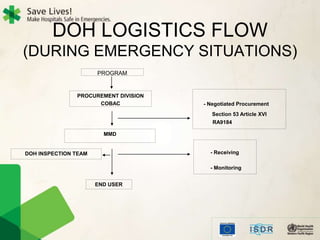
DOH LOGISTICS FLOW
(DURING EMERGENCY SITUATIONS)
PROGRAM
PROCUREMENT DIVISION
COBAC - Negotiated Procurement
Section 53 Article XVI
RA9184
MMD
- Receiving
- Monitoring
END USER
DOH INSPECTION TEAM
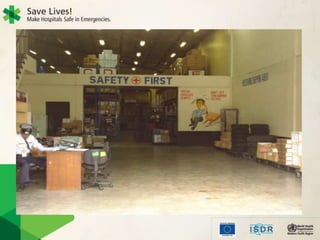
C. STORAGE AND WAREHOUSING.
Preparedness
Look for various storage/warehouse areas in and
outside the hospital. Ideal storage include
warehouse or suitable building where storage
management already exist during pre-disaster.
Emergency/Response Phase
If a suitable space is not available, and available
space in the field can be utilized. Use your
innovations. It could be a lockable transport
container.
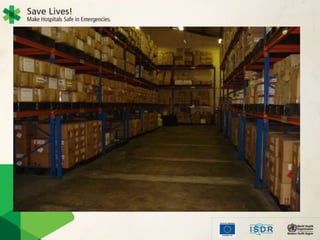
C. STORAGE : Guidelines for careful storage
(to prevent wastage, spoilage, damage)
• Store foods in a dry, well –ventilated area free from rodents,
insects, etc.
• Boxes and bags must be placed not directly on the floor . Use
pallets, boards or bricks underneath the piles.
• Keep the products at least 40 cm. away from the wall and do
not stock too high.
• Keep the damaged boxes /bags away from undamaged ones.
• Pile the boxes/bags two by two crosswise to permit ventilation.
In this way, they are steadier and easy to count.
Logistics Management Process
C. STORAGE : Guidelines for careful storage
• Unauthorized person can’t enter the stockroom.
• Keep an updated stock card and conduct periodic
inventory.
• Observe “ First In –First Out” principle. Dispose food and
medicines at least one (1) year before the expiry date.
• Vaccines should be stored in cold storage with
temperature of 2-8 degrees centigrade. Do not store foods
with vaccines in one cold storage.
• Keep medicines away from sunlight.
Logistics Management Process
• Resources should be distributed equitably to
the concerned areas in the hospital.
• In the event of augmentation from CHD or
HEMS, the logistics shall be provided directly
to the response teams.
D. DISTRIBUTION/DELIVERY
Logistics Management Process
E. MONITORING AND EVALUATION
To ensure that essential items are always
available stock levels should be closely
monitored. It is important to:
- Indicate end destination for items in the
stock records.
- Monitor that they are being used appropriately.
- Provide reliable reports.
E. MONITORING AND EVALUATION
The hospital Supply Officer together with the HEMS
Coordinator shall prepare the following:
- Monthly inventory report of stocks including expiry
dates and location of first delivery.
- Annual utilization reports.
- Post Incident Evaluation of every
emergency/disaster especially on logistical
issues.
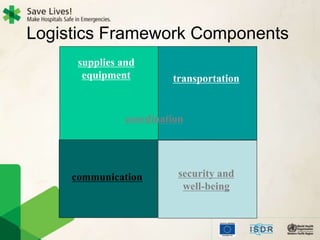
Logistics Framework Components
supplies and
equipment transportation
communication security and
well-being
coordination
COMPONENTS
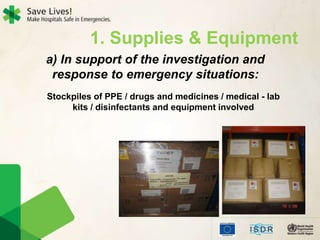
a) In support of the investigation and
response to emergency situations:
Stockpiles of PPE / drugs and medicines / medical - lab
kits / disinfectants and equipment involved
1. Supplies & Equipment
b) In support of the operation:
Transport
Communication - security equipment
Deployment kits for response staff
Administrative kits
Food and beverages
Shelter
1. Supplies & Equipment
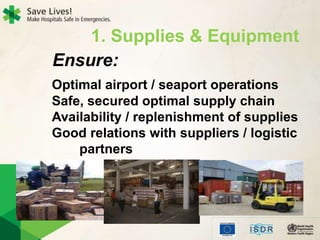
Optimal airport / seaport operations
Safe, secured optimal supply chain
Availability / replenishment of supplies
Good relations with suppliers / logistic
partners
1. Supplies & Equipment
Ensure:
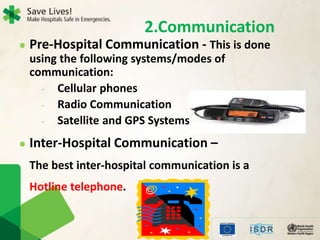
 Pre-Hospital Communication - This is done
using the following systems/modes of
communication:
- Cellular phones
- Radio Communication
- Satellite and GPS Systems
 Inter-Hospital Communication –
The best inter-hospital communication is a
Hotline telephone.
2.Communication
 Ensuring the right communication equipment for the
right place and situation;
 Ensuring proper installation, use and maintenance of
communication equipment;
 Training how to use these communication equipment
to all members of the response team including the
drivers;
 Making a handy list of contact numbers of concerned
individuals/agencies; and
 Communicating with the public.
Communication
3. Transportation
Considerations:
• Determine right kind of vehicle
to transport patients, supplies and
equipment;
• Make sure appropriate vehicles are
available all throughout the operation;
• Ensure daily maintenance of vehicles and level of
spare parts and fuel; and
• Choose routes according to security situation, road
condition, distance, urgency of delivery.
4. Security and Well Being
A. Related to the logistics operation
Secured warehousing and movement of
supplies to avoid looting and wastage:
• warehouse with competent and reliable
staff, security personnel and security alarm
system
• warehouse must be clean, free
from pests and leaks
• transport supplies at day time
B. Related to response team members
• Secured and comfortable working/living space
• Safe work practices
• Safe travel of staff to and from the disaster site;
and
• Safe personal well-being with
respect to local culture, religion,
rules and regulations
Security and Well Being
1. Standard treatment guidelines, protocols and
diagnostic procedures for emergencies
2. Standard National Lists for use in emergencies:
• pharmaceuticals, vaccines, chemicals, reagents and
other supplies
• kits for specific purposes (first aid, triage, injury,
cholera, burns, chemical and radiation accidents
etc.)
• equipment (diagnostics, laboratory, personal
protective equipment, administration, assessment
and administration/reporting), consumables, spare
parts
Components of
supply management systems
There is increased demand for, AND a need to replace
damage/losses, of:
1. triage, first aid and victim transport equipment (kits, tags,
stretchers etc - spare parts and hardware)
2. acute care medical and surgical equipment (spare parts
and hardware)
3. pharmaceuticals, vaccines, antidotes, antivenins, gases,
chemicals, IV fluids, disinfectants, antiseptics
4. diagnostic / laboratory supplies (reagents, culture media)
5. Blood and blood products
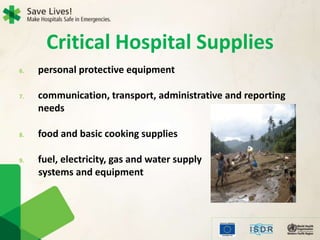
Critical Hospital Supplies
6. personal protective equipment
7. communication, transport, administrative and reporting
needs
8. food and basic cooking supplies
9. fuel, electricity, gas and water supply
systems and equipment
Critical Hospital Supplies
10. orthotics, prosthetics and dental equipment
11. patient care needs – beds, linen etc.
12. damaged office furniture and
13. general / administrative supplies
14. personal needs of hospital staff
• Supplies not readily available locally can be requested
from HEMS like cadaver bags, Water disinfectants,
Vitamin A
Critical Hospital Supplies
Volunteers
Issues to be considered whether hospitals will
allow/accept volunteers:
• what tasks can safely be allocated to untrained volunteers
(away from patient reception and treatment areas)?
• who will supervise them?
• how they will be identified?
• using the media to disseminate messages that volunteers
are or are not required by the hospital?
• what other agencies can the volunteers be directed to?
• are volunteers covered by any insurance if they are injured?
REPUBLIC ACT No. 10121
AN ACT STRENGTHENING THE PHILIPPINE DISASTER
RISK REDUCTION AND MANAGEMENT (DRRM)
SYSTEM
PROVIDING FOR THE NATIONAL DRRM
FRAMEWORK
INSTITUTIONALIZING THE NATIONAL DRRM PLAN,
APPROPRIATING FUNDS THEREFORE AND FOR
OTHER PURPOSES.
Accreditation, Mobilization, and Protection of
Disaster Volunteers and National Service
Reserve Corps, CSOs and the Private Sector.
•The government agencies, CSOs, private sector and
LGUs may mobilize individuals or organized
volunteers to augment their respective personnel
complement and logistical requirements in the
delivery of DRR programs and activities.
•They shall take full responsibility for the
enhancement, welfare and protection of volunteers,
and shall submit the list of volunteers to the OCD,
through the LDRRMOs, for accreditation and inclusion
in the database of community disaster volunteers.
•Mobilization of volunteers shall be in accordance with
the guidelines to be formulated by the NDRRMC.
•Any volunteer who incurs death or injury while
engaged in any of the activities defined under this Act
shall be entitled to compensatory benefits and
individual personnel accident insurance.
Management of Donations during
Emergency and Disaster Situations
• to avoid problems that have been
encountered in the past
- donations turned out to be inappropriate;
- issues of delays;
- confusion in handling and administering
donations; and
- lack of information to ascertain whether
donated items really reached the desired
beneficiaries
• DOH AO # 2007-0017 (Guidelines on the
Acceptance and Processing of Foreign and Local
Donations During Emergency and Disaster
Situations)
- Aims to provide a rational and systematic procedure
for the acceptance, processing and distribution of
foreign and local donations.
Management of Donations during
Emergency and Disaster Situations
Roles and Functions of the Hospital During each Phase
of Disaster:
A. Health Emergency Preparedness Phase
- Proper coordination and arrangements must be
established
- Proper protocols and procedures should be
established
- There should be a directory of available suppliers or
they can establish special arrangement with them in
case of emergencies/disasters.
- Sufficient logistical needs for ER and ambulances
must be in place.
- Ensure plans are in place.
B. Health Emergency Response Phase
- Rapid Assessment on logistics must be conducted.
- The Logistics Officer should take charge in
supplying all the needed logistics by the
responders.
- The Finance Officer should ensure funding
and should be responsible for sourcing out.
- The Hospital Liaison Officer should be able to
network with other hospitals.
C. Health Recovery and Reconstruction
Phase
- Conduct evaluation.
- Update inventory of resources.
- Review and update systems and plans.
- Replenish utilized resources.
Activity:
• “Typhoon Ketsana” hit the northern and central
provinces of Luzon damaging agriculture, houses,
and health infrastructures; displacing thousands of
people; killing and injuring hundreds of people.
• Your hospital was one of those worse hit by the
typhoon. Your ground floor was flooded and a
number of trauma patients were brought to your
hospital
Activity:
What will be your actions in responding to
the emergency thru provision of logistics?
Session Objectives:
By the end of this session, the participants will
be able to:
- Define Logistics Management
- Discuss the scope and purpose of logistics
management
- Discuss Logistic Management Process

Logistics Mgt.ppt

  • 1.
  • 2.
    Session Description: This sessiondiscusses the systems of managing and mobilizing logistics and supplies in times of emergency or disaster to where these are needed most at the right time, with the right quantity, to the right place and with the right quality, based on right and accurate information.
  • 3.
    Session Objectives: By theend of this session, the participants will be able to: - Define Logistics Management - Discuss the scope and purpose of logistics management - Discuss Logistic Management Process
  • 4.
    Q & A Whatis logistics management system?
  • 5.
    Logistics Management System 1.It is the procurement and delivery of the right supplies in the right quantity, in the right order, in good condition at the right place and at the right time (HEMS, 2007). 2. It is the process of planning, preparing, implementing and evaluating all logistics functions in the provision of assistance, as well as its place in carrying out emergency management operations.
  • 6.
  • 7.
    LOGISTICS MANAGEMENT PROCESS A.PLANNING Annual Procurement Plan (APP) This contains list of drugs/medicines, supplies, equipment and materials to be procured for the coming year which shall be prepared by the HEMS Coordinator and signed by the Chief of Hospital at least a quarter prior to the start of the succeeding year.
  • 8.
    The HEMS Coordinatorwill have to consider the following in the preparation of APP: - Inventory of available stocks including expiration dates. - Utilization of the past year. - Post Incident Evaluation (PIE) of disasters specifically on logistics. - All drugs and medicines requisitioned should be in the Philippine National Drug Formulary (PNDF).
  • 9.
    The HEMS Coordinatorwill have to consider the following in the preparation of APP: - Projected needs - Projected emergencies and hazards in the hospital and catchment areas. - Leading causes of morbidity and mortality. - Appropriate storage facilities and back-up.
  • 10.
    Supplemental Procurement Plan Inthe event of additional needs during emergencies/disasters, a supplemental Procurement Plan should be prepared and submitted.
  • 11.
    B. PROCUREMENT It shallfollow pertinent government rules and regulations (RA 9184 or The Government Procurement Reform Act) and other DOH policies relative to procurement. The hospital can make arrangements with pharmaceutical companies and other suppliers during emergencies. In the event that the hospital’s funds are depleted because of the ongoing operations, they can request augmentation from HEMS.
  • 12.
    DOH LOGISTICS FLOW (UNDERNORMAL CONDITIONS) PROGRAM PROCUREMENT DIVISION Central Office Bids & Awards Committee (COBAC)  Competitive public bidding  Alternative Modes of Procurement: - Limited Source Bidding - Direct Contracting - Repeat order - Shopping - Negotiated Procurement Management Materials Division  Customs Clearance/processing  Warehousing - Receiving - Storage - Order Picking - Shipping - Payment - Monitoring END USER DOH INSPECTION TEAM BFAD TEST ANALYSIS
  • 13.
    DOH LOGISTICS FLOW (DURINGEMERGENCY SITUATIONS) PROGRAM PROCUREMENT DIVISION COBAC - Negotiated Procurement Section 53 Article XVI RA9184 MMD - Receiving - Monitoring END USER DOH INSPECTION TEAM
  • 17.
    C. STORAGE ANDWAREHOUSING. Preparedness Look for various storage/warehouse areas in and outside the hospital. Ideal storage include warehouse or suitable building where storage management already exist during pre-disaster. Emergency/Response Phase If a suitable space is not available, and available space in the field can be utilized. Use your innovations. It could be a lockable transport container.
  • 18.
    C. STORAGE :Guidelines for careful storage (to prevent wastage, spoilage, damage) • Store foods in a dry, well –ventilated area free from rodents, insects, etc. • Boxes and bags must be placed not directly on the floor . Use pallets, boards or bricks underneath the piles. • Keep the products at least 40 cm. away from the wall and do not stock too high. • Keep the damaged boxes /bags away from undamaged ones. • Pile the boxes/bags two by two crosswise to permit ventilation. In this way, they are steadier and easy to count. Logistics Management Process
  • 19.
    C. STORAGE :Guidelines for careful storage • Unauthorized person can’t enter the stockroom. • Keep an updated stock card and conduct periodic inventory. • Observe “ First In –First Out” principle. Dispose food and medicines at least one (1) year before the expiry date. • Vaccines should be stored in cold storage with temperature of 2-8 degrees centigrade. Do not store foods with vaccines in one cold storage. • Keep medicines away from sunlight. Logistics Management Process
  • 20.
    • Resources shouldbe distributed equitably to the concerned areas in the hospital. • In the event of augmentation from CHD or HEMS, the logistics shall be provided directly to the response teams. D. DISTRIBUTION/DELIVERY Logistics Management Process
  • 21.
    E. MONITORING ANDEVALUATION To ensure that essential items are always available stock levels should be closely monitored. It is important to: - Indicate end destination for items in the stock records. - Monitor that they are being used appropriately. - Provide reliable reports.
  • 22.
    E. MONITORING ANDEVALUATION The hospital Supply Officer together with the HEMS Coordinator shall prepare the following: - Monthly inventory report of stocks including expiry dates and location of first delivery. - Annual utilization reports. - Post Incident Evaluation of every emergency/disaster especially on logistical issues.
  • 23.
    Logistics Framework Components suppliesand equipment transportation communication security and well-being coordination
  • 24.
  • 25.
    a) In supportof the investigation and response to emergency situations: Stockpiles of PPE / drugs and medicines / medical - lab kits / disinfectants and equipment involved 1. Supplies & Equipment
  • 26.
    b) In supportof the operation: Transport Communication - security equipment Deployment kits for response staff Administrative kits Food and beverages Shelter 1. Supplies & Equipment
  • 27.
    Optimal airport /seaport operations Safe, secured optimal supply chain Availability / replenishment of supplies Good relations with suppliers / logistic partners 1. Supplies & Equipment Ensure:
  • 28.
     Pre-Hospital Communication- This is done using the following systems/modes of communication: - Cellular phones - Radio Communication - Satellite and GPS Systems  Inter-Hospital Communication – The best inter-hospital communication is a Hotline telephone. 2.Communication
  • 29.
     Ensuring theright communication equipment for the right place and situation;  Ensuring proper installation, use and maintenance of communication equipment;  Training how to use these communication equipment to all members of the response team including the drivers;  Making a handy list of contact numbers of concerned individuals/agencies; and  Communicating with the public. Communication
  • 30.
    3. Transportation Considerations: • Determineright kind of vehicle to transport patients, supplies and equipment; • Make sure appropriate vehicles are available all throughout the operation; • Ensure daily maintenance of vehicles and level of spare parts and fuel; and • Choose routes according to security situation, road condition, distance, urgency of delivery.
  • 31.
    4. Security andWell Being A. Related to the logistics operation Secured warehousing and movement of supplies to avoid looting and wastage: • warehouse with competent and reliable staff, security personnel and security alarm system • warehouse must be clean, free from pests and leaks • transport supplies at day time
  • 32.
    B. Related toresponse team members • Secured and comfortable working/living space • Safe work practices • Safe travel of staff to and from the disaster site; and • Safe personal well-being with respect to local culture, religion, rules and regulations Security and Well Being
  • 33.
    1. Standard treatmentguidelines, protocols and diagnostic procedures for emergencies 2. Standard National Lists for use in emergencies: • pharmaceuticals, vaccines, chemicals, reagents and other supplies • kits for specific purposes (first aid, triage, injury, cholera, burns, chemical and radiation accidents etc.) • equipment (diagnostics, laboratory, personal protective equipment, administration, assessment and administration/reporting), consumables, spare parts Components of supply management systems
  • 34.
    There is increaseddemand for, AND a need to replace damage/losses, of: 1. triage, first aid and victim transport equipment (kits, tags, stretchers etc - spare parts and hardware) 2. acute care medical and surgical equipment (spare parts and hardware) 3. pharmaceuticals, vaccines, antidotes, antivenins, gases, chemicals, IV fluids, disinfectants, antiseptics 4. diagnostic / laboratory supplies (reagents, culture media) 5. Blood and blood products Critical Hospital Supplies
  • 35.
    6. personal protectiveequipment 7. communication, transport, administrative and reporting needs 8. food and basic cooking supplies 9. fuel, electricity, gas and water supply systems and equipment Critical Hospital Supplies
  • 36.
    10. orthotics, prostheticsand dental equipment 11. patient care needs – beds, linen etc. 12. damaged office furniture and 13. general / administrative supplies 14. personal needs of hospital staff • Supplies not readily available locally can be requested from HEMS like cadaver bags, Water disinfectants, Vitamin A Critical Hospital Supplies
  • 37.
    Volunteers Issues to beconsidered whether hospitals will allow/accept volunteers: • what tasks can safely be allocated to untrained volunteers (away from patient reception and treatment areas)? • who will supervise them? • how they will be identified? • using the media to disseminate messages that volunteers are or are not required by the hospital? • what other agencies can the volunteers be directed to? • are volunteers covered by any insurance if they are injured?
  • 38.
    REPUBLIC ACT No.10121 AN ACT STRENGTHENING THE PHILIPPINE DISASTER RISK REDUCTION AND MANAGEMENT (DRRM) SYSTEM PROVIDING FOR THE NATIONAL DRRM FRAMEWORK INSTITUTIONALIZING THE NATIONAL DRRM PLAN, APPROPRIATING FUNDS THEREFORE AND FOR OTHER PURPOSES.
  • 39.
    Accreditation, Mobilization, andProtection of Disaster Volunteers and National Service Reserve Corps, CSOs and the Private Sector. •The government agencies, CSOs, private sector and LGUs may mobilize individuals or organized volunteers to augment their respective personnel complement and logistical requirements in the delivery of DRR programs and activities.
  • 40.
    •They shall takefull responsibility for the enhancement, welfare and protection of volunteers, and shall submit the list of volunteers to the OCD, through the LDRRMOs, for accreditation and inclusion in the database of community disaster volunteers. •Mobilization of volunteers shall be in accordance with the guidelines to be formulated by the NDRRMC. •Any volunteer who incurs death or injury while engaged in any of the activities defined under this Act shall be entitled to compensatory benefits and individual personnel accident insurance.
  • 41.
    Management of Donationsduring Emergency and Disaster Situations • to avoid problems that have been encountered in the past - donations turned out to be inappropriate; - issues of delays; - confusion in handling and administering donations; and - lack of information to ascertain whether donated items really reached the desired beneficiaries
  • 42.
    • DOH AO# 2007-0017 (Guidelines on the Acceptance and Processing of Foreign and Local Donations During Emergency and Disaster Situations) - Aims to provide a rational and systematic procedure for the acceptance, processing and distribution of foreign and local donations. Management of Donations during Emergency and Disaster Situations
  • 43.
    Roles and Functionsof the Hospital During each Phase of Disaster: A. Health Emergency Preparedness Phase - Proper coordination and arrangements must be established - Proper protocols and procedures should be established - There should be a directory of available suppliers or they can establish special arrangement with them in case of emergencies/disasters. - Sufficient logistical needs for ER and ambulances must be in place. - Ensure plans are in place.
  • 44.
    B. Health EmergencyResponse Phase - Rapid Assessment on logistics must be conducted. - The Logistics Officer should take charge in supplying all the needed logistics by the responders. - The Finance Officer should ensure funding and should be responsible for sourcing out. - The Hospital Liaison Officer should be able to network with other hospitals.
  • 45.
    C. Health Recoveryand Reconstruction Phase - Conduct evaluation. - Update inventory of resources. - Review and update systems and plans. - Replenish utilized resources.
  • 46.
    Activity: • “Typhoon Ketsana”hit the northern and central provinces of Luzon damaging agriculture, houses, and health infrastructures; displacing thousands of people; killing and injuring hundreds of people. • Your hospital was one of those worse hit by the typhoon. Your ground floor was flooded and a number of trauma patients were brought to your hospital
  • 47.
    Activity: What will beyour actions in responding to the emergency thru provision of logistics?
  • 48.
    Session Objectives: By theend of this session, the participants will be able to: - Define Logistics Management - Discuss the scope and purpose of logistics management - Discuss Logistic Management Process