CRIMINAL PROCEDURE
PROSECUTION OF
OFFENSE
BY: CHELDY SYGACO ELUMBA-
PABLEO,MPA,LLB
RULES OF CRIMINAL PROCEDURE
Substantially revised and the Revised
Rules of Criminal Procedure - approved by
the Supreme Court, in A.M. No. 00-5-03-
SC, effective December 1, 2000.
It is liberally construed in order to promote
JUST, SPEEDY and INEXPENSIVE
disposition of the case.
CRIMINAL PROCEDURE
A procedural steps through criminal
cases found in Rule 110-127 of the
Revised Rules on Criminal Procedure
and the 1987 Constitution of the
Philippines.
DISTICTION
CRIMINAL LAW— substantive. It
defines crimes, treats of their nature
and provides for their punishment.
CRIMINAL PROCEDURE—remedial
law. Provides method by which a
person accused of a crime is arrested,
tried and punished.
CRIMINAL ACTION
It is one by which the State
prosecutes a person for AN ACT or
OMISSION punishable by law.
INSTITUTION OF CRIMINAL OFFENSE
OFFENSES FOR PRELIMINARY
INVESTIGATION: file the complaint with
the proper officer for the purpose of
conducting PI.
ALL OTHER OFFENSES: file the
complaint or information directly with the
Municipal Trial Courts and Municipal
Circuit Trial Courts or the Office of the
Prosecutor.
COMPLAINT OR INFORMATION
The complaint or information shall be in
writing, in the name of the People of the
Philippines and against all persons who
appear to be responsible for the offense
involved.
COMPLAINT/INFORMATION DEFINED
COMPLAINT—It is a sworn statement
charging a person with the offense,
subscribed by the offended party, any
peace officer, or other public officer charged
with the enforcement of the law.
INFORMATION—an accusation in writing
charging a person with an offense
subscribed by the prosecutor and filed with
the court.
SYSTEM OF CRIMINAL PROCEDURE
1. INQUISITORIAL— legal system
where courts or part of the court is
actively involved in investigating the
facts of the case.
Judges tend to be free to make
decisions on a case-to-case basis.
SYSTEM OF CRIMINAL PROCEDURE
2. ACCUSATORIAL/ADVERSARIAL— where
the role of the court is primarily that of an
imperial referee between the prosecution and
the defense.
Previous decisions made by higher courts
forms a precedent which will bind the lower
courts.
INSTITUTION OF CRIMINAL ACTION
INTERRUPTS PRESCRIPTIVE PERIOD
GENERAL RULE: the filing of the
complaint for an offense which carries the
penalty of at least 4 years, 2 months and 1
day without regard to a fine, with the office
of the proper officer authorized to conduct
preliminary investigation interrupts the
prescriptive period of the offense charge.
INSTITUTION OF CRIMINAL ACTION
INTERRUPTS PRESCRIPTIVE PERIOD
EXCEPTION: when a special laws provide
otherwise. Act No. 3323 governs the
prescriptive periods of violations of special
laws, or offenses other than those penalized
under the Revised Penal Code.
Filing of a criminal complaint with the Office
of the Ombudsman also interrupts the
prescription of period of crimes.
CRIMINAL PROSECUTION MAY NOT
BE RESTRAINED
GENERAL RULE: Injunction will not be granted to
restrain criminal prosecution applies with more
reason when the case is still at the preliminary
investigation stage.
May not be restrained through a preliminary or final
injunction or a writ of prohibition, except the case falls
under the exception of the case.
Courts cannot interfere with the discretion of the
prosecutor or the Ombudsman to determine the
specificity and adequacy of the averments of the
offense charge.
INJUNCTION TO RESTRAIN CRIMINAL
PROSECUTION
EXCEPTION to the general rule: (prosecution
may issue in the following instances)
1. Where the injunction is justified by the necessity
to afford protection to the constitutional rights of
the accused;
2. When necessary for the orderly administration
of justice or to avoid oppression or multiplicity of
action;
INJUNCTION TO RESTRAIN CRIMINAL
PROSECUTION
3. When there is a prejudicial question which is
sub judice ( “under judgment” or question of law);
4. When the acts of the officer are without or in
excess of authority;
5. Where the prosecution is under an invalid law,
ordinance, or regulation;
6. When double jeopardy is apparent;
INJUNCTION TO RESTRAIN CRIMINAL
PROSECUTION
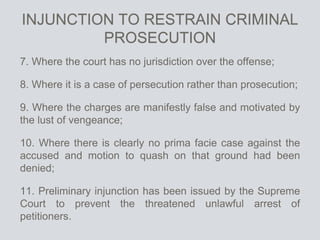
7. Where the court has no jurisdiction over the offense;
8. Where it is a case of persecution rather than prosecution;
9. Where the charges are manifestly false and motivated by
the lust of vengeance;
10. Where there is clearly no prima facie case against the
accused and motion to quash on that ground had been
denied;
11. Preliminary injunction has been issued by the Supreme
Court to prevent the threatened unlawful arrest of
petitioners.
WHO MUST PROSECUTE THE
CRIMINAL ACTIONS?
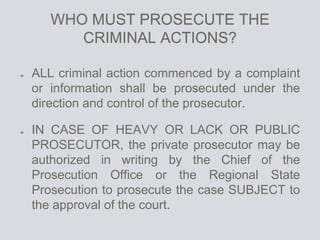
ALL criminal action commenced by a complaint
or information shall be prosecuted under the
direction and control of the prosecutor.
IN CASE OF HEAVY OR LACK OR PUBLIC
PROSECUTOR, the private prosecutor may be
authorized in writing by the Chief of the
Prosecution Office or the Regional State
Prosecution to prosecute the case SUBJECT to
the approval of the court.
WHO MUST PROSECUTE THE
CRIMINAL ACTIONS?
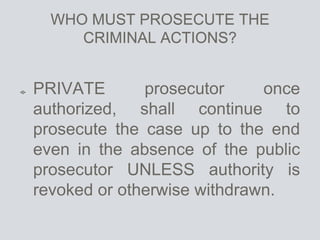
PRIVATE prosecutor once
authorized, shall continue to
prosecute the case up to the end
even in the absence of the public
prosecutor UNLESS authority is
revoked or otherwise withdrawn.
WHO MUST PROSECUTE THE
CRIMINAL ACTIONS?
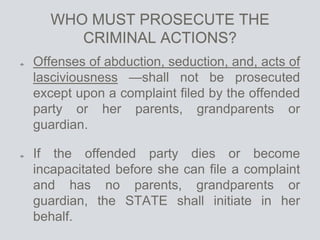
Offenses of abduction, seduction, and, acts of
lasciviousness —shall not be prosecuted
except upon a complaint filed by the offended
party or her parents, grandparents or
guardian.
If the offended party dies or become
incapacitated before she can file a complaint
and has no parents, grandparents or
guardian, the STATE shall initiate in her
behalf.
WHO MUST PROSECUTE THE
CRIMINAL ACTIONS?
Offended party is a MINOR—has the right to
initiate the prosecution of the offense
independently of her parents, grandparents,
or guardian UNLESS she is incompetent or
incapable of doing so.
The parent, grandparents, or guardian is an
exclusive of all persons and shall be exercise
successively.
SUFFICIENCY OF COMPLAINT OR
INFORMATION
It must state:
1. The name of the accused;
2. The designation of the offense given by the
statute;
3. The acts or omission complained of as constituting
the offense;
4. The name of the offended party;
5. The approximate date of the commission of the
offense;
6. The place where the offense was committed
CAUSE OF ACCUSATION
The acts or omissions complained of
as constituting the offense and the
qualifying and aggravating
circumstances must be stated in
ordinary and concise language not
necessarily in the language used in
the statute for the court to pronounce
judgment.
DUPLICITY OF AN OFFENSE
A complaint or information must
charge only one offense EXCEPT
when the law prescribes a single
punishment for a various offenses.
PROSECUTOR’S 2 FOLD
TASK
PROSECUTOR HAS THE CONTROL OF PROSECUTION
1. To prove that the crime has been committed
2. That the accused is the person responsible
therefor.
It must be able to overcome the constitutional
presumption of innocence with evidence
beyond reasonable doubt to justify the
conviction of the accused.
PROSECUTOR HAS THE CONTROL
OF PROSECUTION
The state is the offended party of a criminal
case.
It must be prosecuted under the control and
guidance of the State through the government
prosecutor.
Acquittal and dismissal: when the private
complainant intends to question the judgment,
APPEAL will be represented by the SOLICITOR
GENERAL only.
SOLICITOR GENERAL
In APPEALED cases, only the Solicitor General
may bring or defend action on behalf of the People
once such action is brought to the Court of
Appeals or to the Supreme Court.
As the official in control of criminal cases before
the appellate courts, he may abandon or
discontinue the prosecution case in the exercise of
his sound discretion.
May even recommend acquittal of an accused
when he believes the evidence does not warrant
conviction.
CRIMES WHICH CANNOT BE
PROSECUTED “DE OFFICIO”
Art. 344-Prosecution of crimes of adultery,
concubinage, and acts of lasciviousness (rape is
already a crime against person)
Adultery and concubinage shall not be
prosecuted EXCEPT upon a complaint filed by
the offended spouse.
Offended party cannot institute criminal
prosecution without including BOTH guilty
parties.
JURISDICTION DEFINED
Derived from the 2 latin words “juris"and
“dico”(I speak by the law).
It is the authority to hear and determine a
cause of action. (Herrera vs Barreto)
It is the right that put the wheel of justice in
motion and to proceed to the final
determination of the cause upon the pleadings
and evidence. (PP vs Mariano, supra)
CRIMINAL JURISDICTION
is the authority of the court to hear and try
a particular offense and to impose the
punishment provided by law.
2 inquiries:
1. Has jurisdiction over the offense by virtue
of the imposable penalty and its nature,
2. Filed within the territorial jurisdiction.
2 INQUIRIES OF JURISDICTION
1. Once jurisdiction is acquitted by the court in
which the information is filed, it is there
retained regardless of whether the evidence
proves a lesser offense than that charged in
the information.
GENERAL RULE: Jurisdiction of a court is
determined by the law at the time at the time
of the institution of the action.
EXCEPTION TO THE GENERAL RULE
Where the statute expressly provides,
or is construed that it is intended to
operate to actions pending before its
enactment, which the court where the
criminal actions pending is ousted of
jurisdiction and pending action will have
to be transferred to other court.
JURISDICTION
2.Venue-or the place where the case is to be
tried, which is jurisdictional in criminal cases.
Venue of criminal cases is essential element
of jurisdiction, which requires the action
instituted and tried in the municipality or
territory where the offense has been
committed or the essential ingredients took
place.
JURISDICTION IS DETERMINED
In criminal cases, the complaint or information must
be examined to determined the allegations and not
by the findings of the court may make after the trial.
EXAMPLE:
The prosecution of Kidnapping with murder
alleged that took place in Dapitan City but the
evidence showed that the victim was killed in
Ozamis City, the court of Dapitan City where the
information was filed has the jurisdiction over the
case.
ESTOPPEL AND LACHES TO DENY
JURISDICTION
GENERAL RULE: “Question of
jurisdiction may be raised at any stage of
the proceedings.”
EXCEPTION: Question may not be
raised for the first time in the on appeal,
where there has been estoppel and
laches on the party who raised the
question.
ESTOPPEL AND LACHES TO DENY
JURISDICTION
Adverse party failed at several stages of the
proceedings to raised it ONLY after the Court of
Appeals had rendered an adverse decision for
lack of jurisdiction.
Where the accused had pursued vigorously the
case in the lower court, on the supposition that it
had jurisdiction, and had asked it rendered
judgment of acquittal, he cannot later on
rightfully claim that the court lacked jurisdiction.
TYPES OF JURISDICTION
1. JURISDICTION OVER THE SUBJECT
MATTER—meant the nature of the cause
of action and of the relief sought, and this
is conferred by the sovereign authority
which organizes the court and is to be
sought specially conferred.
• Conferred by law not of the parties.
TYPES OF JURISDICTION
2. JURISDICTION OVER THE
TERRITORY— criminal cases is
jurisdictional. (Regpala vs Tubod)
• Hence, criminal action shall be instituted and
tried in the court of the municipality or
province wherein the offense was committed
or where any of its essential ingredients took
place (Sec. 15, Rule 110)
TYPES OF JURISDICTION
• One cannot be held to answer for any
crime EXCEPT in the jurisdiction where it
was committed. (Hernandez vs Albano/ PP
vs Mercado)—the purpose not to compel
defendant to move and appear in court
different from that province it was
committed as it would cause great
inconvenience. (Beltran vs Ramos)
TYPES OF JURISDICTION
3. JURISDICTION OVER CONTINUING
CRIMES—there should be plurality of the acts
performed separately during the period of tie,
unity of penal provision infringed upon or
violated, and the unity of the intent or purpose
which means that the two or more violations of
the same penal provision are united in one at
the same intent leading to the perpetrator of
the same criminal purpose or aim. (PP vs
Zapata and Bondoc)
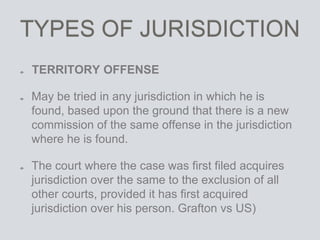
TYPES OF JURISDICTION
TERRITORY OFFENSE
May be tried in any jurisdiction in which he is
found, based upon the ground that there is a new
commission of the same offense in the jurisdiction
where he is found.
The court where the case was first filed acquires
jurisdiction over the same to the exclusion of all
other courts, provided it has first acquired
jurisdiction over his person. Grafton vs US)
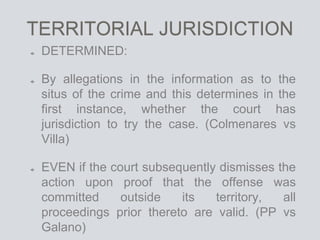
TERRITORIAL JURISDICTION
DETERMINED:
By allegations in the information as to the
situs of the crime and this determines in the
first instance, whether the court has
jurisdiction to try the case. (Colmenares vs
Villa)
EVEN if the court subsequently dismisses the
action upon proof that the offense was
committed outside its territory, all
proceedings prior thereto are valid. (PP vs
Galano)
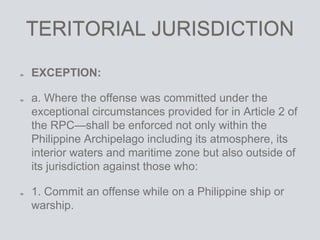
TERITORIAL JURISDICTION
EXCEPTION:
a. Where the offense was committed under the
exceptional circumstances provided for in Article 2 of
the RPC—shall be enforced not only within the
Philippine Archipelago including its atmosphere, its
interior waters and maritime zone but also outside of
its jurisdiction against those who:
1. Commit an offense while on a Philippine ship or
warship.
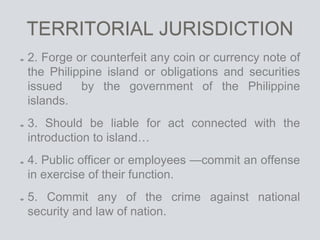
TERRITORIAL JURISDICTION
2. Forge or counterfeit any coin or currency note of
the Philippine island or obligations and securities
issued by the government of the Philippine
islands.
3. Should be liable for act connected with the
introduction to island…
4. Public officer or employees —commit an offense
in exercise of their function.
5. Commit any of the crime against national
security and law of nation.
TERRITORIAL JURISDICTION
EXCEPTION:
b. Piracy
c. Crimes committed on railroad, train,
aircraft, or any other public or private
vehicle while in the course of its trip (any
man.or territory where it passes including
the departure and arrival)
d. Committed on board of a vessel in the
course of its voyage
COURT JURISDICTION
ON
CRIMINAL CASES
SUPREME COURT JURISDICTION
SUMMARY
1. ORIGINAL JURISDICTION over cases involving ambassadors, other public
ministers, and consuls; petitions for certiorari, prohibition, mandamus quo warrants
and habeas corpus (concurrent with RTC)
2. REVIEW, REVISE, MODIFY,OR AFFIRM ON APPEAL OR CERTIORARI, FINAL
JUDGMENTS OF LOWER COURTS in cases which the constitutionality or validity
of any treaty, international or executive agreement, law, decree, proclamation,
order, instruction, ordinance or regulation is in question
3. Cases involving the legality of any tax, impost, assessment, or tool, or penalty
imposed thereto :
A. Cases involving jurisdiction of lower courts
B. All criminal cases in which the penalty is reclusion perpetual or higher
C. All cases in which only an error or question of law is involved.
CA JURISDICTION SUMMARY
1. ORIGINAL JURISDICTION to issue writs of
mandamus, prohibition, certiorari, habeas
corpus, and quo warrants, and auxiliary writs or
processes, whether or not in aid of its appellate
jurisdiction (concurrent with the SC and RTCs)
2. EXCLUSIVE ORIGINAL JURISDICTION over
actions for annulment of judgment of RTCs.
CA JURISDICTION SUMMARY
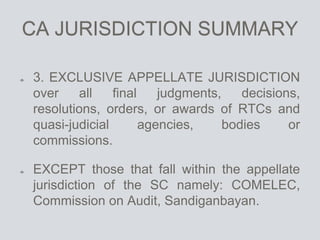
3. EXCLUSIVE APPELLATE JURISDICTION
over all final judgments, decisions,
resolutions, orders, or awards of RTCs and
quasi-judicial agencies, bodies or
commissions.
EXCEPT those that fall within the appellate
jurisdiction of the SC namely: COMELEC,
Commission on Audit, Sandiganbayan.
REGIONAL TRIAL COURT
JURISDICTION SUMMARY
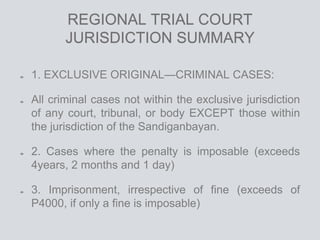
1. EXCLUSIVE ORIGINAL—CRIMINAL CASES:
All criminal cases not within the exclusive jurisdiction
of any court, tribunal, or body EXCEPT those within
the jurisdiction of the Sandiganbayan.
2. Cases where the penalty is imposable (exceeds
4years, 2 months and 1 day)
3. Imprisonment, irrespective of fine (exceeds of
P4000, if only a fine is imposable)
REGIONAL TRIAL COURT
JURISDICTION SUMMARY
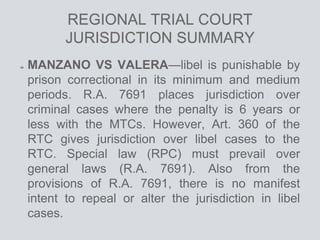
MANZANO VS VALERA—libel is punishable by
prison correctional in its minimum and medium
periods. R.A. 7691 places jurisdiction over
criminal cases where the penalty is 6 years or
less with the MTCs. However, Art. 360 of the
RTC gives jurisdiction over libel cases to the
RTC. Special law (RPC) must prevail over
general laws (R.A. 7691). Also from the
provisions of R.A. 7691, there is no manifest
intent to repeal or alter the jurisdiction in libel
cases.
REGIONAL TRIAL COURT
JURISDICTION SUMMARY
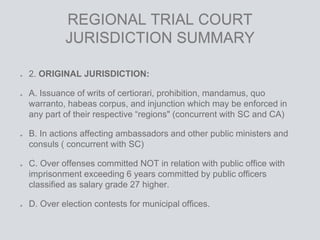
2. ORIGINAL JURISDICTION:
A. Issuance of writs of certiorari, prohibition, mandamus, quo
warranto, habeas corpus, and injunction which may be enforced in
any part of their respective “regions" (concurrent with SC and CA)
B. In actions affecting ambassadors and other public ministers and
consuls ( concurrent with SC)
C. Over offenses committed NOT in relation with public office with
imprisonment exceeding 6 years committed by public officers
classified as salary grade 27 higher.
D. Over election contests for municipal offices.
REGIONAL TRIAL COURT
JURISDICTION SUMMARY
3. APPELLATE JURISDICTION:
A. All cases decided by lower courts (MTCs)
in their respective territorial jurisdictions.
NOTE: no trial de vono, cases are decided
on the basis of decision and supporting
affidavits.
FAMILY COURT (R.A. 8369)
JURISDICTION SUMMARY
EXCLUSIVE ORIGINAL JURISDICTION:
1. One or more accused is below 18 years of age but not less
than 9 years of age;
2. One or more victims is a minor at the time of the commission
of the offense.
PROVIDED, that the minor is found guilty, the court shall
promulgate sentence and ascertain any civil liability which the
accused may have incurred. The sentence however shall be
suspended without the need of application pursuant to the
“Child and Youth Welfare Act”.
FAMILY COURT (R.A.8369)
JURISDICTION SUMMARY
2. Cases against minor cognizable under
the Dangerous Drug Act, as amended;
3. Violation of R.A. No. 7610, otherwise
known as “Special Protection of Children
Against Child Abuse, Exploitation and
Discrimination Act”, as amended by R.A.
7658 and;
FAMILY COURT (R.A.8369)
JURISDICTION SUMMARY
CASES OF DOMESTIC VIOLENCE AGAINST:
A. WOMEN
à Acts of gender based violence that results, or
are likely to result in physical, sexual or
psychological harm or suffering to women; and
other forms of physical abuse such as battering
or threats and coercion which violate a woman's
personhood, integrity and freedom of movement;
AND
FAMILY COURT (R.A.8369)
JURISDICTION SUMMARY
B. CHILDREN
à Includes the commission of all
forms of abuse, neglect, cruelty,
exploitation, violence, and
discrimination and all other conditions
prejudicial to their development.
FAMILY COURT (R.A.8369)
JURISDICTION SUMMARY
If an act constitutes a criminal offense, the accused
shall be subject to criminal proceedings and the
corresponding penalties.
If any question involving any of the above matters
should arise as an incident in any case pending in
the regular courts, said incident shall be determined
in that court.
Decisions and orders of the court shall be appealed
in the same manner and subject to the same
conditions as appeals from the ordinary Regional
Trial Courts.
MUNICIPAL TRIAL COURT
JURISDICTION
Violations of city or municipal ordinances.
All offenses punishable with not more than 4
years 2 months 1 day imprisonment,
irrespective of fine.
All offenses punishable by only a fine of not
more than P4,000.
Offenses involving damage to property
through criminal negligence.
SANDIGANBAYAN JURISDICTION
SUMMARY
Exclusive original jurisdiction
of offenses committed in
relation to public office.
COURT MARTIAL JURISDICTION
Offenses committed by the
members of the Armed Forces of
the Philippines and other persons
subject to military law, if such
offense are “service connected”are
those expressly enumerated in
R.A. No. 7055 otherwise falls in
regular courts.
SUMMARY PROCEDURE
MTC
Violation of traffic laws, rules, regulations
Violation of rental laws
Violations of city or municipality ordinances
All other criminal cases where the penalty does not
exceed 6 months or a fine of P1000 or both,
irrespective of other imposable penalties or of the
amount of civil liability
Damage to property through criminal negligence
where the fine does not exceed P10,000.
THANK YOU FOR READING
CHELDHAYE

Criminal procedure simplified

  • 1.
    CRIMINAL PROCEDURE PROSECUTION OF OFFENSE BY:CHELDY SYGACO ELUMBA- PABLEO,MPA,LLB
  • 2.
    RULES OF CRIMINALPROCEDURE Substantially revised and the Revised Rules of Criminal Procedure - approved by the Supreme Court, in A.M. No. 00-5-03- SC, effective December 1, 2000. It is liberally construed in order to promote JUST, SPEEDY and INEXPENSIVE disposition of the case.
  • 3.
    CRIMINAL PROCEDURE A proceduralsteps through criminal cases found in Rule 110-127 of the Revised Rules on Criminal Procedure and the 1987 Constitution of the Philippines.
  • 4.
    DISTICTION CRIMINAL LAW— substantive.It defines crimes, treats of their nature and provides for their punishment. CRIMINAL PROCEDURE—remedial law. Provides method by which a person accused of a crime is arrested, tried and punished.
  • 5.
    CRIMINAL ACTION It isone by which the State prosecutes a person for AN ACT or OMISSION punishable by law.
  • 6.
    INSTITUTION OF CRIMINALOFFENSE OFFENSES FOR PRELIMINARY INVESTIGATION: file the complaint with the proper officer for the purpose of conducting PI. ALL OTHER OFFENSES: file the complaint or information directly with the Municipal Trial Courts and Municipal Circuit Trial Courts or the Office of the Prosecutor.
  • 7.
    COMPLAINT OR INFORMATION Thecomplaint or information shall be in writing, in the name of the People of the Philippines and against all persons who appear to be responsible for the offense involved.
  • 8.
    COMPLAINT/INFORMATION DEFINED COMPLAINT—It isa sworn statement charging a person with the offense, subscribed by the offended party, any peace officer, or other public officer charged with the enforcement of the law. INFORMATION—an accusation in writing charging a person with an offense subscribed by the prosecutor and filed with the court.
  • 9.
    SYSTEM OF CRIMINALPROCEDURE 1. INQUISITORIAL— legal system where courts or part of the court is actively involved in investigating the facts of the case. Judges tend to be free to make decisions on a case-to-case basis.
  • 10.
    SYSTEM OF CRIMINALPROCEDURE 2. ACCUSATORIAL/ADVERSARIAL— where the role of the court is primarily that of an imperial referee between the prosecution and the defense. Previous decisions made by higher courts forms a precedent which will bind the lower courts.
  • 11.
    INSTITUTION OF CRIMINALACTION INTERRUPTS PRESCRIPTIVE PERIOD GENERAL RULE: the filing of the complaint for an offense which carries the penalty of at least 4 years, 2 months and 1 day without regard to a fine, with the office of the proper officer authorized to conduct preliminary investigation interrupts the prescriptive period of the offense charge.
  • 12.
    INSTITUTION OF CRIMINALACTION INTERRUPTS PRESCRIPTIVE PERIOD EXCEPTION: when a special laws provide otherwise. Act No. 3323 governs the prescriptive periods of violations of special laws, or offenses other than those penalized under the Revised Penal Code. Filing of a criminal complaint with the Office of the Ombudsman also interrupts the prescription of period of crimes.
  • 13.
    CRIMINAL PROSECUTION MAYNOT BE RESTRAINED GENERAL RULE: Injunction will not be granted to restrain criminal prosecution applies with more reason when the case is still at the preliminary investigation stage. May not be restrained through a preliminary or final injunction or a writ of prohibition, except the case falls under the exception of the case. Courts cannot interfere with the discretion of the prosecutor or the Ombudsman to determine the specificity and adequacy of the averments of the offense charge.
  • 14.
    INJUNCTION TO RESTRAINCRIMINAL PROSECUTION EXCEPTION to the general rule: (prosecution may issue in the following instances) 1. Where the injunction is justified by the necessity to afford protection to the constitutional rights of the accused; 2. When necessary for the orderly administration of justice or to avoid oppression or multiplicity of action;
  • 15.
    INJUNCTION TO RESTRAINCRIMINAL PROSECUTION 3. When there is a prejudicial question which is sub judice ( “under judgment” or question of law); 4. When the acts of the officer are without or in excess of authority; 5. Where the prosecution is under an invalid law, ordinance, or regulation; 6. When double jeopardy is apparent;
  • 16.
    INJUNCTION TO RESTRAINCRIMINAL PROSECUTION 7. Where the court has no jurisdiction over the offense; 8. Where it is a case of persecution rather than prosecution; 9. Where the charges are manifestly false and motivated by the lust of vengeance; 10. Where there is clearly no prima facie case against the accused and motion to quash on that ground had been denied; 11. Preliminary injunction has been issued by the Supreme Court to prevent the threatened unlawful arrest of petitioners.
  • 17.
    WHO MUST PROSECUTETHE CRIMINAL ACTIONS? ALL criminal action commenced by a complaint or information shall be prosecuted under the direction and control of the prosecutor. IN CASE OF HEAVY OR LACK OR PUBLIC PROSECUTOR, the private prosecutor may be authorized in writing by the Chief of the Prosecution Office or the Regional State Prosecution to prosecute the case SUBJECT to the approval of the court.
  • 18.
    WHO MUST PROSECUTETHE CRIMINAL ACTIONS? PRIVATE prosecutor once authorized, shall continue to prosecute the case up to the end even in the absence of the public prosecutor UNLESS authority is revoked or otherwise withdrawn.
  • 19.
    WHO MUST PROSECUTETHE CRIMINAL ACTIONS? Offenses of abduction, seduction, and, acts of lasciviousness —shall not be prosecuted except upon a complaint filed by the offended party or her parents, grandparents or guardian. If the offended party dies or become incapacitated before she can file a complaint and has no parents, grandparents or guardian, the STATE shall initiate in her behalf.
  • 20.
    WHO MUST PROSECUTETHE CRIMINAL ACTIONS? Offended party is a MINOR—has the right to initiate the prosecution of the offense independently of her parents, grandparents, or guardian UNLESS she is incompetent or incapable of doing so. The parent, grandparents, or guardian is an exclusive of all persons and shall be exercise successively.
  • 21.
    SUFFICIENCY OF COMPLAINTOR INFORMATION It must state: 1. The name of the accused; 2. The designation of the offense given by the statute; 3. The acts or omission complained of as constituting the offense; 4. The name of the offended party; 5. The approximate date of the commission of the offense; 6. The place where the offense was committed
  • 22.
    CAUSE OF ACCUSATION Theacts or omissions complained of as constituting the offense and the qualifying and aggravating circumstances must be stated in ordinary and concise language not necessarily in the language used in the statute for the court to pronounce judgment.
  • 23.
    DUPLICITY OF ANOFFENSE A complaint or information must charge only one offense EXCEPT when the law prescribes a single punishment for a various offenses.
  • 24.
    PROSECUTOR’S 2 FOLD TASK PROSECUTORHAS THE CONTROL OF PROSECUTION 1. To prove that the crime has been committed 2. That the accused is the person responsible therefor. It must be able to overcome the constitutional presumption of innocence with evidence beyond reasonable doubt to justify the conviction of the accused.
  • 25.
    PROSECUTOR HAS THECONTROL OF PROSECUTION The state is the offended party of a criminal case. It must be prosecuted under the control and guidance of the State through the government prosecutor. Acquittal and dismissal: when the private complainant intends to question the judgment, APPEAL will be represented by the SOLICITOR GENERAL only.
  • 26.
    SOLICITOR GENERAL In APPEALEDcases, only the Solicitor General may bring or defend action on behalf of the People once such action is brought to the Court of Appeals or to the Supreme Court. As the official in control of criminal cases before the appellate courts, he may abandon or discontinue the prosecution case in the exercise of his sound discretion. May even recommend acquittal of an accused when he believes the evidence does not warrant conviction.
  • 27.
    CRIMES WHICH CANNOTBE PROSECUTED “DE OFFICIO” Art. 344-Prosecution of crimes of adultery, concubinage, and acts of lasciviousness (rape is already a crime against person) Adultery and concubinage shall not be prosecuted EXCEPT upon a complaint filed by the offended spouse. Offended party cannot institute criminal prosecution without including BOTH guilty parties.
  • 28.
    JURISDICTION DEFINED Derived fromthe 2 latin words “juris"and “dico”(I speak by the law). It is the authority to hear and determine a cause of action. (Herrera vs Barreto) It is the right that put the wheel of justice in motion and to proceed to the final determination of the cause upon the pleadings and evidence. (PP vs Mariano, supra)
  • 29.
    CRIMINAL JURISDICTION is theauthority of the court to hear and try a particular offense and to impose the punishment provided by law. 2 inquiries: 1. Has jurisdiction over the offense by virtue of the imposable penalty and its nature, 2. Filed within the territorial jurisdiction.
  • 30.
    2 INQUIRIES OFJURISDICTION 1. Once jurisdiction is acquitted by the court in which the information is filed, it is there retained regardless of whether the evidence proves a lesser offense than that charged in the information. GENERAL RULE: Jurisdiction of a court is determined by the law at the time at the time of the institution of the action.
  • 31.
    EXCEPTION TO THEGENERAL RULE Where the statute expressly provides, or is construed that it is intended to operate to actions pending before its enactment, which the court where the criminal actions pending is ousted of jurisdiction and pending action will have to be transferred to other court.
  • 32.
    JURISDICTION 2.Venue-or the placewhere the case is to be tried, which is jurisdictional in criminal cases. Venue of criminal cases is essential element of jurisdiction, which requires the action instituted and tried in the municipality or territory where the offense has been committed or the essential ingredients took place.
  • 33.
    JURISDICTION IS DETERMINED Incriminal cases, the complaint or information must be examined to determined the allegations and not by the findings of the court may make after the trial. EXAMPLE: The prosecution of Kidnapping with murder alleged that took place in Dapitan City but the evidence showed that the victim was killed in Ozamis City, the court of Dapitan City where the information was filed has the jurisdiction over the case.
  • 34.
    ESTOPPEL AND LACHESTO DENY JURISDICTION GENERAL RULE: “Question of jurisdiction may be raised at any stage of the proceedings.” EXCEPTION: Question may not be raised for the first time in the on appeal, where there has been estoppel and laches on the party who raised the question.
  • 35.
    ESTOPPEL AND LACHESTO DENY JURISDICTION Adverse party failed at several stages of the proceedings to raised it ONLY after the Court of Appeals had rendered an adverse decision for lack of jurisdiction. Where the accused had pursued vigorously the case in the lower court, on the supposition that it had jurisdiction, and had asked it rendered judgment of acquittal, he cannot later on rightfully claim that the court lacked jurisdiction.
  • 36.
    TYPES OF JURISDICTION 1.JURISDICTION OVER THE SUBJECT MATTER—meant the nature of the cause of action and of the relief sought, and this is conferred by the sovereign authority which organizes the court and is to be sought specially conferred. • Conferred by law not of the parties.
  • 37.
    TYPES OF JURISDICTION 2.JURISDICTION OVER THE TERRITORY— criminal cases is jurisdictional. (Regpala vs Tubod) • Hence, criminal action shall be instituted and tried in the court of the municipality or province wherein the offense was committed or where any of its essential ingredients took place (Sec. 15, Rule 110)
  • 38.
    TYPES OF JURISDICTION •One cannot be held to answer for any crime EXCEPT in the jurisdiction where it was committed. (Hernandez vs Albano/ PP vs Mercado)—the purpose not to compel defendant to move and appear in court different from that province it was committed as it would cause great inconvenience. (Beltran vs Ramos)
  • 39.
    TYPES OF JURISDICTION 3.JURISDICTION OVER CONTINUING CRIMES—there should be plurality of the acts performed separately during the period of tie, unity of penal provision infringed upon or violated, and the unity of the intent or purpose which means that the two or more violations of the same penal provision are united in one at the same intent leading to the perpetrator of the same criminal purpose or aim. (PP vs Zapata and Bondoc)
  • 40.
    TYPES OF JURISDICTION TERRITORYOFFENSE May be tried in any jurisdiction in which he is found, based upon the ground that there is a new commission of the same offense in the jurisdiction where he is found. The court where the case was first filed acquires jurisdiction over the same to the exclusion of all other courts, provided it has first acquired jurisdiction over his person. Grafton vs US)
  • 41.
    TERRITORIAL JURISDICTION DETERMINED: By allegationsin the information as to the situs of the crime and this determines in the first instance, whether the court has jurisdiction to try the case. (Colmenares vs Villa) EVEN if the court subsequently dismisses the action upon proof that the offense was committed outside its territory, all proceedings prior thereto are valid. (PP vs Galano)
  • 42.
    TERITORIAL JURISDICTION EXCEPTION: a. Wherethe offense was committed under the exceptional circumstances provided for in Article 2 of the RPC—shall be enforced not only within the Philippine Archipelago including its atmosphere, its interior waters and maritime zone but also outside of its jurisdiction against those who: 1. Commit an offense while on a Philippine ship or warship.
  • 43.
    TERRITORIAL JURISDICTION 2. Forgeor counterfeit any coin or currency note of the Philippine island or obligations and securities issued by the government of the Philippine islands. 3. Should be liable for act connected with the introduction to island… 4. Public officer or employees —commit an offense in exercise of their function. 5. Commit any of the crime against national security and law of nation.
  • 44.
    TERRITORIAL JURISDICTION EXCEPTION: b. Piracy c.Crimes committed on railroad, train, aircraft, or any other public or private vehicle while in the course of its trip (any man.or territory where it passes including the departure and arrival) d. Committed on board of a vessel in the course of its voyage
  • 45.
  • 46.
    SUPREME COURT JURISDICTION SUMMARY 1.ORIGINAL JURISDICTION over cases involving ambassadors, other public ministers, and consuls; petitions for certiorari, prohibition, mandamus quo warrants and habeas corpus (concurrent with RTC) 2. REVIEW, REVISE, MODIFY,OR AFFIRM ON APPEAL OR CERTIORARI, FINAL JUDGMENTS OF LOWER COURTS in cases which the constitutionality or validity of any treaty, international or executive agreement, law, decree, proclamation, order, instruction, ordinance or regulation is in question 3. Cases involving the legality of any tax, impost, assessment, or tool, or penalty imposed thereto : A. Cases involving jurisdiction of lower courts B. All criminal cases in which the penalty is reclusion perpetual or higher C. All cases in which only an error or question of law is involved.
  • 47.
    CA JURISDICTION SUMMARY 1.ORIGINAL JURISDICTION to issue writs of mandamus, prohibition, certiorari, habeas corpus, and quo warrants, and auxiliary writs or processes, whether or not in aid of its appellate jurisdiction (concurrent with the SC and RTCs) 2. EXCLUSIVE ORIGINAL JURISDICTION over actions for annulment of judgment of RTCs.
  • 48.
    CA JURISDICTION SUMMARY 3.EXCLUSIVE APPELLATE JURISDICTION over all final judgments, decisions, resolutions, orders, or awards of RTCs and quasi-judicial agencies, bodies or commissions. EXCEPT those that fall within the appellate jurisdiction of the SC namely: COMELEC, Commission on Audit, Sandiganbayan.
  • 49.
    REGIONAL TRIAL COURT JURISDICTIONSUMMARY 1. EXCLUSIVE ORIGINAL—CRIMINAL CASES: All criminal cases not within the exclusive jurisdiction of any court, tribunal, or body EXCEPT those within the jurisdiction of the Sandiganbayan. 2. Cases where the penalty is imposable (exceeds 4years, 2 months and 1 day) 3. Imprisonment, irrespective of fine (exceeds of P4000, if only a fine is imposable)
  • 50.
    REGIONAL TRIAL COURT JURISDICTIONSUMMARY MANZANO VS VALERA—libel is punishable by prison correctional in its minimum and medium periods. R.A. 7691 places jurisdiction over criminal cases where the penalty is 6 years or less with the MTCs. However, Art. 360 of the RTC gives jurisdiction over libel cases to the RTC. Special law (RPC) must prevail over general laws (R.A. 7691). Also from the provisions of R.A. 7691, there is no manifest intent to repeal or alter the jurisdiction in libel cases.
  • 51.
    REGIONAL TRIAL COURT JURISDICTIONSUMMARY 2. ORIGINAL JURISDICTION: A. Issuance of writs of certiorari, prohibition, mandamus, quo warranto, habeas corpus, and injunction which may be enforced in any part of their respective “regions" (concurrent with SC and CA) B. In actions affecting ambassadors and other public ministers and consuls ( concurrent with SC) C. Over offenses committed NOT in relation with public office with imprisonment exceeding 6 years committed by public officers classified as salary grade 27 higher. D. Over election contests for municipal offices.
  • 52.
    REGIONAL TRIAL COURT JURISDICTIONSUMMARY 3. APPELLATE JURISDICTION: A. All cases decided by lower courts (MTCs) in their respective territorial jurisdictions. NOTE: no trial de vono, cases are decided on the basis of decision and supporting affidavits.
  • 53.
    FAMILY COURT (R.A.8369) JURISDICTION SUMMARY EXCLUSIVE ORIGINAL JURISDICTION: 1. One or more accused is below 18 years of age but not less than 9 years of age; 2. One or more victims is a minor at the time of the commission of the offense. PROVIDED, that the minor is found guilty, the court shall promulgate sentence and ascertain any civil liability which the accused may have incurred. The sentence however shall be suspended without the need of application pursuant to the “Child and Youth Welfare Act”.
  • 54.
    FAMILY COURT (R.A.8369) JURISDICTIONSUMMARY 2. Cases against minor cognizable under the Dangerous Drug Act, as amended; 3. Violation of R.A. No. 7610, otherwise known as “Special Protection of Children Against Child Abuse, Exploitation and Discrimination Act”, as amended by R.A. 7658 and;
  • 55.
    FAMILY COURT (R.A.8369) JURISDICTIONSUMMARY CASES OF DOMESTIC VIOLENCE AGAINST: A. WOMEN à Acts of gender based violence that results, or are likely to result in physical, sexual or psychological harm or suffering to women; and other forms of physical abuse such as battering or threats and coercion which violate a woman's personhood, integrity and freedom of movement; AND
  • 56.
    FAMILY COURT (R.A.8369) JURISDICTIONSUMMARY B. CHILDREN à Includes the commission of all forms of abuse, neglect, cruelty, exploitation, violence, and discrimination and all other conditions prejudicial to their development.
  • 57.
    FAMILY COURT (R.A.8369) JURISDICTIONSUMMARY If an act constitutes a criminal offense, the accused shall be subject to criminal proceedings and the corresponding penalties. If any question involving any of the above matters should arise as an incident in any case pending in the regular courts, said incident shall be determined in that court. Decisions and orders of the court shall be appealed in the same manner and subject to the same conditions as appeals from the ordinary Regional Trial Courts.
  • 58.
    MUNICIPAL TRIAL COURT JURISDICTION Violationsof city or municipal ordinances. All offenses punishable with not more than 4 years 2 months 1 day imprisonment, irrespective of fine. All offenses punishable by only a fine of not more than P4,000. Offenses involving damage to property through criminal negligence.
  • 59.
    SANDIGANBAYAN JURISDICTION SUMMARY Exclusive originaljurisdiction of offenses committed in relation to public office.
  • 60.
    COURT MARTIAL JURISDICTION Offensescommitted by the members of the Armed Forces of the Philippines and other persons subject to military law, if such offense are “service connected”are those expressly enumerated in R.A. No. 7055 otherwise falls in regular courts.
  • 61.
    SUMMARY PROCEDURE MTC Violation oftraffic laws, rules, regulations Violation of rental laws Violations of city or municipality ordinances All other criminal cases where the penalty does not exceed 6 months or a fine of P1000 or both, irrespective of other imposable penalties or of the amount of civil liability Damage to property through criminal negligence where the fine does not exceed P10,000.
  • 62.
    THANK YOU FORREADING CHELDHAYE