08/10/13
Ayubowan
Jayadeva de Silva.
M,Sc,FIPM,FITD
©
© 2006 Thomson-Wadsworth
©Jayadeva de Silva
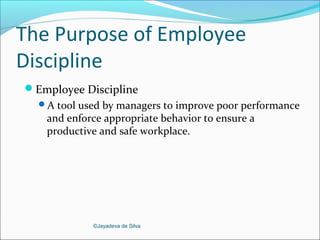
The Purpose of Employee
Discipline
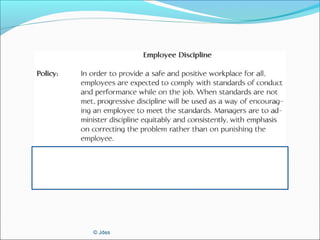
Employee Discipline
A tool used by managers to improve poor performance
and enforce appropriate behavior to ensure a
productive and safe workplace.
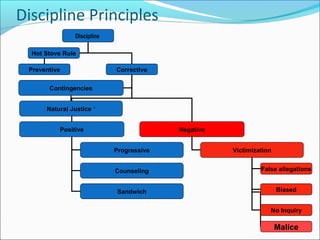
Discipline Principles
Discipline
Preventive Corrective
Positive Negative
Progressive
Sandwich
Counseling
Hot Stove Rule
Contingencies
Victimization
False allegations
Biased
No Inquiry
Natural Justice '
Malice
© humantalents
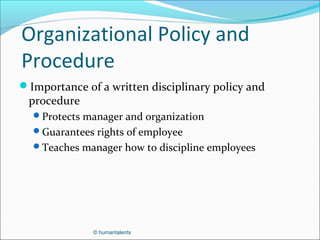
Organizational Policy and
Procedure
Importance of a written disciplinary policy and
procedure
Protects manager and organization
Guarantees rights of employee
Teaches manager how to discipline employees
© Jdes
Disciplinary
Procedure
Jayadeva de Silva
© jdes
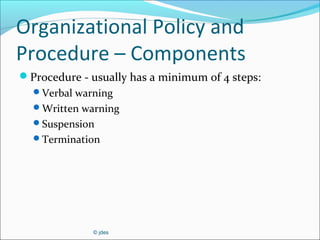
Organizational Policy and
Procedure – Components
Procedure - usually has a minimum of 4 steps:
Verbal warning
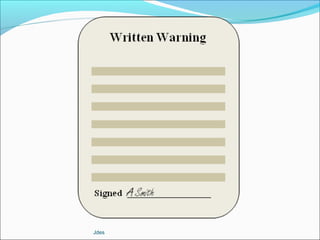
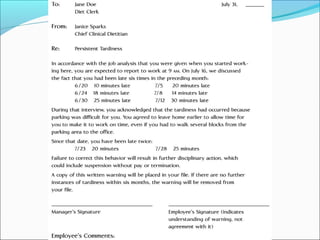
Written warning
Suspension
Termination
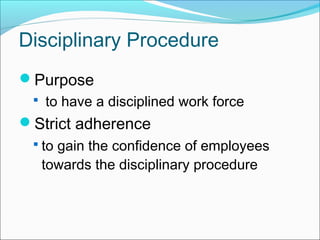
Purpose
 to have a disciplined work force
Strict adherence
 to gain the confidence of employees
towards the disciplinary procedure
Disciplinary Procedure
Why indiscipline?
Ignorance of rules
Physical/ mental incapability
Absence of proper training
Discontented workmen
Misguidance by Trade Union leaders
Absence of standard policies of handling discipline
Uncongenial working conditions
Indiscipline requiring action
Absenteeism
Habitual Late coming
Overstaying leave
Disobeying rules/ standing orders
Insubordination
Misappropriation of funds or valuables
Misconduct
Preliminary Investigation
Show cause / charge sheet
Receipt of explanation
Domestic Inquiry
Findings of the Inquiry Report
Punishments
Subsequent Actions after Termination
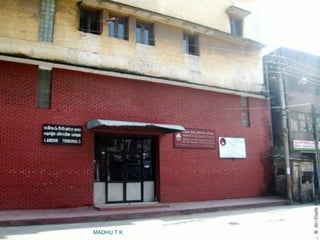
Labour Tribunal
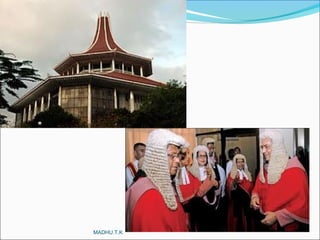
Appeal against the decision of the L.T.
Steps
Preliminary
Investigation
Record a statement of the complainant
Materials and documents connected to the
incident should be removed, sealed and taken to
the custody of the relevant authorized officer
immediately, giving no room to alter
Preliminary Investigation
Record the statements of the witnesses to the
incident
Study fast and gain an idea what exactly has
happened
Record a statement from the suspected
employee/employees as soon as possible
Analyze all these evidence to establish whether
there is any act of misconduct to pursue further
Jdes
A place without disturbances
A reliable person to take down in clear
handwriting
No erasing/tipp-ex
Start with mentioning place date & time
In direct speech
Continuation of the pages and page
numbering
Conclusion
Recording statements
Recording statements with fresh
memories before influences
Identifying witnesses
Facts for better decision to hold an
inquiry or not
Facilititate in preparing counts in
show cause
Advantages of holding a
Preliminary Inquiry
Outcome of the Prelim. Invest.
Prima facie case
Separate counts for each misconduct
Start of the letter
Reply before when (sufficient notice0
State action if no reply receives (ex-parte
inquiry)
Show cause / charge sheet
When the employee is involved in a major
misconduct and the chances are high to prove
such, which warrants termination
Where the presence of the employee in the
work place could seriously affect the inquiry,
specially the possibility of influencing the
witnesses or tampering documents relevant to
the inquiry
Payment during interdiction
Interdiction
Reply to the charges may be
◦ Denying / rejecting all charges
◦ Pleading for mitigatory circumstances
◦ Pleading guilty for all or some charges
◦ Request for further time
◦ No reply at all
Receipt of explanation / no reply
Advantages of holding a domestic
inquiry
 Respect for the principle of natural
justice of giving a reasonable opportunity
to the employee of being heard in his
defense
 Establishing employer’s bona fides at a
subsequent L.T. inquiry
Domestic Inquiry
 Recording all evidences, of which some may not be
able to locate at a later stage (L.T.)
 Recording of all incidents which may not be able to
remember by witnesses at a later stage (L.T.)
 Accused employee will not be able to change his
stand at a later stage
Reasonable notice of the case must be given to
the accused employee.
Reasonable opportunity of being heard in his/her
defense (allowing the accused to defend/present
his side of the case)
Principles of Natural Justice
Independent inquiry officer (not a person
directly involved in the issue)
Inquiry officer to act in reasonably & in good
faith, not arbitrarily and to ensure fair play
BALANCE OF PROBABILITY
What is balance of probability?
MADHU.T.K
Caliber of person
The role of the inquiry officer is to decide whether
charges stated in the charge sheet are proved or
not based on evidence laid before him
Role of the inquiry Officer
The charges should be explained to the
accused and asked whether the accused plead
guilty or not for each count separately
Prosecuting officer to lead evidence-in-chief,
cross examine by defense, re-examine by
prosecution & question by the Inquiry Officer
After finishing witnesses for the prosecution,
evidence-in chief by defense, cross examine by
prosecution, re-examination by defense &
question by the Inquiry Officer for witnesses for
the defense
Inquiry Officer can call any witness again to
clarify any point
Leading questions are not permitted
Written submission may be allowed after
concluding the oral evidence
Prosecuting Officer
Prosecuting/inquiring together
Defense
 Silent observer
 Defending officer
Fellow worker
Branch union official
Parent union Official
Outsider/not a lawyer
Other Roles
Inquiry report
 Decision on each count
 Facts based on for the judgment
 No recommendation for punishment
Punishment
 According to the outcome
 Past record
 Industrial relations aspects
Conclusion of the inquiry
Important Points
MADHU.T.K
©
Charge Sheet
Memorandum of charges
Statement of allegations of misconduct/ omission/
negligence
No particular format prescribed for charge sheet in
any Labour enactment
The object is to give the employee exact idea of the
misconduct committed by him so that he may get
reasonable opportunity to defend.
Requisites of Charge sheet
It should contain complete picture of misconduct
It should state that the act of commission or omission
resulting in misconduct is violation of a particular
clause of standing order
Language to be as per Standing Orders or as required
by the delinquent
Enclose a list of witnesses in support of charges
Be specific
Charges leveled should be specifically stated- avoid ‘
etc..etc’/ ‘ other’/ ‘any’/ ‘ some people’ like
expressions.
The amount misappropriated should be specific sum
and not ‘ around’
Person manhandled should be Mr./Ms. X and not ‘
some one’
Time of misconduct should be exact- avoid ‘around’
time.
Charge sheet for using offending language should
contain the exact word used.
Service of Charge sheet
As stated in the Standing Orders
Serve the charge sheet personally against signature on
the duplicate copy/ delivery book
If absent/ on leave/ under suspension, paste it on the
wall of the residence of the delinquent
By Registered Post
Displaying in the Notice Board of the company
Publishing in the regional newspaper
Domestic Enquiry
Follow rules laid down in Standing Orders
Purpose of domestic enquiry -
Provide delinquent an opportunity to
defend the charges
Provide employer an opportunity to
evaluate the situation and decide the
penalty to be imposed
Notice of Enquiry to be served
Notice to show the Date and Time of enquiry
Venue of holding enquiry
Name of the Enquiry Officer
Notice to be served in the same manner as followed
to serve charge sheet
Workman shall have right to appoint a Defense
Helper
When legally trained person represents
management in enquiry, workman shall also be
allowed to be represented by lawyer (Hindustan
Teleprinters Ltd Vs Mr. Rajan Isaac.)
Recording the Evidences
Question- Answer pattern may be followed
Statement of Management to be taken first
Cross examination by employee/ helper
Take signature of the concerned on record
Examine and cross examine witnesses
Object/ Disallow irrelevant questions
Show Cause Notice
Before punishment is initiated a Show Cause Notice
highlighting the charges, findings of the enquiry and
possible penalty imposed on the delinquent shall also be
served calling on him to show cause ‘why action including
discharge or (even dismissal) shall not be taken against’ the
delinquent.
Though serving of such notice will not make the process of
enquiry invalid (as decided in S. Shenbagaraj Vs
Additional Commissioner of Industries and
Commerce, Chepauk and others.), it is advisable to give
the employee a final opportunity before punishment is
inflicted.
Enquiry report to be furnished to the employee
Order of Punishment
Principles of natural justice to be followed
Order issued without holding a domestic
enquiry or after holding a defective enquiry
will not stand since Labour Court/ Tribunal can
interfere with such order
Some Sample letters
MADHU.T.K
Jdes
© 2006 Thomson-Wadsworth
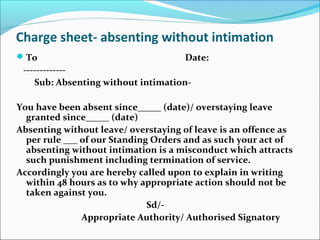
Charge sheet- absenting without intimation
To Date:
-------------
Sub: Absenting without intimation-
You have been absent since_____ (date)/ overstaying leave
granted since_____ (date)
Absenting without leave/ overstaying of leave is an offence as
per rule ___ of our Standing Orders and as such your act of
absenting without intimation is a misconduct which attracts
such punishment including termination of service.
Accordingly you are hereby called upon to explain in writing
within 48 hours as to why appropriate action should not be
taken against you.
Sd/-
Appropriate Authority/ Authorised Signatory
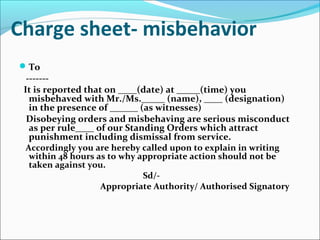
Charge sheet- misbehavior
To
-------
It is reported that on ____(date) at _____(time) you
misbehaved with Mr./Ms._____ (name), ____ (designation)
in the presence of ______ (as witnesses)
Disobeying orders and misbehaving are serious misconduct
as per rule____ of our Standing Orders which attract
punishment including dismissal from service.
Accordingly you are hereby called upon to explain in writing
within 48 hours as to why appropriate action should not be
taken against you.
Sd/-
Appropriate Authority/ Authorised Signatory
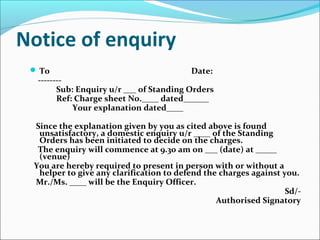
Notice of enquiry
 To Date:
--------
Sub: Enquiry u/r ___ of Standing Orders
Ref: Charge sheet No.____ dated______
Your explanation dated____
Since the explanation given by you as cited above is found
unsatisfactory, a domestic enquiry u/r ____ of the Standing
Orders has been initiated to decide on the charges.
The enquiry will commence at 9.30 am on ___ (date) at _____
(venue)
You are hereby required to present in person with or without a
helper to give any clarification to defend the charges against you.
Mr./Ms. ____ will be the Enquiry Officer.
Sd/-
Authorised Signatory
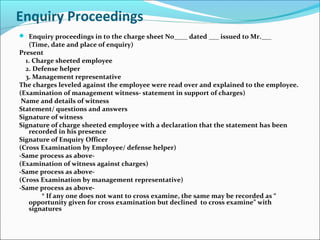
Enquiry Proceedings
 Enquiry proceedings in to the charge sheet No____ dated ___ issued to Mr.___
(Time, date and place of enquiry)
Present
1. Charge sheeted employee
2. Defense helper
3. Management representative
The charges leveled against the employee were read over and explained to the employee.
(Examination of management witness- statement in support of charges)
Name and details of witness
Statement/ questions and answers
Signature of witness
Signature of charge sheeted employee with a declaration that the statement has been
recorded in his presence
Signature of Enquiry Officer
(Cross Examination by Employee/ defense helper)
-Same process as above-
(Examination of witness against charges)
-Same process as above-
(Cross Examination by management representative)
-Same process as above-
* If any one does not want to cross examine, the same may be recorded as “
opportunity given for cross examination but declined to cross examine” with
signatures
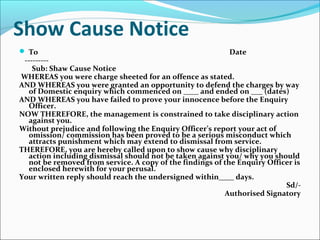
Show Cause Notice
 To Date
---------
Sub: Shaw Cause Notice
WHEREAS you were charge sheeted for an offence as stated.
AND WHEREAS you were granted an opportunity to defend the charges by way
of Domestic enquiry which commenced on ____ and ended on ___ (dates)
AND WHEREAS you have failed to prove your innocence before the Enquiry
Officer.
NOW THEREFORE, the management is constrained to take disciplinary action
against you.
Without prejudice and following the Enquiry Officer’s report your act of
omission/ commission has been proved to be a serious misconduct which
attracts punishment which may extend to dismissal from service.
THEREFORE, you are hereby called upon to show cause why disciplinary
action including dismissal should not be taken against you/ why you should
not be removed from service. A copy of the findings of the Enquiry Officer is
enclosed herewith for your perusal.
Your written reply should reach the undersigned within____ days.
Sd/-
Authorised Signatory
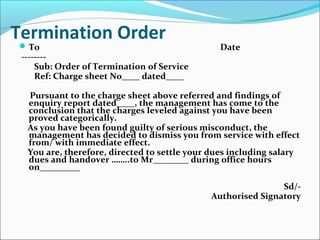
Termination Order
To Date
--------
Sub: Order of Termination of Service
Ref: Charge sheet No____ dated____
Pursuant to the charge sheet above referred and findings of
enquiry report dated____, the management has come to the
conclusion that the charges leveled against you have been
proved categorically.
As you have been found guilty of serious misconduct, the
management has decided to dismiss you from service with effect
from/ with immediate effect.
You are, therefore, directed to settle your dues including salary
dues and handover ……..to Mr________ during office hours
on_________
Sd/-
Authorised Signatory
Jdes
Disciplinary decisions are
challenged through the
Industrial Disputes Act No.
43 of 1950.
MADHU.T.K
Industrial Disputes Act No. 43 of 1950.
An industrial dispute “any dispute or difference between
an employer and an employee or between employers and
employees connected with the employment or non
employment or the terms of employment or with
conditions of labour or the termination of employment or
the reinstatement in employment of any person”
Selection of witnesses &
preparing them for the trial
 Availability of the witness
 Reliability of the witness specially if
the witness is no longer in the
employment
LABOUR TRIBUNAL
MADHU.T.K
 Any possibility of witness is being
approached / influenced by the
applicant
 Ability of the witness to give a strong
answer (the way the evidence were
given at the domestic inquiry)
Secondary Evidence
Appeal against the decision of the
L.T.
MADHU.T.K
K
Question?
Why do we need a
Disciplinary Procedure for an
organization?
MADHU.T.K
Why do we need disciplinary
procedure?
1) To convince a tribunal a third party that the employer
acted in bona fide and that there was no victimization.
2) To show that rules of natural justice had been followed
in arriving at a decision
3) The employee has a right which is stemming from rules of
natural justice that he should be given an opportunity to
be heard.
4) As a means documenting and recording the statements
from the eye witnesses at the preliminary investigation
stage, to document all the evidence of the witnesses at
the domestic inquiry so that witnesses will not
subsequently change their stances.
Why do we need disciplinary
procedure?
5) If it is stipulated by a collective agreement the
employer is expected to follow the same procedure.
6) To see whether there are any mitigatory factors that
we should take in to consideration before
punishment
7) Finally having a good administrative policy is a
form of eradicating employee dissatisfaction.
©
Conclusion
Employee discipline should be used for the
purpose of helping the employee to correct
behavioral or performance problems that have a
negative impact on the workplace.
A disciplinary policy and procedure should be in
place that includes a policy statement, the
purpose for the policy, and a step-by-step
procedure (with specific timelines) for the
process.
©
Conclusion
The usual steps in a disciplinary procedure include
the following disciplinary actions:
Verbal warning
Written warning
Suspension
Termination
©
Conclusion
Managers must use judgment, empathy, consistency,
and fairness when administering employee discipline.
All disciplinary actions should be documented in a
factual, nonjudgmental way.
djayadeva@gmail.com
Jayadeva de Silva
Disciplinary procedure -jdes

Disciplinary procedure -jdes

  • 1.
  • 2.
  • 3.
  • 4.
    ©Jayadeva de Silva ThePurpose of Employee Discipline Employee Discipline A tool used by managers to improve poor performance and enforce appropriate behavior to ensure a productive and safe workplace.
  • 5.
    Discipline Principles Discipline Preventive Corrective PositiveNegative Progressive Sandwich Counseling Hot Stove Rule Contingencies Victimization False allegations Biased No Inquiry Natural Justice ' Malice
  • 6.
    © humantalents Organizational Policyand Procedure Importance of a written disciplinary policy and procedure Protects manager and organization Guarantees rights of employee Teaches manager how to discipline employees
  • 7.
  • 8.
  • 9.
    © jdes Organizational Policyand Procedure – Components Procedure - usually has a minimum of 4 steps: Verbal warning Written warning Suspension Termination
  • 10.
    Purpose  to havea disciplined work force Strict adherence  to gain the confidence of employees towards the disciplinary procedure Disciplinary Procedure
  • 11.
    Why indiscipline? Ignorance ofrules Physical/ mental incapability Absence of proper training Discontented workmen Misguidance by Trade Union leaders Absence of standard policies of handling discipline Uncongenial working conditions
  • 12.
    Indiscipline requiring action Absenteeism HabitualLate coming Overstaying leave Disobeying rules/ standing orders Insubordination Misappropriation of funds or valuables Misconduct
  • 13.
    Preliminary Investigation Show cause/ charge sheet Receipt of explanation Domestic Inquiry Findings of the Inquiry Report Punishments Subsequent Actions after Termination Labour Tribunal Appeal against the decision of the L.T. Steps
  • 14.
  • 15.
    Record a statementof the complainant Materials and documents connected to the incident should be removed, sealed and taken to the custody of the relevant authorized officer immediately, giving no room to alter Preliminary Investigation
  • 16.
    Record the statementsof the witnesses to the incident Study fast and gain an idea what exactly has happened Record a statement from the suspected employee/employees as soon as possible Analyze all these evidence to establish whether there is any act of misconduct to pursue further
  • 17.
  • 18.
    A place withoutdisturbances A reliable person to take down in clear handwriting No erasing/tipp-ex Start with mentioning place date & time In direct speech Continuation of the pages and page numbering Conclusion Recording statements
  • 19.
    Recording statements withfresh memories before influences Identifying witnesses Facts for better decision to hold an inquiry or not Facilititate in preparing counts in show cause Advantages of holding a Preliminary Inquiry
  • 20.
    Outcome of thePrelim. Invest. Prima facie case Separate counts for each misconduct Start of the letter Reply before when (sufficient notice0 State action if no reply receives (ex-parte inquiry) Show cause / charge sheet
  • 21.
    When the employeeis involved in a major misconduct and the chances are high to prove such, which warrants termination Where the presence of the employee in the work place could seriously affect the inquiry, specially the possibility of influencing the witnesses or tampering documents relevant to the inquiry Payment during interdiction Interdiction
  • 22.
    Reply to thecharges may be ◦ Denying / rejecting all charges ◦ Pleading for mitigatory circumstances ◦ Pleading guilty for all or some charges ◦ Request for further time ◦ No reply at all Receipt of explanation / no reply
  • 24.
    Advantages of holdinga domestic inquiry  Respect for the principle of natural justice of giving a reasonable opportunity to the employee of being heard in his defense  Establishing employer’s bona fides at a subsequent L.T. inquiry Domestic Inquiry
  • 25.
     Recording allevidences, of which some may not be able to locate at a later stage (L.T.)  Recording of all incidents which may not be able to remember by witnesses at a later stage (L.T.)  Accused employee will not be able to change his stand at a later stage
  • 26.
    Reasonable notice ofthe case must be given to the accused employee. Reasonable opportunity of being heard in his/her defense (allowing the accused to defend/present his side of the case) Principles of Natural Justice
  • 27.
    Independent inquiry officer(not a person directly involved in the issue) Inquiry officer to act in reasonably & in good faith, not arbitrarily and to ensure fair play BALANCE OF PROBABILITY
  • 28.
    What is balanceof probability? MADHU.T.K
  • 30.
    Caliber of person Therole of the inquiry officer is to decide whether charges stated in the charge sheet are proved or not based on evidence laid before him Role of the inquiry Officer
  • 31.
    The charges shouldbe explained to the accused and asked whether the accused plead guilty or not for each count separately Prosecuting officer to lead evidence-in-chief, cross examine by defense, re-examine by prosecution & question by the Inquiry Officer
  • 32.
    After finishing witnessesfor the prosecution, evidence-in chief by defense, cross examine by prosecution, re-examination by defense & question by the Inquiry Officer for witnesses for the defense Inquiry Officer can call any witness again to clarify any point Leading questions are not permitted Written submission may be allowed after concluding the oral evidence
  • 33.
    Prosecuting Officer Prosecuting/inquiring together Defense Silent observer  Defending officer Fellow worker Branch union official Parent union Official Outsider/not a lawyer Other Roles
  • 34.
    Inquiry report  Decisionon each count  Facts based on for the judgment  No recommendation for punishment Punishment  According to the outcome  Past record  Industrial relations aspects Conclusion of the inquiry
  • 35.
  • 36.
  • 37.
    Charge Sheet Memorandum ofcharges Statement of allegations of misconduct/ omission/ negligence No particular format prescribed for charge sheet in any Labour enactment The object is to give the employee exact idea of the misconduct committed by him so that he may get reasonable opportunity to defend.
  • 38.
    Requisites of Chargesheet It should contain complete picture of misconduct It should state that the act of commission or omission resulting in misconduct is violation of a particular clause of standing order Language to be as per Standing Orders or as required by the delinquent Enclose a list of witnesses in support of charges
  • 39.
    Be specific Charges leveledshould be specifically stated- avoid ‘ etc..etc’/ ‘ other’/ ‘any’/ ‘ some people’ like expressions. The amount misappropriated should be specific sum and not ‘ around’ Person manhandled should be Mr./Ms. X and not ‘ some one’ Time of misconduct should be exact- avoid ‘around’ time. Charge sheet for using offending language should contain the exact word used.
  • 40.
    Service of Chargesheet As stated in the Standing Orders Serve the charge sheet personally against signature on the duplicate copy/ delivery book If absent/ on leave/ under suspension, paste it on the wall of the residence of the delinquent By Registered Post Displaying in the Notice Board of the company Publishing in the regional newspaper
  • 41.
    Domestic Enquiry Follow ruleslaid down in Standing Orders Purpose of domestic enquiry - Provide delinquent an opportunity to defend the charges Provide employer an opportunity to evaluate the situation and decide the penalty to be imposed
  • 42.
    Notice of Enquiryto be served Notice to show the Date and Time of enquiry Venue of holding enquiry Name of the Enquiry Officer Notice to be served in the same manner as followed to serve charge sheet Workman shall have right to appoint a Defense Helper When legally trained person represents management in enquiry, workman shall also be allowed to be represented by lawyer (Hindustan Teleprinters Ltd Vs Mr. Rajan Isaac.)
  • 43.
    Recording the Evidences Question-Answer pattern may be followed Statement of Management to be taken first Cross examination by employee/ helper Take signature of the concerned on record Examine and cross examine witnesses Object/ Disallow irrelevant questions
  • 44.
    Show Cause Notice Beforepunishment is initiated a Show Cause Notice highlighting the charges, findings of the enquiry and possible penalty imposed on the delinquent shall also be served calling on him to show cause ‘why action including discharge or (even dismissal) shall not be taken against’ the delinquent. Though serving of such notice will not make the process of enquiry invalid (as decided in S. Shenbagaraj Vs Additional Commissioner of Industries and Commerce, Chepauk and others.), it is advisable to give the employee a final opportunity before punishment is inflicted. Enquiry report to be furnished to the employee
  • 45.
    Order of Punishment Principlesof natural justice to be followed Order issued without holding a domestic enquiry or after holding a defective enquiry will not stand since Labour Court/ Tribunal can interfere with such order
  • 46.
  • 47.
  • 48.
  • 49.
    Charge sheet- absentingwithout intimation To Date: ------------- Sub: Absenting without intimation- You have been absent since_____ (date)/ overstaying leave granted since_____ (date) Absenting without leave/ overstaying of leave is an offence as per rule ___ of our Standing Orders and as such your act of absenting without intimation is a misconduct which attracts such punishment including termination of service. Accordingly you are hereby called upon to explain in writing within 48 hours as to why appropriate action should not be taken against you. Sd/- Appropriate Authority/ Authorised Signatory
  • 50.
    Charge sheet- misbehavior To ------- Itis reported that on ____(date) at _____(time) you misbehaved with Mr./Ms._____ (name), ____ (designation) in the presence of ______ (as witnesses) Disobeying orders and misbehaving are serious misconduct as per rule____ of our Standing Orders which attract punishment including dismissal from service. Accordingly you are hereby called upon to explain in writing within 48 hours as to why appropriate action should not be taken against you. Sd/- Appropriate Authority/ Authorised Signatory
  • 51.
    Notice of enquiry To Date: -------- Sub: Enquiry u/r ___ of Standing Orders Ref: Charge sheet No.____ dated______ Your explanation dated____ Since the explanation given by you as cited above is found unsatisfactory, a domestic enquiry u/r ____ of the Standing Orders has been initiated to decide on the charges. The enquiry will commence at 9.30 am on ___ (date) at _____ (venue) You are hereby required to present in person with or without a helper to give any clarification to defend the charges against you. Mr./Ms. ____ will be the Enquiry Officer. Sd/- Authorised Signatory
  • 52.
    Enquiry Proceedings  Enquiryproceedings in to the charge sheet No____ dated ___ issued to Mr.___ (Time, date and place of enquiry) Present 1. Charge sheeted employee 2. Defense helper 3. Management representative The charges leveled against the employee were read over and explained to the employee. (Examination of management witness- statement in support of charges) Name and details of witness Statement/ questions and answers Signature of witness Signature of charge sheeted employee with a declaration that the statement has been recorded in his presence Signature of Enquiry Officer (Cross Examination by Employee/ defense helper) -Same process as above- (Examination of witness against charges) -Same process as above- (Cross Examination by management representative) -Same process as above- * If any one does not want to cross examine, the same may be recorded as “ opportunity given for cross examination but declined to cross examine” with signatures
  • 53.
    Show Cause Notice To Date --------- Sub: Shaw Cause Notice WHEREAS you were charge sheeted for an offence as stated. AND WHEREAS you were granted an opportunity to defend the charges by way of Domestic enquiry which commenced on ____ and ended on ___ (dates) AND WHEREAS you have failed to prove your innocence before the Enquiry Officer. NOW THEREFORE, the management is constrained to take disciplinary action against you. Without prejudice and following the Enquiry Officer’s report your act of omission/ commission has been proved to be a serious misconduct which attracts punishment which may extend to dismissal from service. THEREFORE, you are hereby called upon to show cause why disciplinary action including dismissal should not be taken against you/ why you should not be removed from service. A copy of the findings of the Enquiry Officer is enclosed herewith for your perusal. Your written reply should reach the undersigned within____ days. Sd/- Authorised Signatory
  • 54.
    Termination Order To Date -------- Sub:Order of Termination of Service Ref: Charge sheet No____ dated____ Pursuant to the charge sheet above referred and findings of enquiry report dated____, the management has come to the conclusion that the charges leveled against you have been proved categorically. As you have been found guilty of serious misconduct, the management has decided to dismiss you from service with effect from/ with immediate effect. You are, therefore, directed to settle your dues including salary dues and handover ……..to Mr________ during office hours on_________ Sd/- Authorised Signatory
  • 56.
  • 57.
    Disciplinary decisions are challengedthrough the Industrial Disputes Act No. 43 of 1950. MADHU.T.K
  • 58.
    Industrial Disputes ActNo. 43 of 1950. An industrial dispute “any dispute or difference between an employer and an employee or between employers and employees connected with the employment or non employment or the terms of employment or with conditions of labour or the termination of employment or the reinstatement in employment of any person”
  • 59.
    Selection of witnesses& preparing them for the trial  Availability of the witness  Reliability of the witness specially if the witness is no longer in the employment LABOUR TRIBUNAL
  • 60.
  • 61.
     Any possibilityof witness is being approached / influenced by the applicant  Ability of the witness to give a strong answer (the way the evidence were given at the domestic inquiry) Secondary Evidence Appeal against the decision of the L.T.
  • 62.
  • 63.
  • 64.
    Question? Why do weneed a Disciplinary Procedure for an organization? MADHU.T.K
  • 65.
    Why do weneed disciplinary procedure? 1) To convince a tribunal a third party that the employer acted in bona fide and that there was no victimization. 2) To show that rules of natural justice had been followed in arriving at a decision 3) The employee has a right which is stemming from rules of natural justice that he should be given an opportunity to be heard. 4) As a means documenting and recording the statements from the eye witnesses at the preliminary investigation stage, to document all the evidence of the witnesses at the domestic inquiry so that witnesses will not subsequently change their stances.
  • 66.
    Why do weneed disciplinary procedure? 5) If it is stipulated by a collective agreement the employer is expected to follow the same procedure. 6) To see whether there are any mitigatory factors that we should take in to consideration before punishment 7) Finally having a good administrative policy is a form of eradicating employee dissatisfaction.
  • 67.
    © Conclusion Employee discipline shouldbe used for the purpose of helping the employee to correct behavioral or performance problems that have a negative impact on the workplace. A disciplinary policy and procedure should be in place that includes a policy statement, the purpose for the policy, and a step-by-step procedure (with specific timelines) for the process.
  • 68.
    © Conclusion The usual stepsin a disciplinary procedure include the following disciplinary actions: Verbal warning Written warning Suspension Termination
  • 69.
    © Conclusion Managers must usejudgment, empathy, consistency, and fairness when administering employee discipline. All disciplinary actions should be documented in a factual, nonjudgmental way.
  • 70.