Clinical Guidelines—
Pneumococcal
Vaccination in Older
Adults for the Prevention
of Pneumococcal
Disease
Background

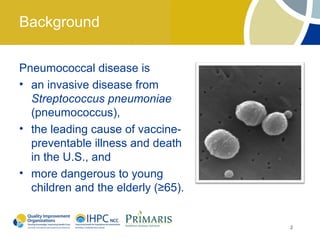
Pneumococcal disease is
• an invasive disease from
  Streptococcus pneumoniae
  (pneumococcus),
• the leading cause of vaccine-
  preventable illness and death
  in the U.S., and
• more dangerous to young
  children and the elderly (≥65).


                                    2
Transmission

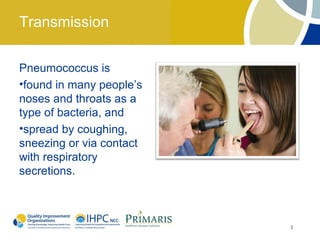
Pneumococcus is
•found in many people’s
noses and throats as a
type of bacteria, and
•spread by coughing,
sneezing or via contact
with respiratory
secretions.


                          3
Everybody Is at Risk


                       4
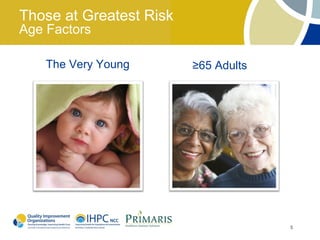
Those at Greatest Risk
Age Factors

    The Very Young       ≥65 Adults


                                      5
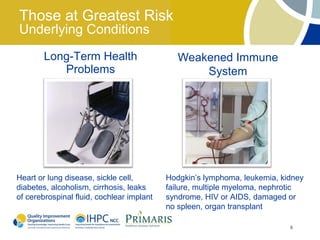
Those at Greatest Risk
Underlying Conditions
        Long-Term Health                      Weakened Immune
           Problems                               System


Heart or lung disease, sickle cell,        Hodgkin’s lymphoma, leukemia, kidney
diabetes, alcoholism, cirrhosis, leaks     failure, multiple myeloma, nephrotic
of cerebrospinal fluid, cochlear implant   syndrome, HIV or AIDS, damaged or
                                           no spleen, organ transplant

                                                                           6
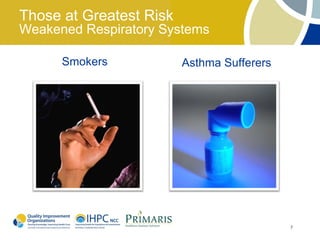
Those at Greatest Risk
Weakened Respiratory Systems

      Smokers            Asthma Sufferers


                                            7
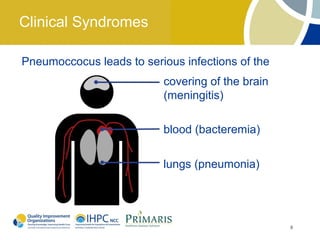
Clinical Syndromes

Pneumoccocus leads to serious infections of the
                          covering of the brain
                          (meningitis)

                          blood (bacteremia)


                          lungs (pneumonia)


                                                  8
Clinical Syndromes
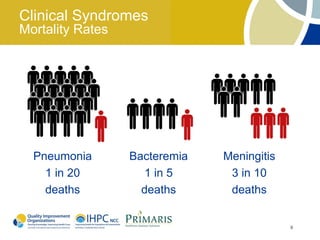
Mortality Rates


  Pneumonia       Bacteremia   Meningitis
    1 in 20          1 in 5     3 in 10
    deaths          deaths      deaths


                                            9
Clinical Syndromes
Mortality Rates

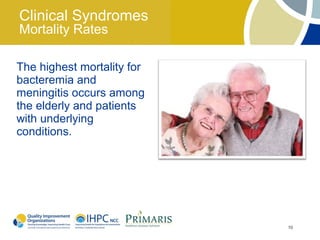
The highest mortality for
bacteremia and
meningitis occurs among
the elderly and patients
with underlying
conditions.


                            10
Pneumonia

•   Most common disease caused by pneumococcal
    infection
•   175,000 estimated U.S. cases annually
•   Occurs alone or in combination with bacteremia
    and/or meningitis
•   Not considered invasive but can be severe when
    isolated


                                                     11
Pneumonia

•   1–3 day incubation period
•   5–7% fatality rate (may be much higher among
    elderly)
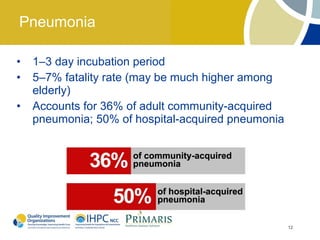
•   Accounts for 36% of adult community-acquired
    pneumonia; 50% of hospital-acquired pneumonia


                                                    12
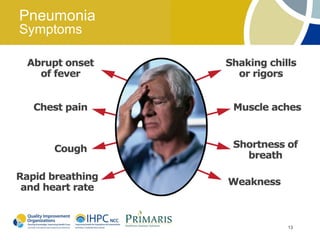
Pneumonia
Symptoms


            13
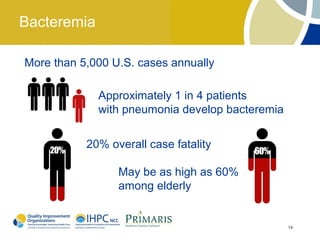
Bacteremia

More than 5,000 U.S. cases annually

             Approximately 1 in 4 patients
             with pneumonia develop bacteremia


           20% overall case fatality

                 May be as high as 60%
                 among elderly


                                                 14
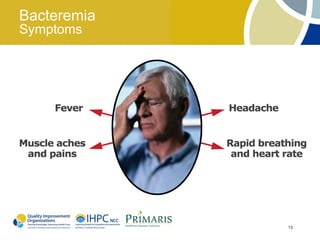
Bacteremia
Symptoms


             15
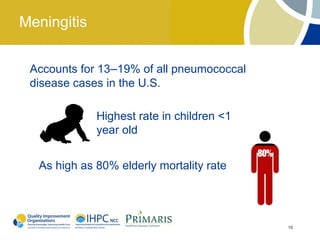
Meningitis


 Accounts for 13–19% of all pneumococcal
 disease cases in the U.S.

             Highest rate in children <1
             year old


  As high as 80% elderly mortality rate


                                           16
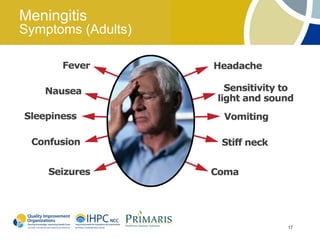
Meningitis
Symptoms (Adults)


                    17
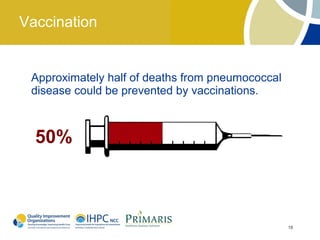
Vaccination


 Approximately half of deaths from pneumococcal
 disease could be prevented by vaccinations.


  50%


                                                  18
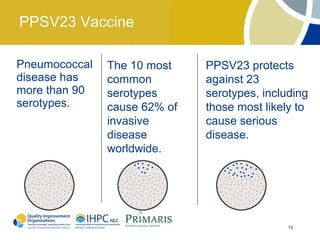
PPSV23 Vaccine

Pneumococcal   The 10 most    PPSV23 protects
disease has    common         against 23
more than 90   serotypes      serotypes, including
serotypes.     cause 62% of   those most likely to
               invasive       cause serious
               disease        disease.
               worldwide.


                                              19
PPSV23 Vaccine
Efficacy

PPSV23 IS
•60–70% effective against invasive disease,
•very good at preventing severe disease,
hospitalization and death, and
•effective at developing antibodies within 2–3 weeks in
more than 80% of healthy adults.


                                                     20
PPSV23 Vaccine
Efficacy

PPSV23 IS NOT
•a “pneumonia vaccine,”
•shown to provide protection against pneumococcal
pneumonia, and
•guaranteed to prevent infection and symptoms in all
people.


                                                       21
PPSV23 Vaccine
Recommendations


             Adults 65 years and older


            Anyone 2–64 years old with a long-term health problem,
            heart disease, lung disease, sickle cell disease, diabetes,
            alcoholism, cirrhosis, leaks of the cerebrospinal fluid or
            cochlear implant


 Updated recommendations for prevention of invasive pneumoccocal disease
 among adults using the PPSV23 vaccine.
 Source: http://www.cdc.gov/mmwr/preview/mmwrhtml/mm5934a3.htm


                                                                           22
PPSV23 Vaccine
Recommendations

       Anyone 2–64 years old with a disease or condition that
       lowers the body’s resistance to infection
       Hodgkin’s lymphoma, leukemia, kidney failure, multiple myeloma,
       nephrotic syndrome, HIV infection or AIDS, damaged or no spleen,
       organ transplant

       Anyone 2–64 years old taking a drug or treatment that
       lowers the body’s resistance to infection
       long-term steroids, certain cancer drugs, radiation therapy


       Any adult 19–64 years old who is a smoker or has
       asthma


                                                                          23
PPSV23 Vaccine
Recommendations

Older adults and persons with chronic illnesses or
immunodeficiency may not respond well, if at all;

                       however,

it is still recommended because they are at high risk of
developing severe disease.


                                                      24
PPSV23 Vaccine
Dosing

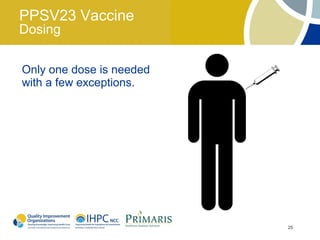
Only one dose is needed
with a few exceptions.


                          25
PPSV23 Vaccine
Dosing Exceptions

Revaccination is recommended for
•People ≥65 years who got first dose younger than 65 and more than 5
years have passed
•People 2–64 years given first dose >5 years ago who have

   o   a damaged or no spleen    o nephrotic syndrome
   o   sickle-cell disease       o an organ or bone marrow transplant
   o   HIV infection or AIDS     o to take medication that lowers
   o   cancer, leukemia,           immunity (chemotherapy, long-term
       lymphoma, multiple          steroids)
       myeloma


                                                                  26
PPSV23 Vaccine
Exclusions

Anyone
•with a life-threatening allergic reaction to PPSV23
•with a severe allergy to any component of the vaccine*
•moderately to severely ill at time of administration
•pregnant** or potentially pregnant


* See CDC Pink Book in Resources at the end of this presentation for vaccine components.
** No evidence exists that PPSV23 would be harmful to a pregnant woman or her fetus.


                                                                                       27
PPSV23 Vaccine
Risks

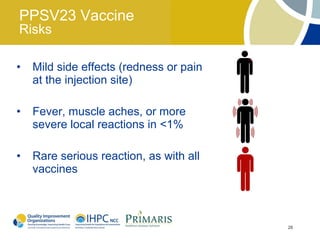
•   Mild side effects (redness or pain
    at the injection site)

•   Fever, muscle aches, or more
    severe local reactions in <1%

•   Rare serious reaction, as with all
    vaccines


                                         28
PPSV23 Vaccine
Risks

PPSV23 cannot possibly cause pneumococcal
disease.

It is an inactivated vaccine that contains only a
portion of the microbe.


                                                    29
PPSV23 Vaccine
Medicare Coverage

C


                    30
PPSV23 Vaccine
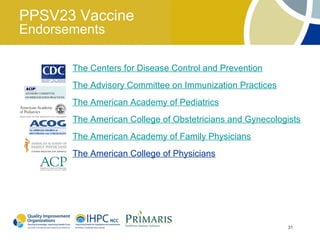
Endorsements

       The Centers for Disease Control and Prevention
       The Advisory Committee on Immunization Practices
       The American Academy of Pediatrics
       The American College of Obstetricians and Gynecologists
       The American Academy of Family Physicians
       The American College of Physicians


                                                          31
PPSV23 Vaccine
Pocket Guide

A laminated quick-reference tool from the CDC for
front-line healthcare personnel is available.

Order here: http://www.immunize.org/ppvguide/


                                                    32
Contact

Sandy Pogones
spogones@primaris.org
314-374-6451


                        33
Resources

From the CDC:
• Clinical Information on Pneumococcal
• Updated Recommendations for the Prevention of Invasive Pneumoccal
   Disease Among Adults Using the 23-Valent Pneumococcal
   Polysaccharide Vaccine (PPSV23)
• Pneumococcal Disease In-Short
• PPSV23 What You Need to Know
• Standing Orders for Administering Pneumococcal Vaccine to Adults
• Pneumoccoccal Disease, Chapter 16 from the CDC Pink Book

From the Immunization Action Coalition:
• Ask the Experts
• Vaccine Information


                                                                      34

Pneumococcal Vaccination

  • 1.
    Clinical Guidelines— Pneumococcal Vaccination inOlder Adults for the Prevention of Pneumococcal Disease
  • 2.
    Background Pneumococcal disease is •an invasive disease from Streptococcus pneumoniae (pneumococcus), • the leading cause of vaccine- preventable illness and death in the U.S., and • more dangerous to young children and the elderly (≥65). 2
  • 3.
    Transmission Pneumococcus is •found inmany people’s noses and throats as a type of bacteria, and •spread by coughing, sneezing or via contact with respiratory secretions. 3
  • 4.
  • 5.
    Those at GreatestRisk Age Factors The Very Young ≥65 Adults 5
  • 6.
    Those at GreatestRisk Underlying Conditions Long-Term Health Weakened Immune Problems System Heart or lung disease, sickle cell, Hodgkin’s lymphoma, leukemia, kidney diabetes, alcoholism, cirrhosis, leaks failure, multiple myeloma, nephrotic of cerebrospinal fluid, cochlear implant syndrome, HIV or AIDS, damaged or no spleen, organ transplant 6
  • 7.
    Those at GreatestRisk Weakened Respiratory Systems Smokers Asthma Sufferers 7
  • 8.
    Clinical Syndromes Pneumoccocus leadsto serious infections of the covering of the brain (meningitis) blood (bacteremia) lungs (pneumonia) 8
  • 9.
    Clinical Syndromes Mortality Rates Pneumonia Bacteremia Meningitis 1 in 20 1 in 5 3 in 10 deaths deaths deaths 9
  • 10.
    Clinical Syndromes Mortality Rates Thehighest mortality for bacteremia and meningitis occurs among the elderly and patients with underlying conditions. 10
  • 11.
    Pneumonia • Most common disease caused by pneumococcal infection • 175,000 estimated U.S. cases annually • Occurs alone or in combination with bacteremia and/or meningitis • Not considered invasive but can be severe when isolated 11
  • 12.
    Pneumonia • 1–3 day incubation period • 5–7% fatality rate (may be much higher among elderly) • Accounts for 36% of adult community-acquired pneumonia; 50% of hospital-acquired pneumonia 12
  • 13.
  • 14.
    Bacteremia More than 5,000U.S. cases annually Approximately 1 in 4 patients with pneumonia develop bacteremia 20% overall case fatality May be as high as 60% among elderly 14
  • 15.
  • 16.
    Meningitis Accounts for13–19% of all pneumococcal disease cases in the U.S. Highest rate in children <1 year old As high as 80% elderly mortality rate 16
  • 17.
  • 18.
    Vaccination Approximately halfof deaths from pneumococcal disease could be prevented by vaccinations. 50% 18
  • 19.
    PPSV23 Vaccine Pneumococcal The 10 most PPSV23 protects disease has common against 23 more than 90 serotypes serotypes, including serotypes. cause 62% of those most likely to invasive cause serious disease disease. worldwide. 19
  • 20.
    PPSV23 Vaccine Efficacy PPSV23 IS •60–70%effective against invasive disease, •very good at preventing severe disease, hospitalization and death, and •effective at developing antibodies within 2–3 weeks in more than 80% of healthy adults. 20
  • 21.
    PPSV23 Vaccine Efficacy PPSV23 ISNOT •a “pneumonia vaccine,” •shown to provide protection against pneumococcal pneumonia, and •guaranteed to prevent infection and symptoms in all people. 21
  • 22.
    PPSV23 Vaccine Recommendations Adults 65 years and older Anyone 2–64 years old with a long-term health problem, heart disease, lung disease, sickle cell disease, diabetes, alcoholism, cirrhosis, leaks of the cerebrospinal fluid or cochlear implant Updated recommendations for prevention of invasive pneumoccocal disease among adults using the PPSV23 vaccine. Source: http://www.cdc.gov/mmwr/preview/mmwrhtml/mm5934a3.htm 22
  • 23.
    PPSV23 Vaccine Recommendations Anyone 2–64 years old with a disease or condition that lowers the body’s resistance to infection Hodgkin’s lymphoma, leukemia, kidney failure, multiple myeloma, nephrotic syndrome, HIV infection or AIDS, damaged or no spleen, organ transplant Anyone 2–64 years old taking a drug or treatment that lowers the body’s resistance to infection long-term steroids, certain cancer drugs, radiation therapy Any adult 19–64 years old who is a smoker or has asthma 23
  • 24.
    PPSV23 Vaccine Recommendations Older adultsand persons with chronic illnesses or immunodeficiency may not respond well, if at all; however, it is still recommended because they are at high risk of developing severe disease. 24
  • 25.
    PPSV23 Vaccine Dosing Only onedose is needed with a few exceptions. 25
  • 26.
    PPSV23 Vaccine Dosing Exceptions Revaccinationis recommended for •People ≥65 years who got first dose younger than 65 and more than 5 years have passed •People 2–64 years given first dose >5 years ago who have o a damaged or no spleen o nephrotic syndrome o sickle-cell disease o an organ or bone marrow transplant o HIV infection or AIDS o to take medication that lowers o cancer, leukemia, immunity (chemotherapy, long-term lymphoma, multiple steroids) myeloma 26
  • 27.
    PPSV23 Vaccine Exclusions Anyone •with alife-threatening allergic reaction to PPSV23 •with a severe allergy to any component of the vaccine* •moderately to severely ill at time of administration •pregnant** or potentially pregnant * See CDC Pink Book in Resources at the end of this presentation for vaccine components. ** No evidence exists that PPSV23 would be harmful to a pregnant woman or her fetus. 27
  • 28.
    PPSV23 Vaccine Risks • Mild side effects (redness or pain at the injection site) • Fever, muscle aches, or more severe local reactions in <1% • Rare serious reaction, as with all vaccines 28
  • 29.
    PPSV23 Vaccine Risks PPSV23 cannotpossibly cause pneumococcal disease. It is an inactivated vaccine that contains only a portion of the microbe. 29
  • 30.
  • 31.
    PPSV23 Vaccine Endorsements The Centers for Disease Control and Prevention The Advisory Committee on Immunization Practices The American Academy of Pediatrics The American College of Obstetricians and Gynecologists The American Academy of Family Physicians The American College of Physicians 31
  • 32.
    PPSV23 Vaccine Pocket Guide Alaminated quick-reference tool from the CDC for front-line healthcare personnel is available. Order here: http://www.immunize.org/ppvguide/ 32
  • 33.
  • 34.
    Resources From the CDC: •Clinical Information on Pneumococcal • Updated Recommendations for the Prevention of Invasive Pneumoccal Disease Among Adults Using the 23-Valent Pneumococcal Polysaccharide Vaccine (PPSV23) • Pneumococcal Disease In-Short • PPSV23 What You Need to Know • Standing Orders for Administering Pneumococcal Vaccine to Adults • Pneumoccoccal Disease, Chapter 16 from the CDC Pink Book From the Immunization Action Coalition: • Ask the Experts • Vaccine Information 34