• Some adults were never vaccinated as children
• Newer vaccines were not available when some
adults were children
• Immunity can begin to fade over time
• As we age, we become more susceptible to
serious disease caused by common infections
(e.g., flu, pneumococcus)
• Contributes to herd immunity in VPDs
Why some adults need vaccines?
• Build on success of
infant/childhood,
adolescent program
• New vaccines targeted
at adults
• Recognition of the
burden of adult
vaccine-preventable
disease
Invigoration of Adult Immunization
2
Recommendations
Vaccine / Age group 19-26 yrs 27-49 yrs 50-59 yrs 60-64 yrs > 65 yrs
Tetanus, Diptheria, Pertussis (Tdap)
Substitude one time dose of Tdap with Td,
then booster with Td every 10 years
Td booster
every 10 yrs
Human Pappiloma Vaccine 3 doses
Varicella 2 doses
Zoster 1 dose
Measles, Mumps, Rubella 1 or 2 doses 1 dose
Influenza 1 dose annually
Pnemococcal (Polysaccharide) 1 or 2 doses 1 dose
Hepatitis A 2 doses
Hepatitis B 3 doses
Meninngicoccal 1 or more doses
5/17/2018 5
ACIP Adult Immunization Schedule, Age-Based
Recommendations, INDIA
Recommended if some risk factor is present
All persons who meet the age criteria
No recommendation
INFLUENZA
Vaccines
– Trivalent inactivated influenza
vaccine (TIV) and
– Live attenuated influenza vaccine
(LAIV)
• Schedule
– The TIV - annual, single dose of 0.5
ml IM.
– The LAIV – 0.5 ml intranasal (spray
0.25 ml per nostril)
6
Recommendations (as per AAIP)
• People aged > 50 years
• Chronic obstructive pulmonary
disease (COPD).
• Cardiac diseases
• Diabetes Mellitus, Cancer
• Immunodeficiency, Renal Disease
• Hemoglobinopathies
• Pregnant Women
• Health Care Providers
• Adult household contacts
• Travelers to endemic area
Influenza cont…
8
• August - September is the optimal time to receive an annual
flu shot to maximize protection.
• Influenza vaccine may be given at any time during the
influenza season (typically October to March) or at other
times when the risk of influenza exists.
• May give with all other vaccines but as a separate injection.
Contraindications
• Previous anaphylactic reaction to this vaccine, to any of its
components, or to eggs.
• Moderate or severe acute illness.
9
Influenza cont…
DISEASE BURDEN OF
PNEUMOCOCCUS
• Invasive Pneumococcal Disease
– Cases: 42,000 (14.0/100,000)
– Deaths: 4,500 (1.5/100,000)
– Rates higher in elderly
• Study by International Clinical
Epidemiology Network (INCLEN)
shows case fatality rate in south India
due to
– Pneumococcal Pneumonia – 19%
– Pneumococcal bacterimia – 21%
– Pneumococcal meningitis – 34%
• 23% of IPD patients were > 50 years
PNEUMOCOCCAL INFECTION
Vaccines
• The pneumococcal polysaccharide
vaccine (PPV), contains 25 μg each of purified
capsular polysaccharide from 23 serotypes of
Streptococcus pneumoniae.
Schedule
– A single standard dose (0.5 ml) is
administered by the intramuscular or
subcutaneous route.
– This vaccine can be co-administered with live
vaccines such as the influenza vaccine.
• Adults who are 65yrs of age or older.
High risk people
• Anatomic asplenia
• Sickle cell disease
• Immunocompromised persons including HIV
• Leukemia, Lymphoma
• Hodgkin’s disease
• Multiple myeloma
• Generalized malignancy
PPV cont…
• One-time revaccination is recommended 5yrs later
for people with
– Rapid antibody loss (e.g., renal disease), nephrotic
syndrome, functional or anatomic asplenia and
immunosuppressive condition.
– People >65yrs of age if the 1st dose was given
prior to age 65 and > 5yrs have elapsed since
previous dose.
PPV cont…
Meningococcal Meningitis
Vaccines
• Types
– Polysaccharide vaccines
•Bivalent (A&C)
•Quadrivalent (A,C,Y & W135)
– Conjugate vaccines
Schedule
• A single dose of 0.5 ml SC in deltoid region.
• In children between 3 months and 2 years of
age, two doses at an interval of 3 months are
indicated.
Meningococcal
cont…
Recommendations
– During an outbreak (HCW, Lab. worker, Close
contacts )
– During inter-epidemic period
– To travelers, pilgrims(Quadrivalent), people
attending fairs and festivals(bivalent 10-14 days
prior).
– Adults with anatomic or functional asplenia, or
terminal complement component deficiencies.
– Mass vaccination may be considered depending on
the age-specific attack rate, geographical
distribution of cases, and the availability of vaccine.
Meningococcal
cont…
HUMAN PAPILLOMAVIRUS
• Human Papillomavirus (HPV) -USA
– At least 70% of sexually active persons
acquire genital HPV infection at some
point in their lives
– ~20 million currently infected
– 6.2 million new infections/year
– ~ >11,000 new cervical cancer cases/year
• Human Papilloma Virus (HPV)
Infection
Nearly 80% of sexually active women
& men are infected with HPV.
India – 1,32,000 new cases &
74,000 deaths per year
HUMAN PAPILLOMAVIRUS
• Papillomavirus infection is precursor to cervical
cancer
– Types 16, 18 account for 70% of cervical
cancers
Vaccines
• Two types HPV vaccines are available.
– Gardasil (Merck, USA), a quadrivalent vaccine
containing HPV virus L1 protein like particles of
HPV 6,11,16, and 18
– Cervarix (GlaxoSmithKline, Belgium) is a
bivalent vaccine containing L1 VLPs of HPV
16,18.
Recommendations
• The vaccine has to be delivered prior to exposure to
the HPV virus. Therefore, the immunization must
precede the sexual debut.
• Age for initiation for vaccination to be 10 - 12 years.
• Catch-up vaccination can be advised up to the age of
26 years for Gardasil vaccine and 45 years for Cervarix
vaccine.
HPV cont…
Contraindications
• Pregnancy
• Patients with hypersensitivity to any of the vaccine
components.
Special situations
• The HPV vaccine is not contraindicated during
lactation.
• The vaccine can be administered to
immunosuppressed individuals.
HPV cont…
0–1 Year 0–5 Years 1–20 Years
Invasive
Cervical
Cancer
Cleared HPV Infection (~80%)
1. Pinto AP, Crum CP. Clin Obstet Gynecol. 2000;43:352–362.
CIN 1
Initial
HPV
Infection
Continuing
Infection
CIN
2/3
Natural History of HPV Infection and
Potential Progression to Cervical Cancer
22
HPV cont…
Hepatitis – B
• Hepatitis – B prevalence in India is
1-2% (Lodha et al)
• Study by Murhekar in 2001 at
Andaman in healthy people
– HBsAg +ve – 1.6% &
– Anti HBs +ve – 18%
• Overall chronic HBsAg +ve rate in
India is 4.7%
Hepatitis B
Hepatitis B
Recommendations
• Person at risk of infection by sexual route
- sex partner of HBsag infection
- sexually active person
- person seeking evaluation or treatment of STD
• Person at risk of infection by subcutaneous or mucosal route
- current or recent injection drug abuser
- household contacts
- healthcare and public safety worker
• Person with ESRD or requiring multiple transfusion
• Others
- person with CLD or HIV
- all other person seeking protection from HBV infection.
Prevaccination screening
• Prevaccination screening in general population has not been
found to be cost effective in India.
• Prevaccination screening may be cost-effective in adult
populations with a prevalence of HBV infection of >20% such
as
– Household or sexual contacts of HBsAg-positive persons;
– HIV infected persons
– Injection drug users
– Men who have sex with men
– Patients with chronic liver disease (CLD)
– End-stage renal disease (ESRD).
HBV cont…
HBV cont…
Hepatitis – A
• Study by Mall in 5 cities (Kolkota,
Cochin, Indore, Jaipur & Patna)
shows adult population was at risk of
HAV as low level of anti HAV
antibodies
• Study by Dhawan et al –
seroprevalance for protective anti
HAV antibodies
High socioeconomic class – 54.5%
Low socioeconomic class – 85%
Hepatitis A
Hepatitis A
Vaccines
• Inactivated-single antigen (HAV antigen)
vaccines,
– Havrix (GlaxoSmithKline) and
– Vaqta (Merck & Co)
• Combination vaccine
– Twinrix ( HAV + HBV antigens GlaxoSmithKline).
Schedule
• Two doses of 1ml at 6 month interval.
• Immune status for hepatitis A should be checked
Recommendations
• The Expert Group felt that universal immunization
for hepatitis A is not recommended as yet.
• Not only is the vaccine costly, more epidemiological
data are required to ascertain its benefits.
• Adults at risk for acquiring hepatitis A, and adults
who are negative for anti-HAV antibodies are likely
to benefit most in view of changing epidemiology.
Hepatitis A cont…
Adults high risk for acquiring hepatitis A:
– People who travel to endemic area of Hep A
– Persons who work with HAV-infected
primates or with HAV in a laboratory
– Who receive clotting factor concentrates
– Persons infected with other hepatitis viruses
– Chronic liver disease not immune to HAV
– Received, or are awaiting a liver transplant
– Men who have sex with men
Hepatitis A cont…
Vaccination schedule for hepatitis A
Hepatitis A cont…
Contraindications
• Previous anaphylactic reaction to this vaccine or
to any of its components.
• Moderate or severe acute illness.
• Safety during pregnancy has not been
determined, so benefits must be weighed against
potential risk.
Hepatitis A cont…
Herpes zoster (shingles)
• Shingles is caused by a reawakening
of the chickenpox virus
• 20-30 % people can expect to get
shingles in their lifetime
Vaccines
• Zostavax - lyophilized preparation of the Oka
strain of live, attenuated varicella zoster virus
(VZV).
Schedule
• Single 0.65 ml dose subcutaneously in the upper
arm.
• Each 0.65 ml dose contains a minimum of 19,400
plaque-forming units [PFU].
• The vaccine must be used within 30 minutes after
reconstitution.
Herpes Zoster cont…
Recommendations
• Recommended for persons > 60 years.
• High risk for developing recurrent herpes
zoster, such as
– Patients with chronic medical conditions (CKD,
diabetes mellitus, rheumatoid arthritis, and
chronic pulmonary disease);
– Persons who are likely to have severe
immunosuppression in near future.
Herpes Zoster cont…
DPT
Diphtheria
• Overall cases of Diphtheria reduces
• 1980 – 39231
• 2005 – 10231
• 2009 – 3480
• Study in Hyderabad shows that annual incidence increases
from 11 to 23/lakh from 2003 to 2006 in 5 – 19 years.
• Study for Protective levels of antibodies in Delhi shows
121 pregnant women – 94% have protective Ab titer
(>0.125U/ml)
574 adults – 87% have protective Ab titer
Tetanus
• Total cases in India
1980 – 45948 cases
2007 – 7005 cases
• Study in Pondicherry for protective level of
Tetanus Ab (> 0.15U/ml)
21 - 30 years – 50.4% (105/208)
31 – 40 years – 29.4%(58/198)
> 41 years – 2.2% (5/224)
Pertussis
1987 -163000 cases
2009 – 55074 cases
Diphtheria, Tetanus, Pertussis
Vaccines
• Two Tdap Vaccines are available for use in those
who are more than 10 years of age.
– [i] Adacel contains tetanus toxoid, diphtheria toxoid,
and five pertussis antigens;
– [ii] Boostrix contains tetanus toxoid, diphtheria toxoid,
and three pertussis antigens.
• Efficacy of Tdap vaccine - 92% in a recent RCT.
Recommendations
• For adults in the age group of 18 to 64 years
– Three dose series if never vaccinated at 0 and 4 weeks,
the third 6-12 months after second
– One dose booster of Tdap every 10 years
• Health care personnel, especially those in direct
contact with the patients, who have not received
Tdap vaccine should receive a single dose of Tdap
vaccine if 2 years or more have elapsed since the last
dose of Td vaccination.
• Women planning pregnancy should receive one dose
of Tdap vaccine if they had not received it previously.
Tdap cont…
• For Pregnant Women
Last dose Recommendation
> 10 Years 1 dose in 2nd or 3rd trimester
2-10 years 1 dose immediate postpartum
Never 3 doses 0, 1, 6 months
• During outbreak if previous unimmunized or
Td before 2 years give 1 dose of Tdap
Tdap cont…
Contraindications
• History of anaphylaxis to any component.
• History of encephalopathy within 7 days of
previous vaccination of Tdap.
• Moderate or severe acute illness, and those
with unstable neurologic conditions (e.g.,
stroke, acute encephalopathies)
• Tdap vaccination is to be deferred until the
acute illness resolves.
Tdap cont…
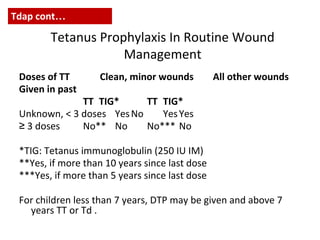
Tetanus Prophylaxis In Routine Wound
Management
Doses of TT Clean, minor wounds All other wounds
Given in past
TT TIG* TT TIG*
Unknown, < 3 doses YesNo YesYes
≥ 3 doses No** No No*** No
*TIG: Tetanus immunoglobulin (250 IU IM)
**Yes, if more than 10 years since last dose
***Yes, if more than 5 years since last dose
For children less than 7 years, DTP may be given and above 7
years TT or Td .
Tdap cont…
Recommended Vaccines for Healthcare
Workers
• Healthcare workers should maintain an
immunization history for:
– Hepatitis B
– Influenza
– MMR
– Varicella (chickenpox)
– Tetanus, diphtheria, pertussis
– Meningococcal
Recommended vaccines for travelers
to India
CDC recommends the vaccines according
to duration of stay in India.
• Tetanus-Diphtheria
• Hepatitis A
• Yellow Fever
• Polio
• Japanese Encephalitis
• Rabies
• Typhoid
• Hepatitis B
• Tuberculosis
• Meningitis
< 1 month
1- 5 month
> 6 month
Source : CDC
OTHER VACCINES
YELLOW FEVER
• Yellow fever caused by virus belonging to
family called flaviviridae.
• Yellow fever vaccine is live attenuated vaccine
• Single s.c dose of 0.5ml given and
seroconversion is >95%.
• Protection stats from 10th
day and last till
10yrs.
LEGAL REQUIREMENT IN INDIA
• all travelers arriving or transiting from
endemic countries like Africa, South America
and Caribbean are requested to carry
international certificate of vaccination or
prophylaxis against yellow fever.
• Any person coming without certificate
quarantined up to 6 days.
RABIES
• Two regime available
- intramuscular
- intradermal
prophylaxis
Pre exposure prophylaxis – 0, 7 and 28
If person already vaccinated – 2 booster dose
irrespective of category of bite
Vaccine in India
• Cholera vaccine
oral cholera – WC, WC-rBS, CVD-103HgR
injectable – not used now
• Typhoid
Vi polysaccharide vaccine
ty21a vaccine
• Tuberculosis
- BCG vaccine currently available and others like DNA
vaccine, subunit vaccine and recombinant BCG under trail.
- vaccine based immunotherapy
RUTI and mycobacterium w
Adult Immunization Challenges
• Inadequate funding for vaccines and
administration in public programs
• Lack of knowledge – both patients
and providers
• Poor public health and private
infrastructure for vaccine delivery.
• Lack of availability of vaccine.
• High cost of vaccine.
Screening Patients for Vaccines
• Screen every patient regardless of reason for
visit
• Utilize screening tools; H-A-L-O
– Health condition
– Age
– Lifestyle
– Occupation
Documentation
• Provide copy of Vaccine
Information Statement (VIS)to
patient
• Documents to be maintained
– Date vaccination & next dose
– Vaccine manufacturer
– Dose & site of vaccine
– Vaccinator’s initials
Vaccine Administration
• Health care personnel should get proper
training before administrating vaccine.
• Always prepare and check the following for
every vaccination you give:
– Right Patient
– Right Drug (vaccine)
– Right Dose
– Right Route (intramuscular, SC,intradermal)
– Right Time (is scheduling correct)

Adult immunisation

  • 1.
    • Some adultswere never vaccinated as children • Newer vaccines were not available when some adults were children • Immunity can begin to fade over time • As we age, we become more susceptible to serious disease caused by common infections (e.g., flu, pneumococcus) • Contributes to herd immunity in VPDs Why some adults need vaccines?
  • 2.
    • Build onsuccess of infant/childhood, adolescent program • New vaccines targeted at adults • Recognition of the burden of adult vaccine-preventable disease Invigoration of Adult Immunization 2
  • 3.
  • 5.
    Vaccine / Agegroup 19-26 yrs 27-49 yrs 50-59 yrs 60-64 yrs > 65 yrs Tetanus, Diptheria, Pertussis (Tdap) Substitude one time dose of Tdap with Td, then booster with Td every 10 years Td booster every 10 yrs Human Pappiloma Vaccine 3 doses Varicella 2 doses Zoster 1 dose Measles, Mumps, Rubella 1 or 2 doses 1 dose Influenza 1 dose annually Pnemococcal (Polysaccharide) 1 or 2 doses 1 dose Hepatitis A 2 doses Hepatitis B 3 doses Meninngicoccal 1 or more doses 5/17/2018 5 ACIP Adult Immunization Schedule, Age-Based Recommendations, INDIA Recommended if some risk factor is present All persons who meet the age criteria No recommendation
  • 6.
    INFLUENZA Vaccines – Trivalent inactivatedinfluenza vaccine (TIV) and – Live attenuated influenza vaccine (LAIV) • Schedule – The TIV - annual, single dose of 0.5 ml IM. – The LAIV – 0.5 ml intranasal (spray 0.25 ml per nostril) 6
  • 8.
    Recommendations (as perAAIP) • People aged > 50 years • Chronic obstructive pulmonary disease (COPD). • Cardiac diseases • Diabetes Mellitus, Cancer • Immunodeficiency, Renal Disease • Hemoglobinopathies • Pregnant Women • Health Care Providers • Adult household contacts • Travelers to endemic area Influenza cont… 8
  • 9.
    • August -September is the optimal time to receive an annual flu shot to maximize protection. • Influenza vaccine may be given at any time during the influenza season (typically October to March) or at other times when the risk of influenza exists. • May give with all other vaccines but as a separate injection. Contraindications • Previous anaphylactic reaction to this vaccine, to any of its components, or to eggs. • Moderate or severe acute illness. 9 Influenza cont…
  • 10.
    DISEASE BURDEN OF PNEUMOCOCCUS •Invasive Pneumococcal Disease – Cases: 42,000 (14.0/100,000) – Deaths: 4,500 (1.5/100,000) – Rates higher in elderly • Study by International Clinical Epidemiology Network (INCLEN) shows case fatality rate in south India due to – Pneumococcal Pneumonia – 19% – Pneumococcal bacterimia – 21% – Pneumococcal meningitis – 34% • 23% of IPD patients were > 50 years
  • 11.
    PNEUMOCOCCAL INFECTION Vaccines • Thepneumococcal polysaccharide vaccine (PPV), contains 25 μg each of purified capsular polysaccharide from 23 serotypes of Streptococcus pneumoniae. Schedule – A single standard dose (0.5 ml) is administered by the intramuscular or subcutaneous route. – This vaccine can be co-administered with live vaccines such as the influenza vaccine.
  • 12.
    • Adults whoare 65yrs of age or older. High risk people • Anatomic asplenia • Sickle cell disease • Immunocompromised persons including HIV • Leukemia, Lymphoma • Hodgkin’s disease • Multiple myeloma • Generalized malignancy PPV cont…
  • 13.
    • One-time revaccinationis recommended 5yrs later for people with – Rapid antibody loss (e.g., renal disease), nephrotic syndrome, functional or anatomic asplenia and immunosuppressive condition. – People >65yrs of age if the 1st dose was given prior to age 65 and > 5yrs have elapsed since previous dose. PPV cont…
  • 14.
    Meningococcal Meningitis Vaccines • Types –Polysaccharide vaccines •Bivalent (A&C) •Quadrivalent (A,C,Y & W135) – Conjugate vaccines
  • 15.
    Schedule • A singledose of 0.5 ml SC in deltoid region. • In children between 3 months and 2 years of age, two doses at an interval of 3 months are indicated. Meningococcal cont…
  • 16.
    Recommendations – During anoutbreak (HCW, Lab. worker, Close contacts ) – During inter-epidemic period – To travelers, pilgrims(Quadrivalent), people attending fairs and festivals(bivalent 10-14 days prior). – Adults with anatomic or functional asplenia, or terminal complement component deficiencies. – Mass vaccination may be considered depending on the age-specific attack rate, geographical distribution of cases, and the availability of vaccine. Meningococcal cont…
  • 17.
    HUMAN PAPILLOMAVIRUS • HumanPapillomavirus (HPV) -USA – At least 70% of sexually active persons acquire genital HPV infection at some point in their lives – ~20 million currently infected – 6.2 million new infections/year – ~ >11,000 new cervical cancer cases/year • Human Papilloma Virus (HPV) Infection Nearly 80% of sexually active women & men are infected with HPV. India – 1,32,000 new cases & 74,000 deaths per year
  • 18.
    HUMAN PAPILLOMAVIRUS • Papillomavirusinfection is precursor to cervical cancer – Types 16, 18 account for 70% of cervical cancers Vaccines • Two types HPV vaccines are available. – Gardasil (Merck, USA), a quadrivalent vaccine containing HPV virus L1 protein like particles of HPV 6,11,16, and 18 – Cervarix (GlaxoSmithKline, Belgium) is a bivalent vaccine containing L1 VLPs of HPV 16,18.
  • 20.
    Recommendations • The vaccinehas to be delivered prior to exposure to the HPV virus. Therefore, the immunization must precede the sexual debut. • Age for initiation for vaccination to be 10 - 12 years. • Catch-up vaccination can be advised up to the age of 26 years for Gardasil vaccine and 45 years for Cervarix vaccine. HPV cont…
  • 21.
    Contraindications • Pregnancy • Patientswith hypersensitivity to any of the vaccine components. Special situations • The HPV vaccine is not contraindicated during lactation. • The vaccine can be administered to immunosuppressed individuals. HPV cont…
  • 22.
    0–1 Year 0–5Years 1–20 Years Invasive Cervical Cancer Cleared HPV Infection (~80%) 1. Pinto AP, Crum CP. Clin Obstet Gynecol. 2000;43:352–362. CIN 1 Initial HPV Infection Continuing Infection CIN 2/3 Natural History of HPV Infection and Potential Progression to Cervical Cancer 22 HPV cont…
  • 23.
    Hepatitis – B •Hepatitis – B prevalence in India is 1-2% (Lodha et al) • Study by Murhekar in 2001 at Andaman in healthy people – HBsAg +ve – 1.6% & – Anti HBs +ve – 18% • Overall chronic HBsAg +ve rate in India is 4.7% Hepatitis B
  • 24.
    Hepatitis B Recommendations • Personat risk of infection by sexual route - sex partner of HBsag infection - sexually active person - person seeking evaluation or treatment of STD • Person at risk of infection by subcutaneous or mucosal route - current or recent injection drug abuser - household contacts - healthcare and public safety worker • Person with ESRD or requiring multiple transfusion • Others - person with CLD or HIV - all other person seeking protection from HBV infection.
  • 26.
    Prevaccination screening • Prevaccinationscreening in general population has not been found to be cost effective in India. • Prevaccination screening may be cost-effective in adult populations with a prevalence of HBV infection of >20% such as – Household or sexual contacts of HBsAg-positive persons; – HIV infected persons – Injection drug users – Men who have sex with men – Patients with chronic liver disease (CLD) – End-stage renal disease (ESRD). HBV cont…
  • 27.
  • 28.
    Hepatitis – A •Study by Mall in 5 cities (Kolkota, Cochin, Indore, Jaipur & Patna) shows adult population was at risk of HAV as low level of anti HAV antibodies • Study by Dhawan et al – seroprevalance for protective anti HAV antibodies High socioeconomic class – 54.5% Low socioeconomic class – 85% Hepatitis A
  • 29.
    Hepatitis A Vaccines • Inactivated-singleantigen (HAV antigen) vaccines, – Havrix (GlaxoSmithKline) and – Vaqta (Merck & Co) • Combination vaccine – Twinrix ( HAV + HBV antigens GlaxoSmithKline). Schedule • Two doses of 1ml at 6 month interval. • Immune status for hepatitis A should be checked
  • 30.
    Recommendations • The ExpertGroup felt that universal immunization for hepatitis A is not recommended as yet. • Not only is the vaccine costly, more epidemiological data are required to ascertain its benefits. • Adults at risk for acquiring hepatitis A, and adults who are negative for anti-HAV antibodies are likely to benefit most in view of changing epidemiology. Hepatitis A cont…
  • 31.
    Adults high riskfor acquiring hepatitis A: – People who travel to endemic area of Hep A – Persons who work with HAV-infected primates or with HAV in a laboratory – Who receive clotting factor concentrates – Persons infected with other hepatitis viruses – Chronic liver disease not immune to HAV – Received, or are awaiting a liver transplant – Men who have sex with men Hepatitis A cont…
  • 32.
    Vaccination schedule forhepatitis A Hepatitis A cont…
  • 33.
    Contraindications • Previous anaphylacticreaction to this vaccine or to any of its components. • Moderate or severe acute illness. • Safety during pregnancy has not been determined, so benefits must be weighed against potential risk. Hepatitis A cont…
  • 34.
    Herpes zoster (shingles) •Shingles is caused by a reawakening of the chickenpox virus • 20-30 % people can expect to get shingles in their lifetime
  • 35.
    Vaccines • Zostavax -lyophilized preparation of the Oka strain of live, attenuated varicella zoster virus (VZV). Schedule • Single 0.65 ml dose subcutaneously in the upper arm. • Each 0.65 ml dose contains a minimum of 19,400 plaque-forming units [PFU]. • The vaccine must be used within 30 minutes after reconstitution. Herpes Zoster cont…
  • 36.
    Recommendations • Recommended forpersons > 60 years. • High risk for developing recurrent herpes zoster, such as – Patients with chronic medical conditions (CKD, diabetes mellitus, rheumatoid arthritis, and chronic pulmonary disease); – Persons who are likely to have severe immunosuppression in near future. Herpes Zoster cont…
  • 37.
    DPT Diphtheria • Overall casesof Diphtheria reduces • 1980 – 39231 • 2005 – 10231 • 2009 – 3480 • Study in Hyderabad shows that annual incidence increases from 11 to 23/lakh from 2003 to 2006 in 5 – 19 years. • Study for Protective levels of antibodies in Delhi shows 121 pregnant women – 94% have protective Ab titer (>0.125U/ml) 574 adults – 87% have protective Ab titer
  • 38.
    Tetanus • Total casesin India 1980 – 45948 cases 2007 – 7005 cases • Study in Pondicherry for protective level of Tetanus Ab (> 0.15U/ml) 21 - 30 years – 50.4% (105/208) 31 – 40 years – 29.4%(58/198) > 41 years – 2.2% (5/224) Pertussis 1987 -163000 cases 2009 – 55074 cases
  • 39.
    Diphtheria, Tetanus, Pertussis Vaccines •Two Tdap Vaccines are available for use in those who are more than 10 years of age. – [i] Adacel contains tetanus toxoid, diphtheria toxoid, and five pertussis antigens; – [ii] Boostrix contains tetanus toxoid, diphtheria toxoid, and three pertussis antigens. • Efficacy of Tdap vaccine - 92% in a recent RCT. Recommendations • For adults in the age group of 18 to 64 years – Three dose series if never vaccinated at 0 and 4 weeks, the third 6-12 months after second – One dose booster of Tdap every 10 years
  • 40.
    • Health carepersonnel, especially those in direct contact with the patients, who have not received Tdap vaccine should receive a single dose of Tdap vaccine if 2 years or more have elapsed since the last dose of Td vaccination. • Women planning pregnancy should receive one dose of Tdap vaccine if they had not received it previously. Tdap cont…
  • 41.
    • For PregnantWomen Last dose Recommendation > 10 Years 1 dose in 2nd or 3rd trimester 2-10 years 1 dose immediate postpartum Never 3 doses 0, 1, 6 months • During outbreak if previous unimmunized or Td before 2 years give 1 dose of Tdap Tdap cont…
  • 42.
    Contraindications • History ofanaphylaxis to any component. • History of encephalopathy within 7 days of previous vaccination of Tdap. • Moderate or severe acute illness, and those with unstable neurologic conditions (e.g., stroke, acute encephalopathies) • Tdap vaccination is to be deferred until the acute illness resolves. Tdap cont…
  • 43.
    Tetanus Prophylaxis InRoutine Wound Management Doses of TT Clean, minor wounds All other wounds Given in past TT TIG* TT TIG* Unknown, < 3 doses YesNo YesYes ≥ 3 doses No** No No*** No *TIG: Tetanus immunoglobulin (250 IU IM) **Yes, if more than 10 years since last dose ***Yes, if more than 5 years since last dose For children less than 7 years, DTP may be given and above 7 years TT or Td . Tdap cont…
  • 45.
    Recommended Vaccines forHealthcare Workers • Healthcare workers should maintain an immunization history for: – Hepatitis B – Influenza – MMR – Varicella (chickenpox) – Tetanus, diphtheria, pertussis – Meningococcal
  • 46.
    Recommended vaccines fortravelers to India CDC recommends the vaccines according to duration of stay in India. • Tetanus-Diphtheria • Hepatitis A • Yellow Fever • Polio • Japanese Encephalitis • Rabies • Typhoid • Hepatitis B • Tuberculosis • Meningitis < 1 month 1- 5 month > 6 month Source : CDC
  • 47.
  • 48.
    YELLOW FEVER • Yellowfever caused by virus belonging to family called flaviviridae. • Yellow fever vaccine is live attenuated vaccine • Single s.c dose of 0.5ml given and seroconversion is >95%. • Protection stats from 10th day and last till 10yrs.
  • 49.
    LEGAL REQUIREMENT ININDIA • all travelers arriving or transiting from endemic countries like Africa, South America and Caribbean are requested to carry international certificate of vaccination or prophylaxis against yellow fever. • Any person coming without certificate quarantined up to 6 days.
  • 50.
    RABIES • Two regimeavailable - intramuscular - intradermal
  • 51.
    prophylaxis Pre exposure prophylaxis– 0, 7 and 28 If person already vaccinated – 2 booster dose irrespective of category of bite
  • 52.
  • 54.
    • Cholera vaccine oralcholera – WC, WC-rBS, CVD-103HgR injectable – not used now • Typhoid Vi polysaccharide vaccine ty21a vaccine • Tuberculosis - BCG vaccine currently available and others like DNA vaccine, subunit vaccine and recombinant BCG under trail. - vaccine based immunotherapy RUTI and mycobacterium w
  • 55.
    Adult Immunization Challenges •Inadequate funding for vaccines and administration in public programs • Lack of knowledge – both patients and providers • Poor public health and private infrastructure for vaccine delivery. • Lack of availability of vaccine. • High cost of vaccine.
  • 56.
    Screening Patients forVaccines • Screen every patient regardless of reason for visit • Utilize screening tools; H-A-L-O – Health condition – Age – Lifestyle – Occupation
  • 57.
    Documentation • Provide copyof Vaccine Information Statement (VIS)to patient • Documents to be maintained – Date vaccination & next dose – Vaccine manufacturer – Dose & site of vaccine – Vaccinator’s initials
  • 58.
    Vaccine Administration • Healthcare personnel should get proper training before administrating vaccine. • Always prepare and check the following for every vaccination you give: – Right Patient – Right Drug (vaccine) – Right Dose – Right Route (intramuscular, SC,intradermal) – Right Time (is scheduling correct)