Clinical Guidelines—
Lowering High Blood
Pressure in Adults
Hypertension
Scope

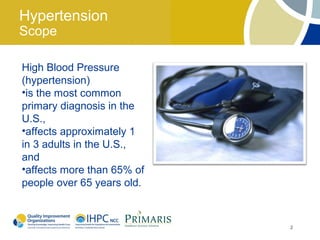
High Blood Pressure
(hypertension)
•is the most common
primary diagnosis in the
U.S.,
•affects approximately 1
in 3 adults in the U.S.,
and
•affects more than 65% of
people over 65 years old.


                            2
Hypertension
Effects
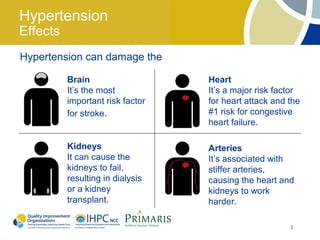
Hypertension can damage the

          Brain                   Heart
          It’s the most           It’s a major risk factor
          important risk factor   for heart attack and the
          for stroke.             #1 risk for congestive
                                  heart failure.

          Kidneys                 Arteries
          It can cause the        It’s associated with
          kidneys to fail,        stiffer arteries,
          resulting in dialysis   causing the heart and
          or a kidney             kidneys to work
          transplant.             harder.

                                                       3
Hypertension
Adults at Risk

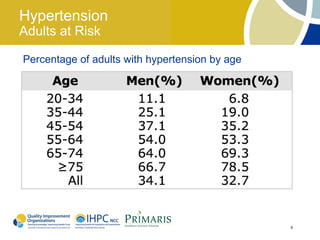
Percentage of adults with hypertension by age


                                                4
Hypertension
Adults at Risk
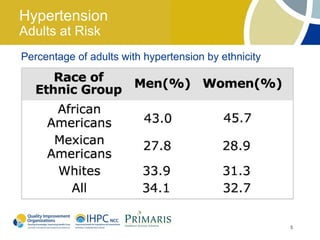
Percentage of adults with hypertension by ethnicity


                                                      5
Hypertension
Adults at Risk

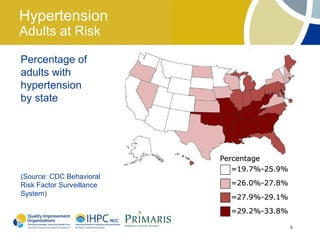
Percentage of
adults with
hypertension
by state


(Source: CDC Behavioral
Risk Factor Surveillance
System)


                           6
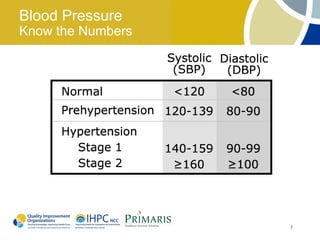
Blood Pressure
Know the Numbers


                   7
Blood Pressure
Cardiovascular Disease (CVD)

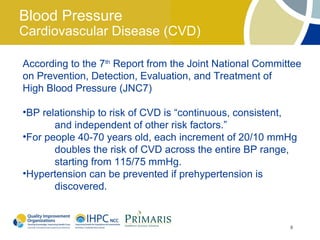
According to the 7th Report from the Joint National Committee
on Prevention, Detection, Evaluation, and Treatment of
High Blood Pressure (JNC7)

•BP relationship to risk of CVD is “continuous, consistent,
       and independent of other risk factors.”
•For people 40-70 years old, each increment of 20/10 mmHg
       doubles the risk of CVD across the entire BP range,
       starting from 115/75 mmHg.
•Hypertension can be prevented if prehypertension is
       discovered.


                                                          8
Blood Pressure
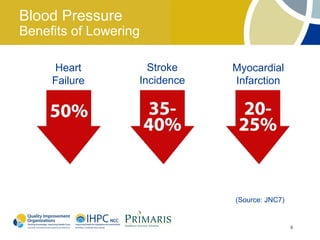
Benefits of Lowering

      Heart          Stroke    Myocardial
     Failure       Incidence   Infarction


                               (Source: JNC7)


                                                9
Hypertension
Evaluation

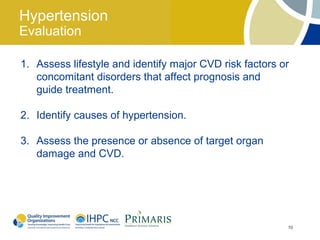
1. Assess lifestyle and identify major CVD risk factors or
   concomitant disorders that affect prognosis and
   guide treatment.

2. Identify causes of hypertension.

3. Assess the presence or absence of target organ
   damage and CVD.


                                                         10
Hypertension Evaluation
1. Assess Lifestyle & CVD Risk Factors


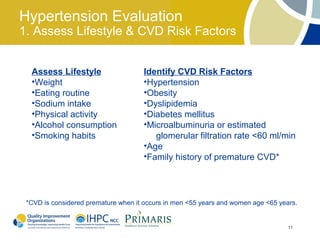
  Assess Lifestyle                   Identify CVD Risk Factors
  •Weight                            •Hypertension
  •Eating routine                    •Obesity
  •Sodium intake                     •Dyslipidemia
  •Physical activity                 •Diabetes mellitus
  •Alcohol consumption               •Microalbuminuria or estimated
  •Smoking habits                       glomerular filtration rate <60 ml/min
                                     •Age
                                     •Family history of premature CVD*


 *CVD is considered premature when it occurs in men <55 years and women age <65 years.


                                                                                   11
Hypertension Evaluation
2. Identify Causes of Hypertension

  Identify Causes of Hypertension
  •Sleep apnea
  •Drug-related causes
  •Chronic kidney disease (CKD)
  •Primary aldosteronism
  •Renovascular disease
  •Chronic steroid therapy and Cushing’s syndrome
  •Pheochromocytoma
  •Coarctation of the aorta
  •Thyroid or parathyroid disease


                                                    12
Hypertension Evaluation
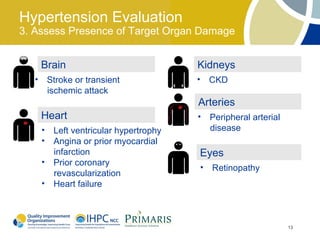
3. Assess Presence of Target Organ Damage


      Brain                               Kidneys
  •       Stroke or transient             • CKD
          ischemic attack
                                          Arteries
      Heart                               •   Peripheral arterial
      •    Left ventricular hypertrophy       disease
      •    Angina or prior myocardial
           infarction                     Eyes
      •    Prior coronary
                                          • Retinopathy
           revascularization
      •    Heart failure


                                                                    13
Treatment
Goal of Therapy

• Reduce CVD and renal morbidity and mortality.

• Treat to BP <140/90 mmHg or BP <130/80 mmHg in
  patients with diabetes or CKD.

• Achieve the systolic BP (SBP) goal, which is especially
  important in persons ≥50 years old.


                                                            14
Treatment
Lifestyle Modification

Modify Lifestyle to             Reduce SBP approximately
•Reduce weight                  5-20 mmHg/10kg weight loss
•Adopt healthy eating plan      8-14 mmHg
•Reduce dietary sodium intake 2-8 mmHg
•Increase physical activity     4-9 mmHg
•Moderate alcohol intake        2-4 mmHg


                                                             15
Treatment
Pharmacological

•Lowering BP with several classes of drugs will reduce the


•Most hypertension patients will need two or more


 (*See algorithm for Treatment of Hypertension in the JNC7 report)


                                                                     16
Treatment
Other Considerations

• CVD risk factors should be treated and
  tobacco avoided.


• Low-dose aspirin therapy should be
  considered but only when BP is
  controlled (risk of hemorrhagic strokes
  increases in patients with uncontrolled
  hypertension).


                                            17
Care Management
Follow-Up

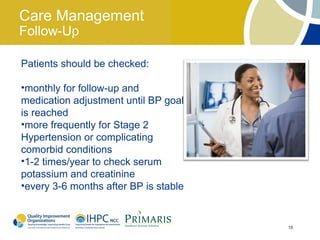
Patients should be checked:

•monthly for follow-up and
medication adjustment until BP goal
is reached
•more frequently for Stage 2
Hypertension or complicating
comorbid conditions
•1-2 times/year to check serum
potassium and creatinine
•every 3-6 months after BP is stable


                                       18
Care Management
Follow-Up
Additional factors that can affect how often patients should
follow-up with their physicians:

Comorbidities                 Other special considerations
•   Ischemic heart disease    •   Minorities
•   Heart failure             •   Obesity
•   Diabetic hypertension     •   Left ventricular hypertrophy
•   CKD                       •   Peripheral arterial disease
•   Cerebrovascular disease   •   Hypertension in older persons
                              •   Postural hypotension
Need for additional           •   Dementia
lab tests                     •   Gender and age
                              •   Urgencies and emergencies


                                                                  19
The Patient’s Choice

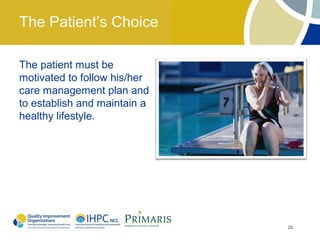
The patient must be
motivated to follow his/her
care management plan and
to establish and maintain a
healthy lifestyle.


                              20
The Patient’s Choice

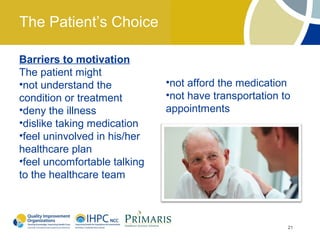
Barriers to motivation
The patient might
•not understand the           •not afford the medication
condition or treatment        •not have transportation to
•deny the illness             appointments
•dislike taking medication
•feel uninvolved in his/her
healthcare plan
•feel uncomfortable talking
to the healthcare team


                                                        21
Patient Tools and Resources
For Motivation and Self-Management

Lifestyle Management
http://www.nhlbi.nih.gov/hbp/prevent/h_eating/h_eating.htm

Medications – Types & Tips
http://www.nhlbi.nih.gov/hbp/treat/treat.htm

Understanding Blood Pressure Readings
http://www.heart.org/HEARTORG/Conditions/HighBloodPressure/AboutHighBloodPressure/U
nderstanding-Blood-Pressure-Readings_UCM_301764_Article.jsp

HBP Risk Calculator
http://www.heart.org/HEARTORG/Conditions/HighBloodPressure/WhyBloodPressureMatters/
Assess-Your-High-Blood-Pressure-Related-Risks_UCM_301829_Article.jsp

HBP Tracker
http://www.heart.org/HEARTORG/Conditions/HighBloodPressure/HighBloodPressureToolsR
esources/Blood-Pressure-Trackers_UCM_303465_Article.jsp


                                                                                22
Contact

Sandy Pogones
spogones@primaris.org
314-374-6451


                        23
Resources

• The 7th Report of the Joint National Committee on
  Prevention, Detection, Evaluation, and Treatment of High
  Blood Pressure (JNC7)
• Million Hearts Blood Pressure Toolkit
• National Heart Lung and Blood Institute (NHLBI)
• NHLBI: Culturally Appropriate Education Materials


                                                         24

Blood Pressure

  • 1.
    Clinical Guidelines— Lowering HighBlood Pressure in Adults
  • 2.
    Hypertension Scope High Blood Pressure (hypertension) •isthe most common primary diagnosis in the U.S., •affects approximately 1 in 3 adults in the U.S., and •affects more than 65% of people over 65 years old. 2
  • 3.
    Hypertension Effects Hypertension can damagethe Brain Heart It’s the most It’s a major risk factor important risk factor for heart attack and the for stroke. #1 risk for congestive heart failure. Kidneys Arteries It can cause the It’s associated with kidneys to fail, stiffer arteries, resulting in dialysis causing the heart and or a kidney kidneys to work transplant. harder. 3
  • 4.
    Hypertension Adults at Risk Percentageof adults with hypertension by age 4
  • 5.
    Hypertension Adults at Risk Percentageof adults with hypertension by ethnicity 5
  • 6.
    Hypertension Adults at Risk Percentageof adults with hypertension by state (Source: CDC Behavioral Risk Factor Surveillance System) 6
  • 7.
  • 8.
    Blood Pressure Cardiovascular Disease(CVD) According to the 7th Report from the Joint National Committee on Prevention, Detection, Evaluation, and Treatment of High Blood Pressure (JNC7) •BP relationship to risk of CVD is “continuous, consistent, and independent of other risk factors.” •For people 40-70 years old, each increment of 20/10 mmHg doubles the risk of CVD across the entire BP range, starting from 115/75 mmHg. •Hypertension can be prevented if prehypertension is discovered. 8
  • 9.
    Blood Pressure Benefits ofLowering Heart Stroke Myocardial Failure Incidence Infarction (Source: JNC7) 9
  • 10.
    Hypertension Evaluation 1. Assess lifestyleand identify major CVD risk factors or concomitant disorders that affect prognosis and guide treatment. 2. Identify causes of hypertension. 3. Assess the presence or absence of target organ damage and CVD. 10
  • 11.
    Hypertension Evaluation 1. AssessLifestyle & CVD Risk Factors Assess Lifestyle Identify CVD Risk Factors •Weight •Hypertension •Eating routine •Obesity •Sodium intake •Dyslipidemia •Physical activity •Diabetes mellitus •Alcohol consumption •Microalbuminuria or estimated •Smoking habits glomerular filtration rate <60 ml/min •Age •Family history of premature CVD* *CVD is considered premature when it occurs in men <55 years and women age <65 years. 11
  • 12.
    Hypertension Evaluation 2. IdentifyCauses of Hypertension Identify Causes of Hypertension •Sleep apnea •Drug-related causes •Chronic kidney disease (CKD) •Primary aldosteronism •Renovascular disease •Chronic steroid therapy and Cushing’s syndrome •Pheochromocytoma •Coarctation of the aorta •Thyroid or parathyroid disease 12
  • 13.
    Hypertension Evaluation 3. AssessPresence of Target Organ Damage Brain Kidneys • Stroke or transient • CKD ischemic attack Arteries Heart • Peripheral arterial • Left ventricular hypertrophy disease • Angina or prior myocardial infarction Eyes • Prior coronary • Retinopathy revascularization • Heart failure 13
  • 14.
    Treatment Goal of Therapy •Reduce CVD and renal morbidity and mortality. • Treat to BP <140/90 mmHg or BP <130/80 mmHg in patients with diabetes or CKD. • Achieve the systolic BP (SBP) goal, which is especially important in persons ≥50 years old. 14
  • 15.
    Treatment Lifestyle Modification Modify Lifestyleto Reduce SBP approximately •Reduce weight 5-20 mmHg/10kg weight loss •Adopt healthy eating plan 8-14 mmHg •Reduce dietary sodium intake 2-8 mmHg •Increase physical activity 4-9 mmHg •Moderate alcohol intake 2-4 mmHg 15
  • 16.
    Treatment Pharmacological •Lowering BP withseveral classes of drugs will reduce the •Most hypertension patients will need two or more (*See algorithm for Treatment of Hypertension in the JNC7 report) 16
  • 17.
    Treatment Other Considerations • CVDrisk factors should be treated and tobacco avoided. • Low-dose aspirin therapy should be considered but only when BP is controlled (risk of hemorrhagic strokes increases in patients with uncontrolled hypertension). 17
  • 18.
    Care Management Follow-Up Patients shouldbe checked: •monthly for follow-up and medication adjustment until BP goal is reached •more frequently for Stage 2 Hypertension or complicating comorbid conditions •1-2 times/year to check serum potassium and creatinine •every 3-6 months after BP is stable 18
  • 19.
    Care Management Follow-Up Additional factorsthat can affect how often patients should follow-up with their physicians: Comorbidities Other special considerations • Ischemic heart disease • Minorities • Heart failure • Obesity • Diabetic hypertension • Left ventricular hypertrophy • CKD • Peripheral arterial disease • Cerebrovascular disease • Hypertension in older persons • Postural hypotension Need for additional • Dementia lab tests • Gender and age • Urgencies and emergencies 19
  • 20.
    The Patient’s Choice Thepatient must be motivated to follow his/her care management plan and to establish and maintain a healthy lifestyle. 20
  • 21.
    The Patient’s Choice Barriersto motivation The patient might •not understand the •not afford the medication condition or treatment •not have transportation to •deny the illness appointments •dislike taking medication •feel uninvolved in his/her healthcare plan •feel uncomfortable talking to the healthcare team 21
  • 22.
    Patient Tools andResources For Motivation and Self-Management Lifestyle Management http://www.nhlbi.nih.gov/hbp/prevent/h_eating/h_eating.htm Medications – Types & Tips http://www.nhlbi.nih.gov/hbp/treat/treat.htm Understanding Blood Pressure Readings http://www.heart.org/HEARTORG/Conditions/HighBloodPressure/AboutHighBloodPressure/U nderstanding-Blood-Pressure-Readings_UCM_301764_Article.jsp HBP Risk Calculator http://www.heart.org/HEARTORG/Conditions/HighBloodPressure/WhyBloodPressureMatters/ Assess-Your-High-Blood-Pressure-Related-Risks_UCM_301829_Article.jsp HBP Tracker http://www.heart.org/HEARTORG/Conditions/HighBloodPressure/HighBloodPressureToolsR esources/Blood-Pressure-Trackers_UCM_303465_Article.jsp 22
  • 23.
  • 24.
    Resources • The 7thReport of the Joint National Committee on Prevention, Detection, Evaluation, and Treatment of High Blood Pressure (JNC7) • Million Hearts Blood Pressure Toolkit • National Heart Lung and Blood Institute (NHLBI) • NHLBI: Culturally Appropriate Education Materials 24