Process Modelling And Simulation
(CH-4311)
Total Number of Lectures: 40
Madhusree Kundu
Department of Chemical Engineering
National Institute of Technology
Rourkela, Orissa
India
10/19/2021 1
• Instructional Objectives
1. The students will be able to Develop mathematical models for various
chemical processes with the help of first principles.
Find the numerical solution of the proposed model using available
numerical methods and MATLAB as simulation Platform.
2. The students will be able to Identification of plant data (time series
signals) using MATLAB System identification toolbox.
3. The students will be able to Learn Machine learning algorithms and
its superset Artificial Intelligence (AI)
4. The students will be able to explore and utilize MATLAB BASED
TOOLBOX: System identification toolbox, Differential equation solver,
and machine-learning toolbox
10/19/2021 2
On Completion of the Course
Course Modules
1. First principle Modeling and Simulation
2. Identification of approximate/lower order models
3. Machine Learning
4. Exploration of MATLAB BASED TOOLBOX
10/19/2021 3
Module Instructional Objectives
Process Modeling and Dynamic Simulation
1. The students will be able to develop mathematical models of
processes related to mass, heat and fluid transfer, separation and
reaction using conservation principles.
2. The students will be able to analyze the dynamics of the aforesaid
processes performing dynamic simulation using the
MATLAB/SIMULINK environment which would help them to monitor
an ongoing process and design appropriate controllers for that
process to ensure product quality and process safety
Process Identification
The students will be able to develop input-output models like ARX, AR,
ARMA, NRMA etc. using plant/experimental time series data, which might
help them in successful monitoring and control of a specific process.
10/19/2021 4
Module Instructional Objectives
Machine Learning
The students will be able to utilize various machine learning
algorithms including AI in solving regression, classification, parameter
estimation problems of data based models, in developing process
monitoring tools and controlling of a process
10/19/2021 5
System identification toolbox, Differential equation solver, and
machine-learning toolbox.
Exploration of MATLAB BASED TOOLBOX
Units
10/19/2021 6
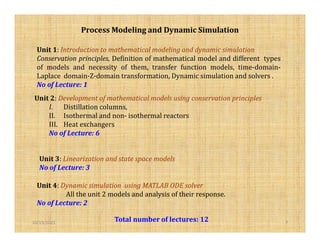
Process Modeling and Dynamic Simulation
Unit 1: Introduction to mathematical modeling and dynamic simulation
Conservation principles, Definition of mathematical model and different types
of models and necessity of them, transfer function models, time-domain-
Laplace domain-Z-domain transformation, Dynamic simulation and solvers .
No of Lecture: 1
Unit 2: Development of mathematical models using conservation principles
I. Distillation columns,
II. Isothermal and non- isothermal reactors
III. Heat exchangers
No of Lecture: 6
Unit 3: Linearization and state space models
No of Lecture: 3
Unit 4: Dynamic simulation using MATLAB ODE solver
All the unit 2 models and analysis of their response.
No of Lecture: 2
Total number of lectures: 12
10/19/2021 7
Process Identification
Unit 1: Introduction to time series data
Time series data and their attributes, auto correlation, partial correlation, cross
correlation, Stationary and non-stationary data, sampling continuous signal,
reconstruction Of continuous signals from their discrete time values, conversion of
continuous to discrete Time models
No of Lecture: 5
Unit 2: Time series models
AR, ARMA, ARMAX, NRMA, NRMAX, output error models for correlating time
series data
No of Lecture:3
Unit 3: System identification tool-box in MATLAB
Use of system identification tool-box for correlating time series data
No of Lecture: 2
Total number of lectures: 10
10/19/2021 8
10/19/2021 9
Machine Learning
Unit 3: Support vector machines (SVM) Algorithms ,and AI architectures
No of Lecture: 3
Unit 1: Introduction to Machine Learning, Chemmometrics, and Artificial
Intelligence (AI). supervised learning, unsupervised learning, and reinforcement
learning and its application for Chemical Proses Industries in Specific, Data
acquisition and preprocessing, attributes of data
No of Lecture:4
Unit 2: : Dimensionality Reduction and Regression and classification
Algorithms, k- Nearest Neighbors (kNN), K-Means Algorithms
No of Lecture: 3
Total number of lectures: 10
10/19/2021 10
Exploration of MATLAB BASED TOOLBOX
Unit 1: System identification toolbox
2 Classes
Unit 2: Differential equation solver
2 Classes
Unit 3: Machine Learning toolbox
4 Classes
Total number of lectures: 8
Essential Reading:
B. Roffel, B. Betlem, “Process Dynamics & Control: Modeling for control and
prediction. John Wiley & Sons Ltd., 2006
William L. Luyben, “Process modeling, simulation, and control for chemical
engineers. ” Second Edition, McGraw-Hill, 1996
Supplementary Reading:
B. Wayne Bequette, “Process Control: Modeling, Design, and Simulation
(International Series in the Physical and Chemical Engineering Sciences) 2nd Edition,
2021.
Madhusree Kundu, Palash Kundu, Seshu Kumar Damarla (2017). A Chemometric
Approach to Monitoring: Product Quality Assessment, Process Fault Detection and
Miscellaneous Applications, 1st Edition, CRC Press, Taylor & Francis Group
(Published 3 October, 2017).
Books
10/19/2021 11
Process Modelling and
Simulation
Madhusree Kundu
CSTR Modeling
Continuously Stirred Tank Reactor (CSTR)
A reactor is used to convert a hazardous
chemical A to an acceptable chemical B in waste
stream before entering a nearby lake. This
particular reactor is dynamically modeled as a
Continuously Stirred Tank Reactor (CSTR) with a
simplified kinetic mechanism that describes the
conversion of reactant A to product B with an
irreversible and exothermic reaction. It is
desired to maintain the temperature at a
constant setpoint that maximizes the
destruction of A (highest possible temperature).
PMS Chemical Engineering Notes

PMS Chemical Engineering Notes

  • 1.
    Process Modelling AndSimulation (CH-4311) Total Number of Lectures: 40 Madhusree Kundu Department of Chemical Engineering National Institute of Technology Rourkela, Orissa India 10/19/2021 1
  • 2.
    • Instructional Objectives 1.The students will be able to Develop mathematical models for various chemical processes with the help of first principles. Find the numerical solution of the proposed model using available numerical methods and MATLAB as simulation Platform. 2. The students will be able to Identification of plant data (time series signals) using MATLAB System identification toolbox. 3. The students will be able to Learn Machine learning algorithms and its superset Artificial Intelligence (AI) 4. The students will be able to explore and utilize MATLAB BASED TOOLBOX: System identification toolbox, Differential equation solver, and machine-learning toolbox 10/19/2021 2 On Completion of the Course
  • 3.
    Course Modules 1. Firstprinciple Modeling and Simulation 2. Identification of approximate/lower order models 3. Machine Learning 4. Exploration of MATLAB BASED TOOLBOX 10/19/2021 3
  • 4.
    Module Instructional Objectives ProcessModeling and Dynamic Simulation 1. The students will be able to develop mathematical models of processes related to mass, heat and fluid transfer, separation and reaction using conservation principles. 2. The students will be able to analyze the dynamics of the aforesaid processes performing dynamic simulation using the MATLAB/SIMULINK environment which would help them to monitor an ongoing process and design appropriate controllers for that process to ensure product quality and process safety Process Identification The students will be able to develop input-output models like ARX, AR, ARMA, NRMA etc. using plant/experimental time series data, which might help them in successful monitoring and control of a specific process. 10/19/2021 4
  • 5.
    Module Instructional Objectives MachineLearning The students will be able to utilize various machine learning algorithms including AI in solving regression, classification, parameter estimation problems of data based models, in developing process monitoring tools and controlling of a process 10/19/2021 5 System identification toolbox, Differential equation solver, and machine-learning toolbox. Exploration of MATLAB BASED TOOLBOX
  • 6.
  • 7.
    Process Modeling andDynamic Simulation Unit 1: Introduction to mathematical modeling and dynamic simulation Conservation principles, Definition of mathematical model and different types of models and necessity of them, transfer function models, time-domain- Laplace domain-Z-domain transformation, Dynamic simulation and solvers . No of Lecture: 1 Unit 2: Development of mathematical models using conservation principles I. Distillation columns, II. Isothermal and non- isothermal reactors III. Heat exchangers No of Lecture: 6 Unit 3: Linearization and state space models No of Lecture: 3 Unit 4: Dynamic simulation using MATLAB ODE solver All the unit 2 models and analysis of their response. No of Lecture: 2 Total number of lectures: 12 10/19/2021 7
  • 8.
    Process Identification Unit 1:Introduction to time series data Time series data and their attributes, auto correlation, partial correlation, cross correlation, Stationary and non-stationary data, sampling continuous signal, reconstruction Of continuous signals from their discrete time values, conversion of continuous to discrete Time models No of Lecture: 5 Unit 2: Time series models AR, ARMA, ARMAX, NRMA, NRMAX, output error models for correlating time series data No of Lecture:3 Unit 3: System identification tool-box in MATLAB Use of system identification tool-box for correlating time series data No of Lecture: 2 Total number of lectures: 10 10/19/2021 8
  • 9.
    10/19/2021 9 Machine Learning Unit3: Support vector machines (SVM) Algorithms ,and AI architectures No of Lecture: 3 Unit 1: Introduction to Machine Learning, Chemmometrics, and Artificial Intelligence (AI). supervised learning, unsupervised learning, and reinforcement learning and its application for Chemical Proses Industries in Specific, Data acquisition and preprocessing, attributes of data No of Lecture:4 Unit 2: : Dimensionality Reduction and Regression and classification Algorithms, k- Nearest Neighbors (kNN), K-Means Algorithms No of Lecture: 3 Total number of lectures: 10
  • 10.
    10/19/2021 10 Exploration ofMATLAB BASED TOOLBOX Unit 1: System identification toolbox 2 Classes Unit 2: Differential equation solver 2 Classes Unit 3: Machine Learning toolbox 4 Classes Total number of lectures: 8
  • 11.
    Essential Reading: B. Roffel,B. Betlem, “Process Dynamics & Control: Modeling for control and prediction. John Wiley & Sons Ltd., 2006 William L. Luyben, “Process modeling, simulation, and control for chemical engineers. ” Second Edition, McGraw-Hill, 1996 Supplementary Reading: B. Wayne Bequette, “Process Control: Modeling, Design, and Simulation (International Series in the Physical and Chemical Engineering Sciences) 2nd Edition, 2021. Madhusree Kundu, Palash Kundu, Seshu Kumar Damarla (2017). A Chemometric Approach to Monitoring: Product Quality Assessment, Process Fault Detection and Miscellaneous Applications, 1st Edition, CRC Press, Taylor & Francis Group (Published 3 October, 2017). Books 10/19/2021 11
  • 12.
  • 13.
    CSTR Modeling Continuously StirredTank Reactor (CSTR) A reactor is used to convert a hazardous chemical A to an acceptable chemical B in waste stream before entering a nearby lake. This particular reactor is dynamically modeled as a Continuously Stirred Tank Reactor (CSTR) with a simplified kinetic mechanism that describes the conversion of reactant A to product B with an irreversible and exothermic reaction. It is desired to maintain the temperature at a constant setpoint that maximizes the destruction of A (highest possible temperature).