What’s new in
PMBoK 6th Edition?
Maksat Abdildayev, PMP, PMI member
Agenda
 1. Review of Major Changes
 2. Review of changes to each knowledge area
 3. Discuss with club mates their insights on new changes
Video from PMI
 https://www.pmi.org/agile-
pmbok?sc_camp=7B5E7704BC054E758446FC4354782EF5
&utm_source=pmi&utm_medium=website&utm_term=D
XP4956&utm_content=HomePage_HeroImage&utm_cam
paign=agile-
pmbok_ldpg_11_25_17&utm_aud=PMIwebsite&utm_thm
=learning&utm_sdte=11_25_17&utm_dep=mkt
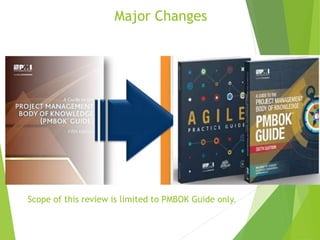
Major Changes
Scope of this review is limited to PMBOK Guide only.
Major Changes
Acknowledge Agile
 Separate Agile Practice Guide released by both PMI and Agile
Alliance.
 When to select Agile
 How to apply agile in your context
 How PMBOK 6th edition is mapped to Agile practices
 PMBOK 6th edition in each Knowledge area have a Consideration
for Agile/Adaptive Environments.
 Some agile-specific tools and techniques have been introduced,
such as sprint and iteration planning.
 Appendix X3 describes it in more details.
My personal feedback: PMI has finally acknowledged agile and
incorporated it into all knowledge areas and processes. That
cannot be bad since agile is used not only in IT but also in
manufacturing, education, health care, etc.
What is your feedback?
Major Changes
Better Structure
 There are 3 parts in PMBOK 6th edition now:
 Part 1. A Guide to the Project Management Body of Knowledge
 Part 2. The Standard for Project Management
 Part 3. Appendices, Glossary, and Index
 In PMBOK 5th edition there wasn’t such explicit division between a
Guide and Standard.
My personal feedback: New structure seems more convenient and
understood
What is your feedback?
Major Changes
Stress on Adaptation and Tailoring
 PMI has clearly stated that PMBOK is not a methodology for project
management, it is rather a guide to create a project management
methodology in your performing organization
 First level of Adaptation: Methodology can be created by internal
experts or externally outsourced professional consultants using
PMBOK 6th edition.
 Second level of Adaptation: project methodology takes into
account the uniqueness of each project within performing
organization, so project manager can adapt processes according
the special conditions of his project.
 In each Knowledge Area there is a subsection named Tailoring
Considerations – more details how you can customize processes to
your project
My personal feedback: New PMBOK is now more flexible and adaptive
What is your feedback?
Major Changes
More Focus on Business needs
 PMBOK 6th edition is now more focused on business needs and
resembles PRINCE2 now.
 1. Project Business Case – a documented economic feasibility study
 2. Project benefits management plan – a documented explanation
defining the processes for creating, maximizing, and sustaining the
benefits provided by a project.
 3. Additional Project Manager’s competencies were introduced as a
logical consequence of previous two items.
 New separate section about Project Manager’s Role.
 PMI Talent Triangle®:
 Technical Project Management
 Leadership
 Strategic and Business Management
My personal feedback: Focus on strategic and business side of the
project is really reinforcing the PM’s and projects’ role in an
organizations.
What is your feedback?
Major Changes
More Focus on Knowledge Management
 PMBOK 6th edition has now focus on Knowledge
Management process
 In the Integration Management Knowledge area a new process
was added: 4.4 Manage Project Knowledge
 Probably the reason is because Agile approaches are
extensively generate knowledge during the project life cycle.
 There are 2 interesting tools:
 Knowledge management (explicit and tacit knowledge, networking,
communities of interests, etc.)
 Information management (coding explicit knowledge, information
gathering and search in web, PMIS, etc.)
My personal feedback: Focus on knowledge management of
the project is far better now than just archiving lessons
learned in the past.
What is your feedback?
Major Changes
More Attention on Enterprise Environment
 PMBOK 6th edition has now a separate section on Enterprise Environment.
 Enterprise Environmental Factors are now categorized into two parts: internal and external
 Internal: Organizational Culture, structure, and governance, geographic distribution of facilities and
resources, infrastructure, software, etc.
 External: marketplace conditions, social and cultural influence, etc.
 Organizational Process Assets are now stated to be originated internally, and are divided into
[Processes, Policies, and Procedures] and Corporate Knowledge Base
 Organizational Systems – in new PMBOK 6th edition organizations are treated as complex systems
in which projects operate within the constraints imposed by the organization through their
structure and governance framework. Three main elements:
 Management elements
 Governance frameworks
 Organizational Structure types
 Organizational structure types – 5 new types of organizational structures:
 Organic or Simple
 Multidivisional
 Virtual
 Hybrid
 PMO
My personal feedback: Although lots of examples for each category is provided and it is
easy to understand some points, some other points are not really clear – new organizational
structures introduction (PMO for example)
What is your feedback?
Changes in PMBOK chapters
 Starting from page 642 of PMBOK 6th edition there is an
overview of the changes to the 6th edition.
 Let’s look at them briefly
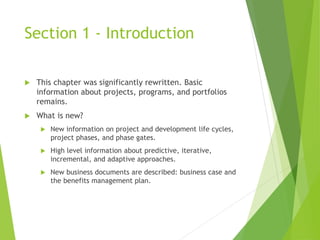
Section 1 - Introduction
 This chapter was significantly rewritten. Basic
information about projects, programs, and portfolios
remains.
 What is new?
 New information on project and development life cycles,
project phases, and phase gates.
 High level information about predictive, iterative,
incremental, and adaptive approaches.
 New business documents are described: business case and
the benefits management plan.
Section 2 – The Environment
in which projects operate
 This chapter was significantly rewritten. Basic
information about OPA and EEF remains.
 What is new?
 New content on governance, management elements, and
organizational structure types.
Section 3 – The Role of
Project Manager
 This chapter is completely new chapter.
 What is new?
 PMI Talent Triangle is introduced:
 Strategic and Business management skills
 Leadership
 Technical Project Management skills
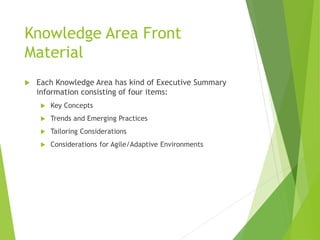
Knowledge Area Front
Material
 Each Knowledge Area has kind of Executive Summary
information consisting of four items:
 Key Concepts
 Trends and Emerging Practices
 Tailoring Considerations
 Considerations for Agile/Adaptive Environments
Changes in Knowledge Areas
names
 Project Time Management  Project Schedule
Management
 Project Human Resource Management  Project
Resource Management
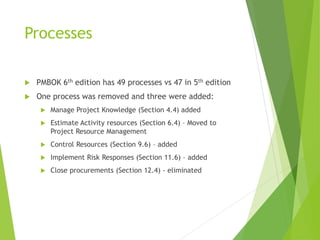
Processes
 PMBOK 6th edition has 49 processes vs 47 in 5th edition
 One process was removed and three were added:
 Manage Project Knowledge (Section 4.4) added
 Estimate Activity resources (Section 6.4) – Moved to
Project Resource Management
 Control Resources (Section 9.6) – added
 Implement Risk Responses (Section 11.6) – added
 Close procurements (Section 12.4) - eliminated
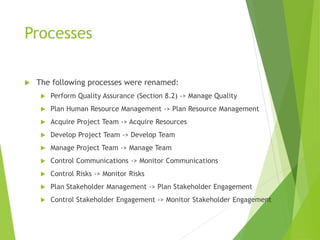
Processes
 The following processes were renamed:
 Perform Quality Assurance (Section 8.2) -> Manage Quality
 Plan Human Resource Management -> Plan Resource Management
 Acquire Project Team -> Acquire Resources
 Develop Project Team -> Develop Team
 Manage Project Team -> Manage Team
 Control Communications -> Monitor Communications
 Control Risks -> Monitor Risks
 Plan Stakeholder Management -> Plan Stakeholder Engagement
 Control Stakeholder Engagement -> Monitor Stakeholder Engagement
Project Integration
Management
 Focus on Pre Project activities
 Focus on business value
 New process – Manage Project Knowledge
 Close Project or Phase (includes Close Procurements)
 More explicit on project documents change
management
Project Scope Management
 More Agile Approach in gathering requirements
 Business Analysts role is elaborated
Project Schedule
Management
 Process “Estimate Activity Resources” moved to the
“Project Resource Management” knowledge area.
 Iterative and on demand scheduling
 Agile Release Planning and Iterative planning
 Monitoring tools like Burndown Charts
Project Cost Management
 Recognize Earned Schedule (ES) as an extension of
Earned Value Management
Project Quality Management
 Change from “Perform Quality Assurance”  “Manage
Quality”
 More Tools to manage and control quality
Project Resource
Management
 Process Renamed from Human Resource Management
 Added Estimate Activity Resources
 Added Control Resources
 Self Organizing Teams
 Team Values
 Team Agreements
Project Communication
Management
 1. Agile Communication
 2. Social Communication
 3. Rename Control Communication to “Monitor
Communications”
Project Risk Management
 Non Event Risks
 Project Resilience
 Added Process: Implement Risk Responses
 Rename Control Risks to Monitor Risks
 New strategy: “Escalate Responses”
Project Procurement
Management
 Process “Close Procurement” is removed
Project Stakeholder
Engagement
 Rename: Plan Stakeholder Engagement
 Rename: Monitor Stakeholder Engagement
Impact on PMP exam
 PMP is based on PMI’s Role Delineation Study
 Understanding of Agile is needed now
 All content of PMBOK 5th edition remains relevant
 Clarity on ITTO
 20% more effort to learn
Conclusion
PMBOK 6th Edition has become better
My personal feedback: PMI has done a great job by monitoring
the latest trends in the field of project management and then
embedding them into the PMBOK.
What is your feedback?

Pmi chapter 29.11.2017

  • 1.
    What’s new in PMBoK6th Edition? Maksat Abdildayev, PMP, PMI member
  • 2.
    Agenda  1. Reviewof Major Changes  2. Review of changes to each knowledge area  3. Discuss with club mates their insights on new changes
  • 3.
    Video from PMI https://www.pmi.org/agile- pmbok?sc_camp=7B5E7704BC054E758446FC4354782EF5 &utm_source=pmi&utm_medium=website&utm_term=D XP4956&utm_content=HomePage_HeroImage&utm_cam paign=agile- pmbok_ldpg_11_25_17&utm_aud=PMIwebsite&utm_thm =learning&utm_sdte=11_25_17&utm_dep=mkt
  • 4.
    Major Changes Scope ofthis review is limited to PMBOK Guide only.
  • 5.
    Major Changes Acknowledge Agile Separate Agile Practice Guide released by both PMI and Agile Alliance.  When to select Agile  How to apply agile in your context  How PMBOK 6th edition is mapped to Agile practices  PMBOK 6th edition in each Knowledge area have a Consideration for Agile/Adaptive Environments.  Some agile-specific tools and techniques have been introduced, such as sprint and iteration planning.  Appendix X3 describes it in more details. My personal feedback: PMI has finally acknowledged agile and incorporated it into all knowledge areas and processes. That cannot be bad since agile is used not only in IT but also in manufacturing, education, health care, etc. What is your feedback?
  • 6.
    Major Changes Better Structure There are 3 parts in PMBOK 6th edition now:  Part 1. A Guide to the Project Management Body of Knowledge  Part 2. The Standard for Project Management  Part 3. Appendices, Glossary, and Index  In PMBOK 5th edition there wasn’t such explicit division between a Guide and Standard. My personal feedback: New structure seems more convenient and understood What is your feedback?
  • 7.
    Major Changes Stress onAdaptation and Tailoring  PMI has clearly stated that PMBOK is not a methodology for project management, it is rather a guide to create a project management methodology in your performing organization  First level of Adaptation: Methodology can be created by internal experts or externally outsourced professional consultants using PMBOK 6th edition.  Second level of Adaptation: project methodology takes into account the uniqueness of each project within performing organization, so project manager can adapt processes according the special conditions of his project.  In each Knowledge Area there is a subsection named Tailoring Considerations – more details how you can customize processes to your project My personal feedback: New PMBOK is now more flexible and adaptive What is your feedback?
  • 8.
    Major Changes More Focuson Business needs  PMBOK 6th edition is now more focused on business needs and resembles PRINCE2 now.  1. Project Business Case – a documented economic feasibility study  2. Project benefits management plan – a documented explanation defining the processes for creating, maximizing, and sustaining the benefits provided by a project.  3. Additional Project Manager’s competencies were introduced as a logical consequence of previous two items.  New separate section about Project Manager’s Role.  PMI Talent Triangle®:  Technical Project Management  Leadership  Strategic and Business Management My personal feedback: Focus on strategic and business side of the project is really reinforcing the PM’s and projects’ role in an organizations. What is your feedback?
  • 9.
    Major Changes More Focuson Knowledge Management  PMBOK 6th edition has now focus on Knowledge Management process  In the Integration Management Knowledge area a new process was added: 4.4 Manage Project Knowledge  Probably the reason is because Agile approaches are extensively generate knowledge during the project life cycle.  There are 2 interesting tools:  Knowledge management (explicit and tacit knowledge, networking, communities of interests, etc.)  Information management (coding explicit knowledge, information gathering and search in web, PMIS, etc.) My personal feedback: Focus on knowledge management of the project is far better now than just archiving lessons learned in the past. What is your feedback?
  • 10.
    Major Changes More Attentionon Enterprise Environment  PMBOK 6th edition has now a separate section on Enterprise Environment.  Enterprise Environmental Factors are now categorized into two parts: internal and external  Internal: Organizational Culture, structure, and governance, geographic distribution of facilities and resources, infrastructure, software, etc.  External: marketplace conditions, social and cultural influence, etc.  Organizational Process Assets are now stated to be originated internally, and are divided into [Processes, Policies, and Procedures] and Corporate Knowledge Base  Organizational Systems – in new PMBOK 6th edition organizations are treated as complex systems in which projects operate within the constraints imposed by the organization through their structure and governance framework. Three main elements:  Management elements  Governance frameworks  Organizational Structure types  Organizational structure types – 5 new types of organizational structures:  Organic or Simple  Multidivisional  Virtual  Hybrid  PMO My personal feedback: Although lots of examples for each category is provided and it is easy to understand some points, some other points are not really clear – new organizational structures introduction (PMO for example) What is your feedback?
  • 11.
    Changes in PMBOKchapters  Starting from page 642 of PMBOK 6th edition there is an overview of the changes to the 6th edition.  Let’s look at them briefly
  • 12.
    Section 1 -Introduction  This chapter was significantly rewritten. Basic information about projects, programs, and portfolios remains.  What is new?  New information on project and development life cycles, project phases, and phase gates.  High level information about predictive, iterative, incremental, and adaptive approaches.  New business documents are described: business case and the benefits management plan.
  • 13.
    Section 2 –The Environment in which projects operate  This chapter was significantly rewritten. Basic information about OPA and EEF remains.  What is new?  New content on governance, management elements, and organizational structure types.
  • 14.
    Section 3 –The Role of Project Manager  This chapter is completely new chapter.  What is new?  PMI Talent Triangle is introduced:  Strategic and Business management skills  Leadership  Technical Project Management skills
  • 15.
    Knowledge Area Front Material Each Knowledge Area has kind of Executive Summary information consisting of four items:  Key Concepts  Trends and Emerging Practices  Tailoring Considerations  Considerations for Agile/Adaptive Environments
  • 16.
    Changes in KnowledgeAreas names  Project Time Management  Project Schedule Management  Project Human Resource Management  Project Resource Management
  • 17.
    Processes  PMBOK 6thedition has 49 processes vs 47 in 5th edition  One process was removed and three were added:  Manage Project Knowledge (Section 4.4) added  Estimate Activity resources (Section 6.4) – Moved to Project Resource Management  Control Resources (Section 9.6) – added  Implement Risk Responses (Section 11.6) – added  Close procurements (Section 12.4) - eliminated
  • 18.
    Processes  The followingprocesses were renamed:  Perform Quality Assurance (Section 8.2) -> Manage Quality  Plan Human Resource Management -> Plan Resource Management  Acquire Project Team -> Acquire Resources  Develop Project Team -> Develop Team  Manage Project Team -> Manage Team  Control Communications -> Monitor Communications  Control Risks -> Monitor Risks  Plan Stakeholder Management -> Plan Stakeholder Engagement  Control Stakeholder Engagement -> Monitor Stakeholder Engagement
  • 19.
    Project Integration Management  Focuson Pre Project activities  Focus on business value  New process – Manage Project Knowledge  Close Project or Phase (includes Close Procurements)  More explicit on project documents change management
  • 20.
    Project Scope Management More Agile Approach in gathering requirements  Business Analysts role is elaborated
  • 21.
    Project Schedule Management  Process“Estimate Activity Resources” moved to the “Project Resource Management” knowledge area.  Iterative and on demand scheduling  Agile Release Planning and Iterative planning  Monitoring tools like Burndown Charts
  • 22.
    Project Cost Management Recognize Earned Schedule (ES) as an extension of Earned Value Management
  • 23.
    Project Quality Management Change from “Perform Quality Assurance”  “Manage Quality”  More Tools to manage and control quality
  • 24.
    Project Resource Management  ProcessRenamed from Human Resource Management  Added Estimate Activity Resources  Added Control Resources  Self Organizing Teams  Team Values  Team Agreements
  • 25.
    Project Communication Management  1.Agile Communication  2. Social Communication  3. Rename Control Communication to “Monitor Communications”
  • 26.
    Project Risk Management Non Event Risks  Project Resilience  Added Process: Implement Risk Responses  Rename Control Risks to Monitor Risks  New strategy: “Escalate Responses”
  • 27.
    Project Procurement Management  Process“Close Procurement” is removed
  • 28.
    Project Stakeholder Engagement  Rename:Plan Stakeholder Engagement  Rename: Monitor Stakeholder Engagement
  • 29.
    Impact on PMPexam  PMP is based on PMI’s Role Delineation Study  Understanding of Agile is needed now  All content of PMBOK 5th edition remains relevant  Clarity on ITTO  20% more effort to learn
  • 30.
    Conclusion PMBOK 6th Editionhas become better My personal feedback: PMI has done a great job by monitoring the latest trends in the field of project management and then embedding them into the PMBOK. What is your feedback?