08/01/13
1
Performance Management TrainingPerformance Management Training
for IBNA Managers and Supervisorsfor IBNA Managers and Supervisors
Presented by: Lynne Rowe
AVP Human Resources &
Judy-Ann McKenzie, VP/ Director HR
08/01/13
2
Today’sToday’s AgendaAgenda
 Introductions
 Objectives
 Performance Management Process
 Standards and goals
 Revised Appraisal Tool
 Annual and Mid-year Performance
Appraisals
 Reinforcement Strategies
 Summary and Closing
08/01/13
3
Let’s Get StartedLet’s Get Started
 Upon completion of this session, you will:
– Understand the Performance Management
process
– List the characteristics of a performance
appraisal
– Learn how to develop S.M.A.R.T. objectives
– Describe the benefits of documenting
performance
– Learn how to define and identify standards and
procedures for documenting performance
– Know how to use the revised performance
appraisal tool
– Year-end process
08/01/13
4
Are We All on the Same Page?Are We All on the Same Page?
 What is Performance Management?
– Is a process of documenting and monitoring an
individual’s performance
– A strategy for improving employee performance
and productivity
– A way to remove the subjectivity out of the
evaluation, and prevent litigation
– A system that drives business results and
reinforces the company’s culture
08/01/13
5
The Performance AppraisalThe Performance Appraisal
 A formal periodic review of an individual’s
performance
 Are conducted annually or semi-annually
 Based on documented performance
 Compares documented performance to
establish standards/goals
 Rates the individual’s performance
 Influences the employee’s pay, promotions,
bonuses
 Written or typed, approved and signed by
supervisor or subordinate
 Effective and fair
08/01/13
6
What is the Appraisal intended toWhat is the Appraisal intended to
do?do?
Communicate Expected standards of
performance
Provide feedback to the employee
Provide an objective basis for the
supervisor’s decisions regarding a
particular employee
Reward employees for top
performance
08/01/13
7
Setting Goals and ObjectivesSetting Goals and Objectives
 Employees need to know what are the
expectations
 How will achievements be measured?
 To ensure “Objectives” are met – and are
tangible, measurable and observable:
– Who will do what? – Resources
– When will it be done? -Time frame
– How will it be done? - get desired results
 What is an ongoing performance criteria that
must be met time after time?
08/01/13
8
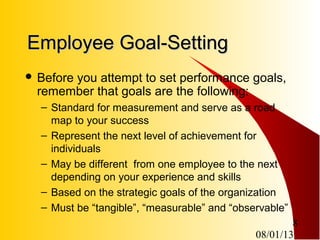
Employee Goal-SettingEmployee Goal-Setting
 Before you attempt to set performance goals,
remember that goals are the following:
– Standard for measurement and serve as a road
map to your success
– Represent the next level of achievement for
individuals
– May be different from one employee to the next
depending on your experience and skills
– Based on the strategic goals of the organization
– Must be “tangible”, “measurable” and “observable”
08/01/13
9
Stating Objectives the S.M.A.R.T. WayStating Objectives the S.M.A.R.T. Way
 Specific
– Spelling out the details, particular, focused
 Measurable
– Quantifiable, provides a standard for comparison
 Attainable
– Practical, achievable, possible
 Results-oriented
– Indicates activity by use of an action verb
 Time-related
– Scheduled, regulated by time, a deadline
08/01/13
10
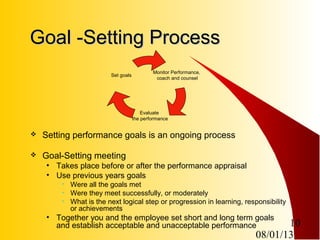
Goal -Setting ProcessGoal -Setting Process
Monitor Performance,
coach and counsel
Evaluate
the performance
Set goals
 Setting performance goals is an ongoing process
 Goal-Setting meeting
• Takes place before or after the performance appraisal
• Use previous years goals
• Were all the goals met
• Were they meet successfully, or moderately
• What is the next logical step or progression in learning, responsibility
or achievements
• Together you and the employee set short and long term goals
and establish acceptable and unacceptable performance
08/01/13
11
Documenting PerformanceDocumenting Performance
 What to Document?
– Employee performance compared to an
established standard
 Quantity of work
 Quality of work
 Number and size of sales
 Cost –consciousness
 Ability to follow directions
 Time management
 Safety
 Attendance and tardiness
 Behavior and attitude
08/01/13
12
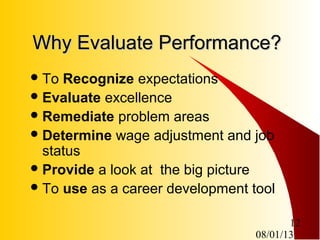
Why Evaluate Performance?Why Evaluate Performance?
To Recognize expectations
Evaluate excellence
Remediate problem areas
Determine wage adjustment and job
status
Provide a look at the big picture
To use as a career development tool
08/01/13
13
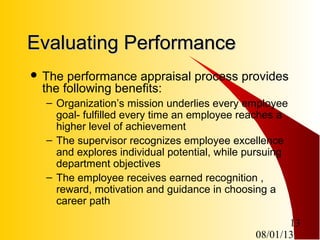
Evaluating PerformanceEvaluating Performance
 The performance appraisal process provides
the following benefits:
– Organization’s mission underlies every employee
goal- fulfilled every time an employee reaches a
higher level of achievement
– The supervisor recognizes employee excellence
and explores individual potential, while pursuing
department objectives
– The employee receives earned recognition ,
reward, motivation and guidance in choosing a
career path
08/01/13
14
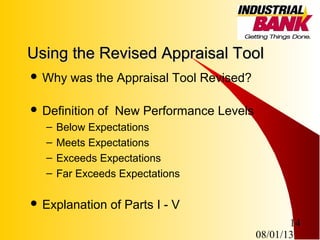
Using the Revised Appraisal ToolUsing the Revised Appraisal Tool
 Why was the Appraisal Tool Revised?
 Definition of New Performance Levels
– Below Expectations
– Meets Expectations
– Exceeds Expectations
– Far Exceeds Expectations
 Explanation of Parts I - V
08/01/13
15
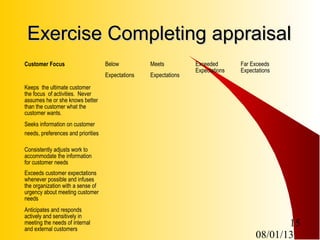
Exercise Completing appraisalExercise Completing appraisal
Customer Focus Below
Expectations
Meets
Expectations
Exceeded
Expectations
Far Exceeds
Expectations
Keeps the ultimate customer
the focus of activities. Never
assumes he or she knows better
than the customer what the
customer wants.
Seeks information on customer
needs, preferences and priorities
Consistently adjusts work to
accommodate the information
for customer needs
Exceeds customer expectations
whenever possible and infuses
the organization with a sense of
urgency about meeting customer
needs
Anticipates and responds
actively and sensitively in
meeting the needs of internal
and external customers
08/01/13
16
Annual and Mid-Year PerformanceAnnual and Mid-Year Performance
AppraisalAppraisal
Purpose of two appraisals
Performance Appraisal Guidelines
Performance Appraisal Time Line
08/01/13
17
Time lineTime line
Completing appraisal
HR receiving documents
Communicating Rating
Merit Increases
08/01/13
18
Reinforcement StrategiesReinforcement Strategies
Set goals
Document
Coach
Evaluate
08/01/13
19
SummarySummary
 Re-emphasis of key points
 Any Questions?
 Complete Evaluation Form
08/01/13
20
Glossary of TermsGlossary of Terms
 Performance Management
 Performance Appraisal
 Pay for Performance
08/01/13
21
Where to Get More InformationWhere to Get More Information
 Contact Judy-Ann McKenzie
Director of Human Resources
– Via e-mail or ext. 3011
 Contact Lynne Miller Rowe
Training Manager
– Via e-mail or ext. 3224

Pm trainingforemployees

  • 1.
    08/01/13 1 Performance Management TrainingPerformanceManagement Training for IBNA Managers and Supervisorsfor IBNA Managers and Supervisors Presented by: Lynne Rowe AVP Human Resources & Judy-Ann McKenzie, VP/ Director HR
  • 2.
    08/01/13 2 Today’sToday’s AgendaAgenda  Introductions Objectives  Performance Management Process  Standards and goals  Revised Appraisal Tool  Annual and Mid-year Performance Appraisals  Reinforcement Strategies  Summary and Closing
  • 3.
    08/01/13 3 Let’s Get StartedLet’sGet Started  Upon completion of this session, you will: – Understand the Performance Management process – List the characteristics of a performance appraisal – Learn how to develop S.M.A.R.T. objectives – Describe the benefits of documenting performance – Learn how to define and identify standards and procedures for documenting performance – Know how to use the revised performance appraisal tool – Year-end process
  • 4.
    08/01/13 4 Are We Allon the Same Page?Are We All on the Same Page?  What is Performance Management? – Is a process of documenting and monitoring an individual’s performance – A strategy for improving employee performance and productivity – A way to remove the subjectivity out of the evaluation, and prevent litigation – A system that drives business results and reinforces the company’s culture
  • 5.
    08/01/13 5 The Performance AppraisalThePerformance Appraisal  A formal periodic review of an individual’s performance  Are conducted annually or semi-annually  Based on documented performance  Compares documented performance to establish standards/goals  Rates the individual’s performance  Influences the employee’s pay, promotions, bonuses  Written or typed, approved and signed by supervisor or subordinate  Effective and fair
  • 6.
    08/01/13 6 What is theAppraisal intended toWhat is the Appraisal intended to do?do? Communicate Expected standards of performance Provide feedback to the employee Provide an objective basis for the supervisor’s decisions regarding a particular employee Reward employees for top performance
  • 7.
    08/01/13 7 Setting Goals andObjectivesSetting Goals and Objectives  Employees need to know what are the expectations  How will achievements be measured?  To ensure “Objectives” are met – and are tangible, measurable and observable: – Who will do what? – Resources – When will it be done? -Time frame – How will it be done? - get desired results  What is an ongoing performance criteria that must be met time after time?
  • 8.
    08/01/13 8 Employee Goal-SettingEmployee Goal-Setting Before you attempt to set performance goals, remember that goals are the following: – Standard for measurement and serve as a road map to your success – Represent the next level of achievement for individuals – May be different from one employee to the next depending on your experience and skills – Based on the strategic goals of the organization – Must be “tangible”, “measurable” and “observable”
  • 9.
    08/01/13 9 Stating Objectives theS.M.A.R.T. WayStating Objectives the S.M.A.R.T. Way  Specific – Spelling out the details, particular, focused  Measurable – Quantifiable, provides a standard for comparison  Attainable – Practical, achievable, possible  Results-oriented – Indicates activity by use of an action verb  Time-related – Scheduled, regulated by time, a deadline
  • 10.
    08/01/13 10 Goal -Setting ProcessGoal-Setting Process Monitor Performance, coach and counsel Evaluate the performance Set goals  Setting performance goals is an ongoing process  Goal-Setting meeting • Takes place before or after the performance appraisal • Use previous years goals • Were all the goals met • Were they meet successfully, or moderately • What is the next logical step or progression in learning, responsibility or achievements • Together you and the employee set short and long term goals and establish acceptable and unacceptable performance
  • 11.
    08/01/13 11 Documenting PerformanceDocumenting Performance What to Document? – Employee performance compared to an established standard  Quantity of work  Quality of work  Number and size of sales  Cost –consciousness  Ability to follow directions  Time management  Safety  Attendance and tardiness  Behavior and attitude
  • 12.
    08/01/13 12 Why Evaluate Performance?WhyEvaluate Performance? To Recognize expectations Evaluate excellence Remediate problem areas Determine wage adjustment and job status Provide a look at the big picture To use as a career development tool
  • 13.
    08/01/13 13 Evaluating PerformanceEvaluating Performance The performance appraisal process provides the following benefits: – Organization’s mission underlies every employee goal- fulfilled every time an employee reaches a higher level of achievement – The supervisor recognizes employee excellence and explores individual potential, while pursuing department objectives – The employee receives earned recognition , reward, motivation and guidance in choosing a career path
  • 14.
    08/01/13 14 Using the RevisedAppraisal ToolUsing the Revised Appraisal Tool  Why was the Appraisal Tool Revised?  Definition of New Performance Levels – Below Expectations – Meets Expectations – Exceeds Expectations – Far Exceeds Expectations  Explanation of Parts I - V
  • 15.
    08/01/13 15 Exercise Completing appraisalExerciseCompleting appraisal Customer Focus Below Expectations Meets Expectations Exceeded Expectations Far Exceeds Expectations Keeps the ultimate customer the focus of activities. Never assumes he or she knows better than the customer what the customer wants. Seeks information on customer needs, preferences and priorities Consistently adjusts work to accommodate the information for customer needs Exceeds customer expectations whenever possible and infuses the organization with a sense of urgency about meeting customer needs Anticipates and responds actively and sensitively in meeting the needs of internal and external customers
  • 16.
    08/01/13 16 Annual and Mid-YearPerformanceAnnual and Mid-Year Performance AppraisalAppraisal Purpose of two appraisals Performance Appraisal Guidelines Performance Appraisal Time Line
  • 17.
    08/01/13 17 Time lineTime line Completingappraisal HR receiving documents Communicating Rating Merit Increases
  • 18.
  • 19.
    08/01/13 19 SummarySummary  Re-emphasis ofkey points  Any Questions?  Complete Evaluation Form
  • 20.
    08/01/13 20 Glossary of TermsGlossaryof Terms  Performance Management  Performance Appraisal  Pay for Performance
  • 21.
    08/01/13 21 Where to GetMore InformationWhere to Get More Information  Contact Judy-Ann McKenzie Director of Human Resources – Via e-mail or ext. 3011  Contact Lynne Miller Rowe Training Manager – Via e-mail or ext. 3224

Editor's Notes

  • #5 Performance Management – is an ongoing process, and not an event Set Goals-monitor performance –evaluate performance
  • #7 Think about your last performance appraisal – what was the rating you received? Did you get a raise or a promotion? Take 5 minutes to discuss What would it have been like to not have receive a review, how would your attitude and performance likely have been affected Lets look at Goal setting
  • #8 Setting goals and objectives is the beginning of the performance process What are goals? Standard for measure or expected outcomes Performance goals are an intrinsic part of the performance appraisal process. When both supervisor and employee reaches agreement on a realistic, achievable set of goals, they give themselves a tangible standard by which either can track, document and measure performance How does a manager and employee set goals? What is an ongoing performance criteria that must be met time after time Answer: STANSARD How do we state Goals?
  • #10 For example is production is at 80- units per day now it’s not realistic to expect 40 more units per day by tomorrow. I t might be more reasonable to expect 20 more units. Does the environmental factors allow for the goals to be attained. For example is the equipment working and allows the goal to be achieved Relevant – Example even if Customer service is an improved company mission you wouldn’t ask the facilities person who is not on phone with the customer to improve their telephone techniques Time related – some projects have due dates and deadlines , which should be clear to the employee. Factors to consider with goal setting is experience, education, and ability. What might be a challenge for one person might be impossible for another.
  • #11 Should use previous years goals Can take place before or after the performance appraisal Once goals have been established the next step in the process is to document the performance
  • #12 What should you look at when documenting performance
  • #14 Things to remember about the evaluation process
  • #15 Why? One tool, competency based, four point rating scale Forces managers to evaluate performance Designed for both Exempt/ Non-exempt No more difficult calculations Inline with a pay for Performance Culture
  • #17 Once jointly establish goals are set at the beginning of the year, the mid year review is a good temperature check to let the employee know how they are doing. A performance appraisal should never be a shock to am employee. Hence the reason for two reviews. Only one is required to be handed into HR, but we will expect something form the manager stating that they have done the mid year review. Appraisal Guide helps you with
  • #21 Performance Management - Performance Appraisal – the systematic evaluation of an employee’s work on the job Positive Reinforcement – using positive consequences to increase the probability that an appropriate behavior will be repeated Negative Reinforcement – avoiding a negative consequence by engaging in appropriate behavior Punishment – used to discourage inappropriate behavior; least effective and most overused Extinction – removing any reinforcers Comparative Methods- develop the employee’s relative standing as compared to other employees Absolute Methods – develops the employee’s standing based on the employee alone