Chapter 7
Project Termination
Project Termination
2
All Things Come to an End
Ch #-2
Contents
• Acknowledge the proper closure of a project
Ch #-3
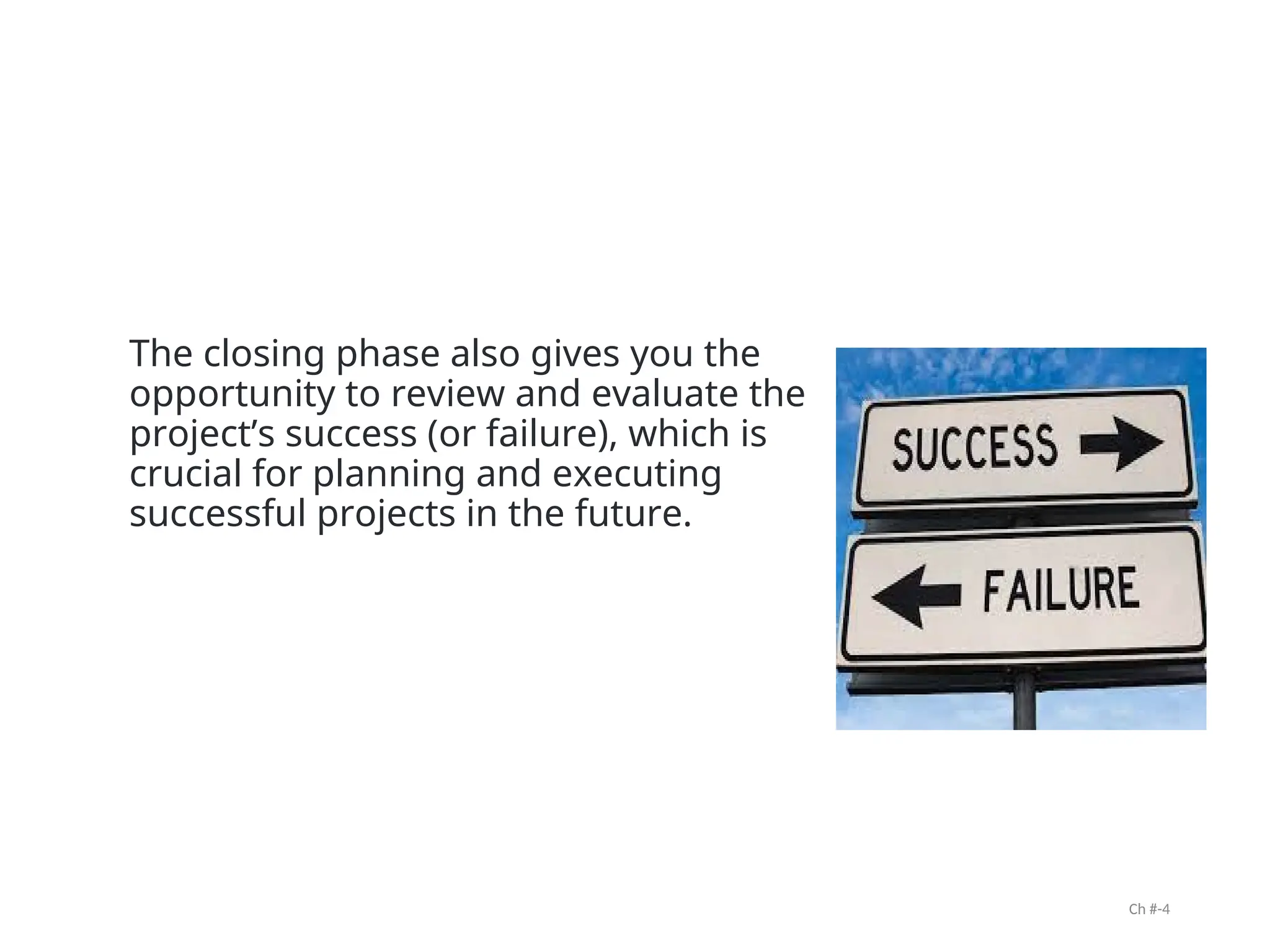
The closing phase also gives you the
opportunity to review and evaluate the
project’s success (or failure), which is
crucial for planning and executing
successful projects in the future.
Ch #-4
Ch #-5
• all deliverables are
finalized and
formally transferred
• All documentation is
signed off,
approved, and
archived.
What is project closure?
When Do Projects
Terminate?
Upon successful completion,
– or . . .
When the organization is no longer
willing to invest
4
Ch #-6
Most Common Reasons
Projects Terminate
1. Low probability of success
2. Low profitability
3. Increasing cost
4. Change in competitive factors
5. Un-resolvable technical problems
6. Higher priority
7. Schedule delays
Source: Dean, 1968
5
Ch #-7
Non-Technical Reasons for Termination
•Political
•Cross-
cultural
•Ageing
Ch #-8
When to Terminate a Project
•Some questions to ask when considering termination:
• Has the project been hindered by technical advances?
• Is the output of the project still cost-effective?
• Is it time to integrate or add the project as a part of regular
operations?
• Are there better alternative uses for the funds, time and
personnel devoted to the project?
• Has a change in the environment altered the need for the
project’s output?
Ch #-9
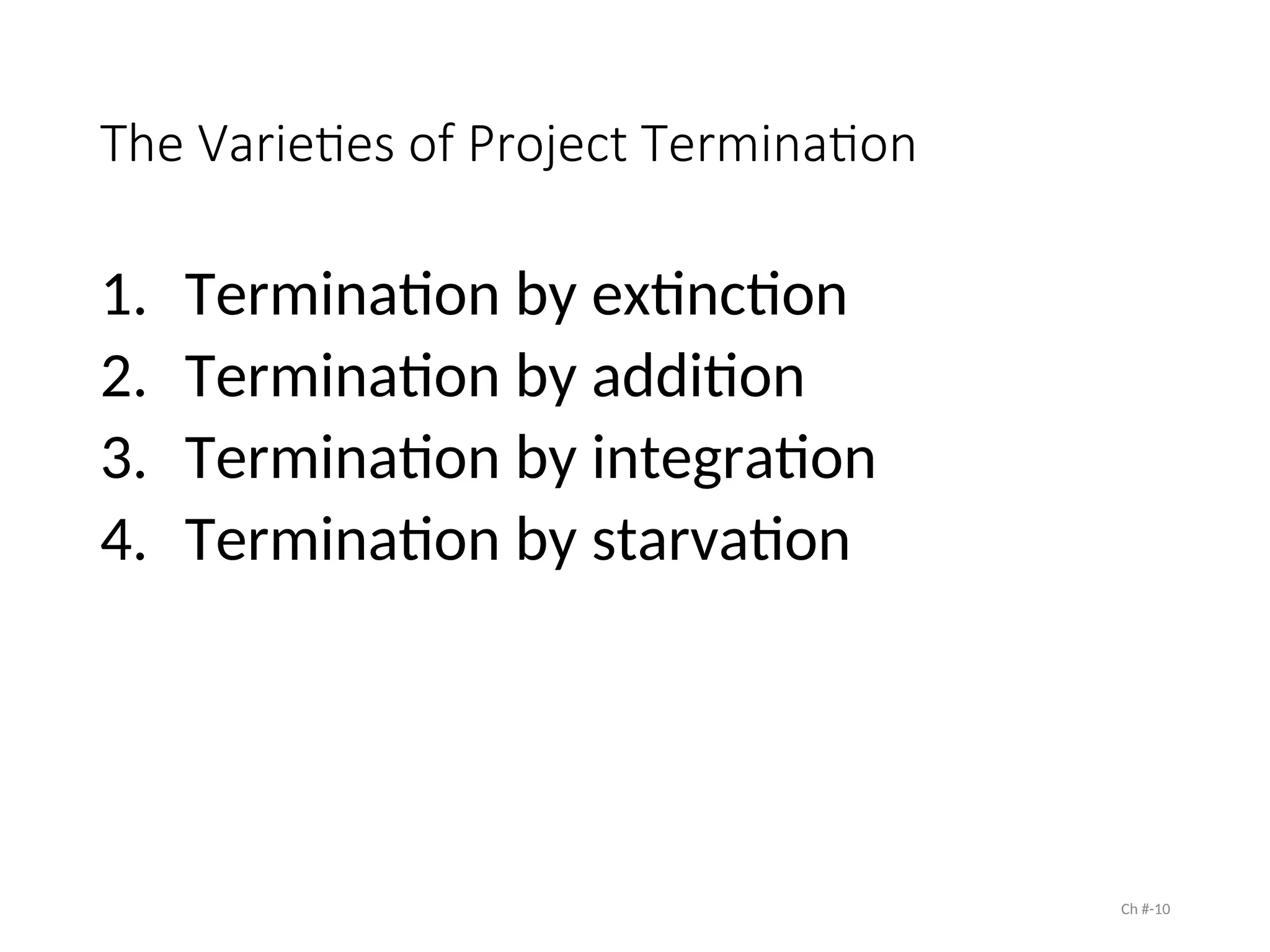
The Varieties of Project Termination
1. Termination by extinction
2. Termination by addition
3. Termination by integration
4. Termination by starvation
Ch #-10
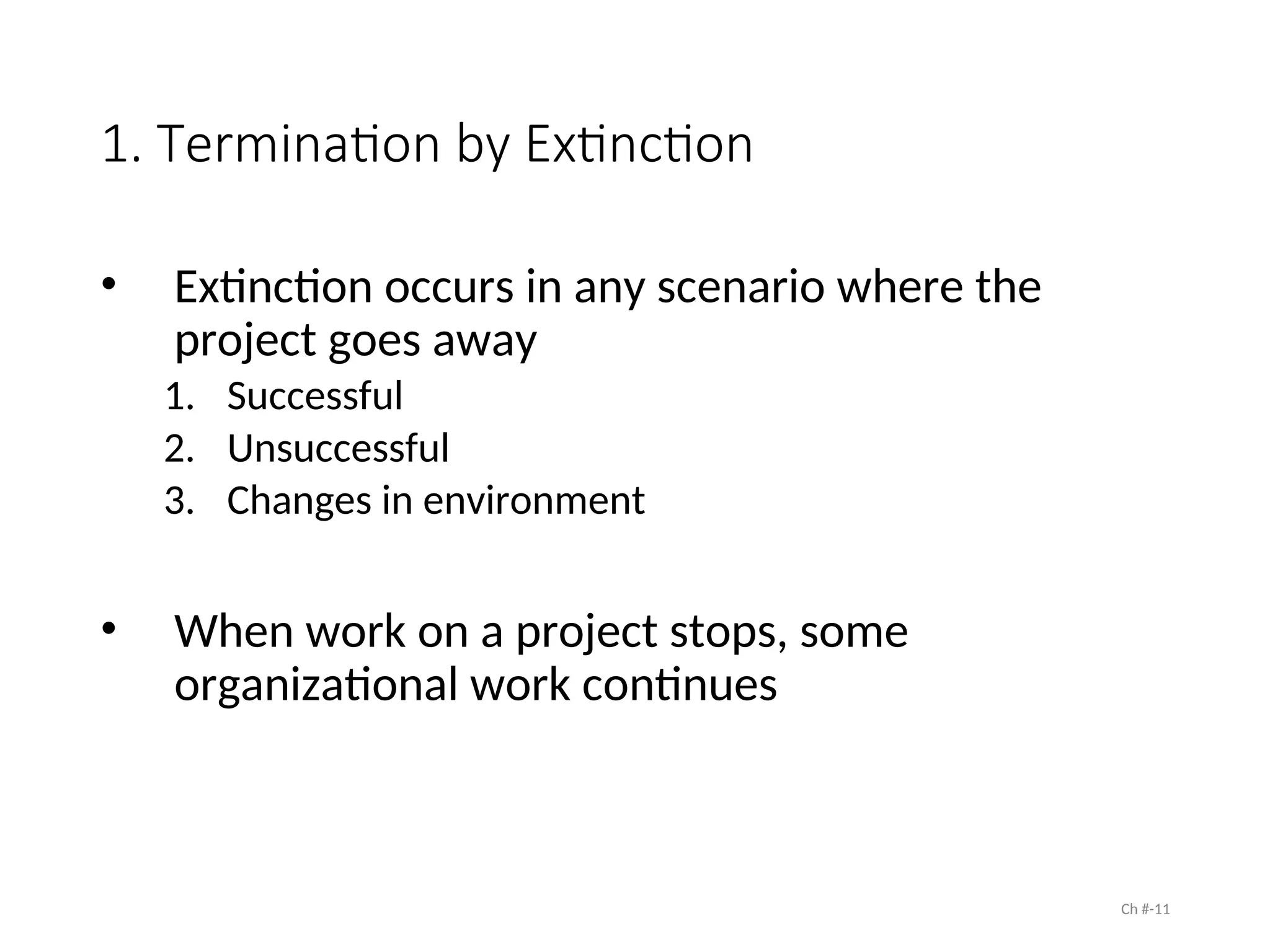
1. Termination by Extinction
• Extinction occurs in any scenario where the
project goes away
1. Successful
2. Unsuccessful
3. Changes in environment
• When work on a project stops, some
organizational work continues
Ch #-11
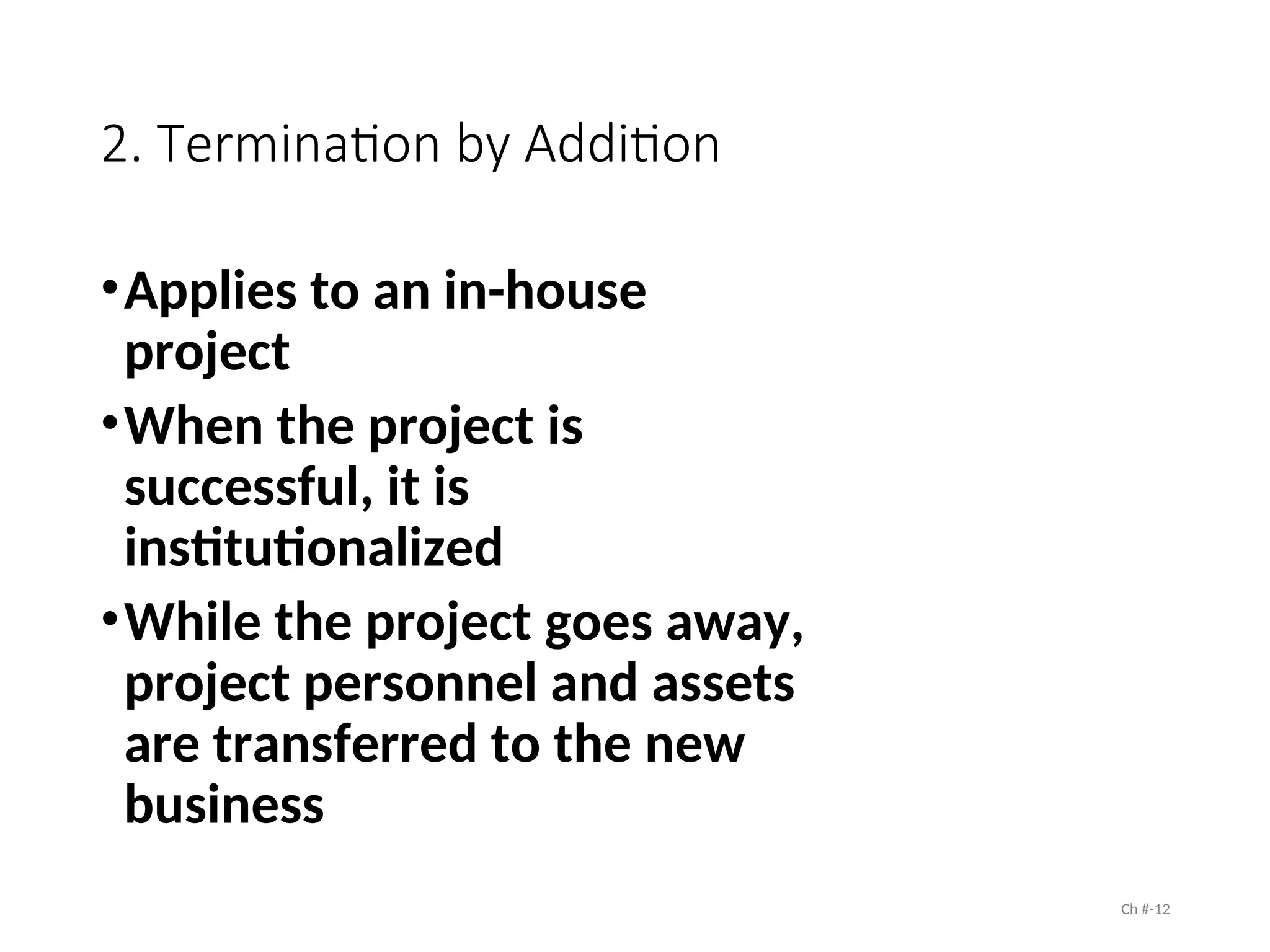
2. Termination by Addition
•Applies to an in-house
project
•When the project is
successful, it is
institutionalized
•While the project goes away,
project personnel and assets
are transferred to the new
business
Ch #-12
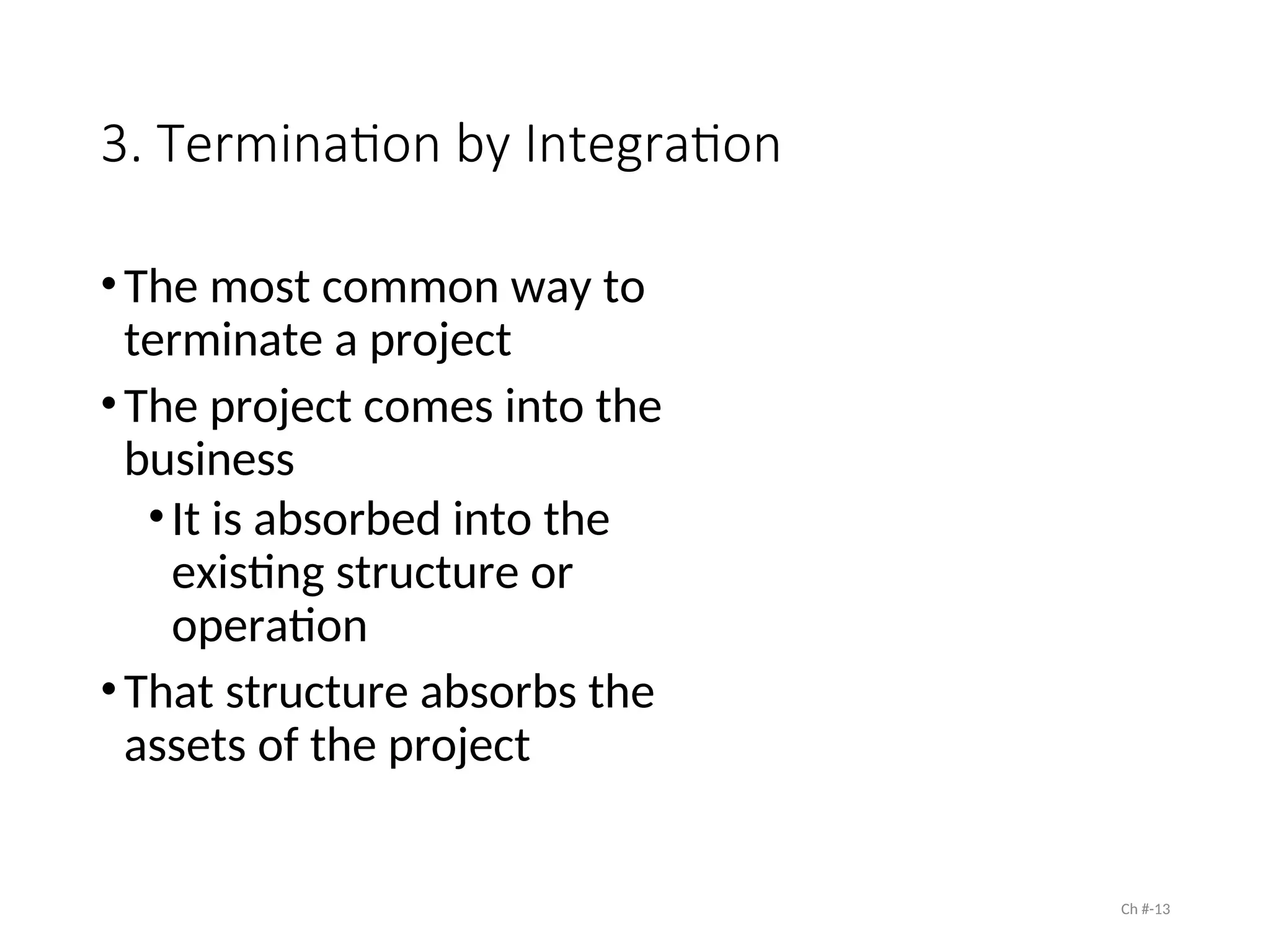
3. Termination by Integration
•The most common way to
terminate a project
•The project comes into the
business
•It is absorbed into the
existing structure or
operation
•That structure absorbs the
assets of the project
Ch #-13
4. Termination by Starvation
•Termination by starvation involves
greatly reducing the budget of a
project
•Used when it is politically dangerous
to cancel a project
•Terminating a project that has not
accomplished its goals is an
admission of failure
Ch #-14
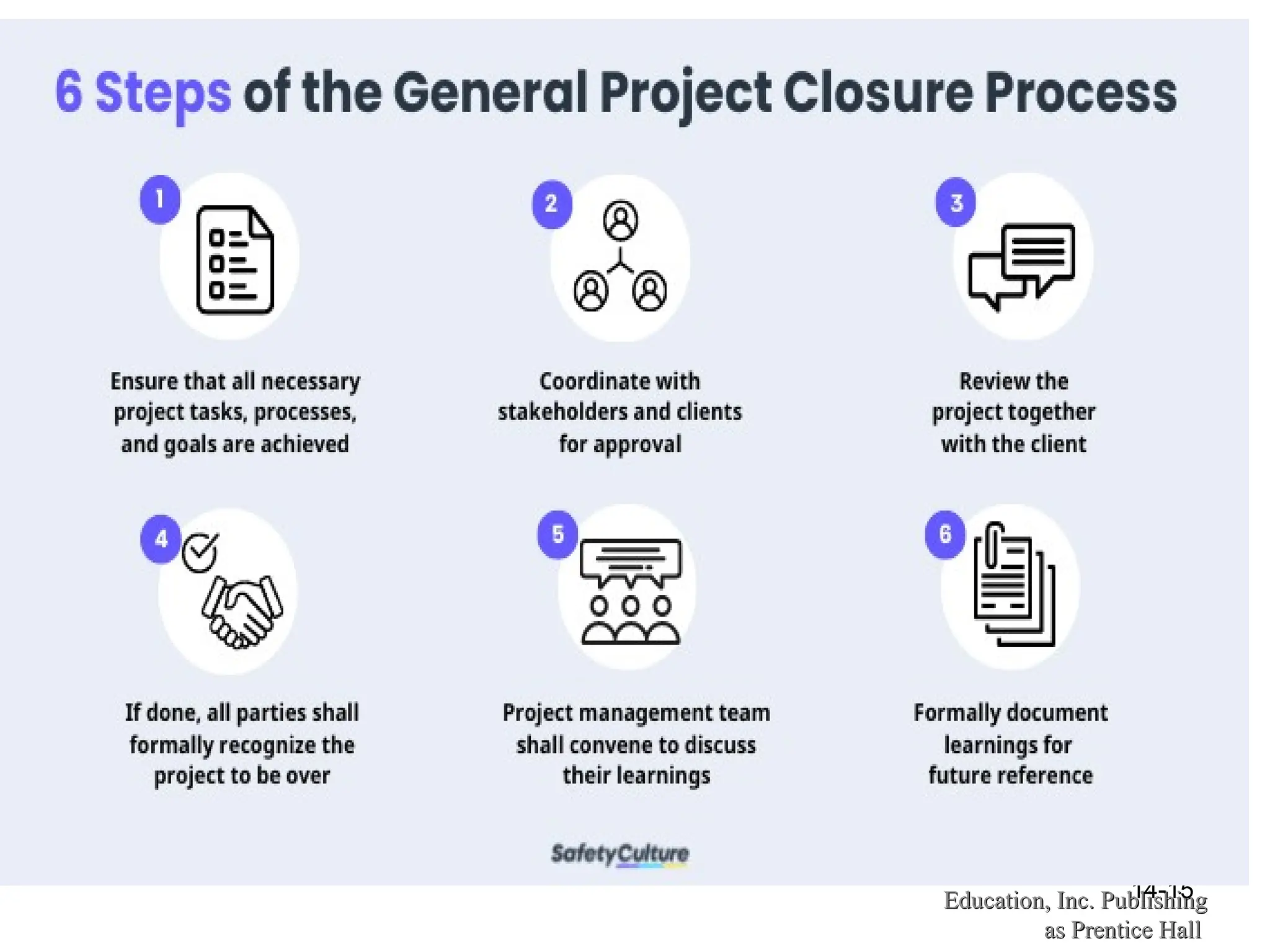
Elements of Project
Closeout Management
Copyright © 2010 Pearson
Education, Inc. Publishing
as Prentice Hall
as Prentice Hall
14-15
The Implementation Process
•Termination can be orderly
•Planning for an implementing an orderly
shut down yields better results
•Who leads the shut down project
•A special termination manager may be
used
Ch #-16
Things to Do
1. Insure tasks are completed
2. Notify the client
3. Finish the paperwork
4. Send out final invoices to the client
5. Redistribute resources
6. Clear with legal
7. Determine what records to keep
8. Assign support
9. Close the project books
Ch #-17
The Final Report
• Several Subjects should be addressed in
the final report:
• Project performance
• Administrative performance
• Organizational structure
• Project and administrative teams
• Techniques of project management
Ch #-18
• Successful delivery of the project scope or failure to do
marks the termination of the project
• Formal documentation is an important stage of project
closure
• A project can be terminated in one of four ways: by
extinction, addition, integration, or starvation
• Making a decision to terminate a project before its
completion is difficult, but a number of factors can be of
help in reaching a decision
Successful delivery of the project scope or failure to do marks the termination of the project

  • 1.
  • 2.
    Project Termination 2 All ThingsCome to an End Ch #-2
  • 3.
    Contents • Acknowledge theproper closure of a project Ch #-3
  • 4.
    The closing phasealso gives you the opportunity to review and evaluate the project’s success (or failure), which is crucial for planning and executing successful projects in the future. Ch #-4
  • 5.
    Ch #-5 • alldeliverables are finalized and formally transferred • All documentation is signed off, approved, and archived. What is project closure?
  • 6.
    When Do Projects Terminate? Uponsuccessful completion, – or . . . When the organization is no longer willing to invest 4 Ch #-6
  • 7.
    Most Common Reasons ProjectsTerminate 1. Low probability of success 2. Low profitability 3. Increasing cost 4. Change in competitive factors 5. Un-resolvable technical problems 6. Higher priority 7. Schedule delays Source: Dean, 1968 5 Ch #-7
  • 8.
    Non-Technical Reasons forTermination •Political •Cross- cultural •Ageing Ch #-8
  • 9.
    When to Terminatea Project •Some questions to ask when considering termination: • Has the project been hindered by technical advances? • Is the output of the project still cost-effective? • Is it time to integrate or add the project as a part of regular operations? • Are there better alternative uses for the funds, time and personnel devoted to the project? • Has a change in the environment altered the need for the project’s output? Ch #-9
  • 10.
    The Varieties ofProject Termination 1. Termination by extinction 2. Termination by addition 3. Termination by integration 4. Termination by starvation Ch #-10
  • 11.
    1. Termination byExtinction • Extinction occurs in any scenario where the project goes away 1. Successful 2. Unsuccessful 3. Changes in environment • When work on a project stops, some organizational work continues Ch #-11
  • 12.
    2. Termination byAddition •Applies to an in-house project •When the project is successful, it is institutionalized •While the project goes away, project personnel and assets are transferred to the new business Ch #-12
  • 13.
    3. Termination byIntegration •The most common way to terminate a project •The project comes into the business •It is absorbed into the existing structure or operation •That structure absorbs the assets of the project Ch #-13
  • 14.
    4. Termination byStarvation •Termination by starvation involves greatly reducing the budget of a project •Used when it is politically dangerous to cancel a project •Terminating a project that has not accomplished its goals is an admission of failure Ch #-14
  • 15.
    Elements of Project CloseoutManagement Copyright © 2010 Pearson Copyright © 2010 Pearson Education, Inc. Publishing Education, Inc. Publishing as Prentice Hall as Prentice Hall 14-15
  • 16.
    The Implementation Process •Terminationcan be orderly •Planning for an implementing an orderly shut down yields better results •Who leads the shut down project •A special termination manager may be used Ch #-16
  • 17.
    Things to Do 1.Insure tasks are completed 2. Notify the client 3. Finish the paperwork 4. Send out final invoices to the client 5. Redistribute resources 6. Clear with legal 7. Determine what records to keep 8. Assign support 9. Close the project books Ch #-17
  • 18.
    The Final Report •Several Subjects should be addressed in the final report: • Project performance • Administrative performance • Organizational structure • Project and administrative teams • Techniques of project management Ch #-18
  • 19.
    • Successful deliveryof the project scope or failure to do marks the termination of the project • Formal documentation is an important stage of project closure • A project can be terminated in one of four ways: by extinction, addition, integration, or starvation • Making a decision to terminate a project before its completion is difficult, but a number of factors can be of help in reaching a decision