Developing a Book’s
Plot and Narrative:
From Dissection to Inspiration
George Galdorisi
La Jolla Writer’s Conference
October 27-29, 2017
Workshop
Developing a Book’s Plot and Narrative:
From Dissection to Inspiration
“This workshop will help attendees focus their original book idea
and put that idea “on trial for its life.” We’ll start with the basics,
focusing on protagonists and antagonists and the most critical
trifecta for any story: What do these guys want, why do they
want it, and what’s keeping them from getting it? We’ll then
move on to the way to shape a story, using character, conflict,
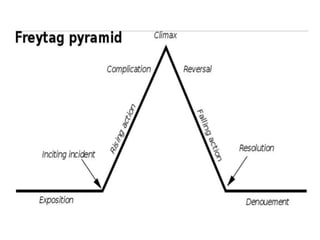
complications, climax and conclusion, and then use the Freytag
Pyramid to examine how action drives a story from beginning to
end. Attendees will be provided with online access to all
workshop material.”
A Few Preliminaries….
• Three promises:
– This will be a fast-paced 110 minutes
– We’ll learn something…and we’ll have fun
– You’ll have access to these slides…take notes…or not….
• Three assumptions:
– You all are interested in nurturing your story idea
– You would like to turn your idea into a novel or….
– You didn’t wake up last Tuesday morning with this notion
• And a word about Power Point….
….by way of background….
Let’s Talk About Writing….
….and isn’t this
the oldest profession?
“If you decide to become a professional writer, you
must, broadly speaking, decide whether you wish to
write for fame, for pleasure, or for money.”
Ian Fleming
How to Write a Thriller
Did You Bring Your Homework?
Developing a Book’s
Plot and Narrative:
From Dissection to Inspiration
Dissection 101 - Quickly
• Do what most successful novelists do:
– Study those who have been successful
– Find the kind of books you want to write
– Break these books down and analyze them
– Spend time understanding what worked for you
– Spend time understanding what didn’t work for you
• You should have a posse of novelists to emulate
• That said, you must bring your own uniqueness
Dissection 101 - Quickly
• You’ll ultimately discover that “your” idea has been
done before
• That is good news, it means your kind of story
appeals to readers
• Now, deep dive into your posse’s novels and do a
story breakdown, focusing on the narrative
• Next, deep dive into your posse’s novels and do a
scene breakdown, focusing on purpose
• Pay particular attention on how everything in your
posse’s novels moves the story forward
….now that you all are budding forensic
pathologists, let’s move on to inspiration
Developing a Book’s Plot and Narrative:
From Dissection to Inspiration
• The coolest thing about writing!
• Start with your original idea
• There must be a story, plot, or mystery
• You must have a protagonist and an antagonist
• Something must happen to make you turn pages
• What happens must matter
• Most readers like a satisfying resolution
“For me, I gotta write, and it’s the adventure of it that’s
hooked me. As the writer, I can do it all. I get to be the
National Security Advisor who recommends the action
to the President who must commit the forces. I’m the
senior officer who sends his men into action and who
feels the pain if they don’t make it back. I’m the enemy
and the defender; logistician and staff planner. But
most of all, I’m a young man again, that fresh
lieutenant who must lead his men into battle.”
Dick Couch
“So you Want to be a Writer”
Developing a Book’s Plot and Narrative:
From Dissection to Inspiration
• The coolest thing about writing!
• Start with your original idea
• There must be a story, plot, or mystery
• You must have a protagonist and an antagonist
• Something must happen to make you turn pages
• What happens must matter
• Most readers like a satisfying resolution
Only You Are the Steward of Your Original Idea
• It is your idea and your idea alone
• You have to nurture it, don’t share it yet
• It is the foundation of your book
• Above all else, it is the spark of inspiration for you
• Don’t do too much, let it germinate
• Come up with another idea, is the first still the best?
Can You State Your Idea In One Sentence?
• If you can’t do this, start over and find a new one
• This one sentence ignites your creative focus
• It is often the core of the pitch to sell your book
• Remembering just one sentence keeps you focused
Your Original Idea in One Sentence
The subject of the sentence will describe (1) an
imperfect but passionate and active protagonist. The
verb will depict (2) the battle. And the direct object will
describe (3) an insurmountable antagonist who tries to
stop the protagonist from reaching (4) a physical goal
on account of (5) the stakes, if the goal is not reached.
Developing a Book’s Plot and Narrative:
From Dissection to Inspiration
• The coolest thing about writing!
• Start with your original idea
• There must be a story, plot, or mystery
• You must have a protagonist and an antagonist
• Something must happen to make you turn pages
• What happens must matter
• Most readers like a satisfying resolution
Is It Just a Story –
Or Something More?
• The king died and then the queen died.
– A story
• The king died and then the queen died of grief.
– A plot
• The queen died, and no one knew why, until it was
discovered that it was through grief at the death of
the king.
– A mystery
There must be a story, plot, or mystery:
The Classic Plot
• The writer introduces a hero or heroine who has just been –
or is about to be – plunged into terrible trouble
• The hero or heroine attempts to solve his or her problem but
only slips deeper into trouble
• As they try to climb out of the hole they’re in, complications
arise, each more terrible than the one before, until the
situation could not become more hopeless, then one final
unthinkable complication arises and makes matters worse.
• At last, deeply affected and changed by his awful experiences
and intolerable circumstances, the hero learns something
about himself and the human condition. He then understands
what he must do to get out of the dangerous situation in
which he has wound up. He takes the necessary actions and
either succeeds or fails, succeeding more often than not.
Developing a Book’s Plot and Narrative:
From Dissection to Inspiration
• The coolest thing about writing!
• Start with your original idea
• There must be a story, plot, or mystery
• You must have a protagonist and an antagonist
• Something must happen to make you turn pages
• What happens must matter
• Most readers like a satisfying resolution
You Must Have a
Protagonist and An Antagonist
• The Protagonist must have a goal
• The Protagonist must have a conflict
• The Antagonist must have a goal
• The Antagonist must have a conflict:
– You must give your antagonist believable motivation
– The reader must understand the antagonist’s goal
– Your antagonist must have a good plan
– The stronger the antagonist, the stronger the protagonist
• Their conflict lock makes the story move forward
Developing a Book’s Plot and Narrative:
From Dissection to Inspiration
• The coolest thing about writing!
• Start with your original idea
• There must be a story, plot, or mystery
• You must have a protagonist and an antagonist
• Something must happen to make you turn pages
• What happens must matter
• Most readers like a satisfying resolution
Something Must Happen
To Make You Turn Pages
• Good stories typically start with an inciting action
• The protagonist usually gets introduced early
• The protagonist has to solve a problem
• The story involves a protagonist solving the problem
• The antagonist is hell-bent to stop the protagonist
Developing a Book’s Plot and Narrative:
From Dissection to Inspiration
• The coolest thing about writing!
• Start with your original idea
• There must be a story, plot, or mystery
• You must have a protagonist and an antagonist
• Something must happen to make you turn pages
• What happens must matter
• Most readers like a satisfying resolution
What Happens Must Matter
• Character
• Conflict
• Complications
• Climax
• Conclusion
Developing a Book’s Plot and Narrative:
From Dissection to Inspiration
• The coolest thing about writing!
• Start with your original idea
• There must be a story, plot, or mystery
• You must have a protagonist and an antagonist
• Something must happen to make you turn pages
• What happens must matter
• Most readers like a satisfying resolution
Most Readers Like a Satisfying Resolution
• The protagonist solves the problem or crisis
• The protagonist must change along the way (1.0-2.0)
• You don’t have to kill the antagonist
• But there must be a reason the antagonist loses
Now That We Know All This
Let’s Write Your Novel
Plot is Important
But That’s Not All
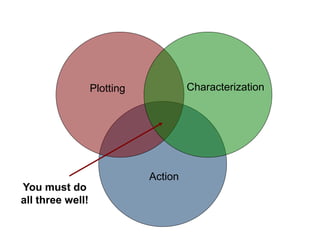
Let’s talk about three of the most
important ingredients in writing a
successful novel…
CharacterizationPlotting
Action
You must do
all three well!
Plotting
“There are only two plots: The hero takes a journey and
a stranger comes to town.”
Timothy Spurgin
“The Art of Reading”
The Great Courses
The Classic Plot
• The writer introduces a hero or heroine who has just been –
or is about to be – plunged into terrible trouble
• The hero or heroine attempts to solve his or her problem but
only slips deeper into trouble
• As they try to climb out of the hole they’re in, complications
arise, each more terrible than the one before, until the
situation could not become more hopeless, then one final
unthinkable complication arises and makes matters worse.
• At last, deeply affected and changed by his awful experiences
and intolerable circumstances, the hero learns something
about himself and the human condition. He then understands
what he must do to get out of the dangerous situation in
which he has wound up. He takes the necessary actions and
either succeeds or fails, succeeding more often than not.
“You can distill anydrama – a Greek tragedy, a
Shakespearian play, a modern novel, a TV drama or
comedy, whatever – into a simple equation: ‘What do
these guys want, why do they want it, and what’s
keeping them from getting it?’”
Bill Bleich
Writing advice
Plots
• Create a compelling plot
• Write a grabber opening
• Write a successful ending
• Create a middle that keeps the reader involved
James Hall – Hit Lit
• Gone with the Wind
• Peyton Place
• To Kill a Mockingbird
• Valley of the Dolls
• The Godfather
• The Exorcist
• Jaws
• The Dead Zone
• The Hunt for Red October
• The Firm
• The Bridges of Madison County
• The Da Vinci Code
Let’s take a deep-dive into one well-known
way to design or deconstruct a plot….
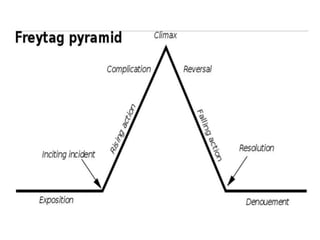
The
Freytag
Pyramid
Now Let’s Get to Work!
A Movie Log Line
The subject of the sentence will describe (1) an
imperfect but passionate and active protagonist. The
verb will depict (2) the battle. And the direct object will
describe (3) an insurmountable antagonist who tries to
stop the protagonist from reaching (4) a physical goal
on account of (5) the stakes, if the goal is not reached.
What is Your Story?
• Take five minutes to do a “log line” for your story
• Partner up! Try your log line on your partner
• Rewrite your log line based on that feedback
• “Hold that thought” – and we’ll see what’s next
Turning Your Log Line
Into a Narrative
Let’s Use This to Dissect a
Book We All Are Familiar With
• Pride and Prejudice
• Ulysses
• War and Peace
• Anna Karenina
• Don Quixote
• Little Women
• The Wizard of Oz
The Wizard of Oz
Exposition
The exposition stage of the story sets the scene and introduces
the characters. In The Wizard of Oz, the exposition is everything
that happens from the beginning of the story to the tornado. We
meet all the major characters. Dorothy runs away with Toto and
meets Professor Marvel; and on her way back to the farm,
Dorothy is overtaken by the storm.
The Wizard of Oz
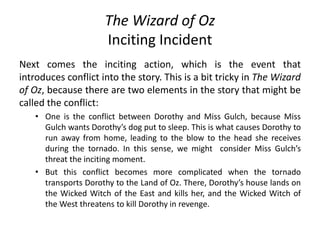
Inciting Incident
Next comes the inciting action, which is the event that
introduces conflict into the story. This is a bit tricky in The Wizard
of Oz, because there are two elements in the story that might be
called the conflict:
• One is the conflict between Dorothy and Miss Gulch, because Miss
Gulch wants Dorothy’s dog put to sleep. This is what causes Dorothy to
run away from home, leading to the blow to the head she receives
during the tornado. In this sense, we might consider Miss Gulch’s
threat the inciting moment.
• But this conflict becomes more complicated when the tornado
transports Dorothy to the Land of Oz. There, Dorothy’s house lands on
the Wicked Witch of the East and kills her, and the Wicked Witch of
the West threatens to kill Dorothy in revenge.
The Wizard of Oz
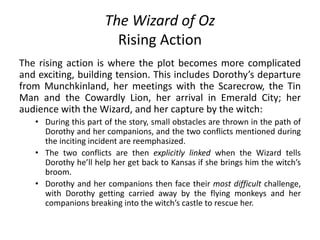
Rising Action
The rising action is where the plot becomes more complicated
and exciting, building tension. This includes Dorothy’s departure
from Munchkinland, her meetings with the Scarecrow, the Tin
Man and the Cowardly Lion, her arrival in Emerald City; her
audience with the Wizard, and her capture by the witch:
• During this part of the story, small obstacles are thrown in the path of
Dorothy and her companions, and the two conflicts mentioned during
the inciting incident are reemphasized.
• The two conflicts are then explicitly linked when the Wizard tells
Dorothy he’ll help her get back to Kansas if she brings him the witch’s
broom.
• Dorothy and her companions then face their most difficult challenge,
with Dorothy getting carried away by the flying monkeys and her
companions breaking into the witch’s castle to rescue her.
The Wizard of Oz
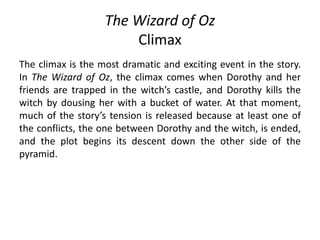
Climax
The climax is the most dramatic and exciting event in the story.
In The Wizard of Oz, the climax comes when Dorothy and her
friends are trapped in the witch’s castle, and Dorothy kills the
witch by dousing her with a bucket of water. At that moment,
much of the story’s tension is released because at least one of
the conflicts, the one between Dorothy and the witch, is ended,
and the plot begins its descent down the other side of the
pyramid.
The Wizard of Oz
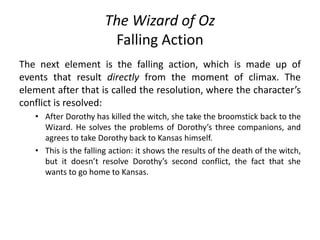
Falling Action
The next element is the falling action, which is made up of
events that result directly from the moment of climax. The
element after that is called the resolution, where the character’s
conflict is resolved:
• After Dorothy has killed the witch, she take the broomstick back to the
Wizard. He solves the problems of Dorothy’s three companions, and
agrees to take Dorothy back to Kansas himself.
• This is the falling action: it shows the results of the death of the witch,
but it doesn’t resolve Dorothy’s second conflict, the fact that she
wants to go home to Kansas.
The Wizard of Oz
Resolution
The resolution comes when the Wizard accidentally takes off in
his balloon without Dorothy, and Dorothy learns from Glinda the
Good Witch that she could have taken herself back to Kansas at
any time just by using the ruby slippers. At this point, Dorothy’s
conflict is finally resolved. The threat from the witch is
liquidated, and she realizes that she always had the power to go
home.
The Wizard of Oz
Dénouement
The denouement is the ending of the story, when order is
restored. At this point, we are often shown the characters one
more time so we can see what happened to them. In The Wizard
of Oz it’s the final scene in Dorothy’s bedroom, where she is
reunited with Aunt Em and Uncle Henry and the now-familiar
farmhands:
• In some stories the denouement simply shows that order has been
restored, and the world is now back to the way it was. But this isn’t
usually the case, and it’s certainly not the case in The Wizard of Oz.
• Dorothy is back home, but everything is not back to the way it was
before she went to Oz. Dorothy’s understanding of herself and her
place in the world have profoundly changed.
Characterization
“There are only two plots: The hero takes a journey and
a stranger comes to town.”
Timothy Spurgin
“The Art of Reading”
The Great Courses
“There are only two plots: The hero takes a journey and
a stranger comes to town.”
Timothy Spurgin
“The Art of Reading”
The Great Courses
Important Qualities for
Heroes, Heroines and Strangers
• Virtue
• Competence
• Courage
• Likeability
• Imperfections
• Change:
– Layers
– Arcs
Character Motivations
• Love
• Curiosity
• Self-preservation
• Greed
• Self-discovery
• Duty
• Revenge
Character Traits
• Physical appearance
• Movement and gestures
• Past life
• Religion
• Sexuality
• Vocation
• Skills and talents
• Fears
• Dreams
• Pleasures
• Plans for the future
• Sense of humor
• Politics
• Voice and speech
Presenting Character Traits Thoughtfully
• How many major and minor characters to have
• All major characters must have a biography
• Develop a “job description” for each character
• You will know what your characters will do
• You are writing a novel – not a movie script
– You have to get your characters from Point A to Point B
– Your characters are not dead when they’re off the page
• What is each character doing?
– On stage
– Off stage
Take a female character who is on her way to her high school
reunion. She’s 50, attractive, divorced, and has had no contact
with her graduating class since she left Iowa for Berkley in
1985. There was a guy she jilted when she went off to
school. Develop her.
• Physical: height, weight, hair color, best feature, worst
feature, etc.
• Occupation: attorney, doctor, college professor, executive,
runs a dot.com startup, etc.
• Personal: strengths, weaknesses, phobias, attitude toward
men, attitude toward all others, etc.
• Family: siblings, relationship with mom/dad, rivalries
• Relationships: good/bad/difficult, marriage(s), children?
James Hall – Hit Lit
• Gone with the Wind
• Peyton Place
• To Kill a Mockingbird
• Valley of the Dolls
• The Godfather
• The Exorcist
• Jaws
• The Dead Zone
• The Hunt for Red October
• The Firm
• The Bridges of Madison County
• The Da Vinci Code
Let’s look at three examples
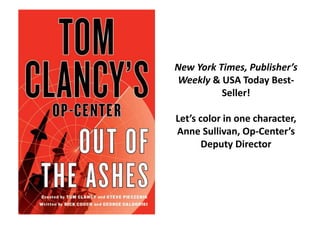
New York Times, Publisher’s
Weekly & USA Today Best-
Seller!
Let’s color in one character,
Anne Sullivan, Op-Center’s
Deputy Director
“Anne Sullivan was a retired General Services
Administration super grade who had made a career in
Washington. She knew all about the government,
including government contracting, hiring, firing, and
funding, and how to sidestep the issues. These were
things Williams never had to deal with, even during his
multiple tours in Washington.”
“Unlike Williams, Sullivan came from money. Her father
had fashioned a successful and lucrative career in
finance with Bain Capital Ventures. Between that family
money and her GSA retirement, she was looking
forward to a comfortable life. She enjoyed the D.C.
social and cultural scene and traveled often, primarily
to Europe and especially to Ireland. That plan was
interrupted when Williams recruited her—charmed
her, really, she readily admitted—to be his deputy.”
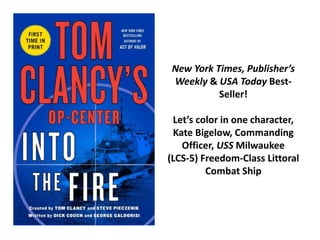
New York Times, Publisher’s
Weekly & USA Today Best-
Seller!
Let’s color in one character,
Kate Bigelow, Commanding
Officer, USS Milwaukee
(LCS-5) Freedom-Class Littoral
Combat Ship
“Kate Bigelow was a graduate of the U.S. Naval Academy. She’d
gone to the Academy for two reasons: to play lacrosse and to
sing. Coming out of Montgomery Blair Prep in Silver Spring,
Maryland, her two passions had been playing lacrosse and
singing in her school glee club and church choir. She was an all-
state midfielder and also had a strong voice. Her grades were
good if not outstanding, but the Academy women’s lacrosse
coach saw her play and liked what she saw. Lacrosse was a rough
sport, even the woman’s game, and Kate Bigelow, while owning a
technically sound game, was not above flattening an opposing
player with a legal hit. She started for three years on the lacrosse
team, beating Army two of those three years, and had sung in
the Catholic Choir and the Naval Academy Glee Club.”
“Kate had graduated in the upper half of the bottom third of the
Class of 2002. She’d never really considered a full career in the
Navy as a seagoing officer, two things intervened that kept her
from leaving the service. She found she liked U.S. Navy sailors
and she had a knack for leading them. Secondly, she found
command intoxicating. There was nothing like it on the outside,
so she stayed in the Navy. She had previously commanded an
MCM ship like Defender that now followed them out of Sasebo.”
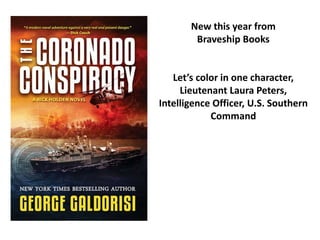
New this year from
Braveship Books
Let’s color in one character,
Lieutenant Laura Peters,
Intelligence Officer, U.S. Southern
Command
For Laura Peters, it was an opportunity for professional growth
that might not come her way again. It was not surprising she
loved what she was doing. The daughter and only child of a
Navy chief petty officer, she had been the apple of her father's
eye. Master Chief Donald Peters had risen through the ranks as
far as he could, but he always wanted to be an officer. That
goal, unfortunately, had eluded him. When it was clear his
marriage would produce no sons, he regaled Laura with the
opportunities that beckoned in the Navy. The master chief
knew enough about how the Navy worked and what it looked
for in its officers—and particularly its need to recruit more
women officers—that he groomed his daughter throughout
high school to make her a shoe-in for winning a Navy ROTC
scholarship.
She had thrived at the University of Virginia, earning top
grades, and lettering in cross-country, squash, and tennis.
Sensing that the Navy was still not enlightened enough to fully
accept women as equal partners commanding ships and
aircraft squadrons, she opted for the intelligence field upon
graduation, correctly surmising that it would provide a more
level professional playing field and afford her the opportunity
to prove herself and advance through the ranks. In her seven
years since graduation she had sought out only the toughest
assignments, usually registering firsts, breaking ground where
female officers had not gone before.
Here’s a better example
When he finished packing, he walked out onto the
third-floor porch of the barracks brushing the dust from
his hands, a very neat and deceptively slim young man
in the summer khakis that were still early morning
fresh.
James Jones
(From Here to Eternity, opening sentence)
"Jones packs a hell of a lot into that first line. He tells
you it's summer, he tells you it's morning, he tells you
you're on an Army post with a soldier who's obviously
leaving for someplace, and he gives you a thumbnail
description of his hero. That's a good opening line."
Ed McBain in Killer's Payoff
…plot?...characterization?...which is more
important?
Plot or Characterization
• You have to have plot to make the reader turn pages
• People are the story and the whole story
????????????????????????????????????????????????
• Plot has the entertainment value to pull the reader
along
• The characters are the vehicle, the tools through
which you tell your story
• Readers want you to tell them a story
• Dialogue brings your characters to life!
Action
“I do not over-intellectualize the production process. I
try to keep it simple: Tell the damned story.”
Tom Clancy
What About Action?
• Action evolves naturally from the plot
• There is no “formula” for having action in your novel
• As Clancy said, don’t overthink the action
• That said, here are some things to consider:
– Different kinds of novels lend themselves to more or less
– Write all the action you can – then consider Goldilocks
– If riveting, hold-your-breath action is anywhere – up front
– Balance scene and summary to bound action scenes
Developing a Book’s Plot and Narrative:
From Dissection to Inspiration
• The coolest thing about writing!
• Start with your original idea
• There must be a story, plot, or mystery
• You must have a protagonist and an antagonist
• Something must happen to make you turn pages
• What happens must matter
• Most readers like a satisfying resolution
Resources
• E.E. Forster Aspects of the Novel
• Francine Prose Reading Like a Writer
• Richard Curtis How To Be Your Own Literary Agent
• James Hall Hit Lit
• Dr. Linda Seger
– The Art of Adaptation
– Advanced Screenwriting
• Robert Masello
– Robert’s Rules of Writing
– Writer Tells All
• The Great Courses, especially, Jane Friedman How to Publish
Your Book
A Word About Surveys:
Comments Typically Come in Three Types
• You rocked my world and my life is now changed forever
for the better – I’m a completely new person
• I’d rather have a root canal than have to sit through this
again – and I think you should pay for it
• I got something (a lot, a little) out of this talk, but if the
instructor does this next year, he should:
– Do more of….
– Do less of….
– Go faster….
– Go slower….
– ????
Slides and Resources Posted:
http://www.georgegaldorisi.com/
For 2017 La Jolla Writer’s Conference Attendees
Contact me via this website for:
Treatment and Narrative Outline for Out of the Ashes
Treatment and Narrative Outline for Into the Fire
And if you’d like to receive my bi-weekly “Writing Tips”
Backups
But That’s Not All!
(Mainstream and Genre)
• High Concept (Think in movie terms)
– The Coronado Conspiracy
– For Duty and Honor
• Theme
– The Coronado Conspiracy
– For Duty and Honor

Plot and Narrative

  • 1.
    Developing a Book’s Plotand Narrative: From Dissection to Inspiration George Galdorisi La Jolla Writer’s Conference October 27-29, 2017
  • 2.
    Workshop Developing a Book’sPlot and Narrative: From Dissection to Inspiration “This workshop will help attendees focus their original book idea and put that idea “on trial for its life.” We’ll start with the basics, focusing on protagonists and antagonists and the most critical trifecta for any story: What do these guys want, why do they want it, and what’s keeping them from getting it? We’ll then move on to the way to shape a story, using character, conflict, complications, climax and conclusion, and then use the Freytag Pyramid to examine how action drives a story from beginning to end. Attendees will be provided with online access to all workshop material.”
  • 3.
    A Few Preliminaries…. •Three promises: – This will be a fast-paced 110 minutes – We’ll learn something…and we’ll have fun – You’ll have access to these slides…take notes…or not…. • Three assumptions: – You all are interested in nurturing your story idea – You would like to turn your idea into a novel or…. – You didn’t wake up last Tuesday morning with this notion • And a word about Power Point….
  • 4.
    ….by way ofbackground….
  • 5.
    Let’s Talk AboutWriting….
  • 6.
    ….and isn’t this theoldest profession?
  • 7.
    “If you decideto become a professional writer, you must, broadly speaking, decide whether you wish to write for fame, for pleasure, or for money.” Ian Fleming How to Write a Thriller
  • 8.
    Did You BringYour Homework?
  • 9.
    Developing a Book’s Plotand Narrative: From Dissection to Inspiration
  • 10.
    Dissection 101 -Quickly • Do what most successful novelists do: – Study those who have been successful – Find the kind of books you want to write – Break these books down and analyze them – Spend time understanding what worked for you – Spend time understanding what didn’t work for you • You should have a posse of novelists to emulate • That said, you must bring your own uniqueness
  • 11.
    Dissection 101 -Quickly • You’ll ultimately discover that “your” idea has been done before • That is good news, it means your kind of story appeals to readers • Now, deep dive into your posse’s novels and do a story breakdown, focusing on the narrative • Next, deep dive into your posse’s novels and do a scene breakdown, focusing on purpose • Pay particular attention on how everything in your posse’s novels moves the story forward
  • 12.
    ….now that youall are budding forensic pathologists, let’s move on to inspiration
  • 13.
    Developing a Book’sPlot and Narrative: From Dissection to Inspiration • The coolest thing about writing! • Start with your original idea • There must be a story, plot, or mystery • You must have a protagonist and an antagonist • Something must happen to make you turn pages • What happens must matter • Most readers like a satisfying resolution
  • 14.
    “For me, Igotta write, and it’s the adventure of it that’s hooked me. As the writer, I can do it all. I get to be the National Security Advisor who recommends the action to the President who must commit the forces. I’m the senior officer who sends his men into action and who feels the pain if they don’t make it back. I’m the enemy and the defender; logistician and staff planner. But most of all, I’m a young man again, that fresh lieutenant who must lead his men into battle.” Dick Couch “So you Want to be a Writer”
  • 15.
    Developing a Book’sPlot and Narrative: From Dissection to Inspiration • The coolest thing about writing! • Start with your original idea • There must be a story, plot, or mystery • You must have a protagonist and an antagonist • Something must happen to make you turn pages • What happens must matter • Most readers like a satisfying resolution
  • 16.
    Only You Arethe Steward of Your Original Idea • It is your idea and your idea alone • You have to nurture it, don’t share it yet • It is the foundation of your book • Above all else, it is the spark of inspiration for you • Don’t do too much, let it germinate • Come up with another idea, is the first still the best?
  • 17.
    Can You StateYour Idea In One Sentence? • If you can’t do this, start over and find a new one • This one sentence ignites your creative focus • It is often the core of the pitch to sell your book • Remembering just one sentence keeps you focused
  • 18.
    Your Original Ideain One Sentence The subject of the sentence will describe (1) an imperfect but passionate and active protagonist. The verb will depict (2) the battle. And the direct object will describe (3) an insurmountable antagonist who tries to stop the protagonist from reaching (4) a physical goal on account of (5) the stakes, if the goal is not reached.
  • 19.
    Developing a Book’sPlot and Narrative: From Dissection to Inspiration • The coolest thing about writing! • Start with your original idea • There must be a story, plot, or mystery • You must have a protagonist and an antagonist • Something must happen to make you turn pages • What happens must matter • Most readers like a satisfying resolution
  • 20.
    Is It Justa Story – Or Something More? • The king died and then the queen died. – A story • The king died and then the queen died of grief. – A plot • The queen died, and no one knew why, until it was discovered that it was through grief at the death of the king. – A mystery
  • 21.
    There must bea story, plot, or mystery: The Classic Plot • The writer introduces a hero or heroine who has just been – or is about to be – plunged into terrible trouble • The hero or heroine attempts to solve his or her problem but only slips deeper into trouble • As they try to climb out of the hole they’re in, complications arise, each more terrible than the one before, until the situation could not become more hopeless, then one final unthinkable complication arises and makes matters worse. • At last, deeply affected and changed by his awful experiences and intolerable circumstances, the hero learns something about himself and the human condition. He then understands what he must do to get out of the dangerous situation in which he has wound up. He takes the necessary actions and either succeeds or fails, succeeding more often than not.
  • 22.
    Developing a Book’sPlot and Narrative: From Dissection to Inspiration • The coolest thing about writing! • Start with your original idea • There must be a story, plot, or mystery • You must have a protagonist and an antagonist • Something must happen to make you turn pages • What happens must matter • Most readers like a satisfying resolution
  • 23.
    You Must Havea Protagonist and An Antagonist • The Protagonist must have a goal • The Protagonist must have a conflict • The Antagonist must have a goal • The Antagonist must have a conflict: – You must give your antagonist believable motivation – The reader must understand the antagonist’s goal – Your antagonist must have a good plan – The stronger the antagonist, the stronger the protagonist • Their conflict lock makes the story move forward
  • 24.
    Developing a Book’sPlot and Narrative: From Dissection to Inspiration • The coolest thing about writing! • Start with your original idea • There must be a story, plot, or mystery • You must have a protagonist and an antagonist • Something must happen to make you turn pages • What happens must matter • Most readers like a satisfying resolution
  • 25.
    Something Must Happen ToMake You Turn Pages • Good stories typically start with an inciting action • The protagonist usually gets introduced early • The protagonist has to solve a problem • The story involves a protagonist solving the problem • The antagonist is hell-bent to stop the protagonist
  • 26.
    Developing a Book’sPlot and Narrative: From Dissection to Inspiration • The coolest thing about writing! • Start with your original idea • There must be a story, plot, or mystery • You must have a protagonist and an antagonist • Something must happen to make you turn pages • What happens must matter • Most readers like a satisfying resolution
  • 27.
    What Happens MustMatter • Character • Conflict • Complications • Climax • Conclusion
  • 28.
    Developing a Book’sPlot and Narrative: From Dissection to Inspiration • The coolest thing about writing! • Start with your original idea • There must be a story, plot, or mystery • You must have a protagonist and an antagonist • Something must happen to make you turn pages • What happens must matter • Most readers like a satisfying resolution
  • 29.
    Most Readers Likea Satisfying Resolution • The protagonist solves the problem or crisis • The protagonist must change along the way (1.0-2.0) • You don’t have to kill the antagonist • But there must be a reason the antagonist loses
  • 30.
    Now That WeKnow All This Let’s Write Your Novel Plot is Important But That’s Not All
  • 31.
    Let’s talk aboutthree of the most important ingredients in writing a successful novel…
  • 32.
  • 33.
  • 34.
    “There are onlytwo plots: The hero takes a journey and a stranger comes to town.” Timothy Spurgin “The Art of Reading” The Great Courses
  • 35.
    The Classic Plot •The writer introduces a hero or heroine who has just been – or is about to be – plunged into terrible trouble • The hero or heroine attempts to solve his or her problem but only slips deeper into trouble • As they try to climb out of the hole they’re in, complications arise, each more terrible than the one before, until the situation could not become more hopeless, then one final unthinkable complication arises and makes matters worse. • At last, deeply affected and changed by his awful experiences and intolerable circumstances, the hero learns something about himself and the human condition. He then understands what he must do to get out of the dangerous situation in which he has wound up. He takes the necessary actions and either succeeds or fails, succeeding more often than not.
  • 36.
    “You can distillanydrama – a Greek tragedy, a Shakespearian play, a modern novel, a TV drama or comedy, whatever – into a simple equation: ‘What do these guys want, why do they want it, and what’s keeping them from getting it?’” Bill Bleich Writing advice
  • 37.
    Plots • Create acompelling plot • Write a grabber opening • Write a successful ending • Create a middle that keeps the reader involved
  • 38.
    James Hall –Hit Lit • Gone with the Wind • Peyton Place • To Kill a Mockingbird • Valley of the Dolls • The Godfather • The Exorcist • Jaws • The Dead Zone • The Hunt for Red October • The Firm • The Bridges of Madison County • The Da Vinci Code
  • 39.
    Let’s take adeep-dive into one well-known way to design or deconstruct a plot….
  • 40.
  • 42.
  • 43.
    A Movie LogLine The subject of the sentence will describe (1) an imperfect but passionate and active protagonist. The verb will depict (2) the battle. And the direct object will describe (3) an insurmountable antagonist who tries to stop the protagonist from reaching (4) a physical goal on account of (5) the stakes, if the goal is not reached.
  • 44.
    What is YourStory? • Take five minutes to do a “log line” for your story • Partner up! Try your log line on your partner • Rewrite your log line based on that feedback • “Hold that thought” – and we’ll see what’s next
  • 45.
    Turning Your LogLine Into a Narrative
  • 46.
    Let’s Use Thisto Dissect a Book We All Are Familiar With • Pride and Prejudice • Ulysses • War and Peace • Anna Karenina • Don Quixote • Little Women • The Wizard of Oz
  • 48.
    The Wizard ofOz Exposition The exposition stage of the story sets the scene and introduces the characters. In The Wizard of Oz, the exposition is everything that happens from the beginning of the story to the tornado. We meet all the major characters. Dorothy runs away with Toto and meets Professor Marvel; and on her way back to the farm, Dorothy is overtaken by the storm.
  • 49.
    The Wizard ofOz Inciting Incident Next comes the inciting action, which is the event that introduces conflict into the story. This is a bit tricky in The Wizard of Oz, because there are two elements in the story that might be called the conflict: • One is the conflict between Dorothy and Miss Gulch, because Miss Gulch wants Dorothy’s dog put to sleep. This is what causes Dorothy to run away from home, leading to the blow to the head she receives during the tornado. In this sense, we might consider Miss Gulch’s threat the inciting moment. • But this conflict becomes more complicated when the tornado transports Dorothy to the Land of Oz. There, Dorothy’s house lands on the Wicked Witch of the East and kills her, and the Wicked Witch of the West threatens to kill Dorothy in revenge.
  • 50.
    The Wizard ofOz Rising Action The rising action is where the plot becomes more complicated and exciting, building tension. This includes Dorothy’s departure from Munchkinland, her meetings with the Scarecrow, the Tin Man and the Cowardly Lion, her arrival in Emerald City; her audience with the Wizard, and her capture by the witch: • During this part of the story, small obstacles are thrown in the path of Dorothy and her companions, and the two conflicts mentioned during the inciting incident are reemphasized. • The two conflicts are then explicitly linked when the Wizard tells Dorothy he’ll help her get back to Kansas if she brings him the witch’s broom. • Dorothy and her companions then face their most difficult challenge, with Dorothy getting carried away by the flying monkeys and her companions breaking into the witch’s castle to rescue her.
  • 51.
    The Wizard ofOz Climax The climax is the most dramatic and exciting event in the story. In The Wizard of Oz, the climax comes when Dorothy and her friends are trapped in the witch’s castle, and Dorothy kills the witch by dousing her with a bucket of water. At that moment, much of the story’s tension is released because at least one of the conflicts, the one between Dorothy and the witch, is ended, and the plot begins its descent down the other side of the pyramid.
  • 52.
    The Wizard ofOz Falling Action The next element is the falling action, which is made up of events that result directly from the moment of climax. The element after that is called the resolution, where the character’s conflict is resolved: • After Dorothy has killed the witch, she take the broomstick back to the Wizard. He solves the problems of Dorothy’s three companions, and agrees to take Dorothy back to Kansas himself. • This is the falling action: it shows the results of the death of the witch, but it doesn’t resolve Dorothy’s second conflict, the fact that she wants to go home to Kansas.
  • 53.
    The Wizard ofOz Resolution The resolution comes when the Wizard accidentally takes off in his balloon without Dorothy, and Dorothy learns from Glinda the Good Witch that she could have taken herself back to Kansas at any time just by using the ruby slippers. At this point, Dorothy’s conflict is finally resolved. The threat from the witch is liquidated, and she realizes that she always had the power to go home.
  • 54.
    The Wizard ofOz Dénouement The denouement is the ending of the story, when order is restored. At this point, we are often shown the characters one more time so we can see what happened to them. In The Wizard of Oz it’s the final scene in Dorothy’s bedroom, where she is reunited with Aunt Em and Uncle Henry and the now-familiar farmhands: • In some stories the denouement simply shows that order has been restored, and the world is now back to the way it was. But this isn’t usually the case, and it’s certainly not the case in The Wizard of Oz. • Dorothy is back home, but everything is not back to the way it was before she went to Oz. Dorothy’s understanding of herself and her place in the world have profoundly changed.
  • 55.
  • 56.
    “There are onlytwo plots: The hero takes a journey and a stranger comes to town.” Timothy Spurgin “The Art of Reading” The Great Courses
  • 57.
    “There are onlytwo plots: The hero takes a journey and a stranger comes to town.” Timothy Spurgin “The Art of Reading” The Great Courses
  • 58.
    Important Qualities for Heroes,Heroines and Strangers • Virtue • Competence • Courage • Likeability • Imperfections • Change: – Layers – Arcs
  • 59.
    Character Motivations • Love •Curiosity • Self-preservation • Greed • Self-discovery • Duty • Revenge
  • 60.
    Character Traits • Physicalappearance • Movement and gestures • Past life • Religion • Sexuality • Vocation • Skills and talents • Fears • Dreams • Pleasures • Plans for the future • Sense of humor • Politics • Voice and speech
  • 61.
    Presenting Character TraitsThoughtfully • How many major and minor characters to have • All major characters must have a biography • Develop a “job description” for each character • You will know what your characters will do • You are writing a novel – not a movie script – You have to get your characters from Point A to Point B – Your characters are not dead when they’re off the page • What is each character doing? – On stage – Off stage
  • 62.
    Take a femalecharacter who is on her way to her high school reunion. She’s 50, attractive, divorced, and has had no contact with her graduating class since she left Iowa for Berkley in 1985. There was a guy she jilted when she went off to school. Develop her. • Physical: height, weight, hair color, best feature, worst feature, etc. • Occupation: attorney, doctor, college professor, executive, runs a dot.com startup, etc. • Personal: strengths, weaknesses, phobias, attitude toward men, attitude toward all others, etc. • Family: siblings, relationship with mom/dad, rivalries • Relationships: good/bad/difficult, marriage(s), children?
  • 63.
    James Hall –Hit Lit • Gone with the Wind • Peyton Place • To Kill a Mockingbird • Valley of the Dolls • The Godfather • The Exorcist • Jaws • The Dead Zone • The Hunt for Red October • The Firm • The Bridges of Madison County • The Da Vinci Code
  • 64.
    Let’s look atthree examples
  • 65.
    New York Times,Publisher’s Weekly & USA Today Best- Seller! Let’s color in one character, Anne Sullivan, Op-Center’s Deputy Director
  • 66.
    “Anne Sullivan wasa retired General Services Administration super grade who had made a career in Washington. She knew all about the government, including government contracting, hiring, firing, and funding, and how to sidestep the issues. These were things Williams never had to deal with, even during his multiple tours in Washington.”
  • 67.
    “Unlike Williams, Sullivancame from money. Her father had fashioned a successful and lucrative career in finance with Bain Capital Ventures. Between that family money and her GSA retirement, she was looking forward to a comfortable life. She enjoyed the D.C. social and cultural scene and traveled often, primarily to Europe and especially to Ireland. That plan was interrupted when Williams recruited her—charmed her, really, she readily admitted—to be his deputy.”
  • 68.
    New York Times,Publisher’s Weekly & USA Today Best- Seller! Let’s color in one character, Kate Bigelow, Commanding Officer, USS Milwaukee (LCS-5) Freedom-Class Littoral Combat Ship
  • 69.
    “Kate Bigelow wasa graduate of the U.S. Naval Academy. She’d gone to the Academy for two reasons: to play lacrosse and to sing. Coming out of Montgomery Blair Prep in Silver Spring, Maryland, her two passions had been playing lacrosse and singing in her school glee club and church choir. She was an all- state midfielder and also had a strong voice. Her grades were good if not outstanding, but the Academy women’s lacrosse coach saw her play and liked what she saw. Lacrosse was a rough sport, even the woman’s game, and Kate Bigelow, while owning a technically sound game, was not above flattening an opposing player with a legal hit. She started for three years on the lacrosse team, beating Army two of those three years, and had sung in the Catholic Choir and the Naval Academy Glee Club.”
  • 70.
    “Kate had graduatedin the upper half of the bottom third of the Class of 2002. She’d never really considered a full career in the Navy as a seagoing officer, two things intervened that kept her from leaving the service. She found she liked U.S. Navy sailors and she had a knack for leading them. Secondly, she found command intoxicating. There was nothing like it on the outside, so she stayed in the Navy. She had previously commanded an MCM ship like Defender that now followed them out of Sasebo.”
  • 71.
    New this yearfrom Braveship Books Let’s color in one character, Lieutenant Laura Peters, Intelligence Officer, U.S. Southern Command
  • 72.
    For Laura Peters,it was an opportunity for professional growth that might not come her way again. It was not surprising she loved what she was doing. The daughter and only child of a Navy chief petty officer, she had been the apple of her father's eye. Master Chief Donald Peters had risen through the ranks as far as he could, but he always wanted to be an officer. That goal, unfortunately, had eluded him. When it was clear his marriage would produce no sons, he regaled Laura with the opportunities that beckoned in the Navy. The master chief knew enough about how the Navy worked and what it looked for in its officers—and particularly its need to recruit more women officers—that he groomed his daughter throughout high school to make her a shoe-in for winning a Navy ROTC scholarship.
  • 73.
    She had thrivedat the University of Virginia, earning top grades, and lettering in cross-country, squash, and tennis. Sensing that the Navy was still not enlightened enough to fully accept women as equal partners commanding ships and aircraft squadrons, she opted for the intelligence field upon graduation, correctly surmising that it would provide a more level professional playing field and afford her the opportunity to prove herself and advance through the ranks. In her seven years since graduation she had sought out only the toughest assignments, usually registering firsts, breaking ground where female officers had not gone before.
  • 74.
  • 75.
    When he finishedpacking, he walked out onto the third-floor porch of the barracks brushing the dust from his hands, a very neat and deceptively slim young man in the summer khakis that were still early morning fresh. James Jones (From Here to Eternity, opening sentence)
  • 76.
    "Jones packs ahell of a lot into that first line. He tells you it's summer, he tells you it's morning, he tells you you're on an Army post with a soldier who's obviously leaving for someplace, and he gives you a thumbnail description of his hero. That's a good opening line." Ed McBain in Killer's Payoff
  • 77.
  • 78.
    Plot or Characterization •You have to have plot to make the reader turn pages • People are the story and the whole story ???????????????????????????????????????????????? • Plot has the entertainment value to pull the reader along • The characters are the vehicle, the tools through which you tell your story • Readers want you to tell them a story • Dialogue brings your characters to life!
  • 79.
  • 80.
    “I do notover-intellectualize the production process. I try to keep it simple: Tell the damned story.” Tom Clancy
  • 81.
    What About Action? •Action evolves naturally from the plot • There is no “formula” for having action in your novel • As Clancy said, don’t overthink the action • That said, here are some things to consider: – Different kinds of novels lend themselves to more or less – Write all the action you can – then consider Goldilocks – If riveting, hold-your-breath action is anywhere – up front – Balance scene and summary to bound action scenes
  • 82.
    Developing a Book’sPlot and Narrative: From Dissection to Inspiration • The coolest thing about writing! • Start with your original idea • There must be a story, plot, or mystery • You must have a protagonist and an antagonist • Something must happen to make you turn pages • What happens must matter • Most readers like a satisfying resolution
  • 83.
    Resources • E.E. ForsterAspects of the Novel • Francine Prose Reading Like a Writer • Richard Curtis How To Be Your Own Literary Agent • James Hall Hit Lit • Dr. Linda Seger – The Art of Adaptation – Advanced Screenwriting • Robert Masello – Robert’s Rules of Writing – Writer Tells All • The Great Courses, especially, Jane Friedman How to Publish Your Book
  • 84.
    A Word AboutSurveys: Comments Typically Come in Three Types • You rocked my world and my life is now changed forever for the better – I’m a completely new person • I’d rather have a root canal than have to sit through this again – and I think you should pay for it • I got something (a lot, a little) out of this talk, but if the instructor does this next year, he should: – Do more of…. – Do less of…. – Go faster…. – Go slower…. – ????
  • 85.
    Slides and ResourcesPosted: http://www.georgegaldorisi.com/ For 2017 La Jolla Writer’s Conference Attendees Contact me via this website for: Treatment and Narrative Outline for Out of the Ashes Treatment and Narrative Outline for Into the Fire And if you’d like to receive my bi-weekly “Writing Tips”
  • 86.
  • 87.
    But That’s NotAll! (Mainstream and Genre) • High Concept (Think in movie terms) – The Coronado Conspiracy – For Duty and Honor • Theme – The Coronado Conspiracy – For Duty and Honor