Why Write?
A Guide to Getting Published
A Few Preliminaries….
• Three promises:
– This will be a fast-paced two hours
– We’ll learn something…and we’ll have fun
– You’ll have access to these slides…take notes…or not….
• Three assumptions:
– You all are interested in writing as a hobby or avocation
– That includes articles of all kinds as well as books
– You didn’t wake up last Tuesday morning with this notion
….by way of background….
Let’s Talk About Writing….
….and isn’t this
the oldest profession?
….and
The newest?
“No one ever made a decision based on a number. They
need a story.”
Michael Lewis
The Undoing Project
“If you decide to become a professional writer, you
must, broadly speaking, decide whether you wish to
write for fame, for pleasure, or for money.”
Ian Fleming
How to Write a Thriller
Course Content & Why Write?
• Why This Course?
• Why Are You Here?
• We’ll Talk about the course content & objectives
• We’ll all get a sense of why each of us are here
• We’ll look at writing from the 100,000 ft. level
• Then we’ll look at some tricks of the trade
Why This Course?
• Writing anything is a journey
• Most of us who do this have been mentored
• I’ve been doing this for four decades
• It might be beneficial to package what I’ve learned
• This is the fourth time I’ve done this
• You’ll benefit from the feedback of earlier classes
In-Class “Homework” Assignment
• Tell us all a two minute "story of your life." A good
place to start is: "I was born at a very young age."
• Tell us what you read in the last year (book, article,
op-ed etc.) that inspired or moved you, or at least
made you think.
• What is your top aspirational goal for writing
(anthology, magazine article, non-fiction book,
newspaper op-ed, etc.).
Some Suggested Ground Rules
• We can conduct this seminar anywhere along a spectrum
• Some ground rules I’ve found helpful in courses I’ve
taken:
– Interactive
– Participatory
– Mutual learning
– Constant feedback
• Homework – but it is all voluntary
• Opportunities to take your game to the next level
• The “Golden Rule” for your fellow attendees
• A word about power point….
• Slides available on my website after each session
“Exit Criteria:” What You Should Expect
• If you’re interested in writing shorter pieces: blogs,
newsletters, print or online articles – you’re ready
• If you’re interested in writing a book or publishing a
book you’ve already written:
o You know enough to give yourself a good pole position to
break yourself away from the crowd
o You know enough about the resources available that you
can choose the ones that work for you
o You’re mindful of the level of effort required for these
pursuits as well as the odds of success
Great…so now that the administrative “stuff” is out of
the way, what will we cover in these six weeks?
Course Construct
• Seminar One: Why Write?
• Seminar Two: First - and Essential - Steps
• Seminar Three: Non-Fiction - The Hungry Market
• Seminar Four: “The Great American Novel”
• Seminar Five: Establishing an Online Presence
• Seminar Six: Social Media - Challenges and Opportunities
Seminar One: Why Write?
• History is what writers say it is
• Picking your medium
• A building block approach
• Due diligence the easy way
Seminar Two: First - and Essential - Steps
• Content-hungry media
• Repurposing and building content
• Building relationships with editors – a win-win for
both parties
• Solo or with a wingman? The pros and cons of
collaboration
Seminar Three:
Non-Fiction - The Hungry Market
• Being - or becoming - the expert?
• Pursuing a subject - or letting life happen?
• Scratching itches - or entertaining?
• How much to tell and what’s next?
Seminar Four:
“The Great American Novel”
• Great or not-so-great? What you need to know
getting started
• Mainstream or genre? Which way should you go?
• Defining your audience and picking a “voice” and
point of view
• Getting the sale – and then promoting your work
Seminar Five:
Establishing an Online Presence
• What makes yours unique?
• Beating the competition for “eyes”
• Balancing content and entertainment
• Doing-it-yourself…or…?
Seminar Six:
Social Media-Challenges and Opportunities
• Everyone is doing it
• Vote early and often
• Building a following
• Sustaining momentum
…Whew!...now that we’ve had an overarching look at
the course, let’s get into the first seminar…but
first…some suggested exit criteria….
Suggested Goals for This Session
• Learn something useful you can apply now
• Focus on what kind of writing you’d like to do
• Have fun doing it rather than make it a chore
• Develop your network among your classmates
Why Write?
“History is what the historians and writers say it is.”
Norman Polmar
(Forty books – and counting)
Why Write?
• History is what writers say it is – what you say it is
• Picking your medium
• A suggested building block approach
• Due diligence the easy way
• If you do nothing else – Bill Terry
“There are authors and artists and then again
there are writers and painters.”
Ian Fleming
How to Writer a Thriller
I keep six honest serving-men
(They taught me all I knew);
Their names are What and Why and When
And How and Where and Who.
Rudyard Kipling
The Elephant’s Child
Some Things to Consider Before You Write
• Who are you writing for?
• What are you going to write?
• Where are you going to write?
• When are you going to write?
• Why are you going to write?
• How are you going to write?
“Storytelling is as human as breathing. Literature, since
it emerged 4,000 years ago, has shaped the lives of
most humans on planet Earth. We are what we read.”
John Sutherland
“Book People”
So Many Outlets – So Little Time
• A wide array of online media
• Newsletters
• Alumni magazines
• Professional journals
• Popular magazines
• Newspapers
• Portions of non-fiction books
• Non-fiction books
• Short stories
• Novels – of all kinds
“Now, if you’re getting all fired up and ready to pound the
keys, I might inject a word of caution. Actually, this word
comes from my wife. For most of us, writing is not a team
sport. An article for a trade journal or a short story is no big
deal, but if you find yourself writing a long piece or a book,
you probably ought to have a chat with your spouse. For
most of us, writing means closing off the other people in
your life for several hours a day and it’s something you
may want to talk about before you begin.”
Dick Couch
(Fifteen books – and counting)
Shipmate, April 1993
With That Caution in Mind
• Telling stories – the oldest profession
• Telling stories – like your life depended on it!
• We all grew up on stories
• Life is a narrative
• The test: So you’re in a bar with your friends…
One Way of Approaching This
• Article in alumni magazine
• Article in professional journal
• Newspaper articles
• Non-fiction books
• Mass-market paperback novels
• Conference proceedings
• Best-selling novels
• ….
Mr. Clancy said none of his success came easily, and he
would remind aspiring writers of that when he spoke to
them. “I tell them you learn to write the same way you
learn to play golf,” he once said. “You do it, and keep doing
it until you get it right. A lot of people think something
mystical happens to you, that maybe the muse kisses you
on the ear. But writing isn’t divinely inspired — it’s hard
work.”
Tom Clancy
Quoted in the New York Times
October 2, 2013
Due diligence the Easy Way
“If you don’t have time to read, you don’t have the
time or tools to write.”
Stephen King
(49 books – and counting)
Due Diligence the Easy Way
• Newsletters in your professional niche
• Popular magazines in your interest areas
• Books that offer a compendium of information
• Books that focus on a single niche
• The next step – novelizing what you do
• It’s all in the library stacks!
If You Write Nothing Else
My Personal Hero:
and What Made Him So
“Listen, Stephen King used to write in the washroom of his trailer
after his kids went to sleep. Harlan Ellison wrote in the stall of a
bathroom of his barracks during boot camp. Elmore Leonard got
up at 5 AM every morning to write before work. Every time my
alarm goes off at 5 AM and I don’t want to get up, or I would
rather sit down after work and play a videogame, I think about
those guys. Take care of your family. They need you and love you.
Make time for them. Then stop screwing around and finish your
damn book.”
Bernard Schaffer
Whitechapel: The Final Stand of Sherlock Holmes
A bit of a leap-ahead to books…
…and a highlight from the CWW
Industry Insider Perspective on Books
• Few industries have changed as much as publishing
• These changes are still working themselves out
• The changes present challenges – and opportunities
• If you know the landscape – you tilt it in your favor
Where and How Do Books Get Published?
• Legacy publishing houses
• Amazon and its imprints
• Academic houses
• Vanity presses
• Self-Publishing on your own
Who Are the Legacy Houses?
• Penguin Random House
• Harper Collins
• Simon & Schuster
• The Hachette Book Group
• Macmillan
What Are the Amazon Imprints?
• Amazon Encore
• Amazon Crossing
• Montlake Romance
• Thomas & Mercer
• 47 North
• New Harvest
• Amazon Publishing
• Grand Harbor Press
• Amazon Children's Publishing
• Little A
• Jet City Comics
• Lake Union Publishing
• StoryFront
• Waterfall Press
Where and How Do Books Get Published?
• Legacy publishing houses
• Amazon and its imprints
• Academic houses
• Vanity presses
• Self-Publishing on your own
Helpful Resources
• Writers on Writing (I)
• Writers on Writing (II)
• NYT Book Review
• NYT Book Review – Last Page
And finally….
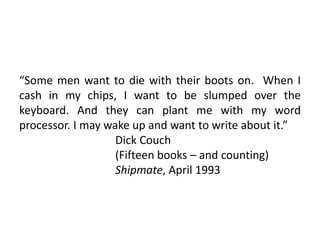
“Some men want to die with their boots on. When I
cash in my chips, I want to be slumped over the
keyboard. And they can plant me with my word
processor. I may wake up and want to write about it.”
Dick Couch
(Fifteen books – and counting)
Shipmate, April 1993
Slides Posted:
http://www.georgegaldorisi.com/
E-Mail Address
george@georgegaldorisi.com
Next Week
First - and Essential - Steps
• Content-hungry media
• Repurposing and building content
• Building relationships with editors – a win-win for
both parties
• Solo or with a wingman? The pros and cons of
collaboration
Optional Homework Assignment
for Next Week
• A significant number of writers who eventually write
books begin their careers by writing for journals and
magazines
• Pick a magazine you enjoy, and write a short letter to
the editor pitching your idea for an article
• Send it to me by Sunday night and I’ll put in into our
slides for next Tuesday – tell me whether to use your
name on it or not
• Don’t struggle with this – give yourself no more than
thirty minutes
Course Construct
We Have Some Options
• Seminar One: Why Write?
• Seminar Two: First - and Essential - Steps
• Seminar Three: Non-Fiction - The Hungry Market
• Seminar Four: “The Great American Novel”
• Seminar Five: Establishing an Online Presence
• Seminar Six: Social Media - Challenges and Opportunities
Course Construct
We Have Some Options
• Seminar One: Why Write?
• Seminar Two: First - and Essential - Steps
• Seminar Three: Non-Fiction - The Hungry Market
• Seminar Four: “The Great American Novel”
• Seminar Five: Establishing an Online Presence
• Seminar Six: Social Media - Challenges and Opportunities
Finally, a word about surveys….
A Word About Surveys:
Comments Typically Come in Three Types
• You rocked my world and my life is now changed forever
for the better – I’m a completely new person
• I’d rather have a root canal than have to sit through this
again – and I think you should pay for it
• I got something (a lot, a little) out of this course, but if
the instructor does this next year, he should:
– Do more of….
– Do less of….
– Go faster….
– Go slower….
– ????
Backups….
Why Are You Here?
• Writing is about telling stories – it’s about the
narrative
• All of us have our own narratives – and that in itself
is story
• Let’s all tell the story of our lives in three minutes.
Suggest starting: “I was born at a very young age.”
• Some things you might include:
The Story of My Life in Three Minutes
• Where born
• Family (X-generation, siblings, etc.)
• Where you grew up
• Where you went to school
• How you happened to be in California in 2018
• What you hope to get out of this course

Why Write?

  • 1.
    Why Write? A Guideto Getting Published
  • 2.
    A Few Preliminaries…. •Three promises: – This will be a fast-paced two hours – We’ll learn something…and we’ll have fun – You’ll have access to these slides…take notes…or not…. • Three assumptions: – You all are interested in writing as a hobby or avocation – That includes articles of all kinds as well as books – You didn’t wake up last Tuesday morning with this notion
  • 3.
    ….by way ofbackground….
  • 4.
    Let’s Talk AboutWriting….
  • 5.
    ….and isn’t this theoldest profession?
  • 6.
  • 7.
    “No one evermade a decision based on a number. They need a story.” Michael Lewis The Undoing Project
  • 8.
    “If you decideto become a professional writer, you must, broadly speaking, decide whether you wish to write for fame, for pleasure, or for money.” Ian Fleming How to Write a Thriller
  • 9.
    Course Content &Why Write? • Why This Course? • Why Are You Here? • We’ll Talk about the course content & objectives • We’ll all get a sense of why each of us are here • We’ll look at writing from the 100,000 ft. level • Then we’ll look at some tricks of the trade
  • 10.
    Why This Course? •Writing anything is a journey • Most of us who do this have been mentored • I’ve been doing this for four decades • It might be beneficial to package what I’ve learned • This is the fourth time I’ve done this • You’ll benefit from the feedback of earlier classes
  • 11.
    In-Class “Homework” Assignment •Tell us all a two minute "story of your life." A good place to start is: "I was born at a very young age." • Tell us what you read in the last year (book, article, op-ed etc.) that inspired or moved you, or at least made you think. • What is your top aspirational goal for writing (anthology, magazine article, non-fiction book, newspaper op-ed, etc.).
  • 12.
    Some Suggested GroundRules • We can conduct this seminar anywhere along a spectrum • Some ground rules I’ve found helpful in courses I’ve taken: – Interactive – Participatory – Mutual learning – Constant feedback • Homework – but it is all voluntary • Opportunities to take your game to the next level • The “Golden Rule” for your fellow attendees • A word about power point…. • Slides available on my website after each session
  • 13.
    “Exit Criteria:” WhatYou Should Expect • If you’re interested in writing shorter pieces: blogs, newsletters, print or online articles – you’re ready • If you’re interested in writing a book or publishing a book you’ve already written: o You know enough to give yourself a good pole position to break yourself away from the crowd o You know enough about the resources available that you can choose the ones that work for you o You’re mindful of the level of effort required for these pursuits as well as the odds of success
  • 14.
    Great…so now thatthe administrative “stuff” is out of the way, what will we cover in these six weeks?
  • 15.
    Course Construct • SeminarOne: Why Write? • Seminar Two: First - and Essential - Steps • Seminar Three: Non-Fiction - The Hungry Market • Seminar Four: “The Great American Novel” • Seminar Five: Establishing an Online Presence • Seminar Six: Social Media - Challenges and Opportunities
  • 16.
    Seminar One: WhyWrite? • History is what writers say it is • Picking your medium • A building block approach • Due diligence the easy way
  • 17.
    Seminar Two: First- and Essential - Steps • Content-hungry media • Repurposing and building content • Building relationships with editors – a win-win for both parties • Solo or with a wingman? The pros and cons of collaboration
  • 18.
    Seminar Three: Non-Fiction -The Hungry Market • Being - or becoming - the expert? • Pursuing a subject - or letting life happen? • Scratching itches - or entertaining? • How much to tell and what’s next?
  • 19.
    Seminar Four: “The GreatAmerican Novel” • Great or not-so-great? What you need to know getting started • Mainstream or genre? Which way should you go? • Defining your audience and picking a “voice” and point of view • Getting the sale – and then promoting your work
  • 20.
    Seminar Five: Establishing anOnline Presence • What makes yours unique? • Beating the competition for “eyes” • Balancing content and entertainment • Doing-it-yourself…or…?
  • 21.
    Seminar Six: Social Media-Challengesand Opportunities • Everyone is doing it • Vote early and often • Building a following • Sustaining momentum
  • 22.
    …Whew!...now that we’vehad an overarching look at the course, let’s get into the first seminar…but first…some suggested exit criteria….
  • 23.
    Suggested Goals forThis Session • Learn something useful you can apply now • Focus on what kind of writing you’d like to do • Have fun doing it rather than make it a chore • Develop your network among your classmates
  • 24.
  • 25.
    “History is whatthe historians and writers say it is.” Norman Polmar (Forty books – and counting)
  • 26.
    Why Write? • Historyis what writers say it is – what you say it is • Picking your medium • A suggested building block approach • Due diligence the easy way • If you do nothing else – Bill Terry
  • 27.
    “There are authorsand artists and then again there are writers and painters.” Ian Fleming How to Writer a Thriller
  • 28.
    I keep sixhonest serving-men (They taught me all I knew); Their names are What and Why and When And How and Where and Who. Rudyard Kipling The Elephant’s Child
  • 29.
    Some Things toConsider Before You Write • Who are you writing for? • What are you going to write? • Where are you going to write? • When are you going to write? • Why are you going to write? • How are you going to write?
  • 30.
    “Storytelling is ashuman as breathing. Literature, since it emerged 4,000 years ago, has shaped the lives of most humans on planet Earth. We are what we read.” John Sutherland “Book People”
  • 31.
    So Many Outlets– So Little Time • A wide array of online media • Newsletters • Alumni magazines • Professional journals • Popular magazines • Newspapers • Portions of non-fiction books • Non-fiction books • Short stories • Novels – of all kinds
  • 32.
    “Now, if you’regetting all fired up and ready to pound the keys, I might inject a word of caution. Actually, this word comes from my wife. For most of us, writing is not a team sport. An article for a trade journal or a short story is no big deal, but if you find yourself writing a long piece or a book, you probably ought to have a chat with your spouse. For most of us, writing means closing off the other people in your life for several hours a day and it’s something you may want to talk about before you begin.” Dick Couch (Fifteen books – and counting) Shipmate, April 1993
  • 33.
    With That Cautionin Mind • Telling stories – the oldest profession • Telling stories – like your life depended on it! • We all grew up on stories • Life is a narrative • The test: So you’re in a bar with your friends…
  • 34.
    One Way ofApproaching This • Article in alumni magazine • Article in professional journal • Newspaper articles • Non-fiction books • Mass-market paperback novels • Conference proceedings • Best-selling novels • ….
  • 35.
    Mr. Clancy saidnone of his success came easily, and he would remind aspiring writers of that when he spoke to them. “I tell them you learn to write the same way you learn to play golf,” he once said. “You do it, and keep doing it until you get it right. A lot of people think something mystical happens to you, that maybe the muse kisses you on the ear. But writing isn’t divinely inspired — it’s hard work.” Tom Clancy Quoted in the New York Times October 2, 2013
  • 36.
  • 37.
    “If you don’thave time to read, you don’t have the time or tools to write.” Stephen King (49 books – and counting)
  • 38.
    Due Diligence theEasy Way • Newsletters in your professional niche • Popular magazines in your interest areas • Books that offer a compendium of information • Books that focus on a single niche • The next step – novelizing what you do • It’s all in the library stacks!
  • 39.
    If You WriteNothing Else
  • 40.
    My Personal Hero: andWhat Made Him So
  • 41.
    “Listen, Stephen Kingused to write in the washroom of his trailer after his kids went to sleep. Harlan Ellison wrote in the stall of a bathroom of his barracks during boot camp. Elmore Leonard got up at 5 AM every morning to write before work. Every time my alarm goes off at 5 AM and I don’t want to get up, or I would rather sit down after work and play a videogame, I think about those guys. Take care of your family. They need you and love you. Make time for them. Then stop screwing around and finish your damn book.” Bernard Schaffer Whitechapel: The Final Stand of Sherlock Holmes
  • 42.
    A bit ofa leap-ahead to books… …and a highlight from the CWW
  • 43.
    Industry Insider Perspectiveon Books • Few industries have changed as much as publishing • These changes are still working themselves out • The changes present challenges – and opportunities • If you know the landscape – you tilt it in your favor
  • 44.
    Where and HowDo Books Get Published? • Legacy publishing houses • Amazon and its imprints • Academic houses • Vanity presses • Self-Publishing on your own
  • 45.
    Who Are theLegacy Houses? • Penguin Random House • Harper Collins • Simon & Schuster • The Hachette Book Group • Macmillan
  • 46.
    What Are theAmazon Imprints? • Amazon Encore • Amazon Crossing • Montlake Romance • Thomas & Mercer • 47 North • New Harvest • Amazon Publishing • Grand Harbor Press • Amazon Children's Publishing • Little A • Jet City Comics • Lake Union Publishing • StoryFront • Waterfall Press
  • 47.
    Where and HowDo Books Get Published? • Legacy publishing houses • Amazon and its imprints • Academic houses • Vanity presses • Self-Publishing on your own
  • 48.
    Helpful Resources • Writerson Writing (I) • Writers on Writing (II) • NYT Book Review • NYT Book Review – Last Page
  • 49.
  • 50.
    “Some men wantto die with their boots on. When I cash in my chips, I want to be slumped over the keyboard. And they can plant me with my word processor. I may wake up and want to write about it.” Dick Couch (Fifteen books – and counting) Shipmate, April 1993
  • 51.
  • 52.
  • 53.
    First - andEssential - Steps • Content-hungry media • Repurposing and building content • Building relationships with editors – a win-win for both parties • Solo or with a wingman? The pros and cons of collaboration
  • 54.
    Optional Homework Assignment forNext Week • A significant number of writers who eventually write books begin their careers by writing for journals and magazines • Pick a magazine you enjoy, and write a short letter to the editor pitching your idea for an article • Send it to me by Sunday night and I’ll put in into our slides for next Tuesday – tell me whether to use your name on it or not • Don’t struggle with this – give yourself no more than thirty minutes
  • 55.
    Course Construct We HaveSome Options • Seminar One: Why Write? • Seminar Two: First - and Essential - Steps • Seminar Three: Non-Fiction - The Hungry Market • Seminar Four: “The Great American Novel” • Seminar Five: Establishing an Online Presence • Seminar Six: Social Media - Challenges and Opportunities
  • 56.
    Course Construct We HaveSome Options • Seminar One: Why Write? • Seminar Two: First - and Essential - Steps • Seminar Three: Non-Fiction - The Hungry Market • Seminar Four: “The Great American Novel” • Seminar Five: Establishing an Online Presence • Seminar Six: Social Media - Challenges and Opportunities
  • 57.
    Finally, a wordabout surveys….
  • 58.
    A Word AboutSurveys: Comments Typically Come in Three Types • You rocked my world and my life is now changed forever for the better – I’m a completely new person • I’d rather have a root canal than have to sit through this again – and I think you should pay for it • I got something (a lot, a little) out of this course, but if the instructor does this next year, he should: – Do more of…. – Do less of…. – Go faster…. – Go slower…. – ????
  • 59.
  • 60.
    Why Are YouHere? • Writing is about telling stories – it’s about the narrative • All of us have our own narratives – and that in itself is story • Let’s all tell the story of our lives in three minutes. Suggest starting: “I was born at a very young age.” • Some things you might include:
  • 61.
    The Story ofMy Life in Three Minutes • Where born • Family (X-generation, siblings, etc.) • Where you grew up • Where you went to school • How you happened to be in California in 2018 • What you hope to get out of this course

Editor's Notes

  • #4 Bio on website and in program Began writing in 1978 with an article in USNIP First novel published in 1998 Latest project – Tom Clancy Op-Center series….
  • #7 Michael Lewis, the Undoing Project ://www.vanityfair.com/news/2016/11/decision-science-daniel-kahneman-amos-tversky
  • #10 Why This Course? Why Are You Here? We’ll Talk about the course content & objectives We’ll all get a sense of why each of us are here We’ll look at writing from the 100,000 ft. level Then we’ll look at some tricks of the trade
  • #11 Writing anything is a journey Most of us who do this have been mentored Have been doing this for four decades It might be beneficial to package what I’ve learned This is the first time I’ve done this We’ll learn how to do this together
  • #12 Writing is about telling stories – it’s about the narrative All of us have our own narratives – and that in itself is story Let’s all tell the story of our lives in three minutes. Suggest starting: “I was born at a very young age.” Some things you might include:
  • #13 We can conduct this seminar anywhere along a spectrum Some ground rules I’ve found helpful in courses I’ve taken: Interactive Participatory Mutual learning Constant feedback No homework – but opportunities to take your game to the next level The “Golden Rule” for your fellow attendees A word about power point Slides available on my website after each session
  • #14 Writing anything is a journey Most of us who do this have been mentored Have been doing this for four decades It might be beneficial to package what I’ve learned This is the first time I’ve done this We’ll learn how to do this together
  • #16 Seminar One: Why Write? Seminar Two: First - and Essential - Steps Seminar Three: Non-Fiction - The Hungry Market Seminar Four: “The Great American Novel” Seminar Five: Establishing an Online Presence Seminar Six: Social Media - Challenges and Opportunities
  • #17 History is what writers say it is Picking your medium A building block approach Due diligence the easy way
  • #18 Content-hungry media Recycling and building content Building relationships with editors – a win-win for both parties Solo or with a wingman? The pros and cons of collaboration
  • #19 Being - or becoming - the expert? Pursuing a subject - or letting life happen? Scratching itches - or entertaining? How much to tell and what’s next?
  • #20 Great or not-so-great? What you need to know getting started Mainstream or genre? Which way should you go? Defining your audience and picking a “voice” and point of view Getting the sale
  • #21 What makes yours unique? Beating the competition for “eyes” Balancing content and entertainment Doing-it-yourself…or…?
  • #22 Everyone is doing it Vote early and often Building a following Sustaining momentum
  • #24 Learn something useful you can apply now Have fun doing it (mindfully) Develop your network among your classmates
  • #27 History is what writers say it is – what you say it is Picking your medium A suggested building block approach Due diligence the easy way If you do nothing else – Bill Terry
  • #30 Who are you writing for? What are you going to write? Where are you going to write? When are you going to write? Why are you going to write? How are you going to write?
  • #32 A wide array of online media Newsletters Alumni magazines Professional journals Popular magazines Newspapers Non-fiction books Portions of non-fiction books Short stories Novels – of all kinds
  • #34 Telling stories – the oldest profession Telling stories – like your life depended on it! We all grew up on stories Life is a narrative The test: So you’re in a bar with your friends…
  • #35 Articles in alumni magazine Articles in professional journal Newspaper articles Non-fiction books Mass-market paperback novels Conference proceedings Best-selling novels ….
  • #39 Newsletters in your professional niche Popular magazines in your professional interest area Books that offer a compendium of information Books that focus on a single niche The next step – novelizing what you do It’s all in the library stacks!
  • #44 Writers on Writing (I) Writers on Writing (II) NYT Book Review NYT Book Review – Last Page
  • #45 Writers on Writing (I) Writers on Writing (II) NYT Book Review NYT Book Review – Last Page
  • #46 Writers on Writing (I) Writers on Writing (II) NYT Book Review NYT Book Review – Last Page
  • #47 https://en.wikipedia.org/wiki/Amazon_Publishing
  • #48 Writers on Writing (I) Writers on Writing (II) NYT Book Review NYT Book Review – Last Page
  • #49 Writers on Writing (I) Writers on Writing (II) NYT Book Review NYT Book Review – Last Page
  • #54 Content-hungry media Recycling and building content Building relationships with editors – a win-win for both parties Solo or with a wingman? The pros and cons of collaboration
  • #55 Writing is about telling stories – it’s about the narrative All of us have our own narratives – and that in itself is story Let’s all tell the story of our lives in three minutes. Suggest starting: “I was born at a very young age.” Some things you might include:
  • #56 Seminar One: Why Write? Seminar Two: First - and Essential - Steps Seminar Three: Non-Fiction - The Hungry Market Seminar Four: “The Great American Novel” Seminar Five: Establishing an Online Presence Seminar Six: Social Media - Challenges and Opportunities
  • #57 Seminar One: Why Write? Seminar Two: First - and Essential - Steps Seminar Three: Non-Fiction - The Hungry Market Seminar Four: “The Great American Novel” Seminar Five: Establishing an Online Presence Seminar Six: Social Media - Challenges and Opportunities
  • #61 Writing is about telling stories – it’s about the narrative All of us have our own narratives – and that in itself is story Let’s all tell the story of our lives in three minutes. Suggest starting: “I was born at a very young age.” Some things you might include:
  • #62 Where born Family (X-generation, siblings, etc.) Where you grew up Where you went to school How you happened to be in California in 2015 What you hope to get out of this course