Miss Catherine’s
Class
February 9-13, 2015
Today’s Objectives
• Daily Meeting…play a game…bring your
homework!
• I-Pads…Audiobook section of the Collage.
• Reading Workshop…
I-Pads
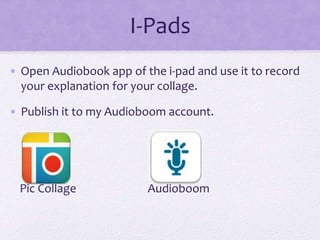
• Open Audiobook app of the i-pad and use it to record
your explanation for your collage.
• Publish it to my Audioboom account.
Pic Collage Audioboom
Reading Workshop
Please confirm that you have your Red
Notebooks on your desks.
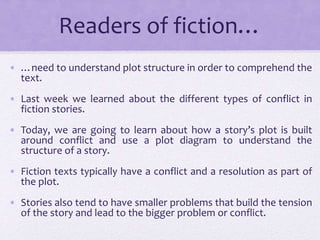
Readers of fiction…
• …need to understand plot structure in order to comprehend the
text.
• Last week we learned about the different types of conflict in
fiction stories.
• Today, we are going to learn about how a story’s plot is built
around conflict and use a plot diagram to understand the
structure of a story.
• Fiction texts typically have a conflict and a resolution as part of
the plot.
• Stories also tend to have smaller problems that build the tension
of the story and lead to the bigger problem or conflict.
Readers
of fiction…
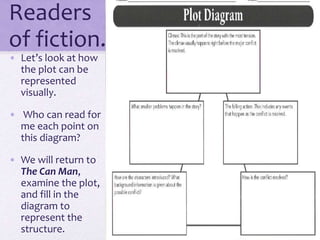
• Let’s look at how
the plot can be
represented
visually.
• Who can read for
me each point on
this diagram?
• We will return to
The Can Man,
examine the plot,
and fill in the
diagram to
represent the
structure.
Readers
of fiction…
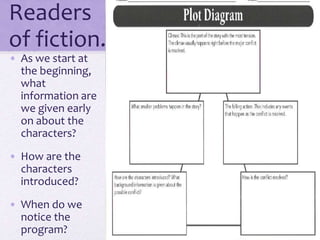
• As we start at
the beginning,
what
information are
we given early
on about the
characters?
• How are the
characters
introduced?
• When do we
notice the
program?
Readers
of fiction…
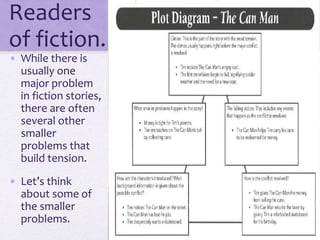
• While there is
usually one
major problem
in fiction stories,
there are often
several other
smaller
problems that
build tension.
• Let’s think
about some of
the smaller
problems.
Readers
of fiction…
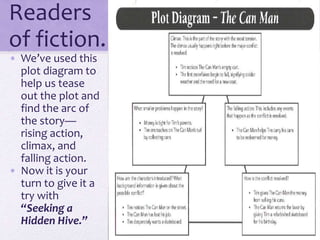
• We’ve used this
plot diagram to
help us tease
out the plot and
find the arc of
the story—
rising action,
climax, and
falling action.
• Now it is your
turn to give it a
try with
“Seeking a
Hidden Hive.”
Readers
of fiction…
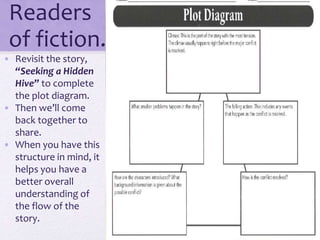
• Revisit the story,
“Seeking a Hidden
Hive” to complete
the plot diagram.
• Then we’ll come
back together to
share.
• When you have this
structure in mind, it
helps you have a
better overall
understanding of
the flow of the
story.
Readers
of fiction…
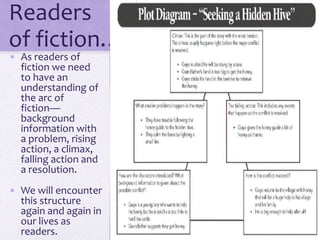
• As readers of
fiction we need
to have an
understanding of
the arc of
fiction—
background
information with
a problem, rising
action, a climax,
falling action and
a resolution.
• We will encounter
this structure
again and again in
our lives as
readers.
west lay
instruments meet
paragraph raised
whether clothes
teacher held
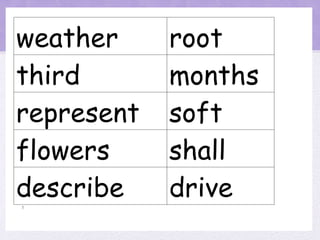
weather root
third months
represent soft
flowers shall
describe drive!
5-Minute Break
Reading Workshop
Please confirm that you have your Red
Notebooks on your desks.
Readers…
• …uncover the theme of the story to build deeper
understanding of the story and the world.
• Earlier in this unit, we discussed a possible theme for
The Can Man.
• Today, we are going to return to the conversation
about theme and grow our thinking about some of our
other mentor texts and their themes.
• We we discussed, a theme is a larger idea about the
world that a piece of literature addresses.
We name themes with single words, such as friendship,
loneliness and identity.
Readers…
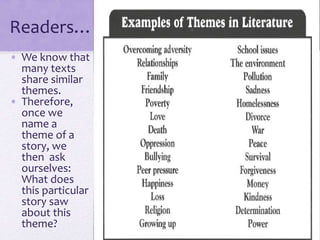
• We know that
many texts
share similar
themes.
• Therefore,
once we
name a
theme of a
story, we
then ask
ourselves:
What does
this particular
story saw
about this
theme?
Readers…
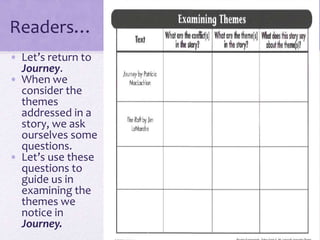
• Let’s return to
Journey.
• When we
consider the
themes
addressed in a
story, we ask
ourselves some
questions.
• Let’s use these
questions to
guide us in
examining the
themes we
notice in
Journey.
Readers…
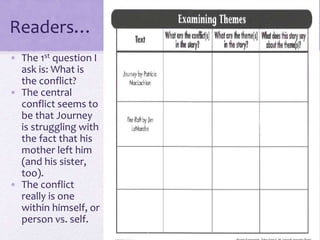
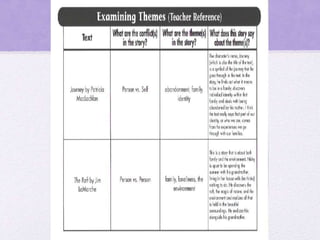
• The 1st question I
ask is: What is
the conflict?
• The central
conflict seems to
be that Journey
is struggling with
the fact that his
mother left him
(and his sister,
too).
• The conflict
really is one
within himself, or
person vs. self.
Readers…
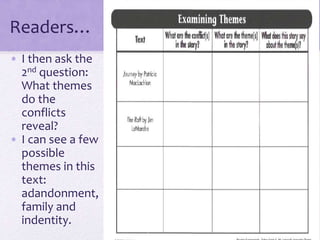
• I then ask the
2nd question:
What themes
do the
conflicts
reveal?
• I can see a few
possible
themes in this
text:
adandonment,
family and
indentity.
Readers…
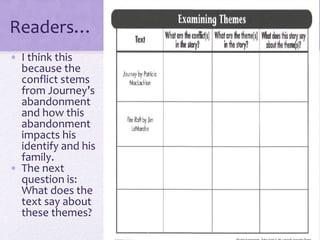
• I think this
because the
conflict stems
from Journey’s
abandonment
and how this
abandonment
impacts his
identify and his
family.
• The next
question is:
What does the
text say about
these themes?
Readers…
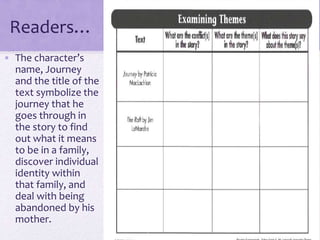
• The character’s
name, Journey
and the title of the
text symbolize the
journey that he
goes through in
the story to find
out what it means
to be in a family,
discover individual
identity within
that family, and
deal with being
abandoned by his
mother.
Readers…
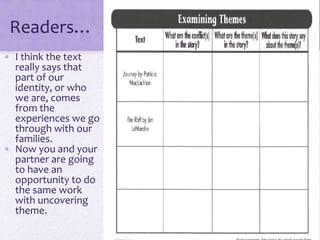
• I think the text
really says that
part of our
identity, or who
we are, comes
from the
experiences we go
through with our
families.
• Now you and your
partner are going
to have an
opportunity to do
the same work
with uncovering
theme.
Readers…
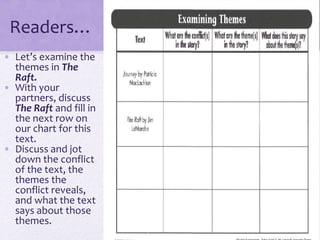
• Let’s examine the
themes in The
Raft.
• With your
partners, discuss
The Raft and fill in
the next row on
our chart for this
text.
• Discuss and jot
down the conflict
of the text, the
themes the
conflict reveals,
and what the text
says about those
themes.
Readers…
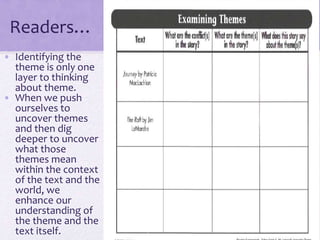
• Identifying the
theme is only one
layer to thinking
about theme.
• When we push
ourselves to
uncover themes
and then dig
deeper to uncover
what those
themes mean
within the context
of the text and the
world, we
enhance our
understanding of
the theme and the
text itself.
5-Minute Break
Writing Workshop
Before we begin, please make sure that you
have your white binders on your desks.
Feb. 9 13

Feb. 9 13

  • 1.
  • 2.
    Today’s Objectives • DailyMeeting…play a game…bring your homework! • I-Pads…Audiobook section of the Collage. • Reading Workshop…
  • 3.
    I-Pads • Open Audiobookapp of the i-pad and use it to record your explanation for your collage. • Publish it to my Audioboom account. Pic Collage Audioboom
  • 4.
    Reading Workshop Please confirmthat you have your Red Notebooks on your desks.
  • 5.
    Readers of fiction… •…need to understand plot structure in order to comprehend the text. • Last week we learned about the different types of conflict in fiction stories. • Today, we are going to learn about how a story’s plot is built around conflict and use a plot diagram to understand the structure of a story. • Fiction texts typically have a conflict and a resolution as part of the plot. • Stories also tend to have smaller problems that build the tension of the story and lead to the bigger problem or conflict.
  • 6.
    Readers of fiction… • Let’slook at how the plot can be represented visually. • Who can read for me each point on this diagram? • We will return to The Can Man, examine the plot, and fill in the diagram to represent the structure.
  • 7.
    Readers of fiction… • Aswe start at the beginning, what information are we given early on about the characters? • How are the characters introduced? • When do we notice the program?
  • 8.
    Readers of fiction… • Whilethere is usually one major problem in fiction stories, there are often several other smaller problems that build tension. • Let’s think about some of the smaller problems.
  • 9.
    Readers of fiction… • We’veused this plot diagram to help us tease out the plot and find the arc of the story— rising action, climax, and falling action. • Now it is your turn to give it a try with “Seeking a Hidden Hive.”
  • 10.
    Readers of fiction… • Revisitthe story, “Seeking a Hidden Hive” to complete the plot diagram. • Then we’ll come back together to share. • When you have this structure in mind, it helps you have a better overall understanding of the flow of the story.
  • 11.
    Readers of fiction… • Asreaders of fiction we need to have an understanding of the arc of fiction— background information with a problem, rising action, a climax, falling action and a resolution. • We will encounter this structure again and again in our lives as readers.
  • 12.
    west lay instruments meet paragraphraised whether clothes teacher held
  • 13.
    weather root third months representsoft flowers shall describe drive!
  • 14.
  • 15.
    Reading Workshop Please confirmthat you have your Red Notebooks on your desks.
  • 16.
    Readers… • …uncover thetheme of the story to build deeper understanding of the story and the world. • Earlier in this unit, we discussed a possible theme for The Can Man. • Today, we are going to return to the conversation about theme and grow our thinking about some of our other mentor texts and their themes. • We we discussed, a theme is a larger idea about the world that a piece of literature addresses. We name themes with single words, such as friendship, loneliness and identity.
  • 17.
    Readers… • We knowthat many texts share similar themes. • Therefore, once we name a theme of a story, we then ask ourselves: What does this particular story saw about this theme?
  • 18.
    Readers… • Let’s returnto Journey. • When we consider the themes addressed in a story, we ask ourselves some questions. • Let’s use these questions to guide us in examining the themes we notice in Journey.
  • 19.
    Readers… • The 1stquestion I ask is: What is the conflict? • The central conflict seems to be that Journey is struggling with the fact that his mother left him (and his sister, too). • The conflict really is one within himself, or person vs. self.
  • 20.
    Readers… • I thenask the 2nd question: What themes do the conflicts reveal? • I can see a few possible themes in this text: adandonment, family and indentity.
  • 21.
    Readers… • I thinkthis because the conflict stems from Journey’s abandonment and how this abandonment impacts his identify and his family. • The next question is: What does the text say about these themes?
  • 22.
    Readers… • The character’s name,Journey and the title of the text symbolize the journey that he goes through in the story to find out what it means to be in a family, discover individual identity within that family, and deal with being abandoned by his mother.
  • 23.
    Readers… • I thinkthe text really says that part of our identity, or who we are, comes from the experiences we go through with our families. • Now you and your partner are going to have an opportunity to do the same work with uncovering theme.
  • 24.
    Readers… • Let’s examinethe themes in The Raft. • With your partners, discuss The Raft and fill in the next row on our chart for this text. • Discuss and jot down the conflict of the text, the themes the conflict reveals, and what the text says about those themes.
  • 25.
    Readers… • Identifying the themeis only one layer to thinking about theme. • When we push ourselves to uncover themes and then dig deeper to uncover what those themes mean within the context of the text and the world, we enhance our understanding of the theme and the text itself.
  • 27.
  • 28.
    Writing Workshop Before webegin, please make sure that you have your white binders on your desks.