Introduction
Introduction
Plot is the arrangement of events within the
written text.
 Event: a significant occurrence, incident, or
experience.
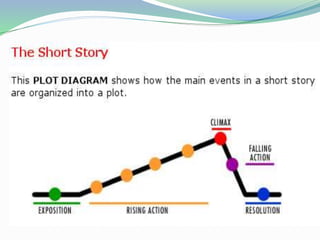
There are five basic elements that structure the plot
1.Exposition: The Beginning
Every story must have a beginning.
 is where the characters and setting are established.
 the conflict or main problem is also introduced.
It provides the background for the plot of the story.
2. Rising Action: Introduction of
the Problem or Conflict
 After the characters and main problem have been
established, the main problem or conflict is dealt with by
some kind of action.
 In this part of the story, the main character is in crisis.
These events create tension and excitement in the plot.
 The complication can arise through a character's conflict
with society, nature, fate, or a number of themes.
3.Climax: The High Point
 The climax is the high point of the story. It is the main
event or danger that the character faces.
 This is the darkest moment, the worst challenge the
character must oppose. At this point it looks as if the
character will fail, and will never get what he/she wants.

 The turning point may be either physical or emotional.
4. Falling Action: Winding Down
 Following the climax, the story begins to slowly wind
down.
 Falling action, shows the result of the actions or decisions
the character has made as a result of the climax.
 This eventually leads to the final part of the novel, the
crisis resolution.
5. Resolution: The Outcome
 The resolution, also often called denouement, which is
French for "to untie" or "unravelling", is the conclusion of
the story.
 The conflicts are resolved, all loose ends are tied up, and
the story concludes with either a happy or sad ending.
Plot an Introduction

Plot an Introduction

  • 1.
  • 2.
    Introduction Plot is thearrangement of events within the written text.  Event: a significant occurrence, incident, or experience. There are five basic elements that structure the plot
  • 3.
    1.Exposition: The Beginning Everystory must have a beginning.  is where the characters and setting are established.  the conflict or main problem is also introduced. It provides the background for the plot of the story.
  • 4.
    2. Rising Action:Introduction of the Problem or Conflict  After the characters and main problem have been established, the main problem or conflict is dealt with by some kind of action.  In this part of the story, the main character is in crisis. These events create tension and excitement in the plot.  The complication can arise through a character's conflict with society, nature, fate, or a number of themes.
  • 5.
    3.Climax: The HighPoint  The climax is the high point of the story. It is the main event or danger that the character faces.  This is the darkest moment, the worst challenge the character must oppose. At this point it looks as if the character will fail, and will never get what he/she wants.   The turning point may be either physical or emotional.
  • 6.
    4. Falling Action:Winding Down  Following the climax, the story begins to slowly wind down.  Falling action, shows the result of the actions or decisions the character has made as a result of the climax.  This eventually leads to the final part of the novel, the crisis resolution.
  • 7.
    5. Resolution: TheOutcome  The resolution, also often called denouement, which is French for "to untie" or "unravelling", is the conclusion of the story.  The conflicts are resolved, all loose ends are tied up, and the story concludes with either a happy or sad ending.