z
Elements Of Literature
(Identifying the Plot)
• A plot is not a story; it is in fact a series of
events providing conflict in the story.
• A plot is sometimes referred to as the ‘spine’
of a story,
• The plot is what happens in a story.
However, a plot is not a simple sequence of
events. 1. A strong plot is centered on one
moment—an interruption of a pattern, a
turning point, or an action—that raises a
dramatic question, which must be
answered throughout the course of the
story.
z
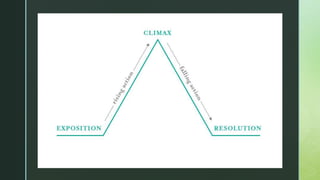
Elements of Literature (Identifying Plot)
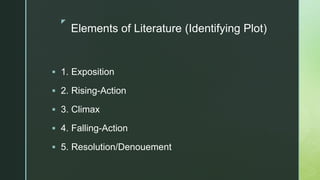
 1. Exposition
 2. Rising-Action
 3. Climax
 4. Falling-Action
 5. Resolution/Denouement
z
2. Exposition
Exposition is the beginning of the story and prepares
the way for upcoming events to unfold. It is in this part
of the plot, where major characters are introduced, the
setting is established, and major conflicts of the story
are revealed
z
3. Rising-Action
It is that point where the main problem or conflict is
revealed. During the point of rising action, the
protagonist will struggle to face the conflict which could
be internal (protagonist vs. self) or external (protagonist
vs. antagonist, protagonist vs. nature/society) and
chronicles how the main characters deal with the
curveball that comes their way.
z
4. Climax
The climax is the turning point in the story,
often centred around the protagonist’s most
difficult challenge or their bleakest moment.
The climax is the most exciting part of the story
and initiates a turning point in the characters’
lives.
z
1.Falling-Action
It is the point that occurs immediately after the climax and reveals the
details of the consequences good or bad, that the main characters must
deal with after the turning point of events.
z
5. Resolution
Resolution is the part where the outcome of the event
and the fate of the protagonist and antagonists are
revealed. This part is where the protagonist resolves the
conflicts and the loose ends of the storyline are tied up
unless, there is a sequel planned wherein there are cliff
hanger scenes to enable further development in the plot
line.
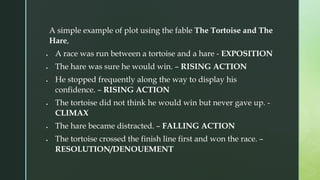
A simple example of plot using the fable The Tortoise and The
Hare,
 A race was run between a tortoise and a hare - EXPOSITION
 The hare was sure he would win. – RISING ACTION
 He stopped frequently along the way to display his
confidence. – RISING ACTION
 The tortoise did not think he would win but never gave up. -
CLIMAX
 The hare became distracted. – FALLING ACTION
 The tortoise crossed the finish line first and won the race. –
RESOLUTION/DENOUEMENT

Elements-Of-Literature-Identifying-the-Plot.pptx

  • 1.
  • 2.
    • A plotis not a story; it is in fact a series of events providing conflict in the story. • A plot is sometimes referred to as the ‘spine’ of a story, • The plot is what happens in a story. However, a plot is not a simple sequence of events. 1. A strong plot is centered on one moment—an interruption of a pattern, a turning point, or an action—that raises a dramatic question, which must be answered throughout the course of the story.
  • 3.
    z Elements of Literature(Identifying Plot)  1. Exposition  2. Rising-Action  3. Climax  4. Falling-Action  5. Resolution/Denouement
  • 4.
    z 2. Exposition Exposition isthe beginning of the story and prepares the way for upcoming events to unfold. It is in this part of the plot, where major characters are introduced, the setting is established, and major conflicts of the story are revealed
  • 5.
    z 3. Rising-Action It isthat point where the main problem or conflict is revealed. During the point of rising action, the protagonist will struggle to face the conflict which could be internal (protagonist vs. self) or external (protagonist vs. antagonist, protagonist vs. nature/society) and chronicles how the main characters deal with the curveball that comes their way.
  • 6.
    z 4. Climax The climaxis the turning point in the story, often centred around the protagonist’s most difficult challenge or their bleakest moment. The climax is the most exciting part of the story and initiates a turning point in the characters’ lives.
  • 7.
    z 1.Falling-Action It is thepoint that occurs immediately after the climax and reveals the details of the consequences good or bad, that the main characters must deal with after the turning point of events.
  • 8.
    z 5. Resolution Resolution isthe part where the outcome of the event and the fate of the protagonist and antagonists are revealed. This part is where the protagonist resolves the conflicts and the loose ends of the storyline are tied up unless, there is a sequel planned wherein there are cliff hanger scenes to enable further development in the plot line.
  • 10.
    A simple exampleof plot using the fable The Tortoise and The Hare,  A race was run between a tortoise and a hare - EXPOSITION  The hare was sure he would win. – RISING ACTION  He stopped frequently along the way to display his confidence. – RISING ACTION  The tortoise did not think he would win but never gave up. - CLIMAX  The hare became distracted. – FALLING ACTION  The tortoise crossed the finish line first and won the race. – RESOLUTION/DENOUEMENT