PLC System Presentation.doc                          1/2/01


                PROGRAMMABLE LOGIC CONTROLLERS
                              AT
                        JEFFERSON LAB

                                Henry Robertson
                              Safety Systems Group
                              TJNAF/Jefferson Lab
PLC System Presentation.doc                                1/2/01


       USES OF PROGRAMMABLE LOGIC CONTROLLERS AT JEFFERSON LAB


  • Equipment Status

  • Process Control

  • Chemical Processing

  • Equipment Interlocks

  • Machine Protection

  • Smoke Detection

  • Gas Monitoring

  • Envelope Monitoring

  • Personnel Safety
PLC System Presentation.doc                                                              1/2/01
       USES OF PROGRAMMABLE LOGIC CONTROLLERS AT JEFFERSON LAB

Chemical Processing


     Processing of Niobium Super conducting cavities uses a buffer chemical polish

            BCP Acids:
               Hydroflouric
               Phosphoric
               Nitric

            Chemical processing cabinet that is normally used for semiconductor wafer processing

            Built to the semi-conductor industry standard SEMI S93.02
PLC System Presentation.doc                                    1/2/01
       USES OF PROGRAMMABLE LOGIC CONTROLLERS AT JEFFERSON LAB

Gas Monitoring


     Experimental Hall B

            PLCs used for alarm functions

            System Part of Evaluated by Factory Mutual Corp.


     Oxygen Monitoring (for ODH) in CEBAF tunnels and halls

            Processor based

            Networked transmitters / sensors
PLC System Presentation.doc                                                               1/2/01
       USES OF PROGRAMMABLE LOGIC CONTROLLERS AT JEFFERSON LAB


Machine Protection


     Free Electron Laser Machine Protection System

            PLCs used for system set up and device monitoring

            Automatically detects FEL configuration and limits beam current to appropriate level
PLC System Presentation.doc                                           1/2/01
       USES OF PROGRAMMABLE LOGIC CONTROLLERS AT JEFFERSON LAB

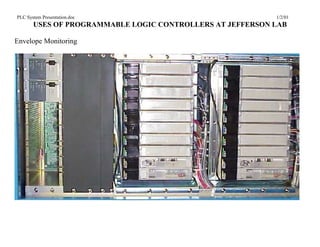
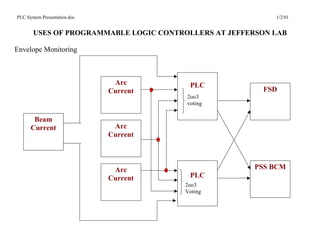
Envelope Monitoring


     Beam Envelope Limit System (BELS)

            Used to ensure that nuclear physics accelerator remains
            within operations and safety envelope

            Allows beam operation close to envelope limits

            Measures beam power

            Redundant PLCs using voting arrangement on inputs
PLC System Presentation.doc                                1/2/01
       USES OF PROGRAMMABLE LOGIC CONTROLLERS AT JEFFERSON LAB

Envelope Monitoring
PLC System Presentation.doc                                1/2/01


       USES OF PROGRAMMABLE LOGIC CONTROLLERS AT JEFFERSON LAB

Envelope Monitoring


                               Arc       PLC
                              Current                   FSD
                                        2oo3
                                        voting

       Beam
      Current                  Arc
                              Current


                               Arc                    PSS BCM
                              Current    PLC
                                        2oo3
                                        Voting
PLC System Presentation.doc                                                             1/2/01
                         USING PLCS IN THE PERSONNEL SAFETY SYSTEM

Why Programmable Controllers?

  • Complexity – Much less complex than large relay based system

  • Modularity – Very flexible due to network architecture

  • Documentation – Virtually self-documenting

  • Resource limitations – Very space efficient and less manpower required to install

  • Cost and schedule – Up front material costs are similar, but savings on installation,
                  maintenance, and troubleshooting increase rapidly as system size increases

  • Reliability – Industry and lab experience demonstrate PLCs comparable to relay system

  • Familiarity – Huge knowledge base in industry

  • Training – Short learning curve for hardware and programming

  • Troubleshooting – Ability to monitor every sensor speeds debug and repair
PLC System Presentation.doc                                                       1/2/01


                         USING PLCS IN THE PERSONNEL SAFETY SYSTEM


  • Programmable Logic Controllers (PLC) used to emulate relay logic interlocks
    and provide device status


  • Special computers/software used for programming and status


  • Stringent programming procedure used


  • Rigorous testing procedures followed


  • Hardware and software changes tightly controlled


  • Proven high reliability and availability
PLC System Presentation.doc                                                 1/2/01


                         PROGRAMMABLE LOGIC CONTROLLER SYSTEM


  • 2 independent PLC systems (A and B)


  • Each system consists of approximately 1000+ I/O points


  • System segmented into 6 physical areas for modularity


  • High speed network used for peer-to-peer communication


  • Fiber optic modems provide long distance networking and EMI isolation


  • Discrete monitoring of every sensor device


  • Discrete management of every control device
PLC System Presentation.doc                                                     1/2/01


                         PROGRAMMABLE LOGIC CONTROLLER SYSTEM


  • Human Machine Interface (HMI) software allows standardized status screens


  • Secure stand-alone computer and software for programming logic


  • Throughput / response time < .5 seconds


  • High-density modules allow efficient use of rack space


  • “Soft” wiring requires only one person


  • Built-in diagnostics simplify trouble-shooting
PLC System Presentation.doc                                                                                                    1/2/01
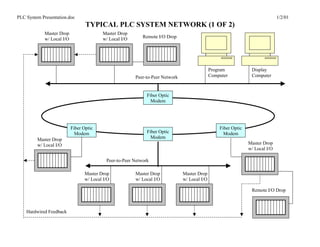
                                  TYPICAL PLC SYSTEM NETWORK (1 OF 2)
            Master Drop                  Master Drop
            w/ Local I/O                 w/ Local I/O       Remote I/O Drop


                                                                                              Program            Display
                                                        Peer-to-Peer Network                  Computer           Computer


                                                              Fiber Optic
                                                                Modem


                           Fiber Optic                                                            Fiber Optic
                             Modem                            Fiber Optic                           Modem
         Master Drop                                            Modem
         w/ Local I/O                                                                                           Master Drop
                                                                                                                w/ Local I/O

                                           Peer-to-Peer Network

                                 Master Drop            Master Drop            Master Drop
                                 w/ Local I/O           w/ Local I/O           w/ Local I/O

                                                                                                                 Remote I/O Drop


    Hardwired Feedback
PLC System Presentation.doc                                                                                    1/2/01
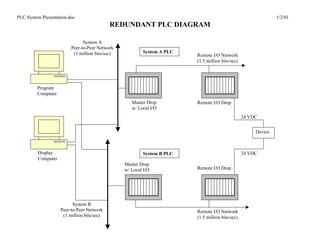
                                            REDUNDANT PLC DIAGRAM

                               System A
                         Peer-to-Peer Network
                          (1 million bits/sec)           System A PLC
                                                                        Remote I/O Network
                                                                        (1.5 million bits/sec)


         Program
         Computer
                                                    Master Drop         Remote I/O Drop
                                                    w/ Local I/O
                                                                                                 24 VDC


                                                                                                      Device


         Display                                         System B PLC                            24 VDC
         Computer
                                                 Master Drop
                                                 w/ Local I/O           Remote I/O Drop


                          System B
                    Peer-to-Peer Network                                Remote I/O Network
                     (1 million bits/sec)                               (1.5 million bits/sec)
PLC System Presentation.doc                                                                             1/2/01
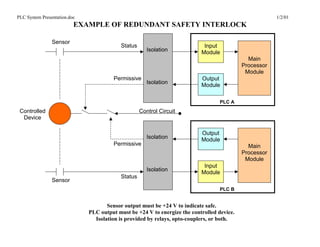
                          EXAMPLE OF REDUNDANT SAFETY INTERLOCK

                Sensor
                                           Status                           Input
                                                       Isolation           Module
                                                                                              Main
                                                                                            Processor
                                                                                             Module
                                        Permissive                         Output
                                                       Isolation
                                                                           Module

                                                                                   PLC A
 Controlled                                         Control Circuit
  Device

                                                                           Output
                                                       Isolation           Module
                                        Permissive                                            Main
                                                                                            Processor
                                                                                             Module
                                                                            Input
                                                       Isolation
                                                                           Module
                                           Status
                Sensor
                                                                                   PLC B


                                     Sensor output must be +24 V to indicate safe.
                              PLC output must be +24 V to energize the controlled device.
                                Isolation is provided by relays, opto-couplers, or both.
PLC System Presentation.doc                                    1/2/01
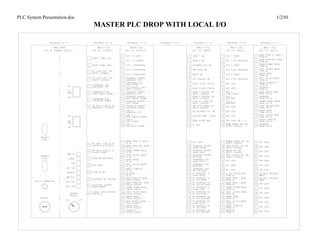
                              MASTER PLC DROP WITH LOCAL I/O
PLC System Presentation.doc                                                              1/2/01
                                        SEGMENTATION


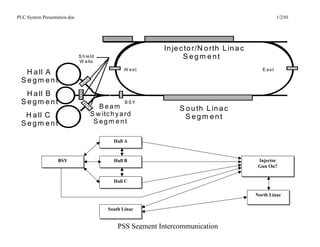
  • Site is segmented into 6 physical areas

            Injector/North Linac, South Linac, Beam Switchyard, Hall A, Hall B, Hall C

  • PLC Masters are located in each physical area (some areas include Remote I/O drops)

  • Allows separate maintenance and auditing of each segment

  • Allows operation and test of the accelerator in logical pieces

  • Each segment can operate independently up to the point where operation of a device within
    one area may present a hazard in another area

  • At that point the areas must agree that it is safe to operate the hazardous device

  • Inter-segment communication handled with hardwired handshake
PLC System Presentation.doc                                                                            1/2/01


                                                            In je c to r/N o rth L in a c
                              S h ie ld                            Segm ent
                              W a lls
                                                 W est                                         E ast
  H a ll A
 Segm ent
  H a ll B
 Segm ent                                         BSY
                                       Beam                      S o u th L in a c
  H a ll C                          S w itc h y a rd               Segm ent
 Segm ent                            Segm ent

                                             Hall A


                   BSY                       Hall B                                          Injector
                                                                                             Gun On?


                                             Hall C

                                                                                            North Linac

                                           South Linac


                                               PSS Segment Intercommunication
PLC System Presentation.doc                                                          1/2/01
                               HMI / SYSTEM MONITORING


Four computers are used in the monitoring of the PSS


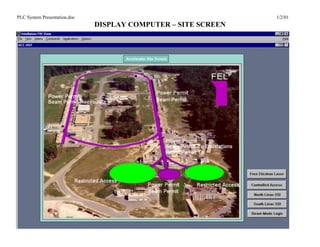
  • Display computer - operates as the safety system operator’s display

  • Development Computer - operates as the PSS technician’s remote display

  • Program Computer - programming, diagnostic, and performance monitoring of the PLC logic

  • X-terminal - passes PSS status to the JLAB instrumentation and control system, EPICS
PLC System Presentation.doc                                                          1/2/01


                              DISPLAY / DEVELOPMENT COMPUTERS


  • Local and remote status screens

  • Trouble-shooting screens

  • Flexible interface for easily customized screens

  • Includes security, alarming, and event logging functions

  • Uses network to monitor status of each area

  • No critical information, e.g. interlock logic, is transferred over the network

  • Configured as a read-only device
PLC System Presentation.doc                                    1/2/01
                              DISPLAY COMPUTER – SITE SCREEN
PLC System Presentation.doc                                        1/2/01
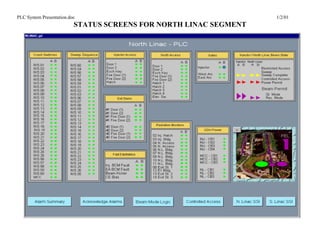
                          STATUS SCREENS FOR NORTH LINAC SEGMENT
PLC System Presentation.doc                                        1/2/01
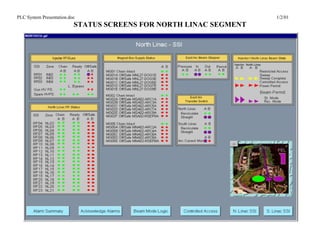
                          STATUS SCREENS FOR NORTH LINAC SEGMENT
PLC System Presentation.doc                                                     1/2/01


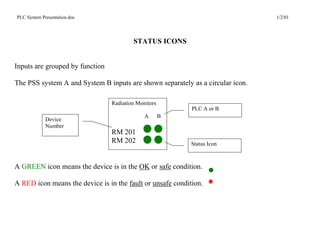
                                         STATUS ICONS


Inputs are grouped by function

The PSS system A and System B inputs are shown separately as a circular icon.

                                 Radiation Monitors
                                                            PLC A or B
                                              A       B
             Device
             Number
                                 RM 201
                                 RM 202                     Status Icon


A GREEN icon means the device is in the OK or safe condition.

A RED icon means the device is in the fault or unsafe condition.
PLC System Presentation.doc                             1/2/01


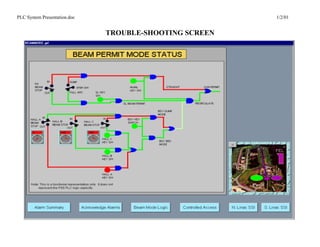
                              TROUBLE-SHOOTING SCREEN
PLC System Presentation.doc                                                                 1/2/01

                                       PLC PROGRAMMING

  • PLCs are programmed by two independent programmers

  • Information on implementation and algorithms are not shared

  • Each person writes the program to conform to a general functional specification of how the
    logic system should behave

  • Each PSS segment has a general logic specification

  • The specification gives a functional and logical description of the PLC logic for the area

  • The specification is careful to avoid detailed algorithms or suggested implementations

  • This allows the greatest degree of freedom in the actual implementation of the logic

  • The logic spec defines two types of logic

         1. state logic, e.g., Restricted Access, Sweep, Controlled Access, etc.

         2. device logic - defines the requirements for the PSS interface with a given device
PLC System Presentation.doc                                                 1/2/01
                              EXAMPLE OF THE SPEC FOR STATE LOGIC

            Beam Permit =
               [
                    Doors and Gates
               &
                    / Crash
               &
                    Exchange Key IN
               &
                    Sweep Complete
               &
                    Radiation Monitor OK
               &
                    High Voltage Ready
               &
                    / Laser Bypass
               &
                    External Systems Ready
               &
                    Chain Intact
               &
                    (    Beam Permit Key Switch Timer OR Beam Permit Mode   )
                ]
PLC System Presentation.doc                                                            1/2/01
                              EXAMPLE OF THE SPEC FOR DEVICE LOGIC

     RS(n) Operational =
                  [
                                   (
                                       (
                                                   Sweep Mode
                                            &
                                                   RS(n) Set Interlock
                                       )
                                            OR
                                                   RS(n) Operational
                                   )
                               &
                                   / RS(n) Crash
                               &
                                   RS(n-1) Operational
                          ]

Each programmer decides how to implement the logic in the context of the overall requirements for
the program

The two implementations are rarely immediately recognizable as being functionally equivalent
PLC System Presentation.doc                              1/2/01

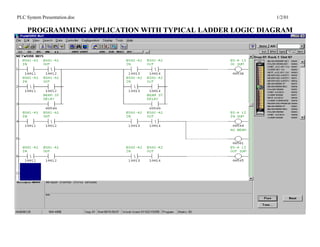
    PROGRAMMING APPLICATION WITH TYPICAL LADDER LOGIC DIAGRAM
PLC System Presentation.doc                                    1/2/01
                                      DOCUMENTATION


  • Virtually self-documenting

  • Ladder Logic diagrams with common name descriptors

  • “Traffic Cop” system configuration listings

  • Detailed listings of all I/O used including descriptions

  • Processor and network configuration details
PLC System Presentation.doc                                                               1/2/01

                              SAFETY SYSTEM CERTIFICATION

  • Adheres to Jefferson Lab Certification Procedure

  • Full Certification of the complete PSS is done semi-annually

  • An Operation's Crew Chief serves as the Test Director

  • Full Certification required for:

     If any part of the PLC interlock logic has been changed
     If the PLC CPU has been removed from the crate

  • Partial Certification required for:

     Required for any device or subsystem which has been modified
     Modification includes temporary disconnection and/or replacement.
     Must include all components affected by or connected to the device/system replaced
PLC System Presentation.doc                                                           1/2/01
                  SAFETY SYSTEMS GROUP CERTIFICATION PROCEDURES


  • Must follow Static and Functional test procedures exactly

  • Static test of all PSS inputs and outputs

  • Functional test of the operation of the PSS logic

  • Tests the separate response of systems A and B to ensure that each responds independently
PLC System Presentation.doc                                                1/2/01
                  SAFETY SYSTEMS GROUP CERTIFICATION PROCEDURES

Typical static tests:

  • Radiation Monitor Test
         Tests dose rate alarm function of CARM
         Tests bypass function of CARMs located in tunnel or endstations
  • Interface Chassis Test
         Tests     Power Permit
                   Off/Safe
                   Interlock Ready input
  • Segment Interface Test
         Tests interdependence of beam states
         Tests injector logic

Typical functional test:

  • Tests special operating modes or combinations of device states

  • Tests actual ability of PSS to shut off Gun and other power supplies
PLC System Presentation.doc                                   1/2/01
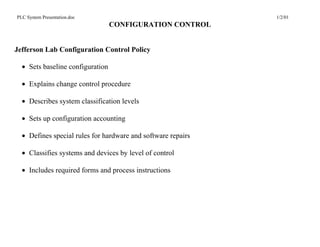
                                  CONFIGURATION CONTROL


Jefferson Lab Configuration Control Policy

  • Sets baseline configuration

  • Explains change control procedure

  • Describes system classification levels

  • Sets up configuration accounting

  • Defines special rules for hardware and software repairs

  • Classifies systems and devices by level of control

  • Includes required forms and process instructions
PLC System Presentation.doc                            1/2/01
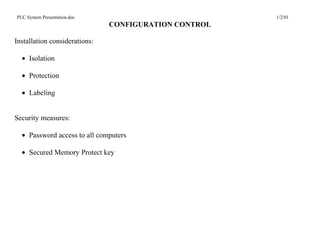
                               CONFIGURATION CONTROL

Installation considerations:

  • Isolation

  • Protection

  • Labeling


Security measures:

  • Password access to all computers

  • Secured Memory Protect key
PLC System Presentation.doc                                                               1/2/01


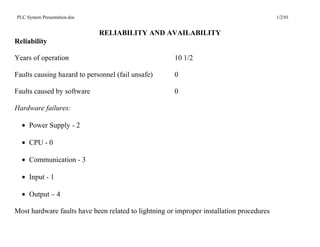
                              RELIABILITY AND AVAILABILITY
Reliability

Years of operation                                    10 1/2

Faults causing hazard to personnel (fail unsafe)      0

Faults caused by software                             0

Hardware failures:

  • Power Supply - 2

  • CPU - 0

  • Communication - 3

  • Input - 1

  • Output – 4

Most hardware faults have been related to lightning or improper installation procedures
PLC System Presentation.doc                                                                 1/2/01


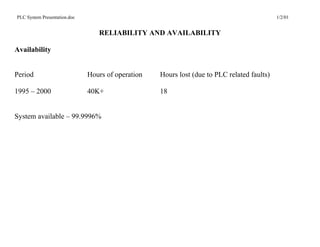
                                 RELIABILITY AND AVAILABILITY

Availability


Period                        Hours of operation   Hours lost (due to PLC related faults)

1995 – 2000                   40K+                 18


System available – 99.9996%

PLC

  • 1.
    PLC System Presentation.doc 1/2/01 PROGRAMMABLE LOGIC CONTROLLERS AT JEFFERSON LAB Henry Robertson Safety Systems Group TJNAF/Jefferson Lab
  • 2.
    PLC System Presentation.doc 1/2/01 USES OF PROGRAMMABLE LOGIC CONTROLLERS AT JEFFERSON LAB • Equipment Status • Process Control • Chemical Processing • Equipment Interlocks • Machine Protection • Smoke Detection • Gas Monitoring • Envelope Monitoring • Personnel Safety
  • 3.
    PLC System Presentation.doc 1/2/01 USES OF PROGRAMMABLE LOGIC CONTROLLERS AT JEFFERSON LAB Chemical Processing Processing of Niobium Super conducting cavities uses a buffer chemical polish BCP Acids: Hydroflouric Phosphoric Nitric Chemical processing cabinet that is normally used for semiconductor wafer processing Built to the semi-conductor industry standard SEMI S93.02
  • 4.
    PLC System Presentation.doc 1/2/01 USES OF PROGRAMMABLE LOGIC CONTROLLERS AT JEFFERSON LAB Gas Monitoring Experimental Hall B PLCs used for alarm functions System Part of Evaluated by Factory Mutual Corp. Oxygen Monitoring (for ODH) in CEBAF tunnels and halls Processor based Networked transmitters / sensors
  • 5.
    PLC System Presentation.doc 1/2/01 USES OF PROGRAMMABLE LOGIC CONTROLLERS AT JEFFERSON LAB Machine Protection Free Electron Laser Machine Protection System PLCs used for system set up and device monitoring Automatically detects FEL configuration and limits beam current to appropriate level
  • 6.
    PLC System Presentation.doc 1/2/01 USES OF PROGRAMMABLE LOGIC CONTROLLERS AT JEFFERSON LAB Envelope Monitoring Beam Envelope Limit System (BELS) Used to ensure that nuclear physics accelerator remains within operations and safety envelope Allows beam operation close to envelope limits Measures beam power Redundant PLCs using voting arrangement on inputs
  • 7.
    PLC System Presentation.doc 1/2/01 USES OF PROGRAMMABLE LOGIC CONTROLLERS AT JEFFERSON LAB Envelope Monitoring
  • 8.
    PLC System Presentation.doc 1/2/01 USES OF PROGRAMMABLE LOGIC CONTROLLERS AT JEFFERSON LAB Envelope Monitoring Arc PLC Current FSD 2oo3 voting Beam Current Arc Current Arc PSS BCM Current PLC 2oo3 Voting
  • 9.
    PLC System Presentation.doc 1/2/01 USING PLCS IN THE PERSONNEL SAFETY SYSTEM Why Programmable Controllers? • Complexity – Much less complex than large relay based system • Modularity – Very flexible due to network architecture • Documentation – Virtually self-documenting • Resource limitations – Very space efficient and less manpower required to install • Cost and schedule – Up front material costs are similar, but savings on installation, maintenance, and troubleshooting increase rapidly as system size increases • Reliability – Industry and lab experience demonstrate PLCs comparable to relay system • Familiarity – Huge knowledge base in industry • Training – Short learning curve for hardware and programming • Troubleshooting – Ability to monitor every sensor speeds debug and repair
  • 10.
    PLC System Presentation.doc 1/2/01 USING PLCS IN THE PERSONNEL SAFETY SYSTEM • Programmable Logic Controllers (PLC) used to emulate relay logic interlocks and provide device status • Special computers/software used for programming and status • Stringent programming procedure used • Rigorous testing procedures followed • Hardware and software changes tightly controlled • Proven high reliability and availability
  • 11.
    PLC System Presentation.doc 1/2/01 PROGRAMMABLE LOGIC CONTROLLER SYSTEM • 2 independent PLC systems (A and B) • Each system consists of approximately 1000+ I/O points • System segmented into 6 physical areas for modularity • High speed network used for peer-to-peer communication • Fiber optic modems provide long distance networking and EMI isolation • Discrete monitoring of every sensor device • Discrete management of every control device
  • 12.
    PLC System Presentation.doc 1/2/01 PROGRAMMABLE LOGIC CONTROLLER SYSTEM • Human Machine Interface (HMI) software allows standardized status screens • Secure stand-alone computer and software for programming logic • Throughput / response time < .5 seconds • High-density modules allow efficient use of rack space • “Soft” wiring requires only one person • Built-in diagnostics simplify trouble-shooting
  • 13.
    PLC System Presentation.doc 1/2/01 TYPICAL PLC SYSTEM NETWORK (1 OF 2) Master Drop Master Drop w/ Local I/O w/ Local I/O Remote I/O Drop Program Display Peer-to-Peer Network Computer Computer Fiber Optic Modem Fiber Optic Fiber Optic Modem Fiber Optic Modem Master Drop Modem w/ Local I/O Master Drop w/ Local I/O Peer-to-Peer Network Master Drop Master Drop Master Drop w/ Local I/O w/ Local I/O w/ Local I/O Remote I/O Drop Hardwired Feedback
  • 14.
    PLC System Presentation.doc 1/2/01 REDUNDANT PLC DIAGRAM System A Peer-to-Peer Network (1 million bits/sec) System A PLC Remote I/O Network (1.5 million bits/sec) Program Computer Master Drop Remote I/O Drop w/ Local I/O 24 VDC Device Display System B PLC 24 VDC Computer Master Drop w/ Local I/O Remote I/O Drop System B Peer-to-Peer Network Remote I/O Network (1 million bits/sec) (1.5 million bits/sec)
  • 15.
    PLC System Presentation.doc 1/2/01 EXAMPLE OF REDUNDANT SAFETY INTERLOCK Sensor Status Input Isolation Module Main Processor Module Permissive Output Isolation Module PLC A Controlled Control Circuit Device Output Isolation Module Permissive Main Processor Module Input Isolation Module Status Sensor PLC B Sensor output must be +24 V to indicate safe. PLC output must be +24 V to energize the controlled device. Isolation is provided by relays, opto-couplers, or both.
  • 16.
    PLC System Presentation.doc 1/2/01 MASTER PLC DROP WITH LOCAL I/O
  • 17.
    PLC System Presentation.doc 1/2/01 SEGMENTATION • Site is segmented into 6 physical areas Injector/North Linac, South Linac, Beam Switchyard, Hall A, Hall B, Hall C • PLC Masters are located in each physical area (some areas include Remote I/O drops) • Allows separate maintenance and auditing of each segment • Allows operation and test of the accelerator in logical pieces • Each segment can operate independently up to the point where operation of a device within one area may present a hazard in another area • At that point the areas must agree that it is safe to operate the hazardous device • Inter-segment communication handled with hardwired handshake
  • 18.
    PLC System Presentation.doc 1/2/01 In je c to r/N o rth L in a c S h ie ld Segm ent W a lls W est E ast H a ll A Segm ent H a ll B Segm ent BSY Beam S o u th L in a c H a ll C S w itc h y a rd Segm ent Segm ent Segm ent Hall A BSY Hall B Injector Gun On? Hall C North Linac South Linac PSS Segment Intercommunication
  • 19.
    PLC System Presentation.doc 1/2/01 HMI / SYSTEM MONITORING Four computers are used in the monitoring of the PSS • Display computer - operates as the safety system operator’s display • Development Computer - operates as the PSS technician’s remote display • Program Computer - programming, diagnostic, and performance monitoring of the PLC logic • X-terminal - passes PSS status to the JLAB instrumentation and control system, EPICS
  • 20.
    PLC System Presentation.doc 1/2/01 DISPLAY / DEVELOPMENT COMPUTERS • Local and remote status screens • Trouble-shooting screens • Flexible interface for easily customized screens • Includes security, alarming, and event logging functions • Uses network to monitor status of each area • No critical information, e.g. interlock logic, is transferred over the network • Configured as a read-only device
  • 21.
    PLC System Presentation.doc 1/2/01 DISPLAY COMPUTER – SITE SCREEN
  • 22.
    PLC System Presentation.doc 1/2/01 STATUS SCREENS FOR NORTH LINAC SEGMENT
  • 23.
    PLC System Presentation.doc 1/2/01 STATUS SCREENS FOR NORTH LINAC SEGMENT
  • 24.
    PLC System Presentation.doc 1/2/01 STATUS ICONS Inputs are grouped by function The PSS system A and System B inputs are shown separately as a circular icon. Radiation Monitors PLC A or B A B Device Number RM 201 RM 202 Status Icon A GREEN icon means the device is in the OK or safe condition. A RED icon means the device is in the fault or unsafe condition.
  • 25.
    PLC System Presentation.doc 1/2/01 TROUBLE-SHOOTING SCREEN
  • 26.
    PLC System Presentation.doc 1/2/01 PLC PROGRAMMING • PLCs are programmed by two independent programmers • Information on implementation and algorithms are not shared • Each person writes the program to conform to a general functional specification of how the logic system should behave • Each PSS segment has a general logic specification • The specification gives a functional and logical description of the PLC logic for the area • The specification is careful to avoid detailed algorithms or suggested implementations • This allows the greatest degree of freedom in the actual implementation of the logic • The logic spec defines two types of logic 1. state logic, e.g., Restricted Access, Sweep, Controlled Access, etc. 2. device logic - defines the requirements for the PSS interface with a given device
  • 27.
    PLC System Presentation.doc 1/2/01 EXAMPLE OF THE SPEC FOR STATE LOGIC Beam Permit = [ Doors and Gates & / Crash & Exchange Key IN & Sweep Complete & Radiation Monitor OK & High Voltage Ready & / Laser Bypass & External Systems Ready & Chain Intact & ( Beam Permit Key Switch Timer OR Beam Permit Mode ) ]
  • 28.
    PLC System Presentation.doc 1/2/01 EXAMPLE OF THE SPEC FOR DEVICE LOGIC RS(n) Operational = [ ( ( Sweep Mode & RS(n) Set Interlock ) OR RS(n) Operational ) & / RS(n) Crash & RS(n-1) Operational ] Each programmer decides how to implement the logic in the context of the overall requirements for the program The two implementations are rarely immediately recognizable as being functionally equivalent
  • 29.
    PLC System Presentation.doc 1/2/01 PROGRAMMING APPLICATION WITH TYPICAL LADDER LOGIC DIAGRAM
  • 30.
    PLC System Presentation.doc 1/2/01 DOCUMENTATION • Virtually self-documenting • Ladder Logic diagrams with common name descriptors • “Traffic Cop” system configuration listings • Detailed listings of all I/O used including descriptions • Processor and network configuration details
  • 31.
    PLC System Presentation.doc 1/2/01 SAFETY SYSTEM CERTIFICATION • Adheres to Jefferson Lab Certification Procedure • Full Certification of the complete PSS is done semi-annually • An Operation's Crew Chief serves as the Test Director • Full Certification required for: If any part of the PLC interlock logic has been changed If the PLC CPU has been removed from the crate • Partial Certification required for: Required for any device or subsystem which has been modified Modification includes temporary disconnection and/or replacement. Must include all components affected by or connected to the device/system replaced
  • 32.
    PLC System Presentation.doc 1/2/01 SAFETY SYSTEMS GROUP CERTIFICATION PROCEDURES • Must follow Static and Functional test procedures exactly • Static test of all PSS inputs and outputs • Functional test of the operation of the PSS logic • Tests the separate response of systems A and B to ensure that each responds independently
  • 33.
    PLC System Presentation.doc 1/2/01 SAFETY SYSTEMS GROUP CERTIFICATION PROCEDURES Typical static tests: • Radiation Monitor Test Tests dose rate alarm function of CARM Tests bypass function of CARMs located in tunnel or endstations • Interface Chassis Test Tests Power Permit Off/Safe Interlock Ready input • Segment Interface Test Tests interdependence of beam states Tests injector logic Typical functional test: • Tests special operating modes or combinations of device states • Tests actual ability of PSS to shut off Gun and other power supplies
  • 34.
    PLC System Presentation.doc 1/2/01 CONFIGURATION CONTROL Jefferson Lab Configuration Control Policy • Sets baseline configuration • Explains change control procedure • Describes system classification levels • Sets up configuration accounting • Defines special rules for hardware and software repairs • Classifies systems and devices by level of control • Includes required forms and process instructions
  • 35.
    PLC System Presentation.doc 1/2/01 CONFIGURATION CONTROL Installation considerations: • Isolation • Protection • Labeling Security measures: • Password access to all computers • Secured Memory Protect key
  • 36.
    PLC System Presentation.doc 1/2/01 RELIABILITY AND AVAILABILITY Reliability Years of operation 10 1/2 Faults causing hazard to personnel (fail unsafe) 0 Faults caused by software 0 Hardware failures: • Power Supply - 2 • CPU - 0 • Communication - 3 • Input - 1 • Output – 4 Most hardware faults have been related to lightning or improper installation procedures
  • 37.
    PLC System Presentation.doc 1/2/01 RELIABILITY AND AVAILABILITY Availability Period Hours of operation Hours lost (due to PLC related faults) 1995 – 2000 40K+ 18 System available – 99.9996%