ACTIVITY 3
PLATE BOUNDARY MODEL
OBJECTIVE
1. Describe the different types
of plate boundaries.
2. Identify geologic features
formed by each type of plate
boundary.
PROCEDURE
A. Divergent Boundary
1. Get a small piece of clay and roll it into
a ball the size of a marble.
2. Press the clay ball onto the boundary
between the two sheets and flatten it.
3. Slowly move the sheets away from each
other. Watch out for any changes in the
clay. Stop the moment you see something
happen.
PROCEDURE
B. Convergent Boundary
1. Take the two sandpaper sheets and place
them on the table roughly half a centimetre
away from each other.
2. Get a piece of clay and roll it into
marble-sized ball.
3. Press the clay ball on the boundary
between the two sheets.
4. Slowly move the sheets towards each
other.
PROCEDURE
C. Transform Boundary
1. Place the sandpaper sheets side by side
on the table.
2. Make a clay ball and flatten it along the
boundary of the two sheets.
3. Get some clay of another color and make
three thin stripes. Press this on the surface
of the flatten clay.
4. Slowly move one of the sandpaper sheets
towards you, and the other away from you.
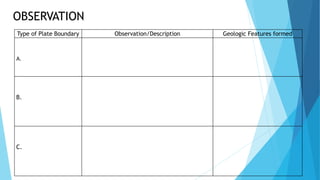
Type of Plate Boundary Observation/Description Geologic Features formed
A.
B.
C.
OBSERVATION

Plate boudary model activity

  • 1.
  • 2.
    OBJECTIVE 1. Describe thedifferent types of plate boundaries. 2. Identify geologic features formed by each type of plate boundary.
  • 3.
    PROCEDURE A. Divergent Boundary 1.Get a small piece of clay and roll it into a ball the size of a marble. 2. Press the clay ball onto the boundary between the two sheets and flatten it. 3. Slowly move the sheets away from each other. Watch out for any changes in the clay. Stop the moment you see something happen.
  • 4.
    PROCEDURE B. Convergent Boundary 1.Take the two sandpaper sheets and place them on the table roughly half a centimetre away from each other. 2. Get a piece of clay and roll it into marble-sized ball. 3. Press the clay ball on the boundary between the two sheets. 4. Slowly move the sheets towards each other.
  • 5.
    PROCEDURE C. Transform Boundary 1.Place the sandpaper sheets side by side on the table. 2. Make a clay ball and flatten it along the boundary of the two sheets. 3. Get some clay of another color and make three thin stripes. Press this on the surface of the flatten clay. 4. Slowly move one of the sandpaper sheets towards you, and the other away from you.
  • 6.
    Type of PlateBoundary Observation/Description Geologic Features formed A. B. C. OBSERVATION