PLASMA EXCHANGE
IN NEUROLOGIC DISEASE
By Wong Pei Yin (Charissa)
BSN, SRN
PLASMA EXCHANGE
(PLASMAPHERESIS)
Plasma is separated,
removed and replaced with
colloid ( Albumin/Plasma)
or crystalloid ( Normal
Saline
• In neurology, plasma exchange is a technique
used in the treatment of some neurological
autoimmune disorders.
• A special machine is used to remove antibodies,
immune complexes in the plasma via double-
lumen catheter inserted through the jugular or
femoral vein.
Neurological Autoimmune
Disorders
• Guillain-barré Syndrome (GBS)
• Myasthenia Gravis (MG)
• Chronic Inflammatory Demyelinating Neuropathy
(CIDP)
• Multiple Screlosis ( MS )
• Acute Disseminated Encephalomyelitis ( ADEM )
• Neuromyelitis Optica ( NMO )
• Transverse Myelitis (TM )
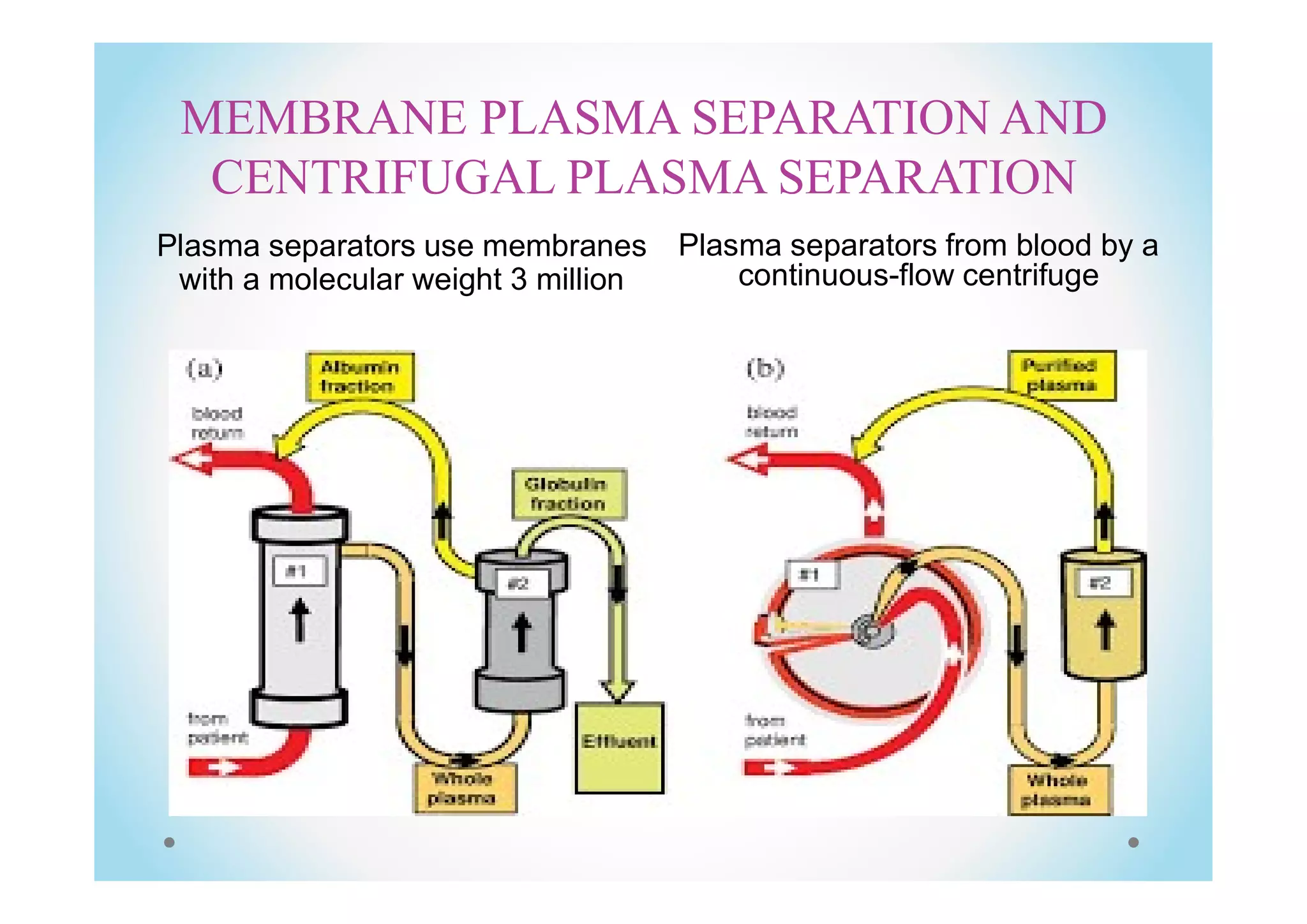
MEMBRANE PLASMA SEPARATION AND
CENTRIFUGAL PLASMA SEPARATION
Plasma separators use membranes
with a molecular weight 3 million
Plasma separators from blood by a
continuous-flow centrifuge
COMPARISION OF
MEMBRANE AND CENTRIFUGAL
PLASMA EXCHANGE
• CENTRIFUGAL PLASMA
EXCHANGE
• Citrate (anticoagulation)
• Lower blood flow rate
• Peripheral or central line
• Plasma extraction 80%
• MEMBRANE PLASMA
EXCHANGE
• Heparin (anticoagulation)
• Higher blood flow rate
• Central venous line
• Plasma extraction 30%
HOW PLASMAAND BLOOD
SEPARATED?
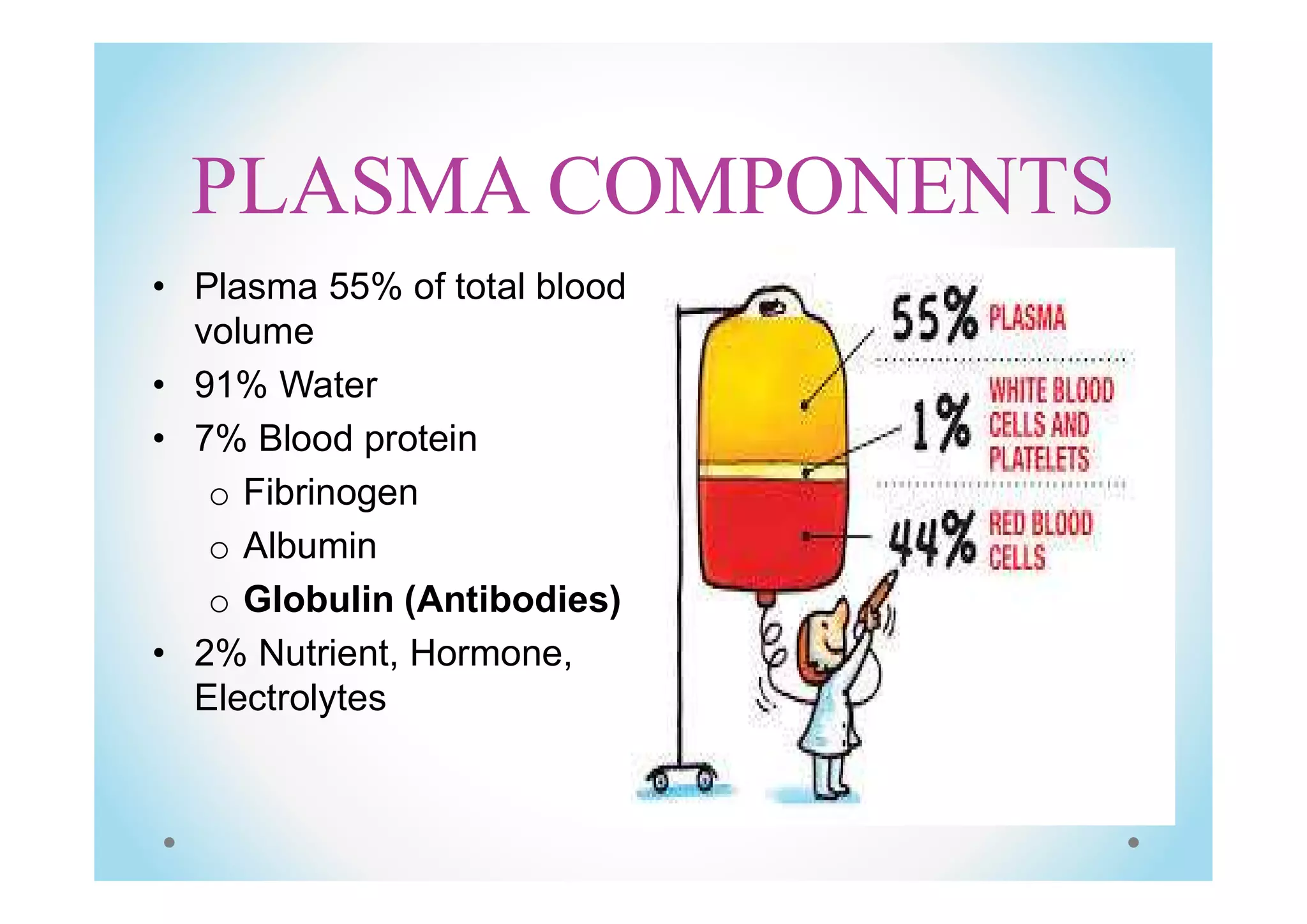
PLASMA COMPONENTS
• Plasma 55% of total blood
volume
• 91% Water
• 7% Blood protein
o Fibrinogen
o Albumin
o Globulin (Antibodies)
• 2% Nutrient, Hormone,
Electrolytes
REGIMENS OF PE
• 1 - 1.5 plasma volumes are exchanged per procedure
per day.
• Routine treatment durations usually 5 - 7 days
alternate day exchanges
• FORMULA PLASMA VOLUME
= ( 0.07 X BODY WEIGHT ) X ( 1 - HEMATOCRIT )
= ( 0.07 X 60 KG ) X ( 1- 0.4 )
= 2.5 LITER
ADVERSE REACTION
SYMPTOM CAUSES ACTION
HYPOTENSION
- DIZZINESS
- NAUSEA
Decrease of oncotic pressure
due to blood viscosity and
plasma levels
Normal saline boluses can be
administered.
HYPOCALCAEMIA
- TINGLING
- NUMBNESS
- CHOVSTEK’S SIGN
( tetany, muscle twitching )
Citrate (anticoagulant) in PE
and binding of calcium ions
leads to a reduction in its
serum concentration
Replacement calcium can be
administered
either intravenously or orally
ALLERGIC REACTIONS
- ITCHING
- RASHES
Allergic to citrate or albumin Antihistamine and
hydrocortisone are given
bolus
INFECTION
- FEVER
Contaminate Infection to
catheter
Technique aseptic dressing
catheter pre and post PE
PROCEDURE FOR
PLASMA EXCHANGE
 Ordered by neurologist consultant.
 Explanation to patient and consent obtained.
 Catheter inserted
 Checks patient ie name, IC, indication for PE, weight, height, blood
group, allergic history, Hep B/C, HIV status
 Ideally give medication after procedure.
 Latest blood sample result FBC, RP, PT, Serum Calcium
 Calculation the amount of volume to be extracted and replacement fluid.
 Maintain aseptic technique
 Procedure started with required observation( BP, HR, TEMPERATURE)
and half hourly during procedure
 Check for complication and inform doctors
 Procedure completed, patient vital sign checked and documentation of
PE.
 Catheter care
DOCUMENTATION
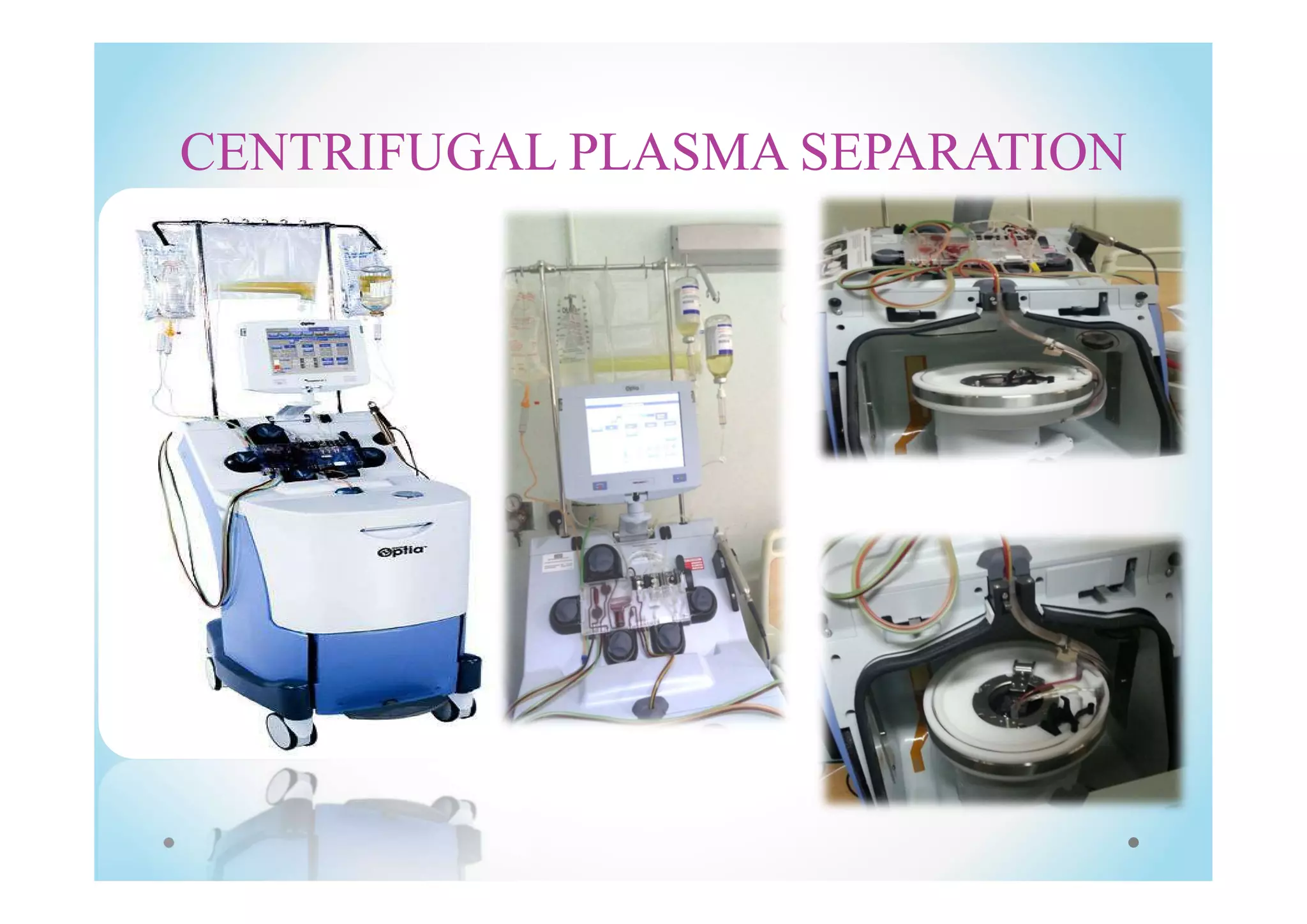
CENTRIFUGAL PLASMA SEPARATION
CASE REPORT
 This is a 62 years old female patient with diagnosis of
acute relapse multiple sclerosis.
 Presented with the complaint of blurry vision,
numbness and tingling,
difficult in walking,
bladder and bowel dysfunction,
worsening muscle weakness and
spasms.
 No other medical illness
 She was immunosuppressed and corticosteroids iv
methylprednisolone was given.
 Plasma Exchange (PE) has been choosen as a second
choice therapy due to steroid unresponsive relapses.
FINDING
• Reduce of numbness, tingling and muscle spasm.
• Lower motor power increase from 1/5 to 3/5.
• Able to walk slowly with assist.
• PLASMA EXCHANGE has been shown effective in acute
relapse of MS who fail to improve with high-dose
corticosteroid treatment.
SUMMARY
• Therapeutic plasma exchange plays an important role
in treatment of neurologic autoimmune disease.
• The risks or side effects are manageable or
preventable.
• The nurses role in the process of plasma exchange is
very important as the nurse is the one who will direct
the patient, coordinate, train, advice, propose changes in
care and participate in clinical research.
Plasma exchange in neurologic disease

Plasma exchange in neurologic disease

  • 1.
    PLASMA EXCHANGE IN NEUROLOGICDISEASE By Wong Pei Yin (Charissa) BSN, SRN
  • 2.
    PLASMA EXCHANGE (PLASMAPHERESIS) Plasma isseparated, removed and replaced with colloid ( Albumin/Plasma) or crystalloid ( Normal Saline
  • 3.
    • In neurology,plasma exchange is a technique used in the treatment of some neurological autoimmune disorders. • A special machine is used to remove antibodies, immune complexes in the plasma via double- lumen catheter inserted through the jugular or femoral vein.
  • 4.
    Neurological Autoimmune Disorders • Guillain-barréSyndrome (GBS) • Myasthenia Gravis (MG) • Chronic Inflammatory Demyelinating Neuropathy (CIDP) • Multiple Screlosis ( MS ) • Acute Disseminated Encephalomyelitis ( ADEM ) • Neuromyelitis Optica ( NMO ) • Transverse Myelitis (TM )
  • 5.
    MEMBRANE PLASMA SEPARATIONAND CENTRIFUGAL PLASMA SEPARATION Plasma separators use membranes with a molecular weight 3 million Plasma separators from blood by a continuous-flow centrifuge
  • 6.
    COMPARISION OF MEMBRANE ANDCENTRIFUGAL PLASMA EXCHANGE • CENTRIFUGAL PLASMA EXCHANGE • Citrate (anticoagulation) • Lower blood flow rate • Peripheral or central line • Plasma extraction 80% • MEMBRANE PLASMA EXCHANGE • Heparin (anticoagulation) • Higher blood flow rate • Central venous line • Plasma extraction 30%
  • 8.
  • 9.
    PLASMA COMPONENTS • Plasma55% of total blood volume • 91% Water • 7% Blood protein o Fibrinogen o Albumin o Globulin (Antibodies) • 2% Nutrient, Hormone, Electrolytes
  • 10.
    REGIMENS OF PE •1 - 1.5 plasma volumes are exchanged per procedure per day. • Routine treatment durations usually 5 - 7 days alternate day exchanges • FORMULA PLASMA VOLUME = ( 0.07 X BODY WEIGHT ) X ( 1 - HEMATOCRIT ) = ( 0.07 X 60 KG ) X ( 1- 0.4 ) = 2.5 LITER
  • 11.
    ADVERSE REACTION SYMPTOM CAUSESACTION HYPOTENSION - DIZZINESS - NAUSEA Decrease of oncotic pressure due to blood viscosity and plasma levels Normal saline boluses can be administered. HYPOCALCAEMIA - TINGLING - NUMBNESS - CHOVSTEK’S SIGN ( tetany, muscle twitching ) Citrate (anticoagulant) in PE and binding of calcium ions leads to a reduction in its serum concentration Replacement calcium can be administered either intravenously or orally ALLERGIC REACTIONS - ITCHING - RASHES Allergic to citrate or albumin Antihistamine and hydrocortisone are given bolus INFECTION - FEVER Contaminate Infection to catheter Technique aseptic dressing catheter pre and post PE
  • 12.
    PROCEDURE FOR PLASMA EXCHANGE Ordered by neurologist consultant.  Explanation to patient and consent obtained.  Catheter inserted  Checks patient ie name, IC, indication for PE, weight, height, blood group, allergic history, Hep B/C, HIV status  Ideally give medication after procedure.  Latest blood sample result FBC, RP, PT, Serum Calcium  Calculation the amount of volume to be extracted and replacement fluid.  Maintain aseptic technique  Procedure started with required observation( BP, HR, TEMPERATURE) and half hourly during procedure  Check for complication and inform doctors  Procedure completed, patient vital sign checked and documentation of PE.  Catheter care
  • 13.
  • 14.
  • 15.
    CASE REPORT  Thisis a 62 years old female patient with diagnosis of acute relapse multiple sclerosis.  Presented with the complaint of blurry vision, numbness and tingling, difficult in walking, bladder and bowel dysfunction, worsening muscle weakness and spasms.  No other medical illness  She was immunosuppressed and corticosteroids iv methylprednisolone was given.  Plasma Exchange (PE) has been choosen as a second choice therapy due to steroid unresponsive relapses.
  • 16.
    FINDING • Reduce ofnumbness, tingling and muscle spasm. • Lower motor power increase from 1/5 to 3/5. • Able to walk slowly with assist. • PLASMA EXCHANGE has been shown effective in acute relapse of MS who fail to improve with high-dose corticosteroid treatment.
  • 17.
    SUMMARY • Therapeutic plasmaexchange plays an important role in treatment of neurologic autoimmune disease. • The risks or side effects are manageable or preventable. • The nurses role in the process of plasma exchange is very important as the nurse is the one who will direct the patient, coordinate, train, advice, propose changes in care and participate in clinical research.