Plasma Arc Machine
Prepared by:
Sagar Joshi
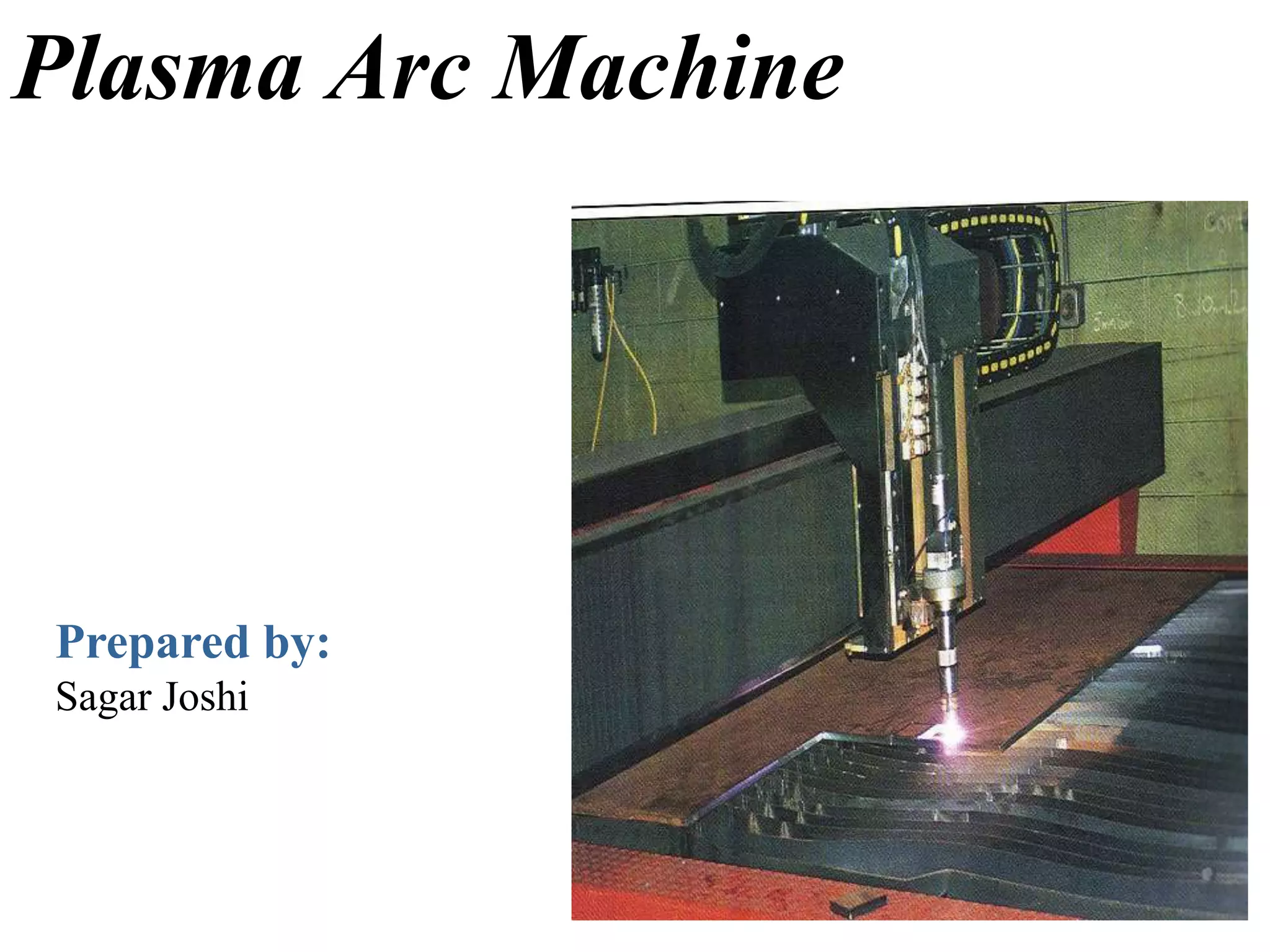
Plasma Arc Machining
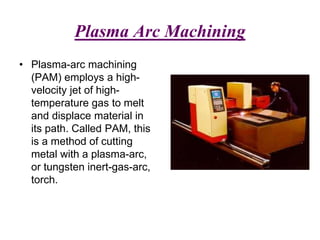
• Plasma-arc machining
(PAM) employs a high-
velocity jet of high-
temperature gas to melt
and displace material in
its path. Called PAM, this
is a method of cutting
metal with a plasma-arc,
or tungsten inert-gas-arc,
torch.
PAM Process
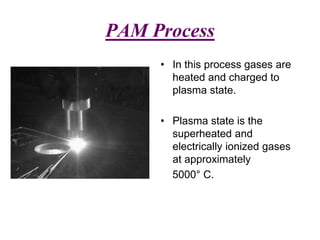
• In this process gases are
heated and charged to
plasma state.
• Plasma state is the
superheated and
electrically ionized gases
at approximately
5000° C.
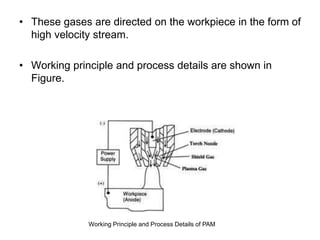
• These gases are directed on the workpiece in the form of
high velocity stream.
• Working principle and process details are shown in
Figure.
Working Principle and Process Details of PAM
Gases Used
• Compressed Air is the most commonly used gas for
lower current plasma cutting and works well for most
metals from gauge thickness to 1 inch.
• Nitrogen is often used for higher current plasma
systems and for cutting materials up to 3 inches thick.
• Oxygen is used when the highest quality mechanized
cuts are desired on carbon steel up to 1 -1/4 inch thick.
• Argon-Hydrogen Mixtures are generally used for
cutting stainless steel and aluminum.
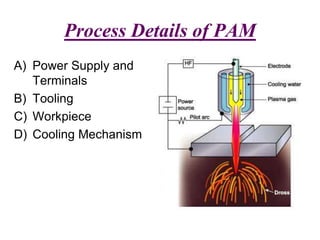
Process Details of PAM
A) Power Supply and
Terminals
B) Tooling
C) Workpiece
D) Cooling Mechanism
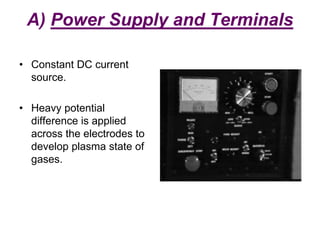
A) Power Supply and Terminals
• Constant DC current
source.
• Heavy potential
difference is applied
across the electrodes to
develop plasma state of
gases.
B) Tooling
• There is no direct visible tool used in PAM.
• Focused spray of hoot, plasma state gases
works as a cutting tool.
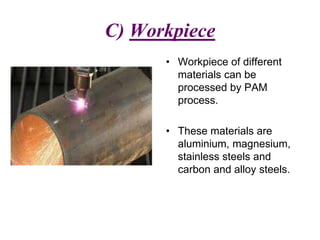
C) Workpiece
• Workpiece of different
materials can be
processed by PAM
process.
• These materials are
aluminium, magnesium,
stainless steels and
carbon and alloy steels.
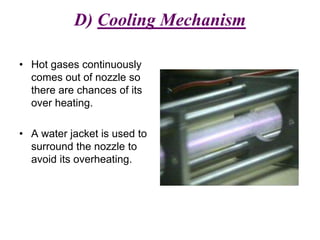
D) Cooling Mechanism
• Hot gases continuously
comes out of nozzle so
there are chances of its
over heating.
• A water jacket is used to
surround the nozzle to
avoid its overheating.
Advantages of PAM Process
1) It gives faster production rate.
2) Very hard and brittle metals can be machined.
3) Small cavities can be machined with good dimensional
accuracy.
4) Plasma cutting requires only minimal operator
training.
Disadvantages of PAM Process
1) Its initial cost is very high.
2) The process requires over safety precautions which
further enhance the initial cost of the setup.
3) Some of the workpiece materials are very much prone
to metallurgical changes on excessive heating so this
fact imposes limitations to this process.
4) It is uneconomical for bigger cavities to be machined.
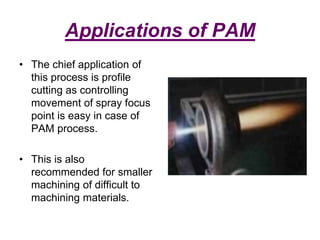
Applications of PAM
• The chief application of
this process is profile
cutting as controlling
movement of spray focus
point is easy in case of
PAM process.
• This is also
recommended for smaller
machining of difficult to
machining materials.
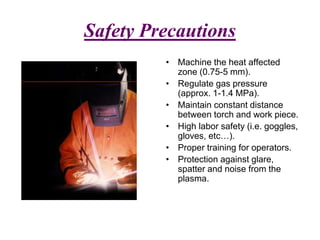
Safety Precautions
• Machine the heat affected
zone (0.75-5 mm).
• Regulate gas pressure
(approx. 1-1.4 MPa).
• Maintain constant distance
between torch and work piece.
• High labor safety (i.e. goggles,
gloves, etc…).
• Proper training for operators.
• Protection against glare,
spatter and noise from the
plasma.
Thank You

Plasma arc Machine

  • 1.
  • 2.
    Plasma Arc Machining •Plasma-arc machining (PAM) employs a high- velocity jet of high- temperature gas to melt and displace material in its path. Called PAM, this is a method of cutting metal with a plasma-arc, or tungsten inert-gas-arc, torch.
  • 3.
    PAM Process • Inthis process gases are heated and charged to plasma state. • Plasma state is the superheated and electrically ionized gases at approximately 5000° C.
  • 4.
    • These gasesare directed on the workpiece in the form of high velocity stream. • Working principle and process details are shown in Figure. Working Principle and Process Details of PAM
  • 5.
    Gases Used • CompressedAir is the most commonly used gas for lower current plasma cutting and works well for most metals from gauge thickness to 1 inch. • Nitrogen is often used for higher current plasma systems and for cutting materials up to 3 inches thick. • Oxygen is used when the highest quality mechanized cuts are desired on carbon steel up to 1 -1/4 inch thick. • Argon-Hydrogen Mixtures are generally used for cutting stainless steel and aluminum.
  • 6.
    Process Details ofPAM A) Power Supply and Terminals B) Tooling C) Workpiece D) Cooling Mechanism
  • 7.
    A) Power Supplyand Terminals • Constant DC current source. • Heavy potential difference is applied across the electrodes to develop plasma state of gases.
  • 8.
    B) Tooling • Thereis no direct visible tool used in PAM. • Focused spray of hoot, plasma state gases works as a cutting tool.
  • 9.
    C) Workpiece • Workpieceof different materials can be processed by PAM process. • These materials are aluminium, magnesium, stainless steels and carbon and alloy steels.
  • 10.
    D) Cooling Mechanism •Hot gases continuously comes out of nozzle so there are chances of its over heating. • A water jacket is used to surround the nozzle to avoid its overheating.
  • 11.
    Advantages of PAMProcess 1) It gives faster production rate. 2) Very hard and brittle metals can be machined. 3) Small cavities can be machined with good dimensional accuracy. 4) Plasma cutting requires only minimal operator training.
  • 12.
    Disadvantages of PAMProcess 1) Its initial cost is very high. 2) The process requires over safety precautions which further enhance the initial cost of the setup. 3) Some of the workpiece materials are very much prone to metallurgical changes on excessive heating so this fact imposes limitations to this process. 4) It is uneconomical for bigger cavities to be machined.
  • 13.
    Applications of PAM •The chief application of this process is profile cutting as controlling movement of spray focus point is easy in case of PAM process. • This is also recommended for smaller machining of difficult to machining materials.
  • 14.
    Safety Precautions • Machinethe heat affected zone (0.75-5 mm). • Regulate gas pressure (approx. 1-1.4 MPa). • Maintain constant distance between torch and work piece. • High labor safety (i.e. goggles, gloves, etc…). • Proper training for operators. • Protection against glare, spatter and noise from the plasma.
  • 15.