MODERN TRENDS IN FRUIT
PRODUCTION
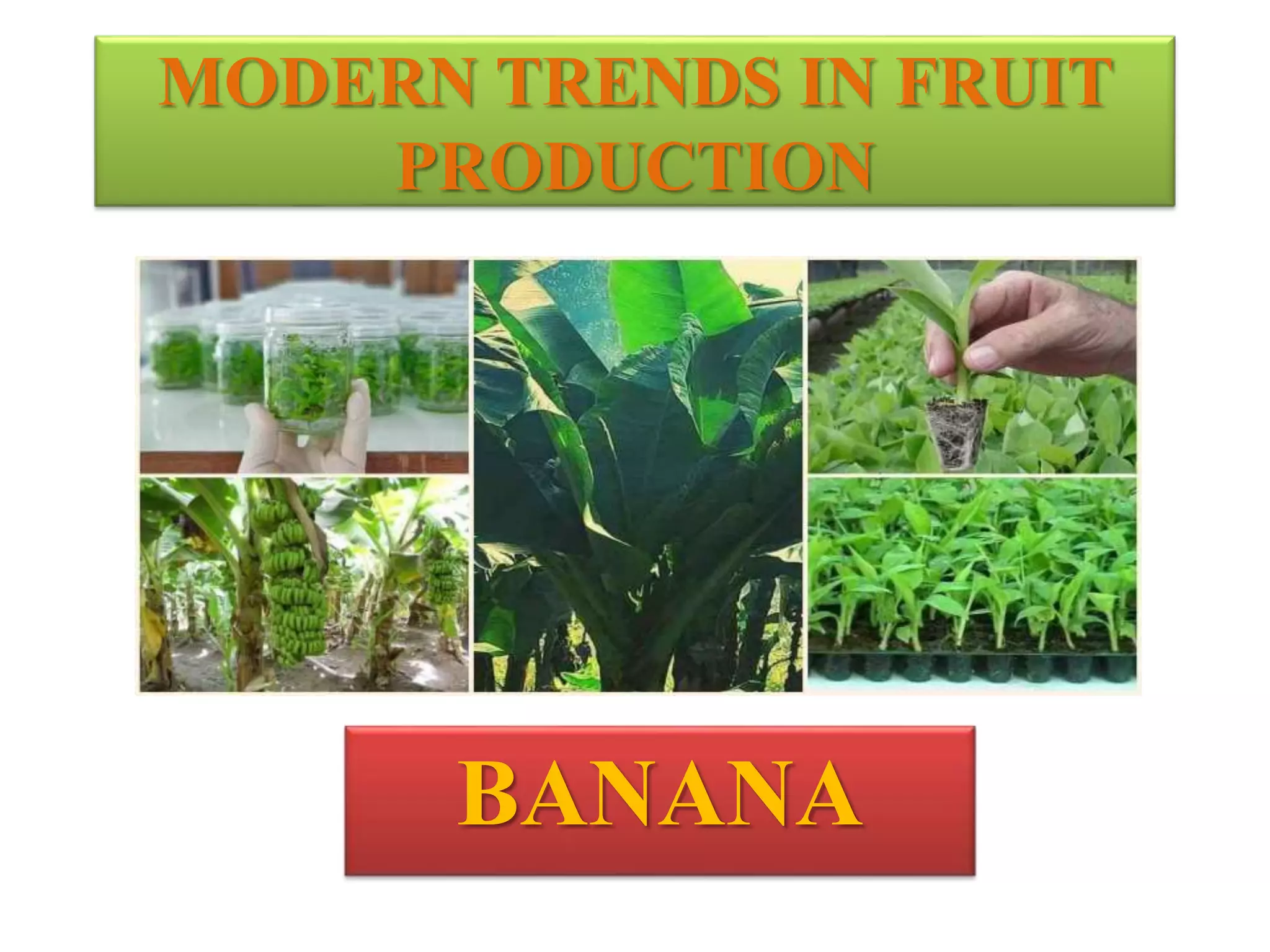
BANANA
INTRODUCTION
1. GENERAL CONCEPTS
2. CURRENT SCENARIO
3. NATIONAL AND INTERNATIONAL
SCENARIO
4. NATIONAL PROBLEMS
GENERAL CONCEPTS
• Scientific name: Musa spp.
• Family: Musaceae
• Chromosome no. 2n = 2X =
22,33,44
• Origin: Indo-Malayan (South
East Asia)
Hey.. Friends one point to
be noticed about me that
I am a heavy feeder of
Potassium
ANTIQUE
FRUIT CROP
APPLE OF
PARADISE
TREE OF
WISDOM
ADAMS FIG
TREE OF
PARADISE
PLANT OF
VIRTUE
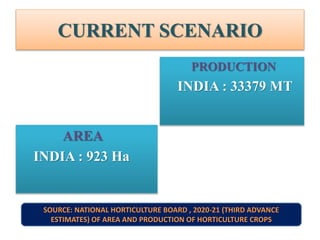
CURRENT SCENARIO
AREA
INDIA : 923 Ha
PRODUCTION
INDIA : 33379 MT
SOURCE: NATIONAL HORTICULTURE BOARD , 2020-21 (THIRD ADVANCE
ESTIMATES) OF AREA AND PRODUCTION OF HORTICULTURE CROPS
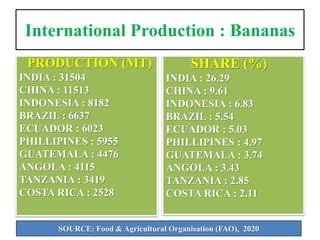
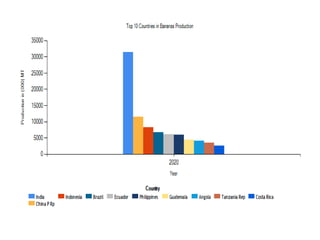
International Production : Bananas
PRODUCTION (MT)
INDIA : 31504
CHINA : 11513
INDONESIA : 8182
BRAZIL : 6637
ECUADOR : 6023
PHILLIPINES : 5955
GUATEMALA : 4476
ANGOLA : 4115
TANZANIA : 3419
COSTA RICA : 2528
SHARE (%)
INDIA : 26.29
CHINA : 9.61
INDONESIA : 6.83
BRAZIL : 5.54
ECUADOR : 5.03
PHILLIPINES : 4.97
GUATEMALA : 3.74
ANGOLA : 3.43
TANZANIA : 2.85
COSTA RICA : 2.11
SOURCE: Food & Agricultural Organisation (FAO), 2020
NATIONAL PROBLEMS
• SOIL SODICITY
• FLOOD DAMAGE
• WIND DAMAGE
• STEM WEEVIL
• CHILLING INJURY
• ERWINIA ROT
• WILT DISEASE
• DROUGHT
• SUN SCORCHING
(PEDUNCLE)
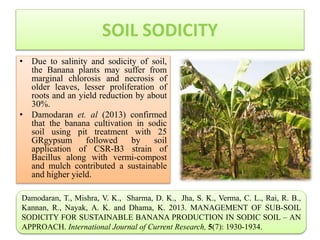
SOIL SODICITY
• Due to salinity and sodicity of soil,
the Banana plants may suffer from
marginal chlorosis and necrosis of
older leaves, lesser proliferation of
roots and an yield reduction by about
30%.
• Damodaran et. al (2013) confirmed
that the banana cultivation in sodic
soil using pit treatment with 25
GRgypsum followed by soil
application of CSR-B3 strain of
Bacillus along with vermi-compost
and mulch contributed a sustainable
and higher yield.
Damodaran, T., Mishra, V. K., Sharma, D. K., Jha, S. K., Verma, C. L., Rai, R. B.,
Kannan, R., Nayak, A. K. and Dhama, K. 2013. MANAGEMENT OF SUB-SOIL
SODICITY FOR SUSTAINABLE BANANA PRODUCTION IN SODIC SOIL – AN
APPROACH. International Journal of Current Research, 5(7): 1930-1934.
FLOOD DAMAGE
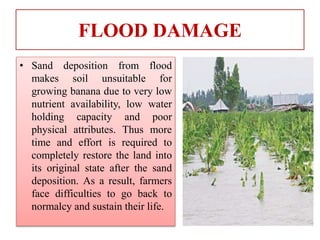
• Sand deposition from flood
makes soil unsuitable for
growing banana due to very low
nutrient availability, low water
holding capacity and poor
physical attributes. Thus more
time and effort is required to
completely restore the land into
its original state after the sand
deposition. As a result, farmers
face difficulties to go back to
normalcy and sustain their life.
 Open deep trenches between
the plant rows for improving
the drainage condition of the
land.
 Give foliar spray of 2%
potassium sulphate. After 15
days, give another foliar spray
of 1% potassium nitrate.
 At the bunch development
stage, give 2% potassium
sulphate spray on bunch, two
times with 15 day interval.
 During flood, the possibility of
outbreak of Sigatoka leaf spot
is more. As a prophylactic
measure, give 0.1 per cent
Propiconozole, 0.2 per cent
Carbendazim and 0.25 per cent
Mancozeb foliar sprays with
15 day intervals between each
spray.
REMEDY
WIND DAMAGE
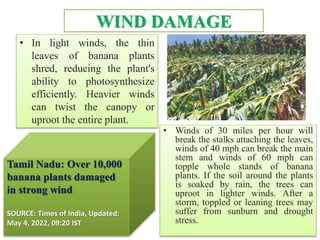
• In light winds, the thin
leaves of banana plants
shred, reducing the plant's
ability to photosynthesize
efficiently. Heavier winds
can twist the canopy or
uproot the entire plant.
• Winds of 30 miles per hour will
break the stalks attaching the leaves,
winds of 40 mph can break the main
stem and winds of 60 mph can
topple whole stands of banana
plants. If the soil around the plants
is soaked by rain, the trees can
uproot in lighter winds. After a
storm, toppled or leaning trees may
suffer from sunburn and drought
stress.
Tamil Nadu: Over 10,000
banana plants damaged
in strong wind
SOURCE: Times of India, Updated:
May 4, 2022, 09:20 IST
PSEUDOSTEM
WEEVIL
• The banana pseudostem weevil is a
monophagous pest. Adults are
strong fliers and move from one
plant to another.
• Eggs are laid singly, at the base of
the outermost leaf sheath. The
incubation period ranges from 3 to
8 days. Emerging grubs are fleshy,
yellowish white in colour and pass
through five instars. The entire life
cycle takes around 45 days.
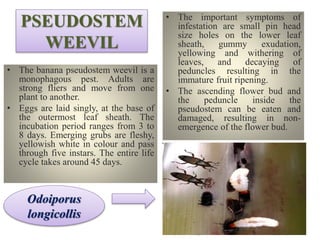
• The important symptoms of
infestation are small pin head
size holes on the lower leaf
sheath, gummy exudation,
yellowing and withering of
leaves, and decaying of
peduncles resulting in the
immature fruit ripening.
• The ascending flower bud and
the peduncle inside the
pseudostem can be eaten and
damaged, resulting in non-
emergence of the flower bud.
Odoiporus
longicollis
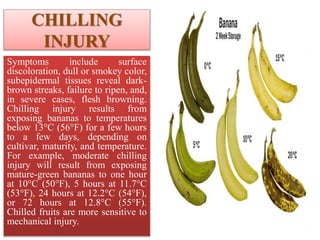
CHILLING
INJURY
Symptoms include surface
discoloration, dull or smokey color,
subepidermal tissues reveal dark-
brown streaks, failure to ripen, and,
in severe cases, flesh browning.
Chilling injury results from
exposing bananas to temperatures
below 13°C (56°F) for a few hours
to a few days, depending on
cultivar, maturity, and temperature.
For example, moderate chilling
injury will result from exposing
mature-green bananas to one hour
at 10°C (50°F), 5 hours at 11.7°C
(53°F), 24 hours at 12.2°C (54°F),
or 72 hours at 12.8°C (55°F).
Chilled fruits are more sensitive to
mechanical injury.
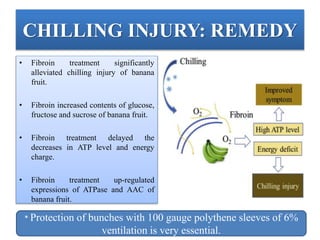
CHILLING INJURY: REMEDY
• Fibroin treatment significantly
alleviated chilling injury of banana
fruit.
• Fibroin increased contents of glucose,
fructose and sucrose of banana fruit.
• Fibroin treatment delayed the
decreases in ATP level and energy
charge.
• Fibroin treatment up-regulated
expressions of ATPase and AAC of
banana fruit.
* Protection of bunches with 100 gauge polythene sleeves of 6%
ventilation is very essential.
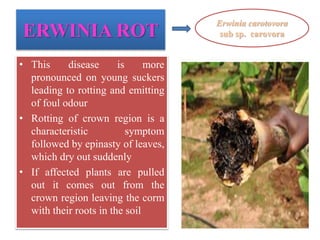
ERWINIA ROT
• This disease is more
pronounced on young suckers
leading to rotting and emitting
of foul odour
• Rotting of crown region is a
characteristic symptom
followed by epinasty of leaves,
which dry out suddenly
• If affected plants are pulled
out it comes out from the
crown region leaving the corm
with their roots in the soil
Erwinia carotovora
sub sp. carovora
REMEDY:
• Good drainage and soil
conditioning can control
the disease to some extent.
• Plant disease free suckers.
• Remove infected plants
immediately.
• Remove plant residues
after harvest.
• Dip suckers in copper
oxychloride (40g/10l)+
streptocycline (3g/10lit)
for 30 min before
planting.
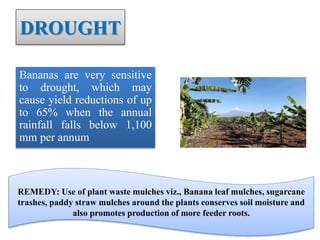
DROUGHT
Bananas are very sensitive
to drought, which may
cause yield reductions of up
to 65% when the annual
rainfall falls below 1,100
mm per annum
REMEDY: Use of plant waste mulches viz., Banana leaf mulches, sugarcane
trashes, paddy straw mulches around the plants conserves soil moisture and
also promotes production of more feeder roots.
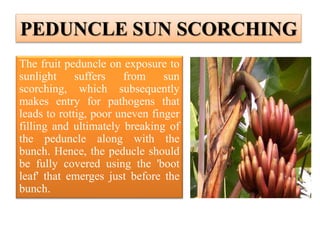
PEDUNCLE SUN SCORCHING
The fruit peduncle on exposure to
sunlight suffers from sun
scorching, which subsequently
makes entry for pathogens that
leads to rottig, poor uneven finger
filling and ultimately breaking of
the peduncle along with the
bunch. Hence, the peducle should
be fully covered using the 'boot
leaf' that emerges just before the
bunch.
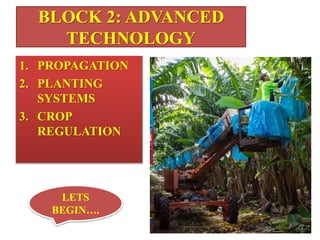
BLOCK 2: ADVANCED
TECHNOLOGY
1. PROPAGATION
2. PLANTING
SYSTEMS
3. CROP
REGULATION
LETS
BEGIN….
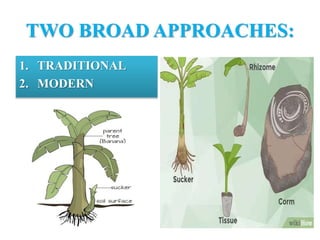
TWO BROAD APPROACHES:
1. TRADITIONAL
2. MODERN
1. TRADITIONAL
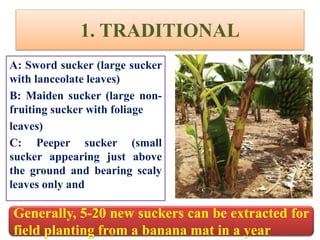
A: Sword sucker (large sucker
with lanceolate leaves)
B: Maiden sucker (large non-
fruiting sucker with foliage
leaves)
C: Peeper sucker (small
sucker appearing just above
the ground and bearing scaly
leaves only and
Generally, 5-20 new suckers can be extracted for
field planting from a banana mat in a year
Improved traditional banana
propagation techniques
•Mother plant stripping
•Decapitation
•Corm technique
(Macropropagation)
Mother plant stripping: The outer leaf
sheaths at the base of the mother plant’s
pseudostem are stripped off to expose the
buds followed by mounding up soil around
the base of the plant to allow the buds to
grow into suckers. This method, can double
the sucker production per mat in a year to as
high as 40 suckers per plant
 This method, can double the sucker production
per mat in a year to as high as 40 suckers per
plant
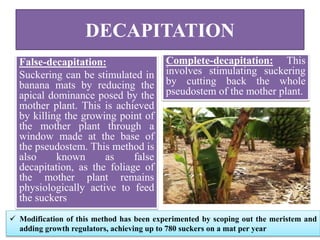
DECAPITATION
False-decapitation:
Suckering can be stimulated in
banana mats by reducing the
apical dominance posed by the
mother plant. This is achieved
by killing the growing point of
the mother plant through a
window made at the base of
the pseudostem. This method is
also known as false
decapitation, as the foliage of
the mother plant remains
physiologically active to feed
the suckers
Complete-decapitation: This
involves stimulating suckering
by cutting back the whole
pseudostem of the mother plant.
 Modification of this method has been experimented by scoping out the meristem and
adding growth regulators, achieving up to 780 suckers on a mat per year
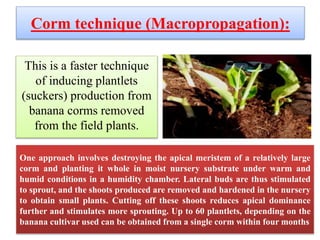
Corm technique (Macropropagation):
This is a faster technique
of inducing plantlets
(suckers) production from
banana corms removed
from the field plants.
One approach involves destroying the apical meristem of a relatively large
corm and planting it whole in moist nursery substrate under warm and
humid conditions in a humidity chamber. Lateral buds are thus stimulated
to sprout, and the shoots produced are removed and hardened in the nursery
to obtain small plants. Cutting off these shoots reduces apical dominance
further and stimulates more sprouting. Up to 60 plantlets, depending on the
banana cultivar used can be obtained from a single corm within four months
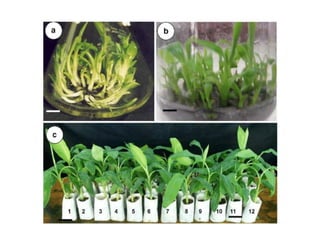
Modern techniques of banana
propagation (Micropropagation)
• Tissue culture is the best
method for propagating
bananas. It ensures they are
true to type and free from pests
and diseases. • The tissue culture
propagation of banana for
the first time in India, was
pioneered by Dr. R. Dore
Swamy at the Indian
Institute of Horticultural
Research, Bangalore.
Why Tissue Culture?
• Sword suckers weighing
approximately 500 – 750 g
are commonly used as
propagating material
• Suckers generally may be
infected with some
pathogens and nematodes.
Similarly due to the
variation in age and size of
sucker the crop is not
uniform, harvesting is
prolonged and management
becomes difficult.
• Therefore, tissue culture
plants are recommended for
planting. They are healthy,
disease free, uniform and
authentic.
• So, properly hardened
secondary seedlings are only
recommended for planting.
Advantages of Tissue Culture
• True to the type of mother
plant under good
management.
• Pest and disease free
seedlings.
• Uniform growth,
increases yield.
• Early maturity of crop.
• Round the year planting
possible as seedlings are
made available
throughout the year. Two
successive ratoons are
possible in a short
duration which minimizes
cost of cultivation.
• 95% - 98% plants bear
bunches.
• New varieties can be
introduced and multiplied
in a short duration.
Commercial cultivation of banana in
J&K through biotechnology
This first cultivation trial was done by planting 2000 samplings of
banana plants with the narrow spacing 2 X 2 m in the month of
August 2016 and fruit setting commenced in the month of July-
August, 2017 while as the maturity and harvesting attained in 13
months. The plant grew to a height of 6.5 to 7.5 feet and gave yield
20-30 kg per plant and 20-25 tonnes/acre. In term of economy
involved, as per market analysis, price of banana in Jammu is
approximately Rs 20 per kg. Thus on an average, 20-30 Kg
yield/plant gives Rs 250-300/Banana plant. On the basis of market
demand, approximately Rs 2.5 lakh net return can be obtained by
cultivation of this crop on one acre of land which is attractive
business for farmers of the Jammu & Kashmir State as it involves
very less inputs but lucrative profit.
SOURCE: Daily Excelsior, 28/11/2017
Conclusion
All techniques of banana propagation have limitations
ranging from low multiplication rates, genetic fidelity,
disease elimination and affordability of the generated
suckers. If the central objective of the seed system is to
generate high quality planting materials, tissue culture
technique offers the highest seed quantity and
quality and therefore, is highly recommended. The
technique can be integrated in the downstream
propagation and dissemination of cleaned suckers to
address the problem of seed quantity and quality.
PLANTING SYSTEM
Planting can be done in May-
June or in September -
October
Ideal time (October-November)
of planting is after the monsoon
season.
With assured irrigation, the
planting can also be done in
February-March
Apply 25 g Pseudomonas fluorescence / plant at the time
of planting.
Trim the roots and decayed portion of the corm, cut the
pseudostem leaving 20 cm from the corm and grade the
suckers to size.
To avoid wilt disease in Rasthali, Monthan, Virupakshi
and other wilt susceptible varieties, infected portions of
the corm may be pared and dipped for 5 minutes in 0.1%
Emisan solution (1 g in 1 lit of water).
Pralinage is done with 40 g of Carbofuran 3 G
granules per sucker. (Dip the corm in slurry solution
containing 4 parts clay plus 5 parts water and
sprinkle Carbofuran to control nematodes).
•Alternatively, dip the corm with 0.75%
Monocrotophos, shade dry for atleast 24 hours and
plant.
•Use tissue cultured banana plants with 5-6 leaves.
SYSTEM OF PLANTING
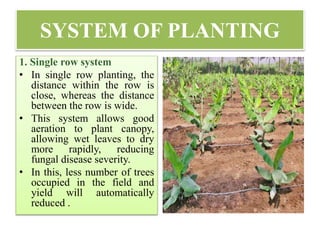
1. Single row system
• In single row planting, the
distance within the row is
close, whereas the distance
between the row is wide.
• This system allows good
aeration to plant canopy,
allowing wet leaves to dry
more rapidly, reducing
fungal disease severity.
• In this, less number of trees
occupied in the field and
yield will automatically
reduced .
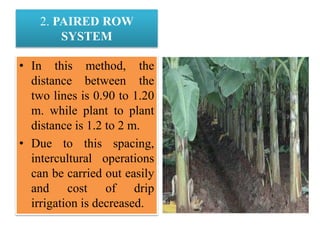
2. PAIRED ROW
SYSTEM
• In this method, the
distance between the
two lines is 0.90 to 1.20
m. while plant to plant
distance is 1.2 to 2 m.
• Due to this spacing,
intercultural operations
can be carried out easily
and cost of drip
irrigation is decreased.
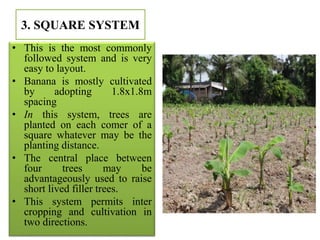
3. SQUARE SYSTEM
• This is the most commonly
followed system and is very
easy to layout.
• Banana is mostly cultivated
by adopting 1.8x1.8m
spacing
• In this system, trees are
planted on each comer of a
square whatever may be the
planting distance.
• The central place between
four trees may be
advantageously used to raise
short lived filler trees.
• This system permits inter
cropping and cultivation in
two directions.
4. TRIANGULAR SYSTEM
• This system is best suited for tissue culture banana
suckers.
• In this, adopt spacing in between rows was 1.5m and
plant to plant was 1.8m in the row.
• The trees are planted as in square system but the
difference being that those in the even numbered rows
are midway between those in the odd rows instead of
opposite to them.
• The distance between any two adjacent trees in a row
is equal to the perpendicular distance between any
two adjacent rows.
• When compared to square system, each tree occupies
more area and hence it accommodates few trees per
hectare than the square system.
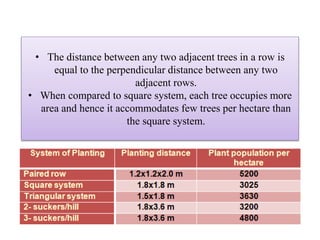
• The distance between any two adjacent trees in a row is
equal to the perpendicular distance between any two
adjacent rows.
• When compared to square system, each tree occupies more
area and hence it accommodates few trees per hectare than
the square system.
PIT METHOD
• Pit planting is commonly
followed in garden land system
of cultivation. Pits of 60 cm x
60 x 60 cm x 60 cm size are
dug, filled with a mixture of
soil, sand and FYM (Farm Yard
Manure) in a 1:1:1 ratio.
Suckers are planted in the centre
of the pit and soil around is
compacted.
• Planting is done from February to
May whereas in North India, it is
done during July-August. In
South-India, it can be done any
time of year except summer.This
is mostly followed in biennial
plantations for Dwarf Cavendish,
Rasthali, Robusta, Poovan and
Karpuravalli banana.
However this method is very laborious and
expensive. The only advantage is that no earthing
up is required as planting is done at the required
depth. This practice is not very popular at present.
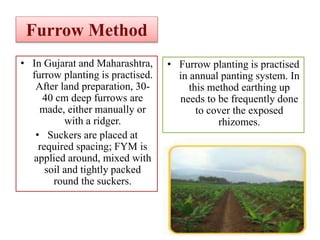
Furrow Method
• In Gujarat and Maharashtra,
furrow planting is practised.
After land preparation, 30-
40 cm deep furrows are
made, either manually or
with a ridger.
• Suckers are placed at
required spacing; FYM is
applied around, mixed with
soil and tightly packed
round the suckers.
• Furrow planting is practised
in annual panting system. In
this method earthing up
needs to be frequently done
to cover the exposed
rhizomes.
Trench Planting
• Trench planting is practiced in
wet land cultivation of Cauvery
delta region of Tamil Nadu. Land
is prepared like paddy using
plenty of water and gauge wheel.
• Water is drained from the field
allowing setting for a day.
Planting is done by simple
pressing the suckers into the wet
field.
• After a week 15 cm deep trenches
are opened both ways maintaining
4 or 6 plants in each block.
• Deepening of trenches by 20-25
cm is taken up every month after
planting till suckers put forth 1-3
leaves.
• During third month trenches are
broadened and deepened to 60
cm. in rainy season some trenches
are used as drainage channels.
After about 2 months, trenches are
cleaned; decayed manure is used
for plants for organic cycling.
High Density Planting
• (HDP) is normally refers to
planting at a spacing than the
usual recommended spacing.
• Choosing the correct planting
density is very important for
bridging the gap between the
actual yield and the potential
yield of banana from a unit area.
• For the highest possible yields of
good quality fruit, there is an
optimum plant density, which
should be maintained for
sustaining the economic life of
the plantation.
• This optimum varies with the
location, cultivator, soil
fertility, management level
and economic considerations.
• These factors in turn influence
more specific determinants of
density choice such as
prevailing climate, plantation
vigour and its longevity.
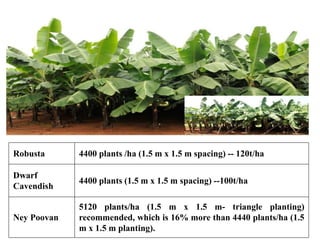
Robusta 4400 plants /ha (1.5 m x 1.5 m spacing) -- 120t/ha
Dwarf
Cavendish
4400 plants (1.5 m x 1.5 m spacing) --100t/ha
Ney Poovan
5120 plants/ha (1.5 m x 1.5 m- triangle planting)
recommended, which is 16% more than 4440 plants/ha (1.5
m x 1.5 m planting).
Advantages of High Density Planting
• It increases yield and reduces labours cost resulting in
low cost of production.
• It also enables the mechanization of fruit crop
production.
• It facilitates more efficient use of fertilizers, water,
solar radiation, fungicides, weedicides and pesticides.
SUCCESS STORY: HDP in Grand
Naine variety
KVK Hirehalli has implemented a Front
Line Demonstration (FLD) on High
Density Planting of Banana with paired
row method in the field of field Shri.
Mahesh, progressive farmer from
Makanahalli village of Tumakuru taluk.
He was a banana farmer specialized in
the cultivation of G-9 variety and
Yelakki. His average annual income from
banana farming was INR 1.47 lakhs /ha.
KVK Hirehalli selected him as a
beneficiary farmer for the FLD – High
density planting in banana, a NRCB
technology. The KVK trained him on the
technology and he planted the banana at
a spacing of 1.5 x 1.5 x 2.0 mt in a paired
row with zig zag method of planting,
unlike conventional planting of 2 x 2 mt.
In this HDP method he could plant
5200 plants per hectare in place of
2500, as in conventional method.
Though in conventional method, bunch
weight of planting was 20.5 kg, his
productivity was 578 qt/ha only.
Whereas in this HDP method, though
the bunch weight was 17.2 kg (3 kg
less than conventional), productivity
was of 760 qt /ha (more than 180 kg
than conventional), due to more
number (almost double) of plants per
hectare. This increased his income level
to Rs. 3.82 lakhs / ha per annum with a
B: C ratio 3.54.
Now Sri. Mahesh is following High Density Planting in banana with different
varieties Viz., Yelakki bale, Puttabale etc., and earning more profit.
CROP MODELING
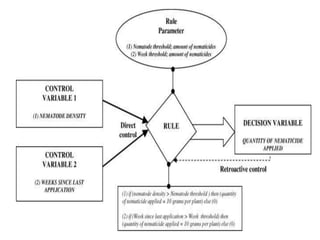
• To design new banana-based cropping systems, a
model called SIMBA was built to simulate this system
and to assess its performances and impacts.
• SIMBA can be used to optimize suitable practices that take
into account the dynamics of the state variables of the
system (pests, plant population, soils, etc.) in order to reach
a target objective.
• SIMBA was developed to simulate and assess the main
environmental risks in banana-cropping systems (pollution
of water and soil erosion) over several cropping cycles.
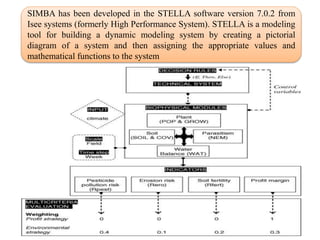
SIMBA has been developed in the STELLA software version 7.0.2 from
Isee systems (formerly High Performance System). STELLA is a modeling
tool for building a dynamic modeling system by creating a pictorial
diagram of a system and then assigning the appropriate values and
mathematical functions to the system
The plant population module
SIMBA-POP
• The SIMBA-POP module based on the cohort population
concept, simulates the plant population structure and its
development patterns, including the management of the
plant population by the farmer (choice of sucker for next
cropping cycle, plant toppling and replacement).
The plant growth module SIMBA-
GROW
• This allows calculating separately the growth of each
group of plants at the same physiological stage. This
module includes simulation of leaf area index (LAI),
vegetative dry matter (leaves, pseudo-stem, roots), and
yield (number and weight of fruits per bunch). The
number of fruits (NF) per bunch is assumed to be a
function of the LAI at the flowering stage, Biotic and
abiotic stresses are simulated; these reduce the growth
potential due to the impact of nitrogen shortage, drought,
or parasitism. As in many crop models, the net primary
production (NPP) and LAI are calculated on the basis of
the interception of the photosynthetically active radiation
(PAR) and its allocation to different organs according to
the stage of the plant.
The plant-parasitic nematode
population module SIMBA-NEM
• Radopholus similis and Pratylenchus coffeae are plant
parasitic nematodes that generate extensive root lesions
and that are considered among the most detrimental
pathogens of banana. The SIMBA-NEM module is based
on a cohort chain structure and a logistic function to
describe population growth in relation with (i) ‘K’ the
environmental carrying capacity (maximal population that
the system can support) depending on the available
banana root dry matter, (ii) ‘c’, an intrinsic growth rate,
and (iii) the interspecific nematodes competition. Soil
water content and nematicide applications are considered
the main variables influencing the intrinsic population
growth rate of each species.
The soil properties modules SIMBA-
COV and SIMBA-SOIL
• Soil cover and soil compaction are simulated by the semi-quantitative
SIMBA-COV module . Soil cover represents, in a simplified way, the
growth of weeds, their destruction by herbicide, the mulch cover supplied by
weed destruction and crop residues at harvest of banana, and the mulch
degradation over time; it runs at the week step. Weed growth follows a
logistic function and is expressed in percentage of soil cover; this growth is
reduced when the LAI of the banana increase. Crop residues (in Mg) are
converted into percentages of soil cover.
• Soil structure is simulated with the SIMBA-SOIL module through a
compaction score that takes into account the number and the type of
mechanized practices (fertilizer application, harvest trailer, plowing).
The effect of these practices is also affected by soil moisture. This
module that measured on soil profiles the percentage of every soil
structural type with different levels of compaction for a wide range of
cropping systems at different stages and after planting.
SIMBA-WAT
• SIMBA-WAT is a simple water balance module used
to simulate the soil water content, run-off, and
leaching. The soil is considered as a reservoir
supplied by rainfall, decreased by crop
evapotranspiration (according to the simplified
Penman equation based on the global radiation and a
crop factor calculated as a function of the LAI
Precision farming
Precision Farming is generally defined as an
information and technology based farm management
system to identify, analyze and manage variability
within fields for optimum profitability, sustainability
and protection of the land resource
Monitoring banana crops with
precision agriculture
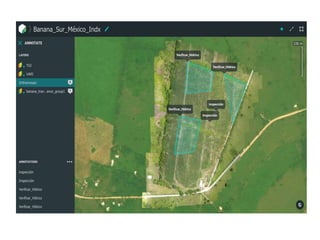
• With the maps created in Pix4Dfields, we can also
identify the places where these problems occur and
make targeted decisions to level or make drains, or
apply more fungicide or pesticide
•Images were processed in Pix4Dfields to create an
aerial representation of banana crops - orthomosaic,
and index maps to highlight problem areas even more.
The challenge for banana growers
• Banana requires a lot of water to grow, and hence dry
spells are a major risk impacting banana productivity.
The other challenge is that of banana cultivation
being dominated by conventional growing techniques
that include applying fertilizers in the forms of
pellets. Although cost-effective, it is ineffective. This
is because nutrients may leach or evaporate after their
application. Bananas are best grown in more acidic
soil with a pH from 6 to 7.5. Low pH levels of soil
increase the risk of the disease Panama.
Why precision irrigation?
Reduce Climate Related Risks
Precision irrigation helps lower climate-related risks and also risks
associated with unpredictable factors detrimental to banana growth. It
offers the right amount of water, nutrients to the banana crop root, thus
making it possible for the cultivators to have control over the yield.
Catering to the Plant Requirement and Saving Resources
Precision irrigation supplies the right quantity of water and nutrients to the
plant roots, which therefore eradicates the need to spend excess resources
to achieve a higher yield. This helps save on valuable resources, and
therefore on operational costs as well.
Optimal use of Land
Precision irrigation helps bring a comparatively large volume of land under
irrigation. This subsequently helps to make optimal use of land and get the
most of each and every hectare.
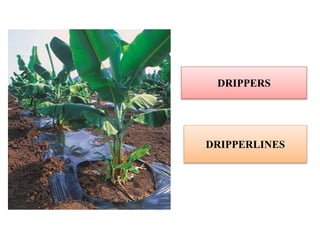
DRIPPERS
DRIPPERLINES
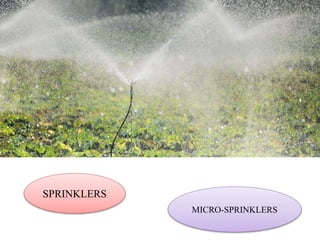
SPRINKLERS
MICRO-SPRINKLERS
OVERCOMING STRESS AND
INTEGRATED APPROACHES:
Banana crop bearing a mesophyte is
very sensitive to water stress conditions,
most of its cultivation is under
irrigation and understanding the
changes in banana genotypes response
to water defecit conditions is very
important.
Drought stress induces a range of
physiological and biochemical responses in
plants. The responses include stomatal
closure, repression of cell growth and
photosynthesis and activation of
respiration.
Chandrashekar et al., 2012 conducted an experiment at
IIHR fruit crops field by planting two contrasting
genotypes Calcutta-4 (AA) and Bee hee kela (BB) in two
structures built by cement bricks having three replications
based on leaf water retention capacity. The results
obtained with the physiological and biochemical studies
are significant. As per the literature available BB genome
has got better drought tolerant capacity than that of AA
genome accordingly. The BB genotype (Bee hee kela) was
found to have better mechanisms to cope with drought
situation than the AA genotype (Calcutta-4)
Chandrashekar, N., Ravishankar, K.V., Laxman, R.H., Rekha, A. and Swarupa, V.
2012. Physiological and biochemical changes during moisture stress in banana.
Asian Journal of Biological Sciences, 7(1): 1-4
Salinity is a major issue affecting
photosynthesis and crop production
worldwide. High salinity induces both
osmotic and ionic stress in plant
tissues as a result of complex
interactions among morphological,
physiological, and biochemical
processes. Salinity in turn can
provoke inactivation of some enzymes
in the calvin benson cycle and
therefore affect the fine adjustment of
electron transport in photosystem 1
and carbon related reactions.
Salinity tolerance in
Musa involves a set of at
least two simultaneous
mechanisms. These
mechanisms include the
activation of the SOS
system, which ensures
the extrusion of Na+
from the cytoplasm and
the activation of anti-
oxidative system, in
particular the increase in
the synthesis of the
enzyme APX and glycine
betaine.
A study carried out by the Indian Institute of Horticultural
Research (IIHR), Bangalore, suggests that banana plants
can be made resistant to hot climatic conditions by
subjecting the seedlings to mild heat stress.
The study involved exposing one group of the cultivar to induction stress, by
which plants were gradually acclimatised at 30—42 degrees Celsius over a
duration of two hours and 30 minutes. This group withstood exposure to high
temperature stress of 55 degrees Celsius lasting two hours.

MODERN TRENDS IN FRUIT PRODUCTION.pptx

  • 1.
    MODERN TRENDS INFRUIT PRODUCTION BANANA
  • 2.
    INTRODUCTION 1. GENERAL CONCEPTS 2.CURRENT SCENARIO 3. NATIONAL AND INTERNATIONAL SCENARIO 4. NATIONAL PROBLEMS
  • 3.
    GENERAL CONCEPTS • Scientificname: Musa spp. • Family: Musaceae • Chromosome no. 2n = 2X = 22,33,44 • Origin: Indo-Malayan (South East Asia) Hey.. Friends one point to be noticed about me that I am a heavy feeder of Potassium
  • 4.
    ANTIQUE FRUIT CROP APPLE OF PARADISE TREEOF WISDOM ADAMS FIG TREE OF PARADISE PLANT OF VIRTUE
  • 5.
    CURRENT SCENARIO AREA INDIA :923 Ha PRODUCTION INDIA : 33379 MT SOURCE: NATIONAL HORTICULTURE BOARD , 2020-21 (THIRD ADVANCE ESTIMATES) OF AREA AND PRODUCTION OF HORTICULTURE CROPS
  • 6.
    International Production :Bananas PRODUCTION (MT) INDIA : 31504 CHINA : 11513 INDONESIA : 8182 BRAZIL : 6637 ECUADOR : 6023 PHILLIPINES : 5955 GUATEMALA : 4476 ANGOLA : 4115 TANZANIA : 3419 COSTA RICA : 2528 SHARE (%) INDIA : 26.29 CHINA : 9.61 INDONESIA : 6.83 BRAZIL : 5.54 ECUADOR : 5.03 PHILLIPINES : 4.97 GUATEMALA : 3.74 ANGOLA : 3.43 TANZANIA : 2.85 COSTA RICA : 2.11 SOURCE: Food & Agricultural Organisation (FAO), 2020
  • 8.
    NATIONAL PROBLEMS • SOILSODICITY • FLOOD DAMAGE • WIND DAMAGE • STEM WEEVIL • CHILLING INJURY • ERWINIA ROT • WILT DISEASE • DROUGHT • SUN SCORCHING (PEDUNCLE)
  • 9.
    SOIL SODICITY • Dueto salinity and sodicity of soil, the Banana plants may suffer from marginal chlorosis and necrosis of older leaves, lesser proliferation of roots and an yield reduction by about 30%. • Damodaran et. al (2013) confirmed that the banana cultivation in sodic soil using pit treatment with 25 GRgypsum followed by soil application of CSR-B3 strain of Bacillus along with vermi-compost and mulch contributed a sustainable and higher yield. Damodaran, T., Mishra, V. K., Sharma, D. K., Jha, S. K., Verma, C. L., Rai, R. B., Kannan, R., Nayak, A. K. and Dhama, K. 2013. MANAGEMENT OF SUB-SOIL SODICITY FOR SUSTAINABLE BANANA PRODUCTION IN SODIC SOIL – AN APPROACH. International Journal of Current Research, 5(7): 1930-1934.
  • 10.
    FLOOD DAMAGE • Sanddeposition from flood makes soil unsuitable for growing banana due to very low nutrient availability, low water holding capacity and poor physical attributes. Thus more time and effort is required to completely restore the land into its original state after the sand deposition. As a result, farmers face difficulties to go back to normalcy and sustain their life.
  • 11.
     Open deeptrenches between the plant rows for improving the drainage condition of the land.  Give foliar spray of 2% potassium sulphate. After 15 days, give another foliar spray of 1% potassium nitrate.  At the bunch development stage, give 2% potassium sulphate spray on bunch, two times with 15 day interval.  During flood, the possibility of outbreak of Sigatoka leaf spot is more. As a prophylactic measure, give 0.1 per cent Propiconozole, 0.2 per cent Carbendazim and 0.25 per cent Mancozeb foliar sprays with 15 day intervals between each spray. REMEDY
  • 12.
    WIND DAMAGE • Inlight winds, the thin leaves of banana plants shred, reducing the plant's ability to photosynthesize efficiently. Heavier winds can twist the canopy or uproot the entire plant. • Winds of 30 miles per hour will break the stalks attaching the leaves, winds of 40 mph can break the main stem and winds of 60 mph can topple whole stands of banana plants. If the soil around the plants is soaked by rain, the trees can uproot in lighter winds. After a storm, toppled or leaning trees may suffer from sunburn and drought stress. Tamil Nadu: Over 10,000 banana plants damaged in strong wind SOURCE: Times of India, Updated: May 4, 2022, 09:20 IST
  • 13.
    PSEUDOSTEM WEEVIL • The bananapseudostem weevil is a monophagous pest. Adults are strong fliers and move from one plant to another. • Eggs are laid singly, at the base of the outermost leaf sheath. The incubation period ranges from 3 to 8 days. Emerging grubs are fleshy, yellowish white in colour and pass through five instars. The entire life cycle takes around 45 days. • The important symptoms of infestation are small pin head size holes on the lower leaf sheath, gummy exudation, yellowing and withering of leaves, and decaying of peduncles resulting in the immature fruit ripening. • The ascending flower bud and the peduncle inside the pseudostem can be eaten and damaged, resulting in non- emergence of the flower bud. Odoiporus longicollis
  • 14.
    CHILLING INJURY Symptoms include surface discoloration,dull or smokey color, subepidermal tissues reveal dark- brown streaks, failure to ripen, and, in severe cases, flesh browning. Chilling injury results from exposing bananas to temperatures below 13°C (56°F) for a few hours to a few days, depending on cultivar, maturity, and temperature. For example, moderate chilling injury will result from exposing mature-green bananas to one hour at 10°C (50°F), 5 hours at 11.7°C (53°F), 24 hours at 12.2°C (54°F), or 72 hours at 12.8°C (55°F). Chilled fruits are more sensitive to mechanical injury.
  • 15.
    CHILLING INJURY: REMEDY •Fibroin treatment significantly alleviated chilling injury of banana fruit. • Fibroin increased contents of glucose, fructose and sucrose of banana fruit. • Fibroin treatment delayed the decreases in ATP level and energy charge. • Fibroin treatment up-regulated expressions of ATPase and AAC of banana fruit. * Protection of bunches with 100 gauge polythene sleeves of 6% ventilation is very essential.
  • 16.
    ERWINIA ROT • Thisdisease is more pronounced on young suckers leading to rotting and emitting of foul odour • Rotting of crown region is a characteristic symptom followed by epinasty of leaves, which dry out suddenly • If affected plants are pulled out it comes out from the crown region leaving the corm with their roots in the soil Erwinia carotovora sub sp. carovora
  • 17.
    REMEDY: • Good drainageand soil conditioning can control the disease to some extent. • Plant disease free suckers. • Remove infected plants immediately. • Remove plant residues after harvest. • Dip suckers in copper oxychloride (40g/10l)+ streptocycline (3g/10lit) for 30 min before planting.
  • 18.
    DROUGHT Bananas are verysensitive to drought, which may cause yield reductions of up to 65% when the annual rainfall falls below 1,100 mm per annum REMEDY: Use of plant waste mulches viz., Banana leaf mulches, sugarcane trashes, paddy straw mulches around the plants conserves soil moisture and also promotes production of more feeder roots.
  • 19.
    PEDUNCLE SUN SCORCHING Thefruit peduncle on exposure to sunlight suffers from sun scorching, which subsequently makes entry for pathogens that leads to rottig, poor uneven finger filling and ultimately breaking of the peduncle along with the bunch. Hence, the peducle should be fully covered using the 'boot leaf' that emerges just before the bunch.
  • 20.
    BLOCK 2: ADVANCED TECHNOLOGY 1.PROPAGATION 2. PLANTING SYSTEMS 3. CROP REGULATION LETS BEGIN….
  • 21.
    TWO BROAD APPROACHES: 1.TRADITIONAL 2. MODERN
  • 22.
    1. TRADITIONAL A: Swordsucker (large sucker with lanceolate leaves) B: Maiden sucker (large non- fruiting sucker with foliage leaves) C: Peeper sucker (small sucker appearing just above the ground and bearing scaly leaves only and Generally, 5-20 new suckers can be extracted for field planting from a banana mat in a year
  • 23.
    Improved traditional banana propagationtechniques •Mother plant stripping •Decapitation •Corm technique (Macropropagation)
  • 24.
    Mother plant stripping:The outer leaf sheaths at the base of the mother plant’s pseudostem are stripped off to expose the buds followed by mounding up soil around the base of the plant to allow the buds to grow into suckers. This method, can double the sucker production per mat in a year to as high as 40 suckers per plant  This method, can double the sucker production per mat in a year to as high as 40 suckers per plant
  • 25.
    DECAPITATION False-decapitation: Suckering can bestimulated in banana mats by reducing the apical dominance posed by the mother plant. This is achieved by killing the growing point of the mother plant through a window made at the base of the pseudostem. This method is also known as false decapitation, as the foliage of the mother plant remains physiologically active to feed the suckers Complete-decapitation: This involves stimulating suckering by cutting back the whole pseudostem of the mother plant.  Modification of this method has been experimented by scoping out the meristem and adding growth regulators, achieving up to 780 suckers on a mat per year
  • 26.
    Corm technique (Macropropagation): Thisis a faster technique of inducing plantlets (suckers) production from banana corms removed from the field plants. One approach involves destroying the apical meristem of a relatively large corm and planting it whole in moist nursery substrate under warm and humid conditions in a humidity chamber. Lateral buds are thus stimulated to sprout, and the shoots produced are removed and hardened in the nursery to obtain small plants. Cutting off these shoots reduces apical dominance further and stimulates more sprouting. Up to 60 plantlets, depending on the banana cultivar used can be obtained from a single corm within four months
  • 27.
    Modern techniques ofbanana propagation (Micropropagation) • Tissue culture is the best method for propagating bananas. It ensures they are true to type and free from pests and diseases. • The tissue culture propagation of banana for the first time in India, was pioneered by Dr. R. Dore Swamy at the Indian Institute of Horticultural Research, Bangalore.
  • 29.
    Why Tissue Culture? •Sword suckers weighing approximately 500 – 750 g are commonly used as propagating material • Suckers generally may be infected with some pathogens and nematodes. Similarly due to the variation in age and size of sucker the crop is not uniform, harvesting is prolonged and management becomes difficult. • Therefore, tissue culture plants are recommended for planting. They are healthy, disease free, uniform and authentic. • So, properly hardened secondary seedlings are only recommended for planting.
  • 30.
    Advantages of TissueCulture • True to the type of mother plant under good management. • Pest and disease free seedlings. • Uniform growth, increases yield. • Early maturity of crop. • Round the year planting possible as seedlings are made available throughout the year. Two successive ratoons are possible in a short duration which minimizes cost of cultivation. • 95% - 98% plants bear bunches. • New varieties can be introduced and multiplied in a short duration.
  • 31.
    Commercial cultivation ofbanana in J&K through biotechnology This first cultivation trial was done by planting 2000 samplings of banana plants with the narrow spacing 2 X 2 m in the month of August 2016 and fruit setting commenced in the month of July- August, 2017 while as the maturity and harvesting attained in 13 months. The plant grew to a height of 6.5 to 7.5 feet and gave yield 20-30 kg per plant and 20-25 tonnes/acre. In term of economy involved, as per market analysis, price of banana in Jammu is approximately Rs 20 per kg. Thus on an average, 20-30 Kg yield/plant gives Rs 250-300/Banana plant. On the basis of market demand, approximately Rs 2.5 lakh net return can be obtained by cultivation of this crop on one acre of land which is attractive business for farmers of the Jammu & Kashmir State as it involves very less inputs but lucrative profit. SOURCE: Daily Excelsior, 28/11/2017
  • 32.
    Conclusion All techniques ofbanana propagation have limitations ranging from low multiplication rates, genetic fidelity, disease elimination and affordability of the generated suckers. If the central objective of the seed system is to generate high quality planting materials, tissue culture technique offers the highest seed quantity and quality and therefore, is highly recommended. The technique can be integrated in the downstream propagation and dissemination of cleaned suckers to address the problem of seed quantity and quality.
  • 33.
    PLANTING SYSTEM Planting canbe done in May- June or in September - October Ideal time (October-November) of planting is after the monsoon season. With assured irrigation, the planting can also be done in February-March
  • 34.
    Apply 25 gPseudomonas fluorescence / plant at the time of planting. Trim the roots and decayed portion of the corm, cut the pseudostem leaving 20 cm from the corm and grade the suckers to size. To avoid wilt disease in Rasthali, Monthan, Virupakshi and other wilt susceptible varieties, infected portions of the corm may be pared and dipped for 5 minutes in 0.1% Emisan solution (1 g in 1 lit of water).
  • 35.
    Pralinage is donewith 40 g of Carbofuran 3 G granules per sucker. (Dip the corm in slurry solution containing 4 parts clay plus 5 parts water and sprinkle Carbofuran to control nematodes). •Alternatively, dip the corm with 0.75% Monocrotophos, shade dry for atleast 24 hours and plant. •Use tissue cultured banana plants with 5-6 leaves.
  • 36.
    SYSTEM OF PLANTING 1.Single row system • In single row planting, the distance within the row is close, whereas the distance between the row is wide. • This system allows good aeration to plant canopy, allowing wet leaves to dry more rapidly, reducing fungal disease severity. • In this, less number of trees occupied in the field and yield will automatically reduced .
  • 37.
    2. PAIRED ROW SYSTEM •In this method, the distance between the two lines is 0.90 to 1.20 m. while plant to plant distance is 1.2 to 2 m. • Due to this spacing, intercultural operations can be carried out easily and cost of drip irrigation is decreased.
  • 38.
    3. SQUARE SYSTEM •This is the most commonly followed system and is very easy to layout. • Banana is mostly cultivated by adopting 1.8x1.8m spacing • In this system, trees are planted on each comer of a square whatever may be the planting distance. • The central place between four trees may be advantageously used to raise short lived filler trees. • This system permits inter cropping and cultivation in two directions.
  • 39.
    4. TRIANGULAR SYSTEM •This system is best suited for tissue culture banana suckers. • In this, adopt spacing in between rows was 1.5m and plant to plant was 1.8m in the row. • The trees are planted as in square system but the difference being that those in the even numbered rows are midway between those in the odd rows instead of opposite to them. • The distance between any two adjacent trees in a row is equal to the perpendicular distance between any two adjacent rows. • When compared to square system, each tree occupies more area and hence it accommodates few trees per hectare than the square system.
  • 40.
    • The distancebetween any two adjacent trees in a row is equal to the perpendicular distance between any two adjacent rows. • When compared to square system, each tree occupies more area and hence it accommodates few trees per hectare than the square system.
  • 41.
    PIT METHOD • Pitplanting is commonly followed in garden land system of cultivation. Pits of 60 cm x 60 x 60 cm x 60 cm size are dug, filled with a mixture of soil, sand and FYM (Farm Yard Manure) in a 1:1:1 ratio. Suckers are planted in the centre of the pit and soil around is compacted. • Planting is done from February to May whereas in North India, it is done during July-August. In South-India, it can be done any time of year except summer.This is mostly followed in biennial plantations for Dwarf Cavendish, Rasthali, Robusta, Poovan and Karpuravalli banana. However this method is very laborious and expensive. The only advantage is that no earthing up is required as planting is done at the required depth. This practice is not very popular at present.
  • 42.
    Furrow Method • InGujarat and Maharashtra, furrow planting is practised. After land preparation, 30- 40 cm deep furrows are made, either manually or with a ridger. • Suckers are placed at required spacing; FYM is applied around, mixed with soil and tightly packed round the suckers. • Furrow planting is practised in annual panting system. In this method earthing up needs to be frequently done to cover the exposed rhizomes.
  • 43.
    Trench Planting • Trenchplanting is practiced in wet land cultivation of Cauvery delta region of Tamil Nadu. Land is prepared like paddy using plenty of water and gauge wheel. • Water is drained from the field allowing setting for a day. Planting is done by simple pressing the suckers into the wet field. • After a week 15 cm deep trenches are opened both ways maintaining 4 or 6 plants in each block. • Deepening of trenches by 20-25 cm is taken up every month after planting till suckers put forth 1-3 leaves. • During third month trenches are broadened and deepened to 60 cm. in rainy season some trenches are used as drainage channels. After about 2 months, trenches are cleaned; decayed manure is used for plants for organic cycling.
  • 44.
    High Density Planting •(HDP) is normally refers to planting at a spacing than the usual recommended spacing. • Choosing the correct planting density is very important for bridging the gap between the actual yield and the potential yield of banana from a unit area. • For the highest possible yields of good quality fruit, there is an optimum plant density, which should be maintained for sustaining the economic life of the plantation. • This optimum varies with the location, cultivator, soil fertility, management level and economic considerations. • These factors in turn influence more specific determinants of density choice such as prevailing climate, plantation vigour and its longevity.
  • 45.
    Robusta 4400 plants/ha (1.5 m x 1.5 m spacing) -- 120t/ha Dwarf Cavendish 4400 plants (1.5 m x 1.5 m spacing) --100t/ha Ney Poovan 5120 plants/ha (1.5 m x 1.5 m- triangle planting) recommended, which is 16% more than 4440 plants/ha (1.5 m x 1.5 m planting).
  • 46.
    Advantages of HighDensity Planting • It increases yield and reduces labours cost resulting in low cost of production. • It also enables the mechanization of fruit crop production. • It facilitates more efficient use of fertilizers, water, solar radiation, fungicides, weedicides and pesticides.
  • 47.
    SUCCESS STORY: HDPin Grand Naine variety KVK Hirehalli has implemented a Front Line Demonstration (FLD) on High Density Planting of Banana with paired row method in the field of field Shri. Mahesh, progressive farmer from Makanahalli village of Tumakuru taluk. He was a banana farmer specialized in the cultivation of G-9 variety and Yelakki. His average annual income from banana farming was INR 1.47 lakhs /ha. KVK Hirehalli selected him as a beneficiary farmer for the FLD – High density planting in banana, a NRCB technology. The KVK trained him on the technology and he planted the banana at a spacing of 1.5 x 1.5 x 2.0 mt in a paired row with zig zag method of planting, unlike conventional planting of 2 x 2 mt. In this HDP method he could plant 5200 plants per hectare in place of 2500, as in conventional method. Though in conventional method, bunch weight of planting was 20.5 kg, his productivity was 578 qt/ha only. Whereas in this HDP method, though the bunch weight was 17.2 kg (3 kg less than conventional), productivity was of 760 qt /ha (more than 180 kg than conventional), due to more number (almost double) of plants per hectare. This increased his income level to Rs. 3.82 lakhs / ha per annum with a B: C ratio 3.54. Now Sri. Mahesh is following High Density Planting in banana with different varieties Viz., Yelakki bale, Puttabale etc., and earning more profit.
  • 48.
    CROP MODELING • Todesign new banana-based cropping systems, a model called SIMBA was built to simulate this system and to assess its performances and impacts. • SIMBA can be used to optimize suitable practices that take into account the dynamics of the state variables of the system (pests, plant population, soils, etc.) in order to reach a target objective. • SIMBA was developed to simulate and assess the main environmental risks in banana-cropping systems (pollution of water and soil erosion) over several cropping cycles.
  • 49.
    SIMBA has beendeveloped in the STELLA software version 7.0.2 from Isee systems (formerly High Performance System). STELLA is a modeling tool for building a dynamic modeling system by creating a pictorial diagram of a system and then assigning the appropriate values and mathematical functions to the system
  • 51.
    The plant populationmodule SIMBA-POP • The SIMBA-POP module based on the cohort population concept, simulates the plant population structure and its development patterns, including the management of the plant population by the farmer (choice of sucker for next cropping cycle, plant toppling and replacement).
  • 52.
    The plant growthmodule SIMBA- GROW • This allows calculating separately the growth of each group of plants at the same physiological stage. This module includes simulation of leaf area index (LAI), vegetative dry matter (leaves, pseudo-stem, roots), and yield (number and weight of fruits per bunch). The number of fruits (NF) per bunch is assumed to be a function of the LAI at the flowering stage, Biotic and abiotic stresses are simulated; these reduce the growth potential due to the impact of nitrogen shortage, drought, or parasitism. As in many crop models, the net primary production (NPP) and LAI are calculated on the basis of the interception of the photosynthetically active radiation (PAR) and its allocation to different organs according to the stage of the plant.
  • 53.
    The plant-parasitic nematode populationmodule SIMBA-NEM • Radopholus similis and Pratylenchus coffeae are plant parasitic nematodes that generate extensive root lesions and that are considered among the most detrimental pathogens of banana. The SIMBA-NEM module is based on a cohort chain structure and a logistic function to describe population growth in relation with (i) ‘K’ the environmental carrying capacity (maximal population that the system can support) depending on the available banana root dry matter, (ii) ‘c’, an intrinsic growth rate, and (iii) the interspecific nematodes competition. Soil water content and nematicide applications are considered the main variables influencing the intrinsic population growth rate of each species.
  • 54.
    The soil propertiesmodules SIMBA- COV and SIMBA-SOIL • Soil cover and soil compaction are simulated by the semi-quantitative SIMBA-COV module . Soil cover represents, in a simplified way, the growth of weeds, their destruction by herbicide, the mulch cover supplied by weed destruction and crop residues at harvest of banana, and the mulch degradation over time; it runs at the week step. Weed growth follows a logistic function and is expressed in percentage of soil cover; this growth is reduced when the LAI of the banana increase. Crop residues (in Mg) are converted into percentages of soil cover. • Soil structure is simulated with the SIMBA-SOIL module through a compaction score that takes into account the number and the type of mechanized practices (fertilizer application, harvest trailer, plowing). The effect of these practices is also affected by soil moisture. This module that measured on soil profiles the percentage of every soil structural type with different levels of compaction for a wide range of cropping systems at different stages and after planting.
  • 55.
    SIMBA-WAT • SIMBA-WAT isa simple water balance module used to simulate the soil water content, run-off, and leaching. The soil is considered as a reservoir supplied by rainfall, decreased by crop evapotranspiration (according to the simplified Penman equation based on the global radiation and a crop factor calculated as a function of the LAI
  • 56.
    Precision farming Precision Farmingis generally defined as an information and technology based farm management system to identify, analyze and manage variability within fields for optimum profitability, sustainability and protection of the land resource
  • 57.
    Monitoring banana cropswith precision agriculture • With the maps created in Pix4Dfields, we can also identify the places where these problems occur and make targeted decisions to level or make drains, or apply more fungicide or pesticide •Images were processed in Pix4Dfields to create an aerial representation of banana crops - orthomosaic, and index maps to highlight problem areas even more.
  • 59.
    The challenge forbanana growers • Banana requires a lot of water to grow, and hence dry spells are a major risk impacting banana productivity. The other challenge is that of banana cultivation being dominated by conventional growing techniques that include applying fertilizers in the forms of pellets. Although cost-effective, it is ineffective. This is because nutrients may leach or evaporate after their application. Bananas are best grown in more acidic soil with a pH from 6 to 7.5. Low pH levels of soil increase the risk of the disease Panama.
  • 60.
    Why precision irrigation? ReduceClimate Related Risks Precision irrigation helps lower climate-related risks and also risks associated with unpredictable factors detrimental to banana growth. It offers the right amount of water, nutrients to the banana crop root, thus making it possible for the cultivators to have control over the yield. Catering to the Plant Requirement and Saving Resources Precision irrigation supplies the right quantity of water and nutrients to the plant roots, which therefore eradicates the need to spend excess resources to achieve a higher yield. This helps save on valuable resources, and therefore on operational costs as well. Optimal use of Land Precision irrigation helps bring a comparatively large volume of land under irrigation. This subsequently helps to make optimal use of land and get the most of each and every hectare.
  • 61.
  • 62.
  • 63.
    OVERCOMING STRESS AND INTEGRATEDAPPROACHES: Banana crop bearing a mesophyte is very sensitive to water stress conditions, most of its cultivation is under irrigation and understanding the changes in banana genotypes response to water defecit conditions is very important. Drought stress induces a range of physiological and biochemical responses in plants. The responses include stomatal closure, repression of cell growth and photosynthesis and activation of respiration.
  • 64.
    Chandrashekar et al.,2012 conducted an experiment at IIHR fruit crops field by planting two contrasting genotypes Calcutta-4 (AA) and Bee hee kela (BB) in two structures built by cement bricks having three replications based on leaf water retention capacity. The results obtained with the physiological and biochemical studies are significant. As per the literature available BB genome has got better drought tolerant capacity than that of AA genome accordingly. The BB genotype (Bee hee kela) was found to have better mechanisms to cope with drought situation than the AA genotype (Calcutta-4) Chandrashekar, N., Ravishankar, K.V., Laxman, R.H., Rekha, A. and Swarupa, V. 2012. Physiological and biochemical changes during moisture stress in banana. Asian Journal of Biological Sciences, 7(1): 1-4
  • 65.
    Salinity is amajor issue affecting photosynthesis and crop production worldwide. High salinity induces both osmotic and ionic stress in plant tissues as a result of complex interactions among morphological, physiological, and biochemical processes. Salinity in turn can provoke inactivation of some enzymes in the calvin benson cycle and therefore affect the fine adjustment of electron transport in photosystem 1 and carbon related reactions. Salinity tolerance in Musa involves a set of at least two simultaneous mechanisms. These mechanisms include the activation of the SOS system, which ensures the extrusion of Na+ from the cytoplasm and the activation of anti- oxidative system, in particular the increase in the synthesis of the enzyme APX and glycine betaine.
  • 66.
    A study carriedout by the Indian Institute of Horticultural Research (IIHR), Bangalore, suggests that banana plants can be made resistant to hot climatic conditions by subjecting the seedlings to mild heat stress. The study involved exposing one group of the cultivar to induction stress, by which plants were gradually acclimatised at 30—42 degrees Celsius over a duration of two hours and 30 minutes. This group withstood exposure to high temperature stress of 55 degrees Celsius lasting two hours.