Managing Skyrocketing
US Electricity Demand:
A STATE AND LOCAL PERSPECTIVE
May 6, 2025
Ian Goldsmith, Michelle Levinson
Footer
2
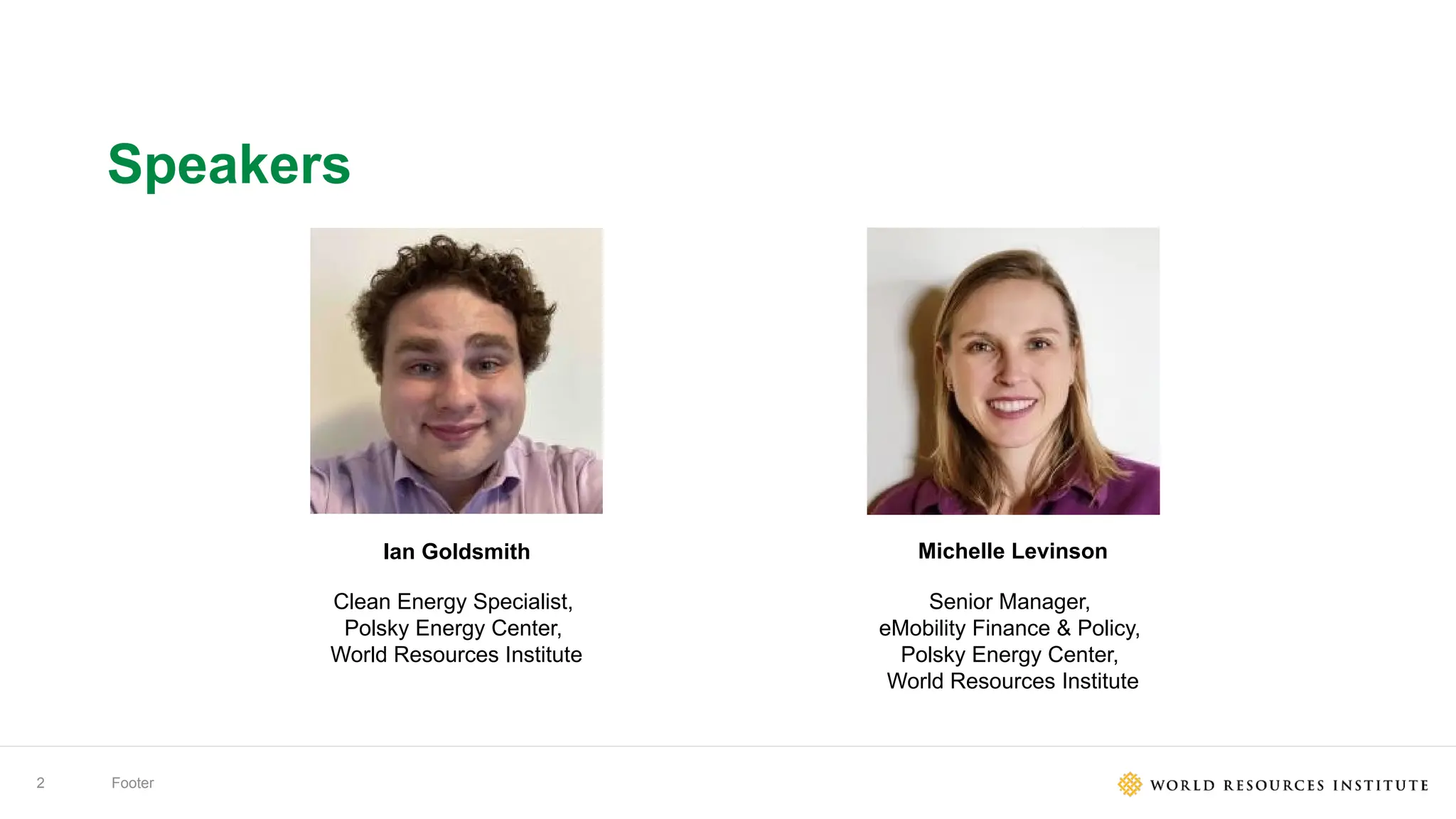
Speakers
Ian Goldsmith
Clean Energy Specialist,
Polsky Energy Center,
World Resources Institute
Michelle Levinson
Senior Manager,
eMobility Finance & Policy,
Polsky Energy Center,
World Resources Institute
Footer
3
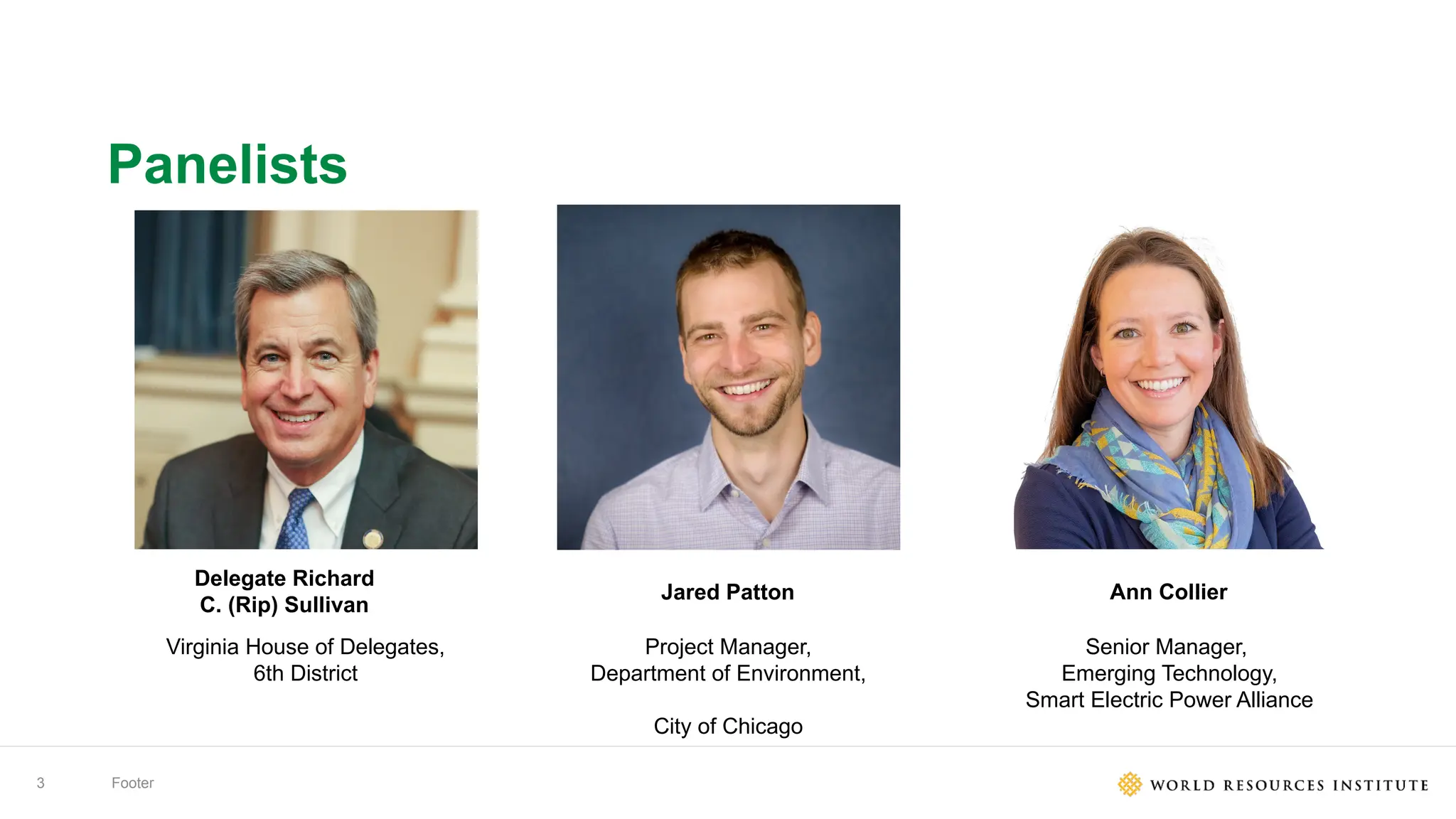
Panelists
Delegate Richard
C. (Rip) Sullivan
Jared Patton
Virginia House of Delegates,
6th District
Project Manager,
Department of Environment,
City of Chicago
Senior Manager,
Emerging Technology,
Smart Electric Power Alliance
Ann Collier
WRI is a global research organization
working to improve people’s lives,
protect nature and halt climate change.
What do we do?
5
As an independent research organization, we
leverage our data, expertise and global reach to
influence policy and catalyze change across systems
like food, land and water; energy; and cities. Our
2,000+ staff work on the ground in more than a
dozen focus countries and with partners in over 50
nations.
The new era of electric
demand growth
01
A new era of
electricity demand is
here.
7
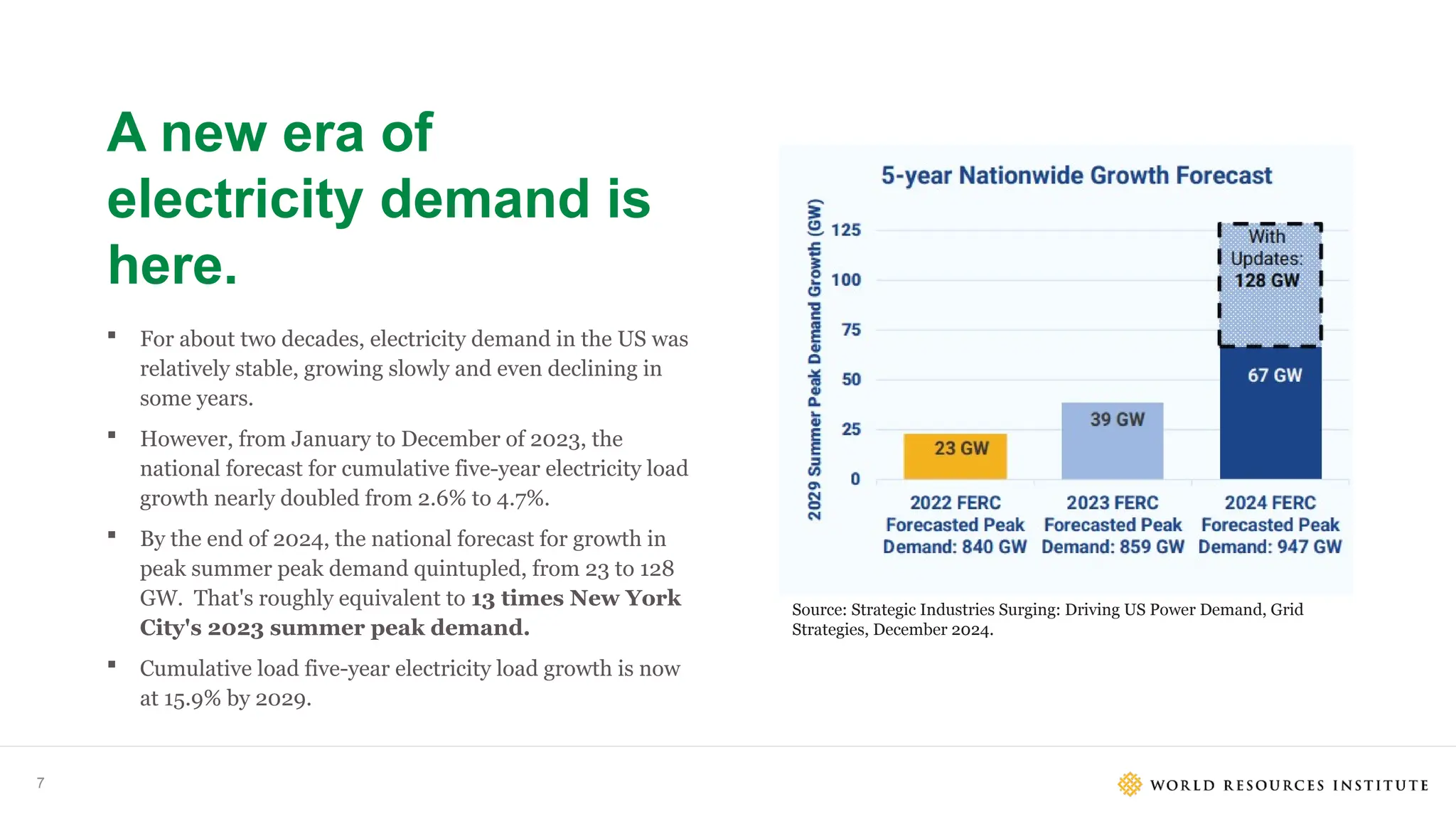
 For about two decades, electricity demand in the US was
relatively stable, growing slowly and even declining in
some years.
 However, from January to December of 2023, the
national forecast for cumulative five-year electricity load
growth nearly doubled from 2.6% to 4.7%.
 By the end of 2024, the national forecast for growth in
peak summer peak demand quintupled, from 23 to 128
GW. That's roughly equivalent to 13 times New York
City's 2023 summer peak demand.
 Cumulative load five-year electricity load growth is now
at 15.9% by 2029.
Source: Strategic Industries Surging: Driving US Power Demand, Grid
Strategies, December 2024.
What’s driving new demand for electricity?
8
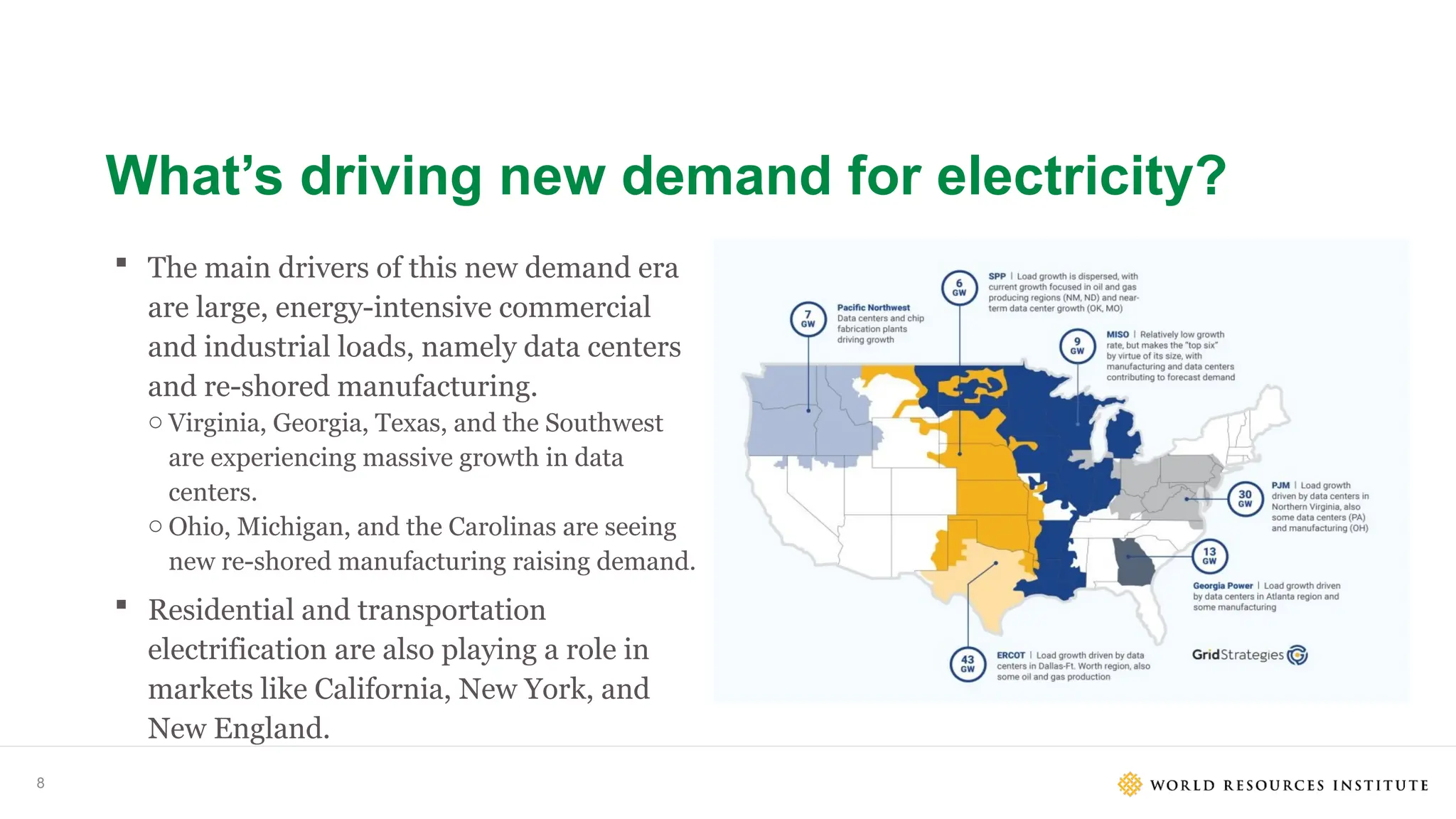
 The main drivers of this new demand era
are large, energy-intensive commercial
and industrial loads, namely data centers
and re-shored manufacturing.
o Virginia, Georgia, Texas, and the Southwest
are experiencing massive growth in data
centers.
o Ohio, Michigan, and the Carolinas are seeing
new re-shored manufacturing raising demand.
 Residential and transportation
electrification are also playing a role in
markets like California, New York, and
New England.
9
Data centers are the largest and fastest
growing source of demand right now.
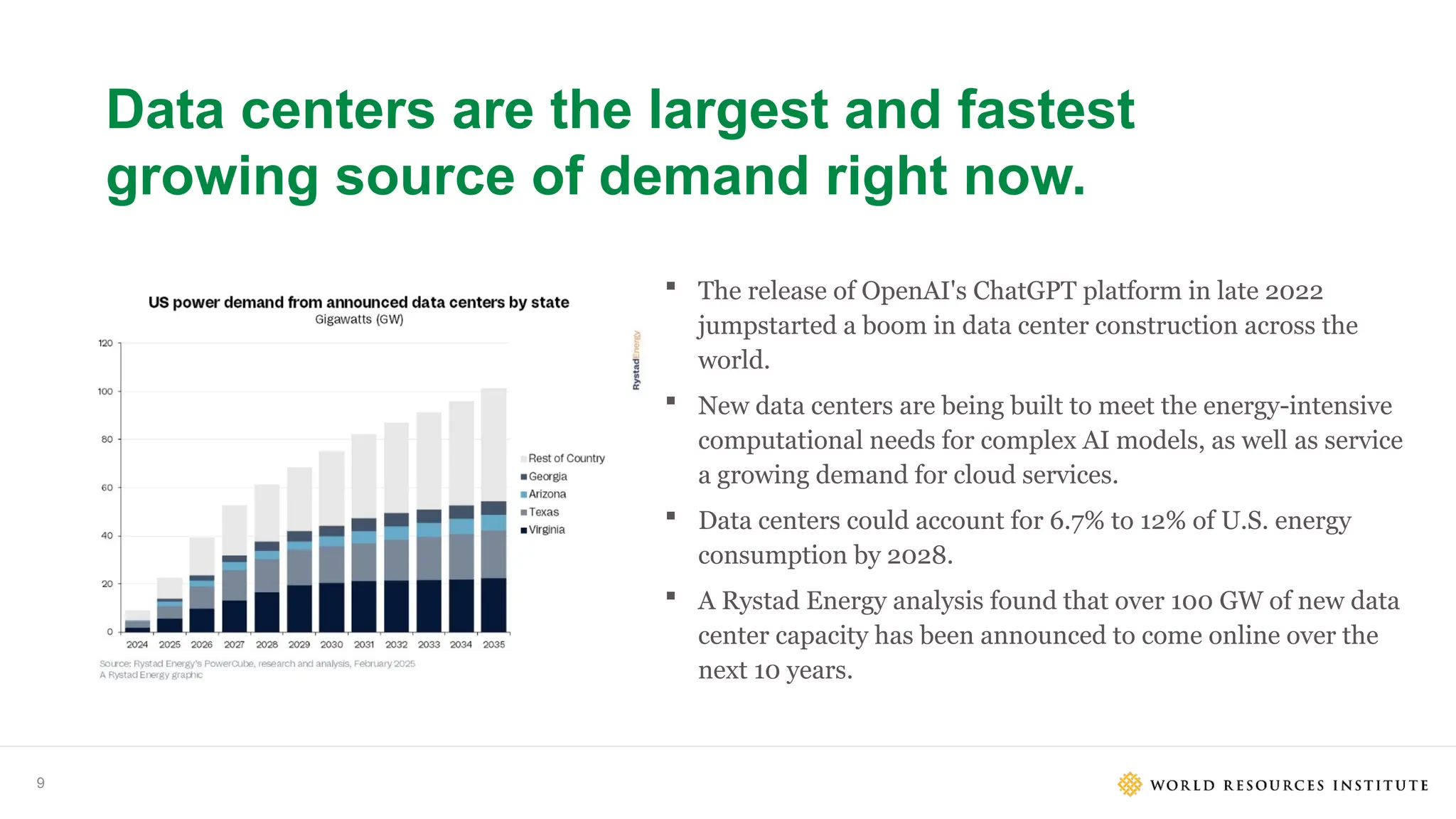
 The release of OpenAI's ChatGPT platform in late 2022
jumpstarted a boom in data center construction across the
world.
 New data centers are being built to meet the energy-intensive
computational needs for complex AI models, as well as service
a growing demand for cloud services.
 Data centers could account for 6.7% to 12% of U.S. energy
consumption by 2028.
 A Rystad Energy analysis found that over 100 GW of new data
center capacity has been announced to come online over the
next 10 years.
What are the potential
impacts of load growth?
02
11
Utilities, generators, and companies are
racing to meet new demand...
 Utilities need all of the generation they can get to serve new load, spurring investment and
development in clean energy.
 Speed to market becoming the most important factor, which is providing a boost to solar and
storage technologies.
 Many tech companies with strong sustainability goals are exploring models for using clean
energy to support their data center buildout:
o In September 2024, Microsoft and Constellation Energy announced that it would restart one of the reactors
at Pennsylvania’s Three Mile Island nuclear plant as part of a power purchase agreement.
o Meta struck a deal with Sage Geosystems to buy 150 MW of geothermal power for its data centers, beginning
operation in 2027.
o Google announced a deal with Intersect Power to develop co-located "energy parks" with renewables and
storage sited next to its data centers.
12
...including by burning fossil fuels.
Source: "A utility promised to stop burning coal. Then Google and Meta came to town." Evan Halper, Washington
Post, October 12, 2024.
 Even as many look to clean energy options to
support load growth development, new load
growth has spurred demand for new gas
generation and support keeping existing
fossil fuel plants online.
 An IEEFA report from January 2025 found
that utilities in Virginia, Georgia, North
Carolina, and South Carolina are planning to
build over 20 GW of new natural gas
capacity by 2040, largely attributed to data
center and manufacturing load.
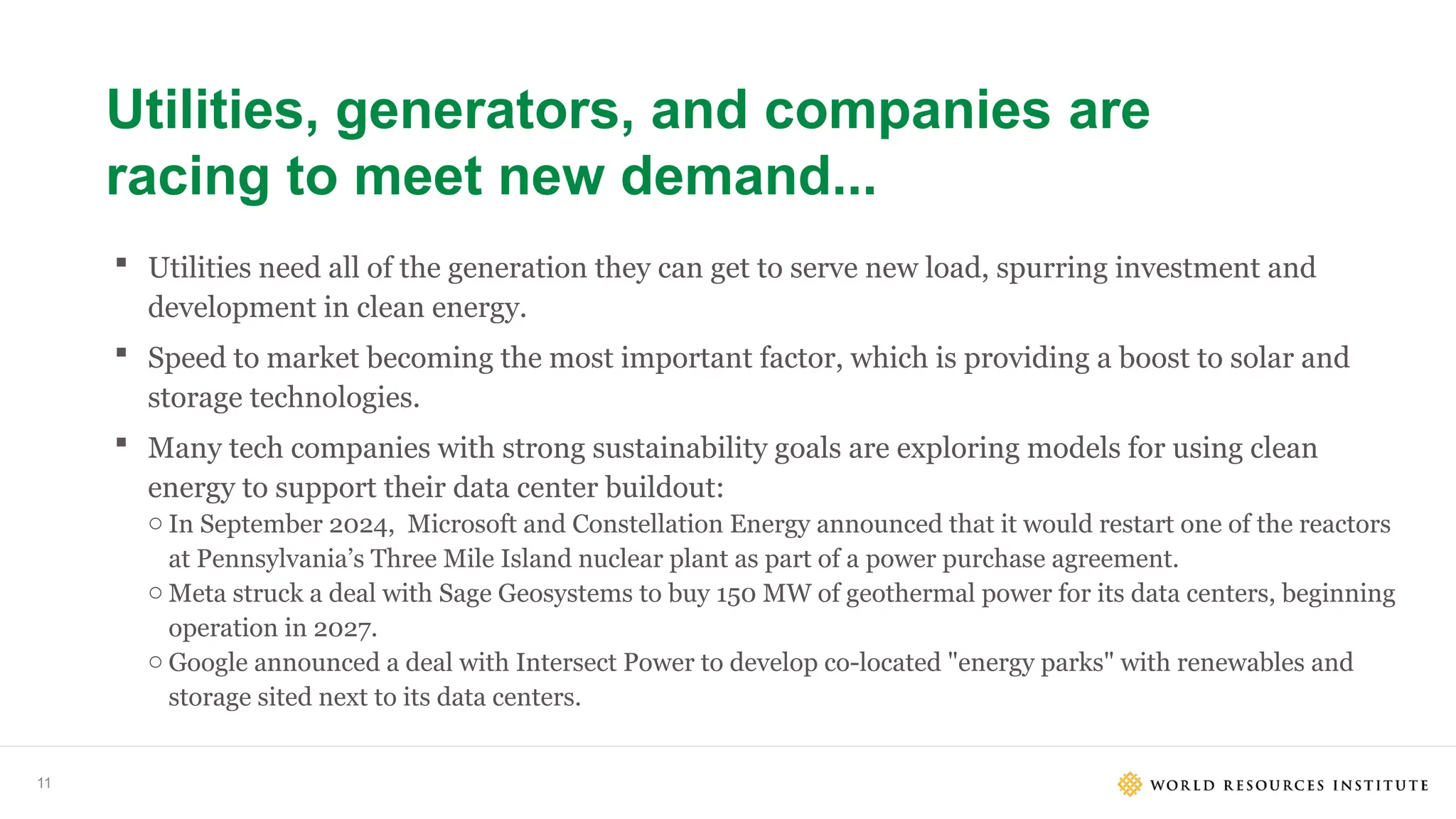
In Nebraska, the arrival of new data centers led
the Omaha Public Power District to indefinitely
delay retirement of two coal-burning generators
next to a disadvantaged community. ​
Footer
13
Large load
integration presents
affordability
concerns.
 As demand rises, ratepayers are likely to increased
bills.
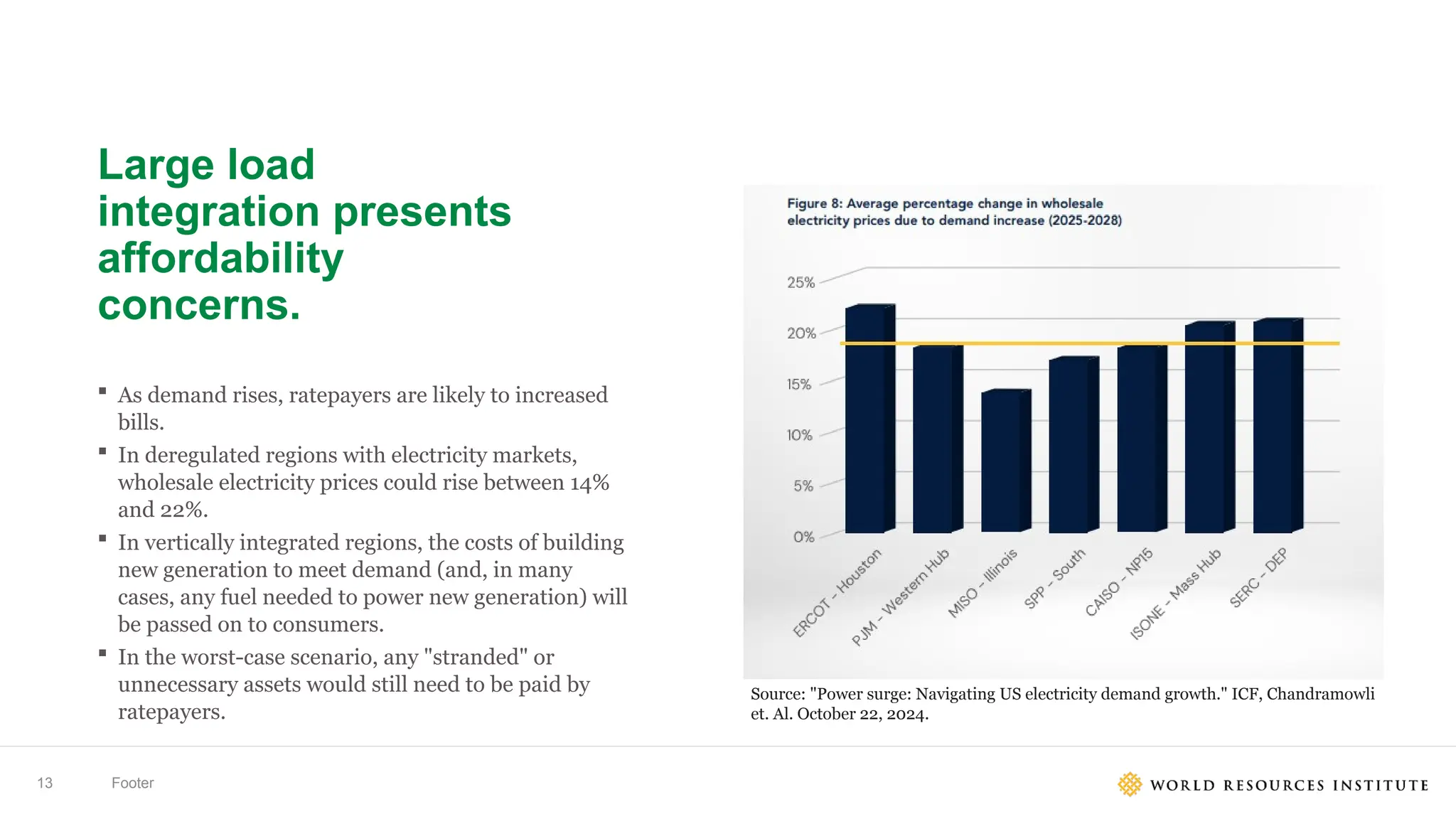
 In deregulated regions with electricity markets,
wholesale electricity prices could rise between 14%
and 22%.
 In vertically integrated regions, the costs of building
new generation to meet demand (and, in many
cases, any fuel needed to power new generation) will
be passed on to consumers.
 In the worst-case scenario, any "stranded" or
unnecessary assets would still need to be paid by
ratepayers.
Source: "Power surge: Navigating US electricity demand growth." ICF, Chandramowli
et. Al. October 22, 2024.
14
Reliability and grid stewardship could be
threatened with increased demand.
 The U.S. power grid is aging and already experiences
significant constraints. Additionally, increasingly
severe weather is leading to more frequent power
disruptions.
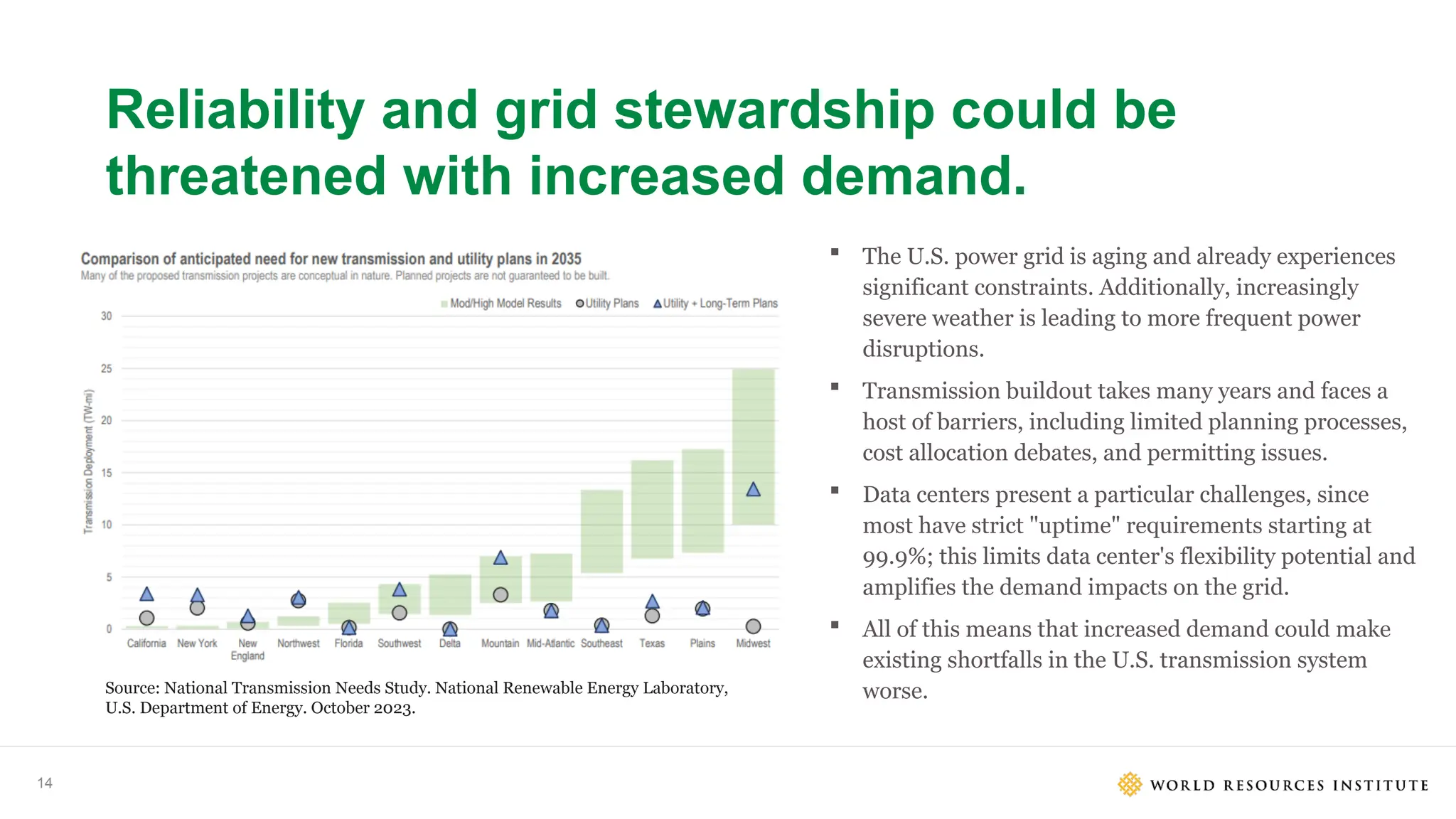
 Transmission buildout takes many years and faces a
host of barriers, including limited planning processes,
cost allocation debates, and permitting issues.
 Data centers present a particular challenges, since
most have strict "uptime" requirements starting at
99.9%; this limits data center's flexibility potential and
amplifies the demand impacts on the grid.
 All of this means that increased demand could make
existing shortfalls in the U.S. transmission system
worse.
Source: National Transmission Needs Study. National Renewable Energy Laboratory,
U.S. Department of Energy. October 2023.
How can state and local
policymakers address new
demand for electricity in the
US?
03
16
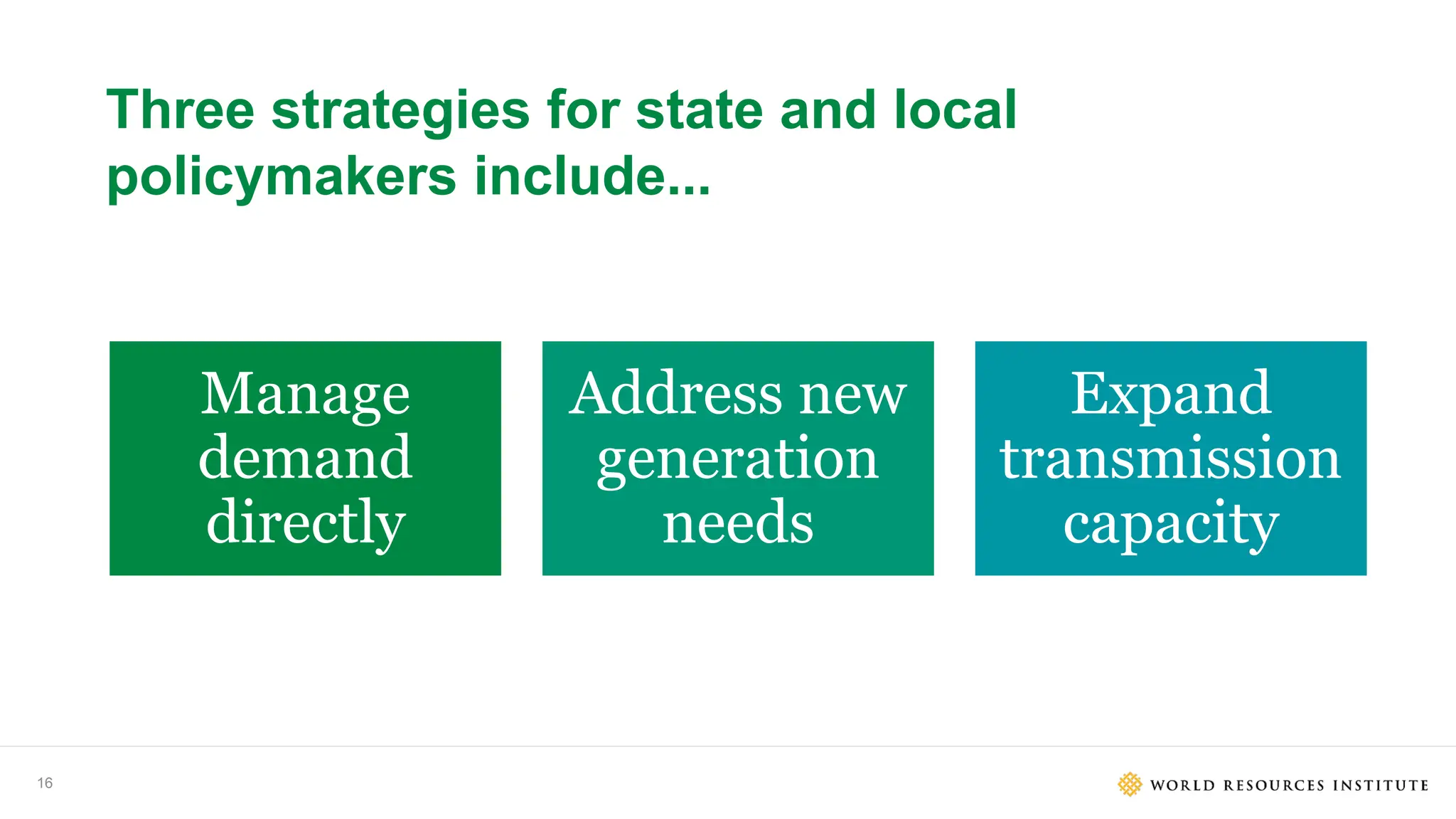
Three strategies for state and local
policymakers include...
Manage
demand
directly
Address new
generation
needs
Expand
transmission
capacity
17
The most direct pathway is to look to the
sources of load growth themselves.
 State and local policymakers have significant power to
manage development and land use within their
jurisdictions, and can use that power to engage directly
with new sources of load.
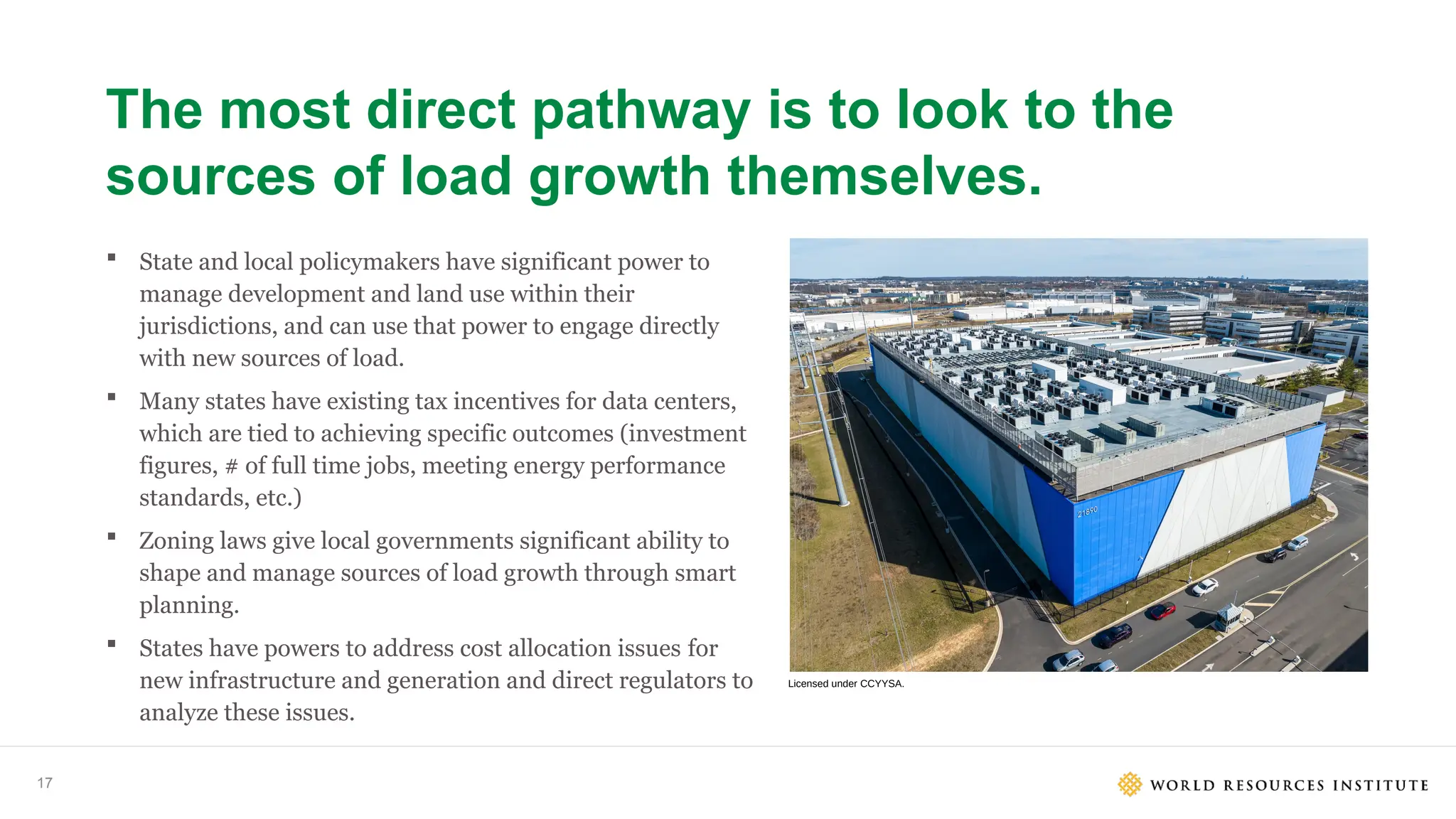
 Many states have existing tax incentives for data centers,
which are tied to achieving specific outcomes (investment
figures, # of full time jobs, meeting energy performance
standards, etc.)
 Zoning laws give local governments significant ability to
shape and manage sources of load growth through smart
planning.
 States have powers to address cost allocation issues for
new infrastructure and generation and direct regulators to
analyze these issues.
Licensed under CCYYSA.
18
Supporting clean energy policies to meet
demand  On the supply side, policymakers can look for ways to
make sure clean energy is being used to meet demand
instead of
 Cities and states can directly procure clean energy for
themselves or their communities through a variety of
mechanisms, including green tariffs and power
purchase agreements.
 States are well situated to reducing the timelines
associated with permitting and siting of new large-
scale generation and transmissions facilities to ensure
that necessary infrastructure additions keep pace with
growing demand.
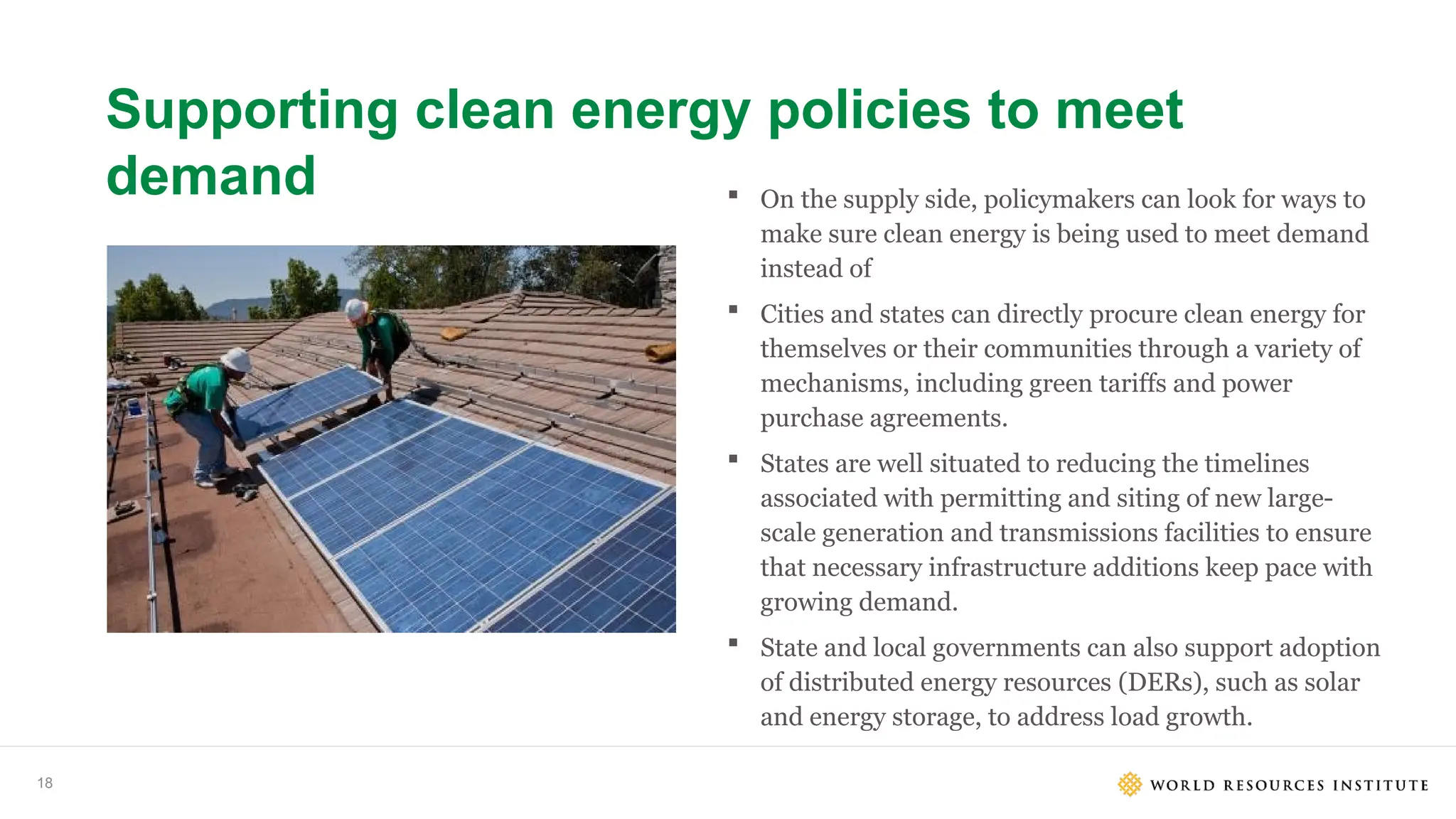
 State and local governments can also support adoption
of distributed energy resources (DERs), such as solar
and energy storage, to address load growth.
19
Reliability and grid stewardship could be
threatened with increased demand.
 State policymakers have authority to regulate how utility transmission plans are conducted
and to introduce requirements and incentives that encourage transmission capacity
growth.
o Multiple states like Minnesota, Massachusetts and California have passed laws requiring utilities to
consider grid-enhancing technologies, which are designed to add more carrying capacity to existing
transmission lines.
o The Montana legislature ordered its Public Service Commission to establish an incentive for building
new transmission lines with “advanced conductors” capable of transmitting more energy than
standard technologies.
 FERC Orders 1920 and 1920-A give states and local decision-makers a pathway to provide
data on their laws, regulations, and policy goals in regional Long-Term Transmission
Planning Processes, directly informing transmission buildout.
Panel
04
Footer
21
Panelists
Delegate Richard
C. (Rip) Sullivan
Jared Patton
Virginia House of
Delegates,
6th District
Project Manager,
Department of
Environment,
City of Chicago
Senior Manager,
Emerging Technology,
Smart Electric Power
Alliance
Ann Collier
Wrap-Up
05
23
Wrap-Up
23
Please visit the article this presentation is
based on by visiting WRI's website.
If you have any questions, please feel free
to reach out to Michelle and Ian at
Michelle.Levinson@wri.org or
ian.goldsmith@wri.org.
Stay tuned for more analysis and
research from WRI on load growth and
data center issues.
Footer
Thank You.
CONTACT US
wri.org
+1 (202) 729-7600
10 G Street NE, Suite 800
Washington DC 20002

Managing Skyrocketing US Electricity Demand: A State and Local Perspective

  • 1.
    Managing Skyrocketing US ElectricityDemand: A STATE AND LOCAL PERSPECTIVE May 6, 2025 Ian Goldsmith, Michelle Levinson
  • 2.
    Footer 2 Speakers Ian Goldsmith Clean EnergySpecialist, Polsky Energy Center, World Resources Institute Michelle Levinson Senior Manager, eMobility Finance & Policy, Polsky Energy Center, World Resources Institute
  • 3.
    Footer 3 Panelists Delegate Richard C. (Rip)Sullivan Jared Patton Virginia House of Delegates, 6th District Project Manager, Department of Environment, City of Chicago Senior Manager, Emerging Technology, Smart Electric Power Alliance Ann Collier
  • 4.
    WRI is aglobal research organization working to improve people’s lives, protect nature and halt climate change.
  • 5.
    What do wedo? 5 As an independent research organization, we leverage our data, expertise and global reach to influence policy and catalyze change across systems like food, land and water; energy; and cities. Our 2,000+ staff work on the ground in more than a dozen focus countries and with partners in over 50 nations.
  • 6.
    The new eraof electric demand growth 01
  • 7.
    A new eraof electricity demand is here. 7  For about two decades, electricity demand in the US was relatively stable, growing slowly and even declining in some years.  However, from January to December of 2023, the national forecast for cumulative five-year electricity load growth nearly doubled from 2.6% to 4.7%.  By the end of 2024, the national forecast for growth in peak summer peak demand quintupled, from 23 to 128 GW. That's roughly equivalent to 13 times New York City's 2023 summer peak demand.  Cumulative load five-year electricity load growth is now at 15.9% by 2029. Source: Strategic Industries Surging: Driving US Power Demand, Grid Strategies, December 2024.
  • 8.
    What’s driving newdemand for electricity? 8  The main drivers of this new demand era are large, energy-intensive commercial and industrial loads, namely data centers and re-shored manufacturing. o Virginia, Georgia, Texas, and the Southwest are experiencing massive growth in data centers. o Ohio, Michigan, and the Carolinas are seeing new re-shored manufacturing raising demand.  Residential and transportation electrification are also playing a role in markets like California, New York, and New England.
  • 9.
    9 Data centers arethe largest and fastest growing source of demand right now.  The release of OpenAI's ChatGPT platform in late 2022 jumpstarted a boom in data center construction across the world.  New data centers are being built to meet the energy-intensive computational needs for complex AI models, as well as service a growing demand for cloud services.  Data centers could account for 6.7% to 12% of U.S. energy consumption by 2028.  A Rystad Energy analysis found that over 100 GW of new data center capacity has been announced to come online over the next 10 years.
  • 10.
    What are thepotential impacts of load growth? 02
  • 11.
    11 Utilities, generators, andcompanies are racing to meet new demand...  Utilities need all of the generation they can get to serve new load, spurring investment and development in clean energy.  Speed to market becoming the most important factor, which is providing a boost to solar and storage technologies.  Many tech companies with strong sustainability goals are exploring models for using clean energy to support their data center buildout: o In September 2024, Microsoft and Constellation Energy announced that it would restart one of the reactors at Pennsylvania’s Three Mile Island nuclear plant as part of a power purchase agreement. o Meta struck a deal with Sage Geosystems to buy 150 MW of geothermal power for its data centers, beginning operation in 2027. o Google announced a deal with Intersect Power to develop co-located "energy parks" with renewables and storage sited next to its data centers.
  • 12.
    12 ...including by burningfossil fuels. Source: "A utility promised to stop burning coal. Then Google and Meta came to town." Evan Halper, Washington Post, October 12, 2024.  Even as many look to clean energy options to support load growth development, new load growth has spurred demand for new gas generation and support keeping existing fossil fuel plants online.  An IEEFA report from January 2025 found that utilities in Virginia, Georgia, North Carolina, and South Carolina are planning to build over 20 GW of new natural gas capacity by 2040, largely attributed to data center and manufacturing load. In Nebraska, the arrival of new data centers led the Omaha Public Power District to indefinitely delay retirement of two coal-burning generators next to a disadvantaged community. ​
  • 13.
    Footer 13 Large load integration presents affordability concerns. As demand rises, ratepayers are likely to increased bills.  In deregulated regions with electricity markets, wholesale electricity prices could rise between 14% and 22%.  In vertically integrated regions, the costs of building new generation to meet demand (and, in many cases, any fuel needed to power new generation) will be passed on to consumers.  In the worst-case scenario, any "stranded" or unnecessary assets would still need to be paid by ratepayers. Source: "Power surge: Navigating US electricity demand growth." ICF, Chandramowli et. Al. October 22, 2024.
  • 14.
    14 Reliability and gridstewardship could be threatened with increased demand.  The U.S. power grid is aging and already experiences significant constraints. Additionally, increasingly severe weather is leading to more frequent power disruptions.  Transmission buildout takes many years and faces a host of barriers, including limited planning processes, cost allocation debates, and permitting issues.  Data centers present a particular challenges, since most have strict "uptime" requirements starting at 99.9%; this limits data center's flexibility potential and amplifies the demand impacts on the grid.  All of this means that increased demand could make existing shortfalls in the U.S. transmission system worse. Source: National Transmission Needs Study. National Renewable Energy Laboratory, U.S. Department of Energy. October 2023.
  • 15.
    How can stateand local policymakers address new demand for electricity in the US? 03
  • 16.
    16 Three strategies forstate and local policymakers include... Manage demand directly Address new generation needs Expand transmission capacity
  • 17.
    17 The most directpathway is to look to the sources of load growth themselves.  State and local policymakers have significant power to manage development and land use within their jurisdictions, and can use that power to engage directly with new sources of load.  Many states have existing tax incentives for data centers, which are tied to achieving specific outcomes (investment figures, # of full time jobs, meeting energy performance standards, etc.)  Zoning laws give local governments significant ability to shape and manage sources of load growth through smart planning.  States have powers to address cost allocation issues for new infrastructure and generation and direct regulators to analyze these issues. Licensed under CCYYSA.
  • 18.
    18 Supporting clean energypolicies to meet demand  On the supply side, policymakers can look for ways to make sure clean energy is being used to meet demand instead of  Cities and states can directly procure clean energy for themselves or their communities through a variety of mechanisms, including green tariffs and power purchase agreements.  States are well situated to reducing the timelines associated with permitting and siting of new large- scale generation and transmissions facilities to ensure that necessary infrastructure additions keep pace with growing demand.  State and local governments can also support adoption of distributed energy resources (DERs), such as solar and energy storage, to address load growth.
  • 19.
    19 Reliability and gridstewardship could be threatened with increased demand.  State policymakers have authority to regulate how utility transmission plans are conducted and to introduce requirements and incentives that encourage transmission capacity growth. o Multiple states like Minnesota, Massachusetts and California have passed laws requiring utilities to consider grid-enhancing technologies, which are designed to add more carrying capacity to existing transmission lines. o The Montana legislature ordered its Public Service Commission to establish an incentive for building new transmission lines with “advanced conductors” capable of transmitting more energy than standard technologies.  FERC Orders 1920 and 1920-A give states and local decision-makers a pathway to provide data on their laws, regulations, and policy goals in regional Long-Term Transmission Planning Processes, directly informing transmission buildout.
  • 20.
  • 21.
    Footer 21 Panelists Delegate Richard C. (Rip)Sullivan Jared Patton Virginia House of Delegates, 6th District Project Manager, Department of Environment, City of Chicago Senior Manager, Emerging Technology, Smart Electric Power Alliance Ann Collier
  • 22.
  • 23.
    23 Wrap-Up 23 Please visit thearticle this presentation is based on by visiting WRI's website. If you have any questions, please feel free to reach out to Michelle and Ian at Michelle.Levinson@wri.org or ian.goldsmith@wri.org. Stay tuned for more analysis and research from WRI on load growth and data center issues. Footer
  • 24.
    Thank You. CONTACT US wri.org +1(202) 729-7600 10 G Street NE, Suite 800 Washington DC 20002