Planning Play Experiences Why Do Early Childhood Educators Plan Play Experiences?
Why Plan? Supportive guidance from adults is essential for moving children to higher levels of development. To help children develop in their use of play as a vehicle for increasing neural structures.
Why Plan? To help children practice skills they will need later in life. To gauge a child’s developmental progress.
Factors Involved With Planning Size, number Gender Abilities Special considerations Budget Where/when
The Early Childhood Educator: Has thorough understanding of how children grow and develop. Plans experiences that support the development of each child. Uses observation to extend the child’s play experience.
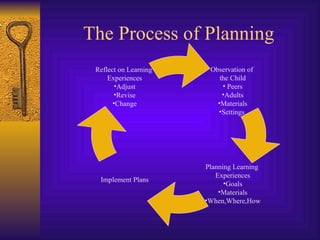
The Process of Planning Planning Learning  Experiences Goals Materials When,Where,How Observation of  the Child Peers Adults Materials Settings  Implement Plans Reflect on Learning  Experiences Adjust Revise Change
Questions Early Childhood Educators Ask  How does the play space support play, wonderment, and learning? What are the appropriate materials needed to support the children’s interests and developmental levels? What are the strategies to support children in exploration, discovery and wonderment?
Questions cont. What is the role of the local community? How are community resource incorporated into the children’s experiences? How are family contributions utilized?
Questions cont. What is the role of the child in making choices about his play experience? How will the children be grouped? How will you use the indoor and outdoor spaces for experiences?
“ We learn in so many different ways – all of them valid – too few of them acknowledged.” (Chenfeld, 2001)
Information taken from: Early Education Curriculum by Hilda Jackman Foundation of Early Childhood Education by Beverlie Dietze Introduction to Early Childhood Education by Ingrid Crowther

Planning play experiences

  • 1.
    Planning Play ExperiencesWhy Do Early Childhood Educators Plan Play Experiences?
  • 2.
    Why Plan? Supportiveguidance from adults is essential for moving children to higher levels of development. To help children develop in their use of play as a vehicle for increasing neural structures.
  • 3.
    Why Plan? Tohelp children practice skills they will need later in life. To gauge a child’s developmental progress.
  • 4.
    Factors Involved WithPlanning Size, number Gender Abilities Special considerations Budget Where/when
  • 5.
    The Early ChildhoodEducator: Has thorough understanding of how children grow and develop. Plans experiences that support the development of each child. Uses observation to extend the child’s play experience.
  • 6.
    The Process ofPlanning Planning Learning Experiences Goals Materials When,Where,How Observation of the Child Peers Adults Materials Settings Implement Plans Reflect on Learning Experiences Adjust Revise Change
  • 7.
    Questions Early ChildhoodEducators Ask How does the play space support play, wonderment, and learning? What are the appropriate materials needed to support the children’s interests and developmental levels? What are the strategies to support children in exploration, discovery and wonderment?
  • 8.
    Questions cont. Whatis the role of the local community? How are community resource incorporated into the children’s experiences? How are family contributions utilized?
  • 9.
    Questions cont. Whatis the role of the child in making choices about his play experience? How will the children be grouped? How will you use the indoor and outdoor spaces for experiences?
  • 10.
    “ We learnin so many different ways – all of them valid – too few of them acknowledged.” (Chenfeld, 2001)
  • 11.
    Information taken from:Early Education Curriculum by Hilda Jackman Foundation of Early Childhood Education by Beverlie Dietze Introduction to Early Childhood Education by Ingrid Crowther