Done by: Latoya Njokwe
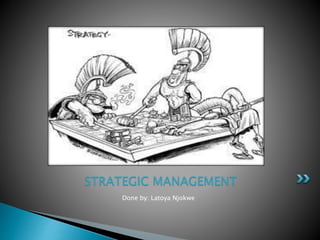
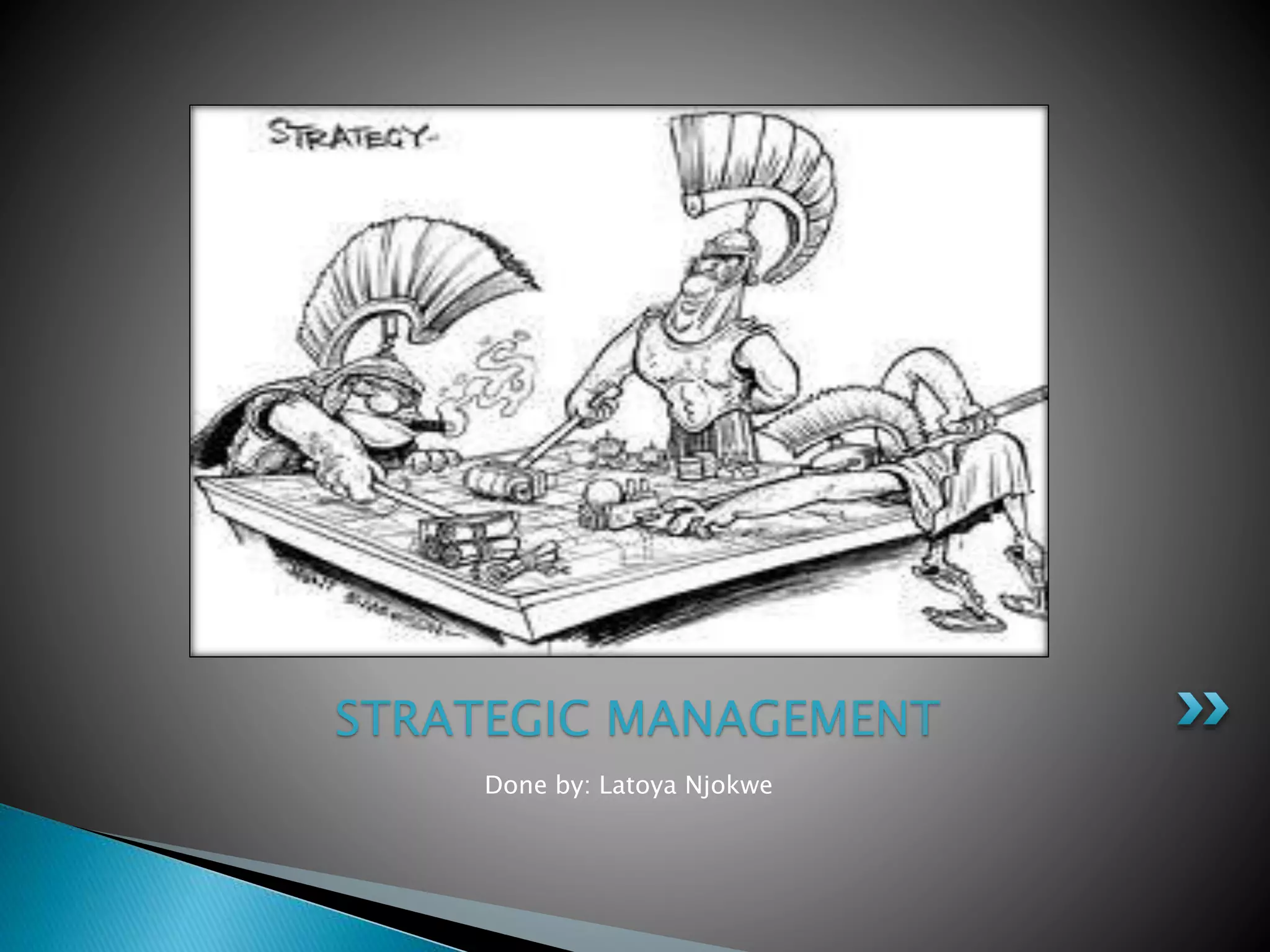
STRATEGIC MANAGEMENT
 This presentation is a combination of work
done by the following authors:
 Alicia Schetteman and Dr.K.Prabhaka.
 What is a strategy?
 How to create strategies that lead to superior
performance?
 How to implement?
 How you have to relate to the environment?
 Why strategy?
 Strategy is a set of related actions that
managers take to increase organization’s
performance.
 If it results in superior performance to that of
its rivals it is said to have competitive
advantage.
 Example: Wal Mart, American Airlines, Airtel
Strategic planning is not
 A substitute for strategic thinking, acting,
and learning
 A substitute for leadership
1. Know what you’re talking about
2. Know what your goal for planning is
3. Know what strategic planning will NOT do
4. Strategic planning flows from mission
5. Share your strategic planning work with others
6. Focus, focus, focus
7. Trade assistance with other organizations (Jea
Nae Remala)
8. You need to know where you are now to know
where you want to go
9. Need to move goals to action plans
10. Tie goals to budgets and performance
• Address critical performance issues
• Create the right balance between what the
organization is capable of doing vs. what the
organization would like to do
• Cover a sufficient time period to close the
performance gap (3-5 years reasonable time)
• Visionary – convey a desired future end state
• Flexible – allow and accommodate change
• Guide decision-making at lower levels –
operational, tactical, individual
 How to most effectively manage a
organizational strategy making process to
create competitive advantage.
• SMP is the process by which managers select
and then implement a set of strategies that
aim to achieve a cometitive advantage.
• Strategy formulation is selection of strategies
• Strategy implementation is the task of putting
strategies in to action; it includes designing;
delivering; and supporting products;
improving efficienty and effectiveness of
organiztions; desinging organizational
structure; Control systems and culture.
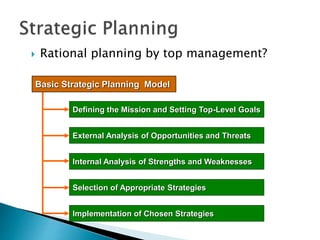
 Rational planning by top management?
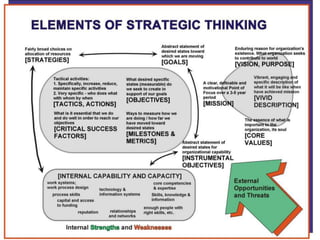
Defining the Mission and Setting Top-Level Goals
External Analysis of Opportunities and Threats
Internal Analysis of Strengths and Weaknesses
Selection of Appropriate Strategies
Implementation of Chosen Strategies
Basic Strategic Planning Model
8/10/2011Strategic Management
1-
12
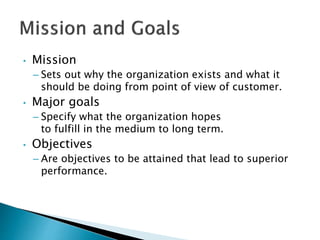
• Mission
– Sets out why the organization exists and what it
should be doing from point of view of customer.
• Major goals
– Specify what the organization hopes
to fulfill in the medium to long term.
• Objectives
– Are objectives to be attained that lead to superior
performance.
 Perception is strong and sight is weak. In
strategy it is important to see distant things
as if they were close and to take a distanced
view of close things.Miyamoto Musashi 1584-
1645, legendary Japanese swordsman
 Identify strategic opportunities and threats
in the operating environment.
 Identify strengths
◦ Quality and quantity of resources available
◦ Distinctive competencies
 Identify weaknesses
◦ Inadequate resources
◦ Managerial and
organizational deficiencies
• Cost leadership
– Attaining, then using the lowest total cost basis as
a competitive advantage; Example of Intel
• Differentiation
– Using product features or services to distinguish
the firm’s offerings from its competitors;Apple
Computers
• Market niche focus
– Concentrating competitively on a specific market
segment; Nala Appakadai
 Focus is on improving the effectiveness of
operations within a company.
◦ Manufacturing
◦ Marketing
◦ Materials management
◦ Research and development
◦ Human resources
 Multidomestic
 International
 Global
 Transnational
 Vertical integration
 Diversification
 Strategic alliances
 Acquisitions
 New ventures
 Business portfolio restructuring
 In real life, strategy is actually very
straightforward. You pick a general direction
and implement like hell-Jack Welch in
Winning, 2005
• Designing organizational structure
• Designing control systems
– Market and output controls
– Bureaucratic controls
– Control through organizational culture
– Rewards and incentives
• Matching strategy, structure, and controls
– Congruence (fit) among strategy,
structure, and controls
 The only constant is change.
 Success requires adapting strategy and
structure to a changing world.
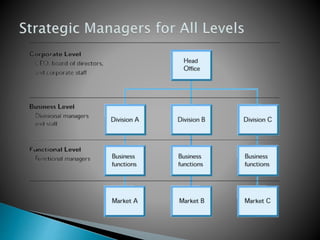
 General managers
◦ Responsible for the overall (strategic) performance
and health of the total organization.
 Operations managers
◦ Responsible for specific business
functions or operations.
 Vision, eloquence, and consistency
 Commitment to the vision
 Being well informed
 Willingness to delegate and empower
 Astute use of power
 Emotional intelligence
 Strategy making in an unpredictable world
◦ Creates the necessity for flexible strategic
approaches.
 Strategy making by lower-level managers
◦ Strategy evolves through autonomous action.
 Serendipity and strategy
◦ Accidental discoveries and happenstances can
have dramatic effects on strategic direction.
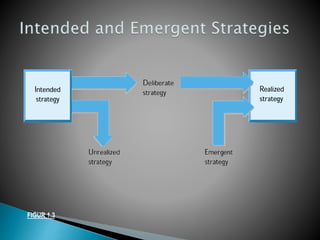
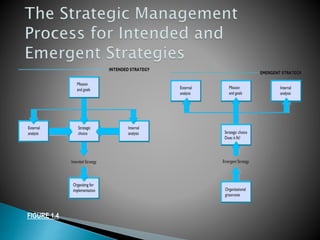
 Intended and emergent strategies
◦ Realized strategies are combinations of intended
and emergent strategies.
FIGUR 1.3
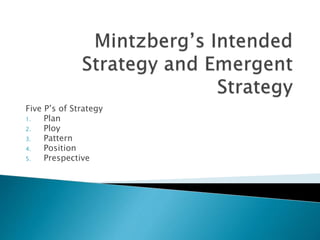
Five P’s of Strategy
1. Plan
2. Ploy
3. Pattern
4. Position
5. Prespective
FIGURE 1.4
 Planning under uncertainty
◦ Scenario planning for dynamic environmental
change
 Ivory tower planning
◦ Lack of contact with operational realities
◦ The importance of involving operating managers
◦ Procedural justice in the decision-making process
 Engagement, explanation, and expectations
 Planning for the present: Strategic Intent
◦ Recognition of the static nature of the strategic
fit model
◦ Strategic intent in focusing the organization on
winning by achieving stretch goals
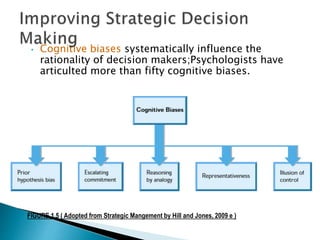
• Cognitive biases systematically influence the
rationality of decision makers;Psychologists have
articulted more than fifty cognitive biases.
FIGURE 1.5 ( Adopted from Strategic Mangement by Hill and Jones, 2009 e )
 Pitfalls of groupthink
◦ Failing to question underlying assumptions.
◦ Coalescing around a single person or policy.
◦ Filtering out conflicting information.
◦ Developing after-the-fact rationalizations.
◦ Having an emotional (nonobjective)
commitment to an action.
 How to create strategic alternatives
 How to select alternative that is most suitable
for organization
 Implement the strategies that will help the
stakeholders to maximise their wealth.
 http://www.slideshare.net/kprabhakar975/in
troduction-to-strategic-management-
8863746?qid=a4396c5c-8164-4490-b50c-
8e59576677f2&v=default&b=&from_search=
3
 http://www.grad.niu.edu/grad/apply/atlarge.shtml

Strategic Management Presentation

  • 1.
    Done by: LatoyaNjokwe STRATEGIC MANAGEMENT
  • 2.
     This presentationis a combination of work done by the following authors:  Alicia Schetteman and Dr.K.Prabhaka.
  • 3.
     What isa strategy?  How to create strategies that lead to superior performance?  How to implement?  How you have to relate to the environment?  Why strategy?
  • 4.
     Strategy isa set of related actions that managers take to increase organization’s performance.  If it results in superior performance to that of its rivals it is said to have competitive advantage.  Example: Wal Mart, American Airlines, Airtel
  • 5.
    Strategic planning isnot  A substitute for strategic thinking, acting, and learning  A substitute for leadership
  • 6.
    1. Know whatyou’re talking about 2. Know what your goal for planning is 3. Know what strategic planning will NOT do 4. Strategic planning flows from mission 5. Share your strategic planning work with others 6. Focus, focus, focus 7. Trade assistance with other organizations (Jea Nae Remala) 8. You need to know where you are now to know where you want to go 9. Need to move goals to action plans 10. Tie goals to budgets and performance
  • 7.
    • Address criticalperformance issues • Create the right balance between what the organization is capable of doing vs. what the organization would like to do • Cover a sufficient time period to close the performance gap (3-5 years reasonable time) • Visionary – convey a desired future end state • Flexible – allow and accommodate change • Guide decision-making at lower levels – operational, tactical, individual
  • 8.
     How tomost effectively manage a organizational strategy making process to create competitive advantage.
  • 9.
    • SMP isthe process by which managers select and then implement a set of strategies that aim to achieve a cometitive advantage. • Strategy formulation is selection of strategies • Strategy implementation is the task of putting strategies in to action; it includes designing; delivering; and supporting products; improving efficienty and effectiveness of organiztions; desinging organizational structure; Control systems and culture.
  • 10.
     Rational planningby top management? Defining the Mission and Setting Top-Level Goals External Analysis of Opportunities and Threats Internal Analysis of Strengths and Weaknesses Selection of Appropriate Strategies Implementation of Chosen Strategies Basic Strategic Planning Model
  • 12.
  • 13.
    • Mission – Setsout why the organization exists and what it should be doing from point of view of customer. • Major goals – Specify what the organization hopes to fulfill in the medium to long term. • Objectives – Are objectives to be attained that lead to superior performance.
  • 14.
     Perception isstrong and sight is weak. In strategy it is important to see distant things as if they were close and to take a distanced view of close things.Miyamoto Musashi 1584- 1645, legendary Japanese swordsman
  • 15.
     Identify strategicopportunities and threats in the operating environment.
  • 16.
     Identify strengths ◦Quality and quantity of resources available ◦ Distinctive competencies  Identify weaknesses ◦ Inadequate resources ◦ Managerial and organizational deficiencies
  • 17.
    • Cost leadership –Attaining, then using the lowest total cost basis as a competitive advantage; Example of Intel • Differentiation – Using product features or services to distinguish the firm’s offerings from its competitors;Apple Computers • Market niche focus – Concentrating competitively on a specific market segment; Nala Appakadai
  • 18.
     Focus ison improving the effectiveness of operations within a company. ◦ Manufacturing ◦ Marketing ◦ Materials management ◦ Research and development ◦ Human resources
  • 19.
  • 20.
     Vertical integration Diversification  Strategic alliances  Acquisitions  New ventures  Business portfolio restructuring
  • 21.
     In reallife, strategy is actually very straightforward. You pick a general direction and implement like hell-Jack Welch in Winning, 2005
  • 22.
    • Designing organizationalstructure • Designing control systems – Market and output controls – Bureaucratic controls – Control through organizational culture – Rewards and incentives • Matching strategy, structure, and controls – Congruence (fit) among strategy, structure, and controls
  • 23.
     The onlyconstant is change.  Success requires adapting strategy and structure to a changing world.
  • 24.
     General managers ◦Responsible for the overall (strategic) performance and health of the total organization.  Operations managers ◦ Responsible for specific business functions or operations.
  • 26.
     Vision, eloquence,and consistency  Commitment to the vision  Being well informed  Willingness to delegate and empower  Astute use of power  Emotional intelligence
  • 27.
     Strategy makingin an unpredictable world ◦ Creates the necessity for flexible strategic approaches.  Strategy making by lower-level managers ◦ Strategy evolves through autonomous action.  Serendipity and strategy ◦ Accidental discoveries and happenstances can have dramatic effects on strategic direction.  Intended and emergent strategies ◦ Realized strategies are combinations of intended and emergent strategies.
  • 28.
  • 29.
    Five P’s ofStrategy 1. Plan 2. Ploy 3. Pattern 4. Position 5. Prespective
  • 30.
  • 31.
     Planning underuncertainty ◦ Scenario planning for dynamic environmental change  Ivory tower planning ◦ Lack of contact with operational realities ◦ The importance of involving operating managers ◦ Procedural justice in the decision-making process  Engagement, explanation, and expectations  Planning for the present: Strategic Intent ◦ Recognition of the static nature of the strategic fit model ◦ Strategic intent in focusing the organization on winning by achieving stretch goals
  • 32.
    • Cognitive biasessystematically influence the rationality of decision makers;Psychologists have articulted more than fifty cognitive biases. FIGURE 1.5 ( Adopted from Strategic Mangement by Hill and Jones, 2009 e )
  • 33.
     Pitfalls ofgroupthink ◦ Failing to question underlying assumptions. ◦ Coalescing around a single person or policy. ◦ Filtering out conflicting information. ◦ Developing after-the-fact rationalizations. ◦ Having an emotional (nonobjective) commitment to an action.
  • 34.
     How tocreate strategic alternatives  How to select alternative that is most suitable for organization  Implement the strategies that will help the stakeholders to maximise their wealth.
  • 35.