Planning and learning
in the i-mode generation
Are you ready?
Time is passing...
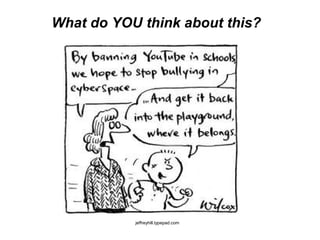
What do YOU think about this?
jeffreyhill.typepad.com
Are you going crazy with all this
technology?
upperdublincff.wikispaces.com
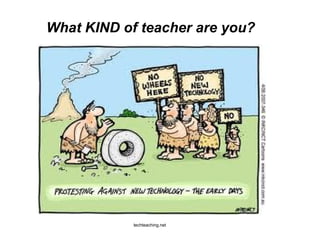
What KIND of teacher are you?
techteaching.net
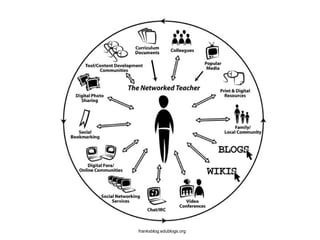
franksblog.edublogs.org
Contemporary technologies and
school based-learning:
Can they work together
to benefit
our students?
Assumptions:
• the more CCTs are used in the classrooms the
better the education will be;
• new technologies are mainly about information;
• the educational uses of new technologies in
classrooms learning are now well understood
and integrating CCTs into learning is just a
matter of 'mastering the intricacies 'of each new
technology as it appears;
(Bigum 2002:135)
Results:
• massive amounts of 'digital busy
work’;
• a lot of old wine in new bottles;
• a lot of bells and whistles;
Open your eye ...
seentvcanada.com
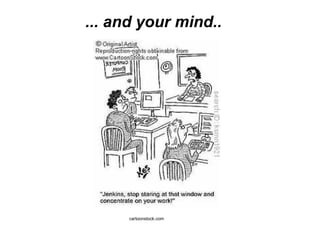
... and your mind..
cartoonstock.com
and make a difference!
Strenghten the education creating activities
that can promote approximations to expert
practice, authentic/non-contrived uses,
collaborative work, recognition of
distributed knowledge and expertise,
efficacy for in situ use, capacity to mediate
whole practices and etc.
Have in mind:
• Practices like blogging, instant messaging, text
messaging and all the other i-mode gadgets
should be taken into account in school-based
learning and school Discourses of learning
(school projects, history, science...) should relate
to learners' lives through diverse social practices
in social institutions seeking approximations to
mature Discourses.
• Learning should produce knowledge rather than
consume knowledge
BE AWARE:
Communication and computing technologies
(CCTs) are not the focus or purpose of work. They
are media that play useful roles in supporting
student work that has genuine value to outside
groups and audience.
The use of CCTs should be based on consolidating
new kinds of relationships within the school and
outside the school producing knowledge in a new
and significant way.
Schools should be seen as:
sites where serious knowledge
production and research can occur
and contemporary technologies,
social practices and cultures of use
engaged outside of school can be
incorporated into school- based
learning for the students' benefit.
References
• LANSHEAR, C. & KNOBEL, M. New
literacies: everyday practices & classroom
learning. Open University Press: 2006.
• _________________. Planning Pedagogy
for i-mode: Learning in the Age of ‘The
Mobile Net’, chapter 6, p.181-209.

Planning and learning 2

  • 1.
    Planning and learning inthe i-mode generation Are you ready? Time is passing...
  • 2.
    What do YOUthink about this? jeffreyhill.typepad.com
  • 3.
    Are you goingcrazy with all this technology? upperdublincff.wikispaces.com
  • 4.
    What KIND ofteacher are you? techteaching.net
  • 5.
  • 6.
    Contemporary technologies and schoolbased-learning: Can they work together to benefit our students?
  • 7.
    Assumptions: • the moreCCTs are used in the classrooms the better the education will be; • new technologies are mainly about information; • the educational uses of new technologies in classrooms learning are now well understood and integrating CCTs into learning is just a matter of 'mastering the intricacies 'of each new technology as it appears; (Bigum 2002:135)
  • 8.
    Results: • massive amountsof 'digital busy work’; • a lot of old wine in new bottles; • a lot of bells and whistles;
  • 9.
    Open your eye... seentvcanada.com
  • 10.
    ... and yourmind.. cartoonstock.com
  • 11.
    and make adifference! Strenghten the education creating activities that can promote approximations to expert practice, authentic/non-contrived uses, collaborative work, recognition of distributed knowledge and expertise, efficacy for in situ use, capacity to mediate whole practices and etc.
  • 12.
    Have in mind: •Practices like blogging, instant messaging, text messaging and all the other i-mode gadgets should be taken into account in school-based learning and school Discourses of learning (school projects, history, science...) should relate to learners' lives through diverse social practices in social institutions seeking approximations to mature Discourses. • Learning should produce knowledge rather than consume knowledge
  • 13.
    BE AWARE: Communication andcomputing technologies (CCTs) are not the focus or purpose of work. They are media that play useful roles in supporting student work that has genuine value to outside groups and audience. The use of CCTs should be based on consolidating new kinds of relationships within the school and outside the school producing knowledge in a new and significant way.
  • 14.
    Schools should beseen as: sites where serious knowledge production and research can occur and contemporary technologies, social practices and cultures of use engaged outside of school can be incorporated into school- based learning for the students' benefit.
  • 15.
    References • LANSHEAR, C.& KNOBEL, M. New literacies: everyday practices & classroom learning. Open University Press: 2006. • _________________. Planning Pedagogy for i-mode: Learning in the Age of ‘The Mobile Net’, chapter 6, p.181-209.