Innovation Through Technology
    21st Century Learning
What’s Your Responsibility As A
                    Teacher?

Ensure Today’s Students Are Ready to:
* Live
    *Learn
         *Work
             *Thrive
                          In this high-tech-global-
                           highly
                          participatory world
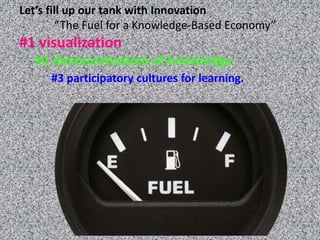
Let’s fill up our tank with Innovation
        ā€œThe Fuel for a Knowledge-Based Economyā€
#1 visualization
  #2 democratization of knowledge
     #3 participatory cultures for learning.
Let’s engage today’s
students deep into learning !

 Students need a balance to flow
     (adaptive expertise)
        50% skill building
        50% Creativity
Innovation One: Visualization
• Develop students as informed consumers of
  information
   – *recognition of the potential for manipulation of
      media
• Engage students in thinking critically and
  creatively using visuals
   – *Gapminder
• Engage students in communicating using visuals
   – *contrast, repetition, alignment, proximity
Innovation Two: Democratization of
                  Knowledge
• -provides the opportunity for lifelong individual and group learning. For
  students to leverage that opportunity fully requires critical thinking,
  information literacy, and a measure of self-direction, all of which need to
  be developed in part of our school systems.

Examples:
• Browsing the Net-Providing intensive work with students on informed searching,
   navigating the visible and invisible Web, critiquing websites to check for reliable
   sources, persevering to ensure comprehensive, balanced searches
• Learning Objects- Digital/Web based resource for use and reuse to support
   learning
• Simulations-students are able to experiment with parameters behind a visual
   simulation


21st century skills: rethinking how students learn/(edited by) James Bellanca, Ron Brandt.
Innovation Three: Participatory
                Learning
• Web 2.0 tools of the 21st century have given
  rise to a participatory culture

• Students expect to be active participants
  Example: Use of Facebook to engage students to
  learn about the periodic table
Does your classroom advance
 21st century learning and student
  engagement by embracing the
    innovations of visualization,
democratization of knowledge and
participatory/collaborative learning?
References
• Text
   21st century skills: rethinking how students
   learn/(edited by) James Bellanca, Ron
   Brandt.
• Pictures
  Clipart from Microsoft Word

Innovation powerpoint

  • 1.
    Innovation Through Technology 21st Century Learning
  • 2.
    What’s Your ResponsibilityAs A Teacher? Ensure Today’s Students Are Ready to: * Live *Learn *Work *Thrive In this high-tech-global- highly participatory world
  • 3.
    Let’s fill upour tank with Innovation ā€œThe Fuel for a Knowledge-Based Economyā€ #1 visualization #2 democratization of knowledge #3 participatory cultures for learning.
  • 4.
    Let’s engage today’s studentsdeep into learning ! Students need a balance to flow (adaptive expertise) 50% skill building 50% Creativity
  • 5.
    Innovation One: Visualization •Develop students as informed consumers of information – *recognition of the potential for manipulation of media • Engage students in thinking critically and creatively using visuals – *Gapminder • Engage students in communicating using visuals – *contrast, repetition, alignment, proximity
  • 6.
    Innovation Two: Democratizationof Knowledge • -provides the opportunity for lifelong individual and group learning. For students to leverage that opportunity fully requires critical thinking, information literacy, and a measure of self-direction, all of which need to be developed in part of our school systems. Examples: • Browsing the Net-Providing intensive work with students on informed searching, navigating the visible and invisible Web, critiquing websites to check for reliable sources, persevering to ensure comprehensive, balanced searches • Learning Objects- Digital/Web based resource for use and reuse to support learning • Simulations-students are able to experiment with parameters behind a visual simulation 21st century skills: rethinking how students learn/(edited by) James Bellanca, Ron Brandt.
  • 7.
    Innovation Three: Participatory Learning • Web 2.0 tools of the 21st century have given rise to a participatory culture • Students expect to be active participants Example: Use of Facebook to engage students to learn about the periodic table
  • 8.
    Does your classroomadvance 21st century learning and student engagement by embracing the innovations of visualization, democratization of knowledge and participatory/collaborative learning?
  • 9.
    References • Text 21st century skills: rethinking how students learn/(edited by) James Bellanca, Ron Brandt. • Pictures Clipart from Microsoft Word