Four Points Sheraton Leominster, MA April 11, 2008 Bob Stahl R.A. Stahl Company www.tfwallace.com NSMG   Northeast Supply Management Group Executive S&OP What is it? How to implement it successfully?
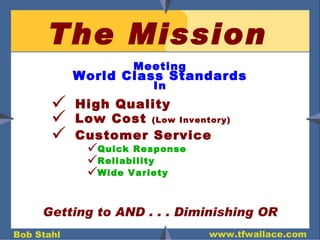
The Mission High Quality Low Cost  (Low Inventory) Customer Service Quick Response Reliability Wide Variety Meeting World Class Standards In Getting to AND . . . Diminishing OR
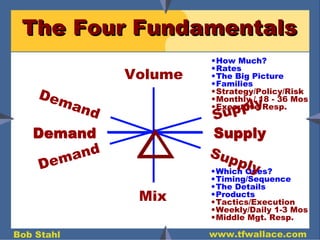
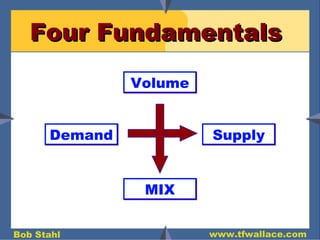
The Four Fundamentals Mix How Much? Rates The Big Picture Families Strategy/Policy/Risk Monthly / 18 - 36 Mos Executive Resp. Which Ones? Timing/Sequence The Details Products Tactics/Execution Weekly/Daily 1-3 Mos Middle Mgt. Resp. Demand Supply Volume Demand Supply Demand Supply Demand Supply
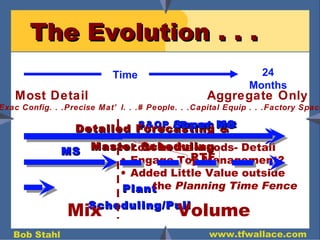
The Evolution . . .  Most Detail Aggregate Only Exac Config. . .Precise Mat’l. . .# People. . .Capital Equip . . .Factory Space Lost in the woods- Detail Engage Top Management? Added Little Value   outside the  Planning Time Fence Plant Scheduling/Pull MS S&OP / Rough Cut PTF 24 Months Time Volume Mix Detailed Forecasting & Master Scheduling Super MS
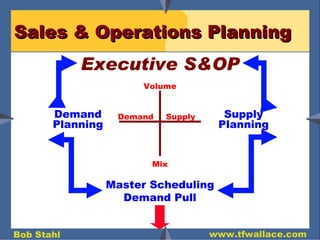
Sales & Operations Planning Demand Supply Volume Mix Executive S&OP Demand Planning Supply Planning Master Scheduling Demand Pull
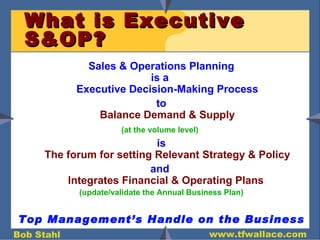
What is Executive S&OP? Sales & Operations Planning is a  Executive Decision-Making Process to Balance Demand & Supply (at the volume level)   is The forum for setting Relevant Strategy & Policy and  Integrates Financial & Operating Plans  (update/validate the Annual Business Plan) Top Management’s Handle on the Business
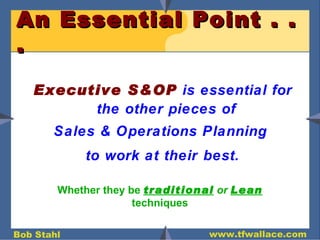
An Essential Point . . . Executive S&OP  is essential for the other pieces of  Sales & Operations Planning  to work at their   best. Whether they be  traditional  or  Lean   techniques
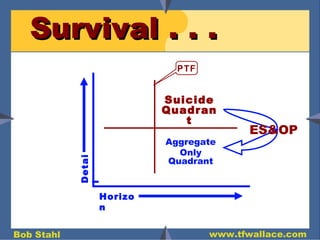
Survival . . .  PTF Horizon Detail Suicide Quadrant Aggregate Only Quadrant ES&OP
Four Fundamentals Demand Supply MIX Volume
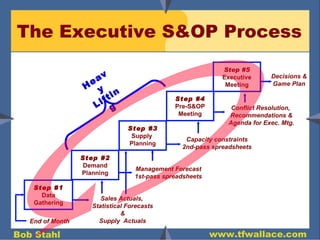
Step #1 Data Gathering End of Month Sales Actuals,  Statistical Forecasts & Supply  Actuals The Executive S&OP Process Step #5 Executive Meeting Decisions & Game Plan Step #4 Pre-S&OP Meeting Conflict Resolution,  Recommendations & Agenda for Exec. Mtg. Step #2 Demand Planning Management Forecast 1st-pass spreadsheets Step #3 Supply  Planning Capacity constraints 2nd-pass spreadsheets Heavy Lifting
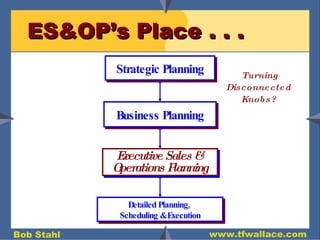
ES&OP’s Place . . .  Strategic Planning Detailed Planning,  Scheduling & Execution Business Planning Disconnect!!! Executive Sales &  Operations Planning Turning Disconnected  Knobs?
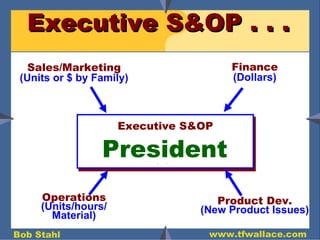
Executive S&OP . . .  Executive S&OP A process to reconcile, agree  upon, & communicate  the company game plan Sales/Marketing (Units or $ by Family) Operations (Units/hours/ Material) Finance (Dollars) Product Dev. (New Product Issues) President
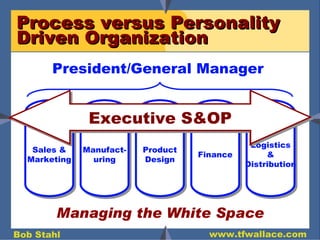
Process versus Personality Driven Organization Supply Chain Management Executive S&OP Managing the White Space Sales & Marketing Manufact- uring Product Design Finance Logistics & Distribution President/General Manager
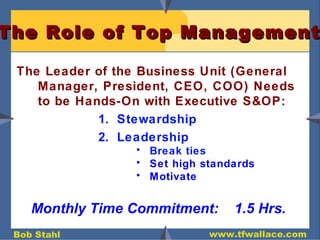
The Leader of the Business Unit (General Manager, President, CEO, COO) Needs to be Hands-On with Executive S&OP: Stewardship Leadership  Break ties Set high standards Motivate Monthly Time Commitment:  1.5 Hrs.  The Role of Top Management
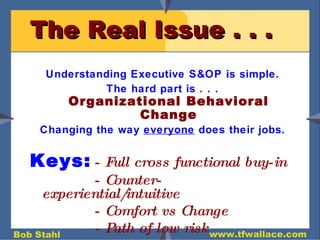
The Real Issue . . .  Understanding Executive S&OP is simple. The hard part is . . . Organizational Behavioral Change Changing the way  everyone  does their jobs. Keys: - Full cross functional buy-in - Counter-experiential/intuitive - Comfort vs Change - Path of low risk
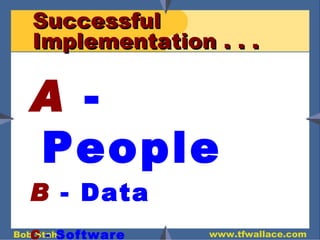
Successful  Implementation . . .   A   - People B   - Data C   - Software
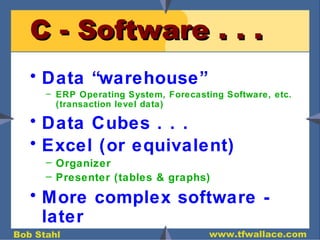
C - Software . . . Data “warehouse” ERP Operating System, Forecasting Software, etc. (transaction level data) Data Cubes . . .  Excel (or equivalent)   Organizer Presenter (tables & graphs) More complex software - later
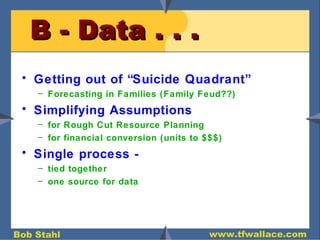
B - Data . . .  Getting out of “Suicide Quadrant” Forecasting in Families (Family Feud??) Simplifying Assumptions for Rough Cut Resource Planning for financial conversion (units to $$$) Single process - tied together one source for data
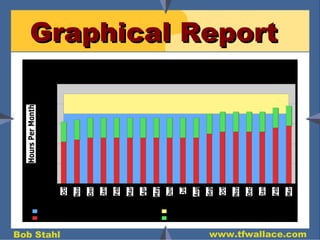
Graphical Report
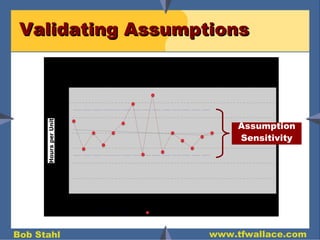
Validating Assumptions Assumption Sensitivity
A - People . . .  Top Management “centric” The Leader of the business (CEO, President, GM, MD, etc.) must not only provide Support Funding Commitment Leadership They must also be  “hands-on”  each and every month (Top Management must not only support it, they must willing, ready, & able to do it!) It’s not doing what you do better, it’s doing something different to be better!  Counter-experiencial & Counter-intuitive equals Discomfort & Risk
Engaging Top Management In  Change , there is no  Comfort (In  Comfort , there is no  Change) Those who succeed with Executive S&OP   are willing the endure the discomfort that is  required! Risk
Uninformed (before Go/No-go #1)   Boss:  “Okay, let’s do an Executive  Briefing.” Semi-informed (after Briefing: Go/No-go #1)    Boss:  “Okay, let’s do a Live Pilot” Fully informed (after Pilot: Go/No-go #2)   Boss:  “Okay, let’s go to full cutover.” Three Levels  of Commitment . . .  Low Risk
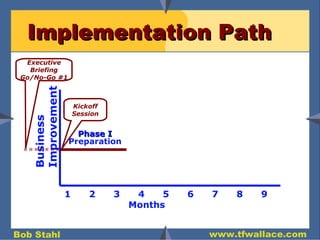
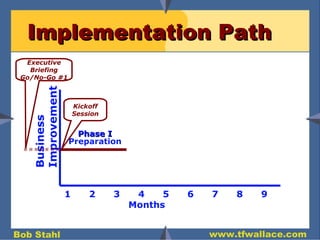
Implementation Path 1  2  3  4  5  6  7  8  9 Months Business Improvement Executive Briefing Go/No-Go #1 Kickoff Session Phase I Preparation
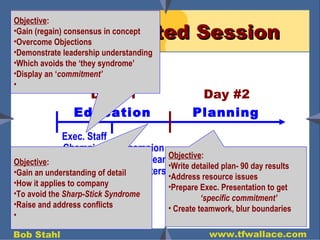
Getting Started Session Day #1 Day #2 Exec. Staff Champion Design Team Supporters Champion Design Team Supporters Design Team Education Planning Objective :  Gain (regain) consensus in concept Overcome Objections Demonstrate leadership understanding  Which avoids the ‘they syndrome’ Display an ‘ commitment’ Objective :  Write detailed plan- 90 day results Address resource issues Prepare Exec. Presentation to get  ‘specific commitment’ Create teamwork, blur boundaries Objective :  Gain an understanding of detail How it applies to company  To avoid the  Sharp-Stick Syndrome Raise and address conflicts
Implementation Path 1  2  3  4  5  6  7  8  9 Months Business Improvement Executive Briefing Go/No-Go #1 Kickoff Session Phase I Preparation
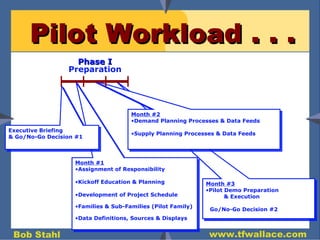
Pilot Workload . . .  Month #1 Assignment of Responsibility Kickoff Education & Planning Development of Project Schedule Families & Sub-Families (Pilot Family) Data Definitions, Sources & Displays Month #3 Pilot Demo Preparation  & Execution Go/No-Go Decision #2 Month #2 Demand Planning Processes & Data Feeds Supply Planning Processes & Data Feeds Executive Briefing & Go/No-Go Decision #1 Phase I Preparation
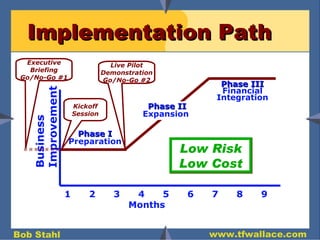
Implementation Path 1  2  3  4  5  6  7  8  9 Months Business Improvement Live Pilot Demonstration Go/No-Go #2 Executive Briefing Go/No-Go #1 Kickoff Session Low Risk Low Cost Phase I Preparation Phase II Expansion  Phase III Financial Integration
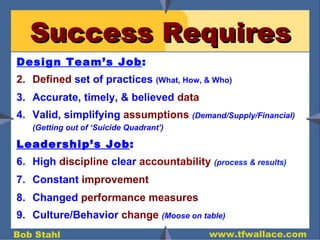
Success Requires Design Team’s Job : Defined  set of practices  (What, How, & Who) Accurate, timely, & believed  data Valid, simplifying  assumptions   (Demand/Supply/Financial) (Getting out of ‘Suicide Quadrant’) Leadership’s Job : High  discipline  clear  accountability  (process & results) Constant  improvement Changed  performance measures Culture/Behavior  change   (Moose on table)
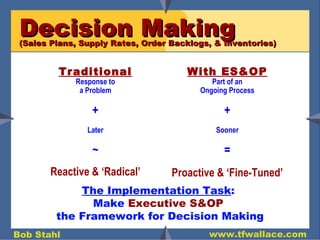
Decision Making (Sales Plans, Supply Rates, Order Backlogs, & Inventories) Traditional Response to a Problem + Later ~ Reactive & ‘Radical’ With ES&OP Part of an Ongoing Process + Sooner = Proactive & ‘Fine-Tuned’ The Implementation Task :  Make  Executive S&OP  the Framework for Decision Making
Done Properly . . .  Simpler (Not Easier) Better
Making Change “ Change happens one step at a time,  by thinking globally  (big),   but acting locally  (small) ” “ In human affairs, the  willed future  always prevails over the  logical future .” Rene Dubos ‘ A Celebration of Life’ An essay
‘ The Books’
Thanks & Good Luck ! 508/226-0477 [email_address] www.tfwallace.com Go to Web site :  Copy of presentation Copy of Dubos Essay Copy of bi-monthly newsletter

Executive S&OP

  • 1.
    Four Points SheratonLeominster, MA April 11, 2008 Bob Stahl R.A. Stahl Company www.tfwallace.com NSMG Northeast Supply Management Group Executive S&OP What is it? How to implement it successfully?
  • 2.
    The Mission HighQuality Low Cost (Low Inventory) Customer Service Quick Response Reliability Wide Variety Meeting World Class Standards In Getting to AND . . . Diminishing OR
  • 3.
    The Four FundamentalsMix How Much? Rates The Big Picture Families Strategy/Policy/Risk Monthly / 18 - 36 Mos Executive Resp. Which Ones? Timing/Sequence The Details Products Tactics/Execution Weekly/Daily 1-3 Mos Middle Mgt. Resp. Demand Supply Volume Demand Supply Demand Supply Demand Supply
  • 4.
    The Evolution .. . Most Detail Aggregate Only Exac Config. . .Precise Mat’l. . .# People. . .Capital Equip . . .Factory Space Lost in the woods- Detail Engage Top Management? Added Little Value outside the Planning Time Fence Plant Scheduling/Pull MS S&OP / Rough Cut PTF 24 Months Time Volume Mix Detailed Forecasting & Master Scheduling Super MS
  • 5.
    Sales & OperationsPlanning Demand Supply Volume Mix Executive S&OP Demand Planning Supply Planning Master Scheduling Demand Pull
  • 6.
    What is ExecutiveS&OP? Sales & Operations Planning is a Executive Decision-Making Process to Balance Demand & Supply (at the volume level) is The forum for setting Relevant Strategy & Policy and Integrates Financial & Operating Plans (update/validate the Annual Business Plan) Top Management’s Handle on the Business
  • 7.
    An Essential Point. . . Executive S&OP is essential for the other pieces of Sales & Operations Planning to work at their best. Whether they be traditional or Lean techniques
  • 8.
    Survival . .. PTF Horizon Detail Suicide Quadrant Aggregate Only Quadrant ES&OP
  • 9.
    Four Fundamentals DemandSupply MIX Volume
  • 10.
    Step #1 DataGathering End of Month Sales Actuals, Statistical Forecasts & Supply Actuals The Executive S&OP Process Step #5 Executive Meeting Decisions & Game Plan Step #4 Pre-S&OP Meeting Conflict Resolution, Recommendations & Agenda for Exec. Mtg. Step #2 Demand Planning Management Forecast 1st-pass spreadsheets Step #3 Supply Planning Capacity constraints 2nd-pass spreadsheets Heavy Lifting
  • 11.
    ES&OP’s Place .. . Strategic Planning Detailed Planning, Scheduling & Execution Business Planning Disconnect!!! Executive Sales & Operations Planning Turning Disconnected Knobs?
  • 12.
    Executive S&OP .. . Executive S&OP A process to reconcile, agree upon, & communicate the company game plan Sales/Marketing (Units or $ by Family) Operations (Units/hours/ Material) Finance (Dollars) Product Dev. (New Product Issues) President
  • 13.
    Process versus PersonalityDriven Organization Supply Chain Management Executive S&OP Managing the White Space Sales & Marketing Manufact- uring Product Design Finance Logistics & Distribution President/General Manager
  • 14.
    The Leader ofthe Business Unit (General Manager, President, CEO, COO) Needs to be Hands-On with Executive S&OP: Stewardship Leadership Break ties Set high standards Motivate Monthly Time Commitment: 1.5 Hrs. The Role of Top Management
  • 15.
    The Real Issue. . . Understanding Executive S&OP is simple. The hard part is . . . Organizational Behavioral Change Changing the way everyone does their jobs. Keys: - Full cross functional buy-in - Counter-experiential/intuitive - Comfort vs Change - Path of low risk
  • 16.
    Successful Implementation. . . A - People B - Data C - Software
  • 17.
    C - Software. . . Data “warehouse” ERP Operating System, Forecasting Software, etc. (transaction level data) Data Cubes . . . Excel (or equivalent) Organizer Presenter (tables & graphs) More complex software - later
  • 18.
    B - Data. . . Getting out of “Suicide Quadrant” Forecasting in Families (Family Feud??) Simplifying Assumptions for Rough Cut Resource Planning for financial conversion (units to $$$) Single process - tied together one source for data
  • 19.
  • 20.
  • 21.
    A - People. . . Top Management “centric” The Leader of the business (CEO, President, GM, MD, etc.) must not only provide Support Funding Commitment Leadership They must also be “hands-on” each and every month (Top Management must not only support it, they must willing, ready, & able to do it!) It’s not doing what you do better, it’s doing something different to be better! Counter-experiencial & Counter-intuitive equals Discomfort & Risk
  • 22.
    Engaging Top ManagementIn Change , there is no Comfort (In Comfort , there is no Change) Those who succeed with Executive S&OP are willing the endure the discomfort that is required! Risk
  • 23.
    Uninformed (before Go/No-go#1) Boss: “Okay, let’s do an Executive Briefing.” Semi-informed (after Briefing: Go/No-go #1) Boss: “Okay, let’s do a Live Pilot” Fully informed (after Pilot: Go/No-go #2) Boss: “Okay, let’s go to full cutover.” Three Levels of Commitment . . . Low Risk
  • 24.
    Implementation Path 1 2 3 4 5 6 7 8 9 Months Business Improvement Executive Briefing Go/No-Go #1 Kickoff Session Phase I Preparation
  • 25.
    Getting Started SessionDay #1 Day #2 Exec. Staff Champion Design Team Supporters Champion Design Team Supporters Design Team Education Planning Objective : Gain (regain) consensus in concept Overcome Objections Demonstrate leadership understanding Which avoids the ‘they syndrome’ Display an ‘ commitment’ Objective : Write detailed plan- 90 day results Address resource issues Prepare Exec. Presentation to get ‘specific commitment’ Create teamwork, blur boundaries Objective : Gain an understanding of detail How it applies to company To avoid the Sharp-Stick Syndrome Raise and address conflicts
  • 26.
    Implementation Path 1 2 3 4 5 6 7 8 9 Months Business Improvement Executive Briefing Go/No-Go #1 Kickoff Session Phase I Preparation
  • 27.
    Pilot Workload .. . Month #1 Assignment of Responsibility Kickoff Education & Planning Development of Project Schedule Families & Sub-Families (Pilot Family) Data Definitions, Sources & Displays Month #3 Pilot Demo Preparation & Execution Go/No-Go Decision #2 Month #2 Demand Planning Processes & Data Feeds Supply Planning Processes & Data Feeds Executive Briefing & Go/No-Go Decision #1 Phase I Preparation
  • 28.
    Implementation Path 1 2 3 4 5 6 7 8 9 Months Business Improvement Live Pilot Demonstration Go/No-Go #2 Executive Briefing Go/No-Go #1 Kickoff Session Low Risk Low Cost Phase I Preparation Phase II Expansion Phase III Financial Integration
  • 29.
    Success Requires DesignTeam’s Job : Defined set of practices (What, How, & Who) Accurate, timely, & believed data Valid, simplifying assumptions (Demand/Supply/Financial) (Getting out of ‘Suicide Quadrant’) Leadership’s Job : High discipline clear accountability (process & results) Constant improvement Changed performance measures Culture/Behavior change (Moose on table)
  • 30.
    Decision Making (SalesPlans, Supply Rates, Order Backlogs, & Inventories) Traditional Response to a Problem + Later ~ Reactive & ‘Radical’ With ES&OP Part of an Ongoing Process + Sooner = Proactive & ‘Fine-Tuned’ The Implementation Task : Make Executive S&OP the Framework for Decision Making
  • 31.
    Done Properly .. . Simpler (Not Easier) Better
  • 32.
    Making Change “Change happens one step at a time, by thinking globally (big), but acting locally (small) ” “ In human affairs, the willed future always prevails over the logical future .” Rene Dubos ‘ A Celebration of Life’ An essay
  • 33.
  • 34.
    Thanks & GoodLuck ! 508/226-0477 [email_address] www.tfwallace.com Go to Web site : Copy of presentation Copy of Dubos Essay Copy of bi-monthly newsletter

Editor's Notes

  • #3 The mission of a commercial enterprise???? Can not longer compete on ONE thing! Getting to AND . . . Diminishing OR Demand Driven vs Supply Driven How to make Mfg a ‘competitive weapon’?
  • #15 < 2 HOURS PER MONTH
  • #25 • Even tho Phase #1 & #3 show not benefit; “Unintended Benefits”
  • #27 • Even tho Phase #1 & #3 show not benefit; “Unintended Benefits”
  • #29 • Even tho Phase #1 & #3 show not benefit; “Unintended Benefits”
  • #32 Simple does not = EASY!!
  • #33 • Doom & Gloom ? • Winners & Loosers yet to be established • Future can be bright • Urgent vs Important • Global Paradox -- LARGE vs SMALL
  • #34 - Who was at Tom Wallace’s Talk???