













Are You Planning for              Your Retirement                  or Uncle Sam’s?RETIREMENTAFTERTAXESYour 401(k), 403(b), IRA and Pension Benefitswill probably be taxable at a higher rate at retirement
If What You Know to Be True       Turned Out Not to Be True,            When Would You Want to Know?“The problem in America isn’t so much what people don’t know; the problem is what people think they know that just ain’t so.”
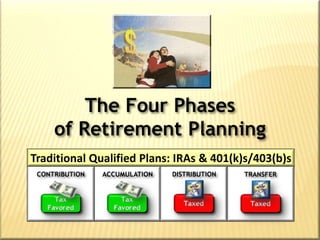
FOUR PHASES OF RETIREMENT PLANNINGTaxFavoredTaxFavoredTaxedTaxedTraditional Qualified Plans: IRAs & 401(k)s/403(b)sDISTRIBUTIONCONTRIBUTIONACCUMULATIONTRANSFERThe Four Phases of Retirement Planning
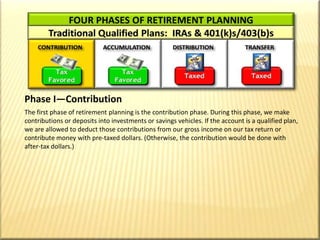
FOUR PHASES OF RETIREMENT PLANNINGTraditional Qualified Plans:  IRAs & 401(k)s/403(b)sDISTRIBUTIONCONTRIBUTIONACCUMULATIONTRANSFERThe Four Phases of Retirement PlanningFOUR PHASES OF RETIREMENT PLANNINGTaxFavoredTaxFavoredTaxedTaxedPhase I—ContributionThe first phase of retirement planning is the contribution phase. During this phase, we make contributions or deposits into investments or savings vehicles. If the account is a qualified plan, we are allowed to deduct those contributions from our gross income on our tax return or contribute money with pre-taxed dollars. (Otherwise, the contribution would be done with after-tax dollars.)
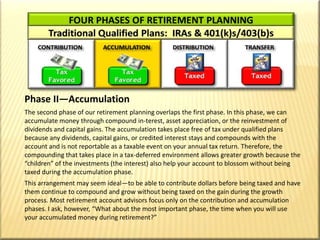
FOUR PHASES OF RETIREMENT PLANNINGTraditional Qualified Plans:  IRAs & 401(k)s/403(b)sDISTRIBUTIONCONTRIBUTIONACCUMULATIONTRANSFERThe Four Phases of Retirement PlanningFOUR PHASES OF RETIREMENT PLANNINGTaxFavoredTaxFavoredTaxedTaxedPhase II—AccumulationThe second phase of our retirement planning overlaps the first phase. In this phase, we can accumulate money through compound in­terest, asset appreciation, or the reinvestment of dividends and capital gains. The accumulation takes place free of tax under qualified plans because any dividends, capital gains, or credited interest stays and compounds with the account and is not reportable as a taxable event on your annual tax return. Therefore, the compounding that takes place in a tax-deferred environment allows greater growth because the “children” of the investments (the interest) also help your account to blossom without being taxed during the accumulation phase.This arrangement may seem ideal—to be able to contribute dollars before being taxed and have them continue to compound and grow without being taxed on the gain during the growth process. Most retirement account advisors focus only on the contribution and accumulation phases. I ask, however, “What about the most important phase, the time when you will use your accumulated money during retirement?”
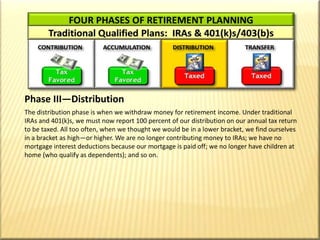
FOUR PHASES OF RETIREMENT PLANNINGTraditional Qualified Plans:  IRAs & 401(k)s/403(b)sDISTRIBUTIONCONTRIBUTIONACCUMULATIONTRANSFERThe Four Phases of Retirement PlanningFOUR PHASES OF RETIREMENT PLANNINGTaxFavoredTaxFavoredTaxedTaxedPhase III—DistributionThe distribution phase is when we withdraw money for retirement income. Under traditional IRAs and 401(k)s, we must now report 100 percent of our distribution on our annual tax return to be taxed. All too often, when we thought we would be in a lower bracket, we find ourselves in a bracket as high—or higher. We are no longer contributing money to IRAs; we have no mortgage interest deductions because our mortgage is paid off; we no longer have children at home (who qualify as dependents); and so on.
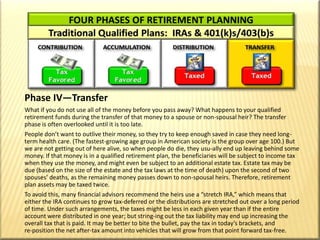
DISTRIBUTIONCONTRIBUTIONACCUMULATIONTRANSFERFOUR PHASES OF RETIREMENT PLANNINGTaxFavoredTaxFavoredTaxedTaxedPhase IV—TransferWhat if you do not use all of the money before you pass away? What happens to your qualified retirement funds during the transfer of that money to a spouse or non-spousal heir? The transfer phase is often overlooked until it is too late.People don’t want to outlive their money, so they try to keep enough saved in case they need long-term health care. (The fastest-growing age group in American society is the group over age 100.) But we are not getting out of here alive, so when people do die, they usu­ally end up leaving behind some money. If that money is in a qualified retirement plan, the beneficiaries will be subject to income tax when they use the money, and might even be subject to an additional estate tax. Estate tax may be due (based on the size of the estate and the tax laws at the time of death) upon the second of two spouses’ deaths, as the remaining money passes down to non-spousal heirs. Therefore, retirement plan assets may be taxed twice.To avoid this, many financial advisors recommend the heirs use a “stretch IRA,” which means that either the IRA continues to grow tax-deferred or the distributions are stretched out over a long period of time. Under such arrangements, the taxes might be less in each given year than if the entire account were distributed in one year; but string­ing out the tax liability may end up increasing the overall tax that is paid. It may be better to bite the bullet, pay the tax in today’s brackets, and             re-position the net after-tax amount into vehicles that will grow from that point forward tax-free.
Tax Bracket: Higher or Lower at Retirement?When You Retire…Do you think your Tax Bracketwill be Higher, the SameorLowerthan what it is now?INCOME TAX RATES
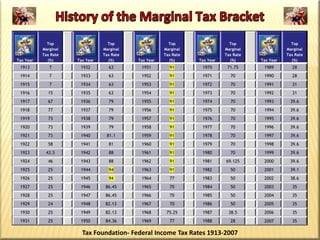
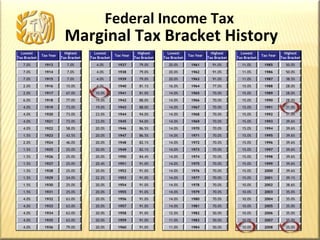
History of the Marginal Tax BracketTax Foundation- Federal Income Tax Rates 1913-2007
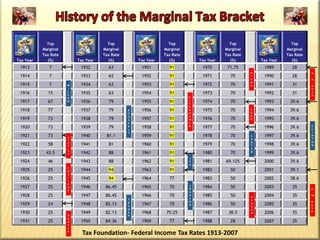
History of the Marginal Tax BracketN I XONGHBUS HW I  L SONE  I  S ENHOWE RFORDROOSVELTC L  I NTONC A R T E  RHARD I N GJ F KCOOLIDGEJOHN SONGWBUS HREAGANTRUMANHOOV E RTax Foundation- Federal Income Tax Rates 1913-2007
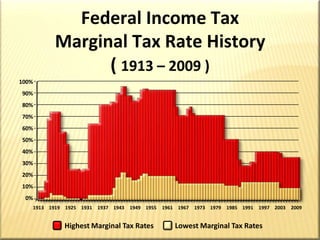
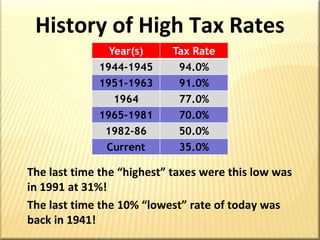
Federal Income TaxMarginal Tax Rate History( 1913 – 2009 )100%90%80%70%60%50%40%30%20%10%0%19131919192519311937194319491955196119671973197919851991199720032009Highest Marginal Tax RatesLowest Marginal Tax Rates
History of High Tax RatesThe last time the “highest” taxes were this low was in 1991 at 31%!The last time the 10% “lowest” rate of today was back in 1941!
Federal Income Tax Marginal Tax Bracket History
TAXESFEDERAL INCOME TAX ~ SOCIAL SECURITY TAX ~ STATE TAX ~ CITY TAX ~ COUNTY TAX ~ PROPERTY TAX ~ PERSONAL PROPERTY TAX ~ SCHOOL TAX ~ LONG CAPITAL GAINS TAX ~ SHORT CAPITAL GAINS TAX ~ SALES TAX ~ ESTATE TAX ~ GASOLINE TAX ~ WATER TAX ~ SEWER TAX ~ TAX ON ENERGY – GAS ~ ELECTRIC ~ HEATING OIL ~ BUSINESS TAX ~ AIRPORT TAX ~ TELEPHONE TAX ~ LICENSE PLATE TAX ~ HOTEL TAX ~ CABLE TV TAX ~ USER TAXES ~ UNEMPLOYMENT TAX ~ WORKERS COMP. TAX ~ 100’S OF REGULATORY FEES ~ CIGARETTE TAX ~ CORPORATE INCOME TAX ~ INHERITANCE TAX ~ ACCOUNTS RECEIVABLE TAX ~ INVENTORY TAX ~ MARRIAGE LICENSE TAX ~ LIQUOR TAX ~ BUILDING PERMIT TAX ~ MEDICARE TAX ~ FISHING LICENSE TAX ~ REAL ESTATE TAX ~ FOOD LICENSE TAX ~ FUEL PERMIT TAX ~ HUNTING LICENSE TAX ~ ROAD USAGE TAX (TRUCKERS) ~ LUXURY TAX ~ RECREATIONAL VEHICLE TAX ~ UTILITY TAX ~ SEPTIC PERMIT TAX ~ WELL PERMIT TAX ~ ROAD TOLL BOOTH TAX ~ VEHICLE SALES TAX ~ WORKERS COMPENSATION TAX ~ TRAILER REGISTRATION TAX ~ WATERCRAFT REGISTRATION TAX ~ LONG TERM CAPITAL GAINS TAX ~ SHORT TERM CAPITAL GAINS TAX ~ TELEPHONE FEDERAL EXCISE TAX ~ TELEPHONE STATE AND LOCAL TAX ~ TELEPHONE USAGE CHARGE TAX  ~  TELEPHONE FEDERAL UNIVERSAL SERVICE FEE TAXFEDERAL INCOME TAX ~ SOCIAL SECURITY TAX ~ STATE TAX ~ CITY TAX ~ COUNTY TAX ~ PROPERTY TAX ~ PERSONAL PROPERTY TAX ~ SCHOOL TAX ~ LONG CAPITAL GAINS TAX ~ SHORT CAPITAL GAINS TAX ~ SALES TAX ~ ESTATE TAX ~ GASOLINE TAX ~ WATER TAX ~ SEWER TAX ~ TAX ON ENERGY – GAS ~ ELECTRIC ~ HEATING OIL ~ BUSINESS TAX ~ AIRPORT TAX ~ TELEPHONE TAX ~ LICENSE PLATE TAX ~ HOTEL TAX ~ CABLE TV TAX ~ USER TAXES ~ UNEMPLOYMENT TAX ~ WORKERS COMP. TAX ~ 100’S OF REGULATORY FEES ~ CIGARETTE TAX ~ CORPORATE INCOME TAX ~ INHERITANCE TAX ~ ACCOUNTS RECEIVABLE TAX ~ INVENTORY TAX ~ MARRIAGE LICENSE TAX ~ LIQUOR TAX ~ BUILDING PERMIT TAX ~ MEDICARE TAX ~ FISHING LICENSE TAX ~ REAL ESTATE TAX ~ FOOD LICENSE TAX ~ FUEL PERMIT TAX ~ HUNTING LICENSE TAX ~ ROAD USAGE TAX (TRUCKERS) ~ LUXURY TAX ~ RECREATIONAL VEHICLE TAX ~ UTILITY TAX ~ SEPTIC PERMIT TAX ~ WELL PERMIT TAX ~ ROAD TOLL BOOTH TAX ~ VEHICLE SALES TAX ~ WORKERS COMPENSATION TAX ~ TRAILER REGISTRATION TAX ~ WATERCRAFT REGISTRATION TAX ~ LONG TERM CAPITAL GAINS TAX ~ SHORT TERM CAPITAL GAINS TAX ~ TELEPHONE FEDERAL EXCISE TAX ~ TELEPHONE STATE AND LOCAL TAX ~ TELEPHONE USAGE CHARGE TAX  ~  TELEPHONE FEDERAL UNIVERSAL SERVICE FEE TAX
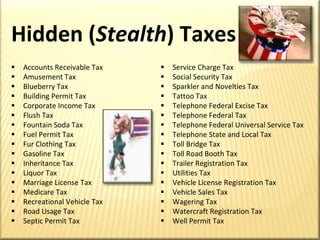
Hidden (Stealth) TaxesAccounts Receivable TaxAmusement TaxBlueberry TaxBuilding Permit TaxCorporate Income Tax Flush TaxFountain Soda Tax Fuel Permit TaxFur Clothing Tax Gasoline TaxInheritance TaxLiquor TaxMarriage License Tax Medicare Tax Recreational Vehicle Tax Road Usage Tax Septic Permit TaxService Charge TaxSocial Security TaxSparkler and Novelties TaxTattoo TaxTelephone Federal Excise Tax Telephone Federal TaxTelephone Federal Universal Service Tax Telephone State and Local TaxToll Bridge TaxToll Road Booth TaxTrailer Registration TaxUtilities TaxVehicle License Registration Tax Vehicle Sales TaxWagering TaxWatercraft Registration TaxWell Permit Tax
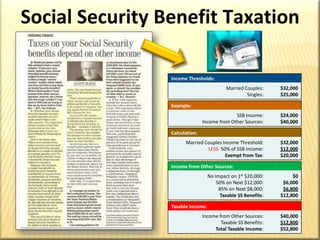
Social Security Benefit Taxation
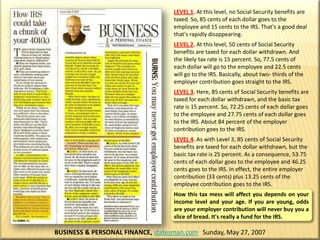
LEVEL 1. At this level, no Social Security benefits are taxed. So, 85 cents of each dollar goes to the employee and 15 cents to the IRS. That's a good deal that's rapidly disappearing.LEVEL 2. At this level, 50 cents of Social Security benefits are taxed for each dollar withdrawn. And the likely tax rate is 15 percent. So, 77.5 cents of each dollar will go to the employee and 22.5 cents will go to the IRS. Basically, about two- thirds of the employer contribution goes straight to the IRS.LEVEL 3. Here, 85 cents of Social Security benefits are taxed for each dollar withdrawn, and the basic tax rate is 15 percent. So, 72.25 cents of each dollar goes to the employee and 27.75 cents of each dollar goes to the IRS. About 84 percent of the employer contribution goes to the IRS.LEVEL 4. As with Level 3, 85 cents of Social Security benefits are taxed for each dollar withdrawn, but the basic tax rate is 25 percent. As a consequence, 53.75 cents of each dollar goes to the employee and 46.25 cents goes to the IRS. In effect, the entire employer contribution (33 cents) plus 13.25 cents of the employee contribution goes to the IRS.How this tax mess will affect you depends on your income level and your age. If you are young, odds are your employer contribution will never buy you a slice of bread. It's really a fund for the IRS.BUSINESS & PERSONAL FINANCE, statesman.com   Sunday, May 27, 2007
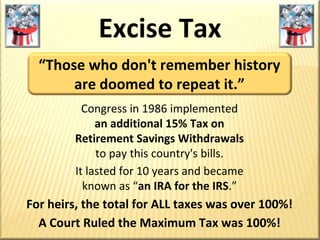
Excise Tax“Those who don't remember historyare doomed to repeat it.”Congress in 1986 implementedan additional 15% Tax onRetirement Savings Withdrawals to pay this country's bills.It lasted for 10 years and becameknown as “an IRA for the IRS.”For heirs, the total for ALL taxes was over 100%!A Court Ruled the Maximum Tax was 100%!
As a graduate student at the University of Texas Southwestern Medical Center in Dallas, I attended lectures on various topics.During a discussion on  Hemophilia, the professor discussed how a person can go into shock or die from slow, continuous bleeding.“Ah,”said a voice in the back of the room, “The IRS Method.”
Planning for Success or Failure?Now tell me…Are you planning be financially successful or are you planning to be a failure?
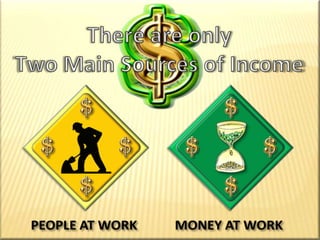
There are only Two Main Sources of IncomePEOPLE AT WORKMONEY AT WORK
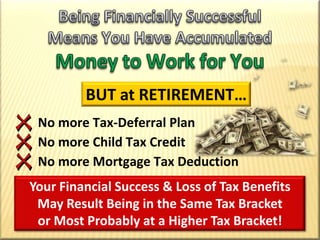
Being Financially SuccessfulMeans You Have Accumulated Money to Work for YouBUT at RETIREMENT…No more Tax-Deferral PlanNo more Child Tax CreditNo more Mortgage Tax DeductionThis Success May Result in Being in the Same Tax Bracketor Possibly at a Higher Tax Bracket!Your Financial Success & Loss of Tax BenefitsMay Result Being in the Same Tax Bracketor Most Probably at a Higher Tax Bracket!
Qualified PlansQualified PlansWhat’s the Rest of the Story?403 bTSA
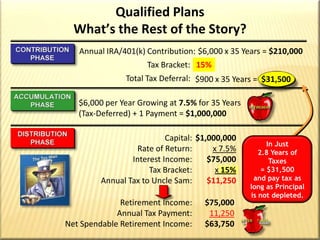
Qualified PlansWhat’s the Rest of the Story?$1,000,000x 7.5%$75,000x 15%$11,250Capital:Rate of Return:Interest Income:Tax Bracket:Annual Tax to Uncle Sam:Retirement Income:Annual Tax Payment:Net Spendable Retirement Income:$75,00011,250$63,750CONTRIBUTIONPHASEAnnual IRA/401(k) Contribution:$6,000 x 35 Years = $210,000Tax Bracket:15%Total Tax Deferral:$900 x 35 Years =  $31,500ACCUMULATIONPHASE$6,000 per Year Growing at 7.5% for 35 Years(Tax-Deferred) + 1 Payment = $1,000,000DISTRIBUTIONPHASEJust3 Yearsof Taxes= $75,000In Just 2.8 Years of Taxes = $31,500and pay tax as long as Principal is not depleted.
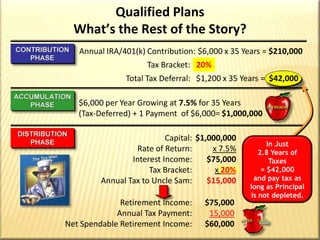
Qualified PlansWhat’s the Rest of the Story?$1,000,000x 7.5%$75,000x 20%$15,000Capital:Rate of Return:Interest Income:Tax Bracket:Annual Tax to Uncle Sam:Retirement Income:Annual Tax Payment:Net Spendable Retirement Income:$75,00015,000$60,000CONTRIBUTIONPHASEAnnual IRA/401(k) Contribution:$6,000 x 35 Years = $210,000Tax Bracket:20%Total Tax Deferral:$1,200 x 35 Years =  $42,000ACCUMULATIONPHASE$6,000 per Year Growing at 7.5% for 35 Years(Tax-Deferred) + 1 Payment  of $6,000= $1,000,000DISTRIBUTIONPHASEJust4 Yearsof Taxes= $75,000In Just 2.8 Years of Taxes = $42,000and pay tax as long as Principal is not depleted.
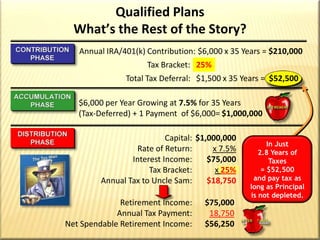
Qualified PlansWhat’s the Rest of the Story?$1,000,000x 7.5%$75,000x 25%$18,750Capital:Rate of Return:Interest Income:Tax Bracket:Annual Tax to Uncle Sam:Retirement Income:Annual Tax Payment:Net Spendable Retirement Income:$75,00018,750$56,250CONTRIBUTIONPHASEAnnual IRA/401(k) Contribution:$6,000 x 35 Years = $210,000Tax Bracket:25%Total Tax Deferral:$1,500 x 35 Years =  $52,500ACCUMULATIONPHASE$6,000 per Year Growing at 7.5% for 35 Years(Tax-Deferred) + 1 Payment  of $6,000= $1,000,000DISTRIBUTIONPHASEJust4 Yearsof Taxes= $75,000In Just 2.8 Years of Taxes = $52,500and pay tax as long as Principal is not depleted.
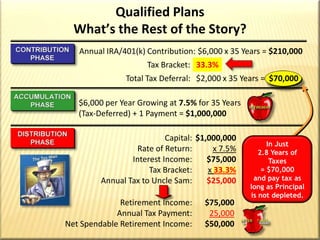
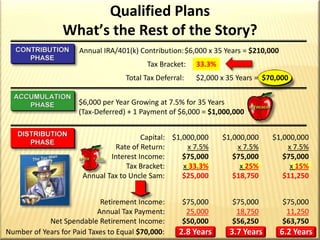
Qualified PlansWhat’s the Rest of the Story?$1,000,000x 7.5%$75,000x 33.3%$25,000Capital:Rate of Return:Interest Income:Tax Bracket:Annual Tax to Uncle Sam:Retirement Income:Annual Tax Payment:Net Spendable Retirement Income:$75,00025,000$50,000CONTRIBUTIONPHASEAnnual IRA/401(k) Contribution:$6,000 x 35 Years = $210,000Tax Bracket:33.3%Total Tax Deferral:$2,000 x 35 Years =  $70,000ACCUMULATIONPHASE$6,000 per Year Growing at 7.5% for 35 Years(Tax-Deferred) + 1 Payment = $1,000,000DISTRIBUTIONPHASEJust3 Yearsof Taxes= $75,000In Just 2.8 Years of Taxes = $70,000and pay tax as long as Principal is not depleted.
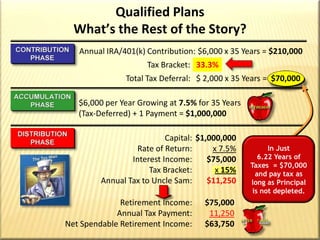
Qualified PlansWhat’s the Rest of the Story?$1,000,000x 7.5%$75,000x 15%$11,250Capital:Rate of Return:Interest Income:Tax Bracket:Annual Tax to Uncle Sam:Retirement Income:Annual Tax Payment:Net Spendable Retirement Income:$75,00011,250$63,750CONTRIBUTIONPHASEAnnual IRA/401(k) Contribution:$6,000 x 35 Years = $210,000Tax Bracket:33.3%Total Tax Deferral:$ 2,000 x 35 Years =  $70,000ACCUMULATIONPHASE$6,000 per Year Growing at 7.5% for 35 Years(Tax-Deferred) + 1 Payment = $1,000,000DISTRIBUTIONPHASEJust3 Yearsof Taxes= $75,000In Just 6.22 Years of Taxes  = $70,000and pay tax as long as Principal is not depleted.
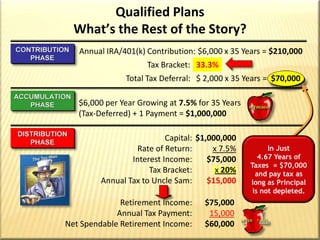
Qualified PlansWhat’s the Rest of the Story?$1,000,000x 7.5%$75,000x 20%$15,000Capital:Rate of Return:Interest Income:Tax Bracket:Annual Tax to Uncle Sam:Retirement Income:Annual Tax Payment:Net Spendable Retirement Income:$75,00015,000$60,000CONTRIBUTIONPHASEAnnual IRA/401(k) Contribution:$6,000 x 35 Years = $210,000Tax Bracket:33.3%Total Tax Deferral:$ 2,000 x 35 Years =  $70,000ACCUMULATIONPHASE$6,000 per Year Growing at 7.5% for 35 Years(Tax-Deferred) + 1 Payment = $1,000,000DISTRIBUTIONPHASEJust3 Yearsof Taxes= $75,000In Just 4.67 Years of Taxes  = $70,000and pay tax as long as Principal is not depleted.
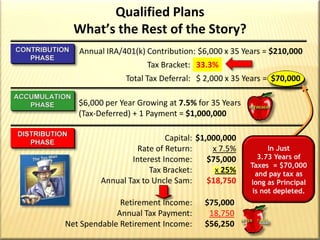
Qualified PlansWhat’s the Rest of the Story?$1,000,000x 7.5%$75,000x 25%$18,750Capital:Rate of Return:Interest Income:Tax Bracket:Annual Tax to Uncle Sam:Retirement Income:Annual Tax Payment:Net Spendable Retirement Income:$75,00018,750$56,250CONTRIBUTIONPHASEAnnual IRA/401(k) Contribution:$6,000 x 35 Years = $210,000Tax Bracket:33.3%Total Tax Deferral:$ 2,000 x 35 Years =  $70,000ACCUMULATIONPHASE$6,000 per Year Growing at 7.5% for 35 Years(Tax-Deferred) + 1 Payment = $1,000,000DISTRIBUTIONPHASEJust3 Yearsof Taxes= $75,000In Just 3.73 Years of Taxes  = $70,000and pay tax as long as Principal is not depleted.
Qualified PlansWhat’s the Rest of the Story?$1,000,000x 7.5%$75,000x 33.3%$25,000Capital:Rate of Return:Interest Income:Tax Bracket:Annual Tax to Uncle Sam:Retirement Income:Annual Tax Payment:Net Spendable Retirement Income:$75,00025,000$50,000CONTRIBUTIONPHASEAnnual IRA/401(k) Contribution:$6,000 x 35 Years = $210,000Tax Bracket:33.3%Total Tax Deferral:$ 2,000 x 35 Years =  $70,000ACCUMULATIONPHASE$6,000 per Year Growing at 7.5% for 35 Years(Tax-Deferred) + 1 Payment = $1,000,000DISTRIBUTIONPHASEJust3 Yearsof Taxes= $75,000In Just 2.8 Years of Taxes  = $70,000and pay tax as long as Principal is not depleted.
Qualified PlansWhat’s the Rest of the Story?CONTRIBUTIONPHASEAnnual IRA/401(k) Contribution:$6,000 x 35 Years = $210,000Tax Bracket:33.3%Total Tax Deferral:$2,000 x 35 Years =  $70,000ACCUMULATIONPHASE$6,000 per Year Growing at 7.5% for 35 Years(Tax-Deferred) + 1 Payment of $6,000 = $1,000,000DISTRIBUTIONPHASE$1,000,000x 7.5%$75,000x 15%$11,250Capital:Rate of Return:Interest Income:Tax Bracket:Annual Tax to Uncle Sam:$1,000,000x 7.5%$75,000x 33.3%$25,000$1,000,000x 7.5%$75,000x 25%$18,750Just5 Yearsof Taxes= $75,000Retirement Income:Annual Tax Payment:Net Spendable Retirement Income:$75,00011,250$63,750$75,00025,000$50,000$75,00018,750$56,2502.8 Years3.7 Years6.2 YearsNumber of Years for Paid Taxes to Equal $70,000:
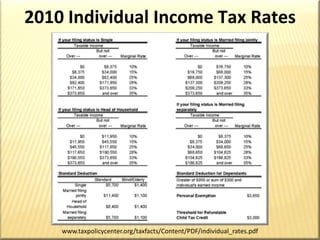
2010 Individual Income Tax Rateswww.taxpolicycenter.org/taxfacts/Content/PDF/individual_rates.pdf
Whose Future RetirementAre You Saving for?YourRetirement?Uncle Sam’sRetirement?or
The Government Knows Exactly How & When to HarvestPREDICTABILITY EXERCISES
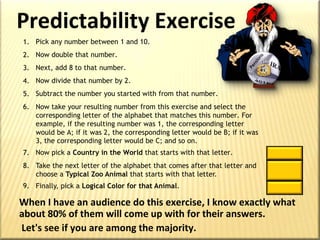
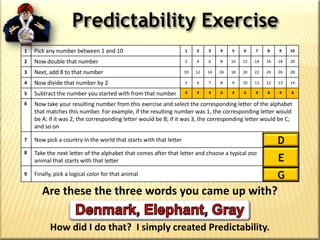
Predictability ExerciseWhen I have an audience do this exercise, I know exactly what about 80% of them will come up with for their answers.  Let's see if you are among the majority.
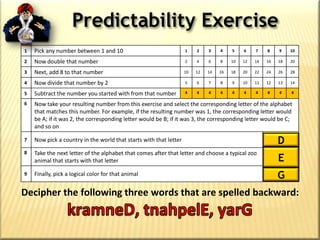
Predictability ExerciseDEGDecipher the following three words that are spelled backward:        kramneD, tnahpelE, yarG
Predictability ExerciseDEGAre these the three words you came up with?Denmark, Elephant, GrayHow did I do that?  I simply created Predictability.
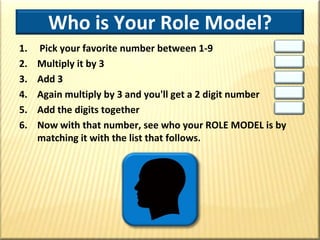
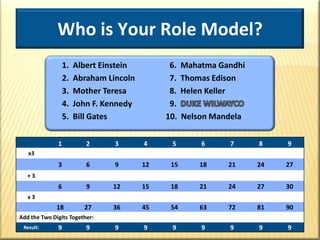
Who is Your Role Model? Pick your favorite number between 1-9Multiply it by 3Add 3 Again multiply by 3 and you'll get a 2 digit numberAdd the digits togetherNow with that number, see who your ROLE MODEL is by matching it with the list that follows.
Who is Your Role Model?1.  Albert Einstein2.  Abraham Lincoln3.  Mother Teresa4.  John F. Kennedy5.  Bill Gates  6.  Mahatma Gandhi  7.  Thomas Edison  8.  Helen Keller  9.  DUKE WILWAYCO10.  Nelson Mandela
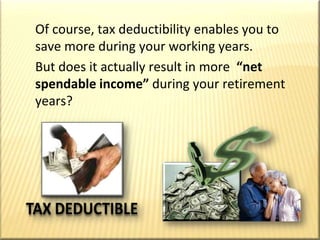
Of course, tax deductibility enables you to save more during your working years.But does it actually result in more  “net spendable income” during your retirement years?Tax-Deductibility or Net Spendable Income?
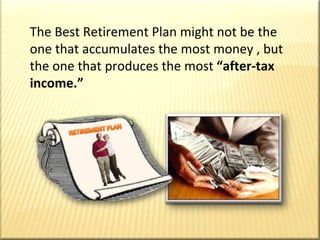
The Best Retirement Plan might not be the one that accumulates the most money , but the one that produces the most “after-tax income.”Best Retirement Plan
Summing It Up“Retirement planning strategies are no different. Predictably, qualified retirement plans motivate the majority of people to invest in order to get tax-favored treatment during the “Contribution” and “Accumulation” phases of retirement planning.Later, when traditional qualified plans are liquidated and used for retirement, they produce the taxable results  that the government predicted and intended.It always sounds better to us when we are shown            the tax breaks we can get immediately. But I          maintain it doesn't make sense to postpone                   tax for some perceived advantage in the future.”- Douglas R. Andrew
POSTPONING TAX MAY NOT BE THE BEST IDEA?
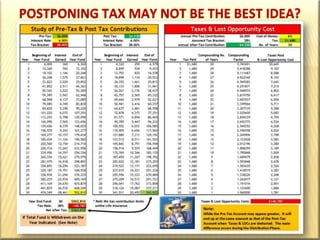
Postponing Taxes: Is It the Best Idea?Pre-Tax:Interest Rate:Tax Bracket:Post Tax:Interest Rate:Tax Bracket:Annual Pre-Tax Contribution:Assumed Tax Bracket:Annual After-Tax Contribution:$6,0006.00%28.00%$4,3206.00%28.00%$6,00028%$4,320Cost of Money:Tax Paid:No. of Years:6%$1,68030End of Year Fund:@ 28% Tax Rate:Net After Tax:$502,810140,787$362,023Taxes plus Lost Opportunity Cost:$140,787
Pay Taxon the Seed?Pay Taxon the Harvest?You Have a ChoiceWhich Would You Prefer?
Qualified PlansThe Best Savings Bond      Uncle Sam Has Ever Devised for HimselfUncles Sam’s Best Savings Bond
Qualified Plans“Uncle Sam’s Money Farm”PLAN PARTICIPANT…and you are one of his farm hands!During the Distribution Phase, after returning all the taxes you deferred during the Contribution Phase, he is also assured of a Retirement Annuity or  a Lump Sum from you by way of taxes.
RSIJohn and Mary Jones’ hope is that maybe someday their ship will come in.  One thing they’re sure of, is that when that day comes,  the           will be there... to help unload it for them.
POSTPONING TAX MAY NOT BE THE BEST IDEA!Because your 401(k), 403(b), IRA and pension benefitswill probably be taxable at a higher rate at retirementRETIREMENTAFTERTAXESWould you be interested in a strategy:Where there are no restrictions on how much you can put in?
Where you can withdraw money if needed without IRS penalties?
Where you are not obligated to put it back unless you want to?

Plan Your Retirement & Not Uncle Sam's

  • 1.
    Are You Planningfor Your Retirement or Uncle Sam’s?RETIREMENTAFTERTAXESYour 401(k), 403(b), IRA and Pension Benefitswill probably be taxable at a higher rate at retirement
  • 2.
    If What YouKnow to Be True Turned Out Not to Be True, When Would You Want to Know?“The problem in America isn’t so much what people don’t know; the problem is what people think they know that just ain’t so.”
  • 3.
    FOUR PHASES OFRETIREMENT PLANNINGTaxFavoredTaxFavoredTaxedTaxedTraditional Qualified Plans: IRAs & 401(k)s/403(b)sDISTRIBUTIONCONTRIBUTIONACCUMULATIONTRANSFERThe Four Phases of Retirement Planning
  • 4.
    FOUR PHASES OFRETIREMENT PLANNINGTraditional Qualified Plans: IRAs & 401(k)s/403(b)sDISTRIBUTIONCONTRIBUTIONACCUMULATIONTRANSFERThe Four Phases of Retirement PlanningFOUR PHASES OF RETIREMENT PLANNINGTaxFavoredTaxFavoredTaxedTaxedPhase I—ContributionThe first phase of retirement planning is the contribution phase. During this phase, we make contributions or deposits into investments or savings vehicles. If the account is a qualified plan, we are allowed to deduct those contributions from our gross income on our tax return or contribute money with pre-taxed dollars. (Otherwise, the contribution would be done with after-tax dollars.)
  • 5.
    FOUR PHASES OFRETIREMENT PLANNINGTraditional Qualified Plans: IRAs & 401(k)s/403(b)sDISTRIBUTIONCONTRIBUTIONACCUMULATIONTRANSFERThe Four Phases of Retirement PlanningFOUR PHASES OF RETIREMENT PLANNINGTaxFavoredTaxFavoredTaxedTaxedPhase II—AccumulationThe second phase of our retirement planning overlaps the first phase. In this phase, we can accumulate money through compound in­terest, asset appreciation, or the reinvestment of dividends and capital gains. The accumulation takes place free of tax under qualified plans because any dividends, capital gains, or credited interest stays and compounds with the account and is not reportable as a taxable event on your annual tax return. Therefore, the compounding that takes place in a tax-deferred environment allows greater growth because the “children” of the investments (the interest) also help your account to blossom without being taxed during the accumulation phase.This arrangement may seem ideal—to be able to contribute dollars before being taxed and have them continue to compound and grow without being taxed on the gain during the growth process. Most retirement account advisors focus only on the contribution and accumulation phases. I ask, however, “What about the most important phase, the time when you will use your accumulated money during retirement?”
  • 6.
    FOUR PHASES OFRETIREMENT PLANNINGTraditional Qualified Plans: IRAs & 401(k)s/403(b)sDISTRIBUTIONCONTRIBUTIONACCUMULATIONTRANSFERThe Four Phases of Retirement PlanningFOUR PHASES OF RETIREMENT PLANNINGTaxFavoredTaxFavoredTaxedTaxedPhase III—DistributionThe distribution phase is when we withdraw money for retirement income. Under traditional IRAs and 401(k)s, we must now report 100 percent of our distribution on our annual tax return to be taxed. All too often, when we thought we would be in a lower bracket, we find ourselves in a bracket as high—or higher. We are no longer contributing money to IRAs; we have no mortgage interest deductions because our mortgage is paid off; we no longer have children at home (who qualify as dependents); and so on.
  • 7.
    DISTRIBUTIONCONTRIBUTIONACCUMULATIONTRANSFERFOUR PHASES OFRETIREMENT PLANNINGTaxFavoredTaxFavoredTaxedTaxedPhase IV—TransferWhat if you do not use all of the money before you pass away? What happens to your qualified retirement funds during the transfer of that money to a spouse or non-spousal heir? The transfer phase is often overlooked until it is too late.People don’t want to outlive their money, so they try to keep enough saved in case they need long-term health care. (The fastest-growing age group in American society is the group over age 100.) But we are not getting out of here alive, so when people do die, they usu­ally end up leaving behind some money. If that money is in a qualified retirement plan, the beneficiaries will be subject to income tax when they use the money, and might even be subject to an additional estate tax. Estate tax may be due (based on the size of the estate and the tax laws at the time of death) upon the second of two spouses’ deaths, as the remaining money passes down to non-spousal heirs. Therefore, retirement plan assets may be taxed twice.To avoid this, many financial advisors recommend the heirs use a “stretch IRA,” which means that either the IRA continues to grow tax-deferred or the distributions are stretched out over a long period of time. Under such arrangements, the taxes might be less in each given year than if the entire account were distributed in one year; but string­ing out the tax liability may end up increasing the overall tax that is paid. It may be better to bite the bullet, pay the tax in today’s brackets, and re-position the net after-tax amount into vehicles that will grow from that point forward tax-free.
  • 8.
    Tax Bracket: Higheror Lower at Retirement?When You Retire…Do you think your Tax Bracketwill be Higher, the SameorLowerthan what it is now?INCOME TAX RATES
  • 9.
    History of theMarginal Tax BracketTax Foundation- Federal Income Tax Rates 1913-2007
  • 10.
    History of theMarginal Tax BracketN I XONGHBUS HW I L SONE I S ENHOWE RFORDROOSVELTC L I NTONC A R T E RHARD I N GJ F KCOOLIDGEJOHN SONGWBUS HREAGANTRUMANHOOV E RTax Foundation- Federal Income Tax Rates 1913-2007
  • 11.
    Federal Income TaxMarginalTax Rate History( 1913 – 2009 )100%90%80%70%60%50%40%30%20%10%0%19131919192519311937194319491955196119671973197919851991199720032009Highest Marginal Tax RatesLowest Marginal Tax Rates
  • 12.
    History of HighTax RatesThe last time the “highest” taxes were this low was in 1991 at 31%!The last time the 10% “lowest” rate of today was back in 1941!
  • 13.
    Federal Income TaxMarginal Tax Bracket History
  • 14.
    TAXESFEDERAL INCOME TAX~ SOCIAL SECURITY TAX ~ STATE TAX ~ CITY TAX ~ COUNTY TAX ~ PROPERTY TAX ~ PERSONAL PROPERTY TAX ~ SCHOOL TAX ~ LONG CAPITAL GAINS TAX ~ SHORT CAPITAL GAINS TAX ~ SALES TAX ~ ESTATE TAX ~ GASOLINE TAX ~ WATER TAX ~ SEWER TAX ~ TAX ON ENERGY – GAS ~ ELECTRIC ~ HEATING OIL ~ BUSINESS TAX ~ AIRPORT TAX ~ TELEPHONE TAX ~ LICENSE PLATE TAX ~ HOTEL TAX ~ CABLE TV TAX ~ USER TAXES ~ UNEMPLOYMENT TAX ~ WORKERS COMP. TAX ~ 100’S OF REGULATORY FEES ~ CIGARETTE TAX ~ CORPORATE INCOME TAX ~ INHERITANCE TAX ~ ACCOUNTS RECEIVABLE TAX ~ INVENTORY TAX ~ MARRIAGE LICENSE TAX ~ LIQUOR TAX ~ BUILDING PERMIT TAX ~ MEDICARE TAX ~ FISHING LICENSE TAX ~ REAL ESTATE TAX ~ FOOD LICENSE TAX ~ FUEL PERMIT TAX ~ HUNTING LICENSE TAX ~ ROAD USAGE TAX (TRUCKERS) ~ LUXURY TAX ~ RECREATIONAL VEHICLE TAX ~ UTILITY TAX ~ SEPTIC PERMIT TAX ~ WELL PERMIT TAX ~ ROAD TOLL BOOTH TAX ~ VEHICLE SALES TAX ~ WORKERS COMPENSATION TAX ~ TRAILER REGISTRATION TAX ~ WATERCRAFT REGISTRATION TAX ~ LONG TERM CAPITAL GAINS TAX ~ SHORT TERM CAPITAL GAINS TAX ~ TELEPHONE FEDERAL EXCISE TAX ~ TELEPHONE STATE AND LOCAL TAX ~ TELEPHONE USAGE CHARGE TAX ~ TELEPHONE FEDERAL UNIVERSAL SERVICE FEE TAXFEDERAL INCOME TAX ~ SOCIAL SECURITY TAX ~ STATE TAX ~ CITY TAX ~ COUNTY TAX ~ PROPERTY TAX ~ PERSONAL PROPERTY TAX ~ SCHOOL TAX ~ LONG CAPITAL GAINS TAX ~ SHORT CAPITAL GAINS TAX ~ SALES TAX ~ ESTATE TAX ~ GASOLINE TAX ~ WATER TAX ~ SEWER TAX ~ TAX ON ENERGY – GAS ~ ELECTRIC ~ HEATING OIL ~ BUSINESS TAX ~ AIRPORT TAX ~ TELEPHONE TAX ~ LICENSE PLATE TAX ~ HOTEL TAX ~ CABLE TV TAX ~ USER TAXES ~ UNEMPLOYMENT TAX ~ WORKERS COMP. TAX ~ 100’S OF REGULATORY FEES ~ CIGARETTE TAX ~ CORPORATE INCOME TAX ~ INHERITANCE TAX ~ ACCOUNTS RECEIVABLE TAX ~ INVENTORY TAX ~ MARRIAGE LICENSE TAX ~ LIQUOR TAX ~ BUILDING PERMIT TAX ~ MEDICARE TAX ~ FISHING LICENSE TAX ~ REAL ESTATE TAX ~ FOOD LICENSE TAX ~ FUEL PERMIT TAX ~ HUNTING LICENSE TAX ~ ROAD USAGE TAX (TRUCKERS) ~ LUXURY TAX ~ RECREATIONAL VEHICLE TAX ~ UTILITY TAX ~ SEPTIC PERMIT TAX ~ WELL PERMIT TAX ~ ROAD TOLL BOOTH TAX ~ VEHICLE SALES TAX ~ WORKERS COMPENSATION TAX ~ TRAILER REGISTRATION TAX ~ WATERCRAFT REGISTRATION TAX ~ LONG TERM CAPITAL GAINS TAX ~ SHORT TERM CAPITAL GAINS TAX ~ TELEPHONE FEDERAL EXCISE TAX ~ TELEPHONE STATE AND LOCAL TAX ~ TELEPHONE USAGE CHARGE TAX ~ TELEPHONE FEDERAL UNIVERSAL SERVICE FEE TAX
  • 15.
    Hidden (Stealth) TaxesAccountsReceivable TaxAmusement TaxBlueberry TaxBuilding Permit TaxCorporate Income Tax Flush TaxFountain Soda Tax Fuel Permit TaxFur Clothing Tax Gasoline TaxInheritance TaxLiquor TaxMarriage License Tax Medicare Tax Recreational Vehicle Tax Road Usage Tax Septic Permit TaxService Charge TaxSocial Security TaxSparkler and Novelties TaxTattoo TaxTelephone Federal Excise Tax Telephone Federal TaxTelephone Federal Universal Service Tax Telephone State and Local TaxToll Bridge TaxToll Road Booth TaxTrailer Registration TaxUtilities TaxVehicle License Registration Tax Vehicle Sales TaxWagering TaxWatercraft Registration TaxWell Permit Tax
  • 16.
  • 17.
    LEVEL 1. Atthis level, no Social Security benefits are taxed. So, 85 cents of each dollar goes to the employee and 15 cents to the IRS. That's a good deal that's rapidly disappearing.LEVEL 2. At this level, 50 cents of Social Security benefits are taxed for each dollar withdrawn. And the likely tax rate is 15 percent. So, 77.5 cents of each dollar will go to the employee and 22.5 cents will go to the IRS. Basically, about two- thirds of the employer contribution goes straight to the IRS.LEVEL 3. Here, 85 cents of Social Security benefits are taxed for each dollar withdrawn, and the basic tax rate is 15 percent. So, 72.25 cents of each dollar goes to the employee and 27.75 cents of each dollar goes to the IRS. About 84 percent of the employer contribution goes to the IRS.LEVEL 4. As with Level 3, 85 cents of Social Security benefits are taxed for each dollar withdrawn, but the basic tax rate is 25 percent. As a consequence, 53.75 cents of each dollar goes to the employee and 46.25 cents goes to the IRS. In effect, the entire employer contribution (33 cents) plus 13.25 cents of the employee contribution goes to the IRS.How this tax mess will affect you depends on your income level and your age. If you are young, odds are your employer contribution will never buy you a slice of bread. It's really a fund for the IRS.BUSINESS & PERSONAL FINANCE, statesman.com Sunday, May 27, 2007
  • 18.
    Excise Tax“Those whodon't remember historyare doomed to repeat it.”Congress in 1986 implementedan additional 15% Tax onRetirement Savings Withdrawals to pay this country's bills.It lasted for 10 years and becameknown as “an IRA for the IRS.”For heirs, the total for ALL taxes was over 100%!A Court Ruled the Maximum Tax was 100%!
  • 19.
    As a graduatestudent at the University of Texas Southwestern Medical Center in Dallas, I attended lectures on various topics.During a discussion on Hemophilia, the professor discussed how a person can go into shock or die from slow, continuous bleeding.“Ah,”said a voice in the back of the room, “The IRS Method.”
  • 20.
    Planning for Successor Failure?Now tell me…Are you planning be financially successful or are you planning to be a failure?
  • 21.
    There are onlyTwo Main Sources of IncomePEOPLE AT WORKMONEY AT WORK
  • 22.
    Being Financially SuccessfulMeansYou Have Accumulated Money to Work for YouBUT at RETIREMENT…No more Tax-Deferral PlanNo more Child Tax CreditNo more Mortgage Tax DeductionThis Success May Result in Being in the Same Tax Bracketor Possibly at a Higher Tax Bracket!Your Financial Success & Loss of Tax BenefitsMay Result Being in the Same Tax Bracketor Most Probably at a Higher Tax Bracket!
  • 23.
    Qualified PlansQualified PlansWhat’sthe Rest of the Story?403 bTSA
  • 24.
    Qualified PlansWhat’s theRest of the Story?$1,000,000x 7.5%$75,000x 15%$11,250Capital:Rate of Return:Interest Income:Tax Bracket:Annual Tax to Uncle Sam:Retirement Income:Annual Tax Payment:Net Spendable Retirement Income:$75,00011,250$63,750CONTRIBUTIONPHASEAnnual IRA/401(k) Contribution:$6,000 x 35 Years = $210,000Tax Bracket:15%Total Tax Deferral:$900 x 35 Years = $31,500ACCUMULATIONPHASE$6,000 per Year Growing at 7.5% for 35 Years(Tax-Deferred) + 1 Payment = $1,000,000DISTRIBUTIONPHASEJust3 Yearsof Taxes= $75,000In Just 2.8 Years of Taxes = $31,500and pay tax as long as Principal is not depleted.
  • 25.
    Qualified PlansWhat’s theRest of the Story?$1,000,000x 7.5%$75,000x 20%$15,000Capital:Rate of Return:Interest Income:Tax Bracket:Annual Tax to Uncle Sam:Retirement Income:Annual Tax Payment:Net Spendable Retirement Income:$75,00015,000$60,000CONTRIBUTIONPHASEAnnual IRA/401(k) Contribution:$6,000 x 35 Years = $210,000Tax Bracket:20%Total Tax Deferral:$1,200 x 35 Years = $42,000ACCUMULATIONPHASE$6,000 per Year Growing at 7.5% for 35 Years(Tax-Deferred) + 1 Payment of $6,000= $1,000,000DISTRIBUTIONPHASEJust4 Yearsof Taxes= $75,000In Just 2.8 Years of Taxes = $42,000and pay tax as long as Principal is not depleted.
  • 26.
    Qualified PlansWhat’s theRest of the Story?$1,000,000x 7.5%$75,000x 25%$18,750Capital:Rate of Return:Interest Income:Tax Bracket:Annual Tax to Uncle Sam:Retirement Income:Annual Tax Payment:Net Spendable Retirement Income:$75,00018,750$56,250CONTRIBUTIONPHASEAnnual IRA/401(k) Contribution:$6,000 x 35 Years = $210,000Tax Bracket:25%Total Tax Deferral:$1,500 x 35 Years = $52,500ACCUMULATIONPHASE$6,000 per Year Growing at 7.5% for 35 Years(Tax-Deferred) + 1 Payment of $6,000= $1,000,000DISTRIBUTIONPHASEJust4 Yearsof Taxes= $75,000In Just 2.8 Years of Taxes = $52,500and pay tax as long as Principal is not depleted.
  • 27.
    Qualified PlansWhat’s theRest of the Story?$1,000,000x 7.5%$75,000x 33.3%$25,000Capital:Rate of Return:Interest Income:Tax Bracket:Annual Tax to Uncle Sam:Retirement Income:Annual Tax Payment:Net Spendable Retirement Income:$75,00025,000$50,000CONTRIBUTIONPHASEAnnual IRA/401(k) Contribution:$6,000 x 35 Years = $210,000Tax Bracket:33.3%Total Tax Deferral:$2,000 x 35 Years = $70,000ACCUMULATIONPHASE$6,000 per Year Growing at 7.5% for 35 Years(Tax-Deferred) + 1 Payment = $1,000,000DISTRIBUTIONPHASEJust3 Yearsof Taxes= $75,000In Just 2.8 Years of Taxes = $70,000and pay tax as long as Principal is not depleted.
  • 28.
    Qualified PlansWhat’s theRest of the Story?$1,000,000x 7.5%$75,000x 15%$11,250Capital:Rate of Return:Interest Income:Tax Bracket:Annual Tax to Uncle Sam:Retirement Income:Annual Tax Payment:Net Spendable Retirement Income:$75,00011,250$63,750CONTRIBUTIONPHASEAnnual IRA/401(k) Contribution:$6,000 x 35 Years = $210,000Tax Bracket:33.3%Total Tax Deferral:$ 2,000 x 35 Years = $70,000ACCUMULATIONPHASE$6,000 per Year Growing at 7.5% for 35 Years(Tax-Deferred) + 1 Payment = $1,000,000DISTRIBUTIONPHASEJust3 Yearsof Taxes= $75,000In Just 6.22 Years of Taxes = $70,000and pay tax as long as Principal is not depleted.
  • 29.
    Qualified PlansWhat’s theRest of the Story?$1,000,000x 7.5%$75,000x 20%$15,000Capital:Rate of Return:Interest Income:Tax Bracket:Annual Tax to Uncle Sam:Retirement Income:Annual Tax Payment:Net Spendable Retirement Income:$75,00015,000$60,000CONTRIBUTIONPHASEAnnual IRA/401(k) Contribution:$6,000 x 35 Years = $210,000Tax Bracket:33.3%Total Tax Deferral:$ 2,000 x 35 Years = $70,000ACCUMULATIONPHASE$6,000 per Year Growing at 7.5% for 35 Years(Tax-Deferred) + 1 Payment = $1,000,000DISTRIBUTIONPHASEJust3 Yearsof Taxes= $75,000In Just 4.67 Years of Taxes = $70,000and pay tax as long as Principal is not depleted.
  • 30.
    Qualified PlansWhat’s theRest of the Story?$1,000,000x 7.5%$75,000x 25%$18,750Capital:Rate of Return:Interest Income:Tax Bracket:Annual Tax to Uncle Sam:Retirement Income:Annual Tax Payment:Net Spendable Retirement Income:$75,00018,750$56,250CONTRIBUTIONPHASEAnnual IRA/401(k) Contribution:$6,000 x 35 Years = $210,000Tax Bracket:33.3%Total Tax Deferral:$ 2,000 x 35 Years = $70,000ACCUMULATIONPHASE$6,000 per Year Growing at 7.5% for 35 Years(Tax-Deferred) + 1 Payment = $1,000,000DISTRIBUTIONPHASEJust3 Yearsof Taxes= $75,000In Just 3.73 Years of Taxes = $70,000and pay tax as long as Principal is not depleted.
  • 31.
    Qualified PlansWhat’s theRest of the Story?$1,000,000x 7.5%$75,000x 33.3%$25,000Capital:Rate of Return:Interest Income:Tax Bracket:Annual Tax to Uncle Sam:Retirement Income:Annual Tax Payment:Net Spendable Retirement Income:$75,00025,000$50,000CONTRIBUTIONPHASEAnnual IRA/401(k) Contribution:$6,000 x 35 Years = $210,000Tax Bracket:33.3%Total Tax Deferral:$ 2,000 x 35 Years = $70,000ACCUMULATIONPHASE$6,000 per Year Growing at 7.5% for 35 Years(Tax-Deferred) + 1 Payment = $1,000,000DISTRIBUTIONPHASEJust3 Yearsof Taxes= $75,000In Just 2.8 Years of Taxes = $70,000and pay tax as long as Principal is not depleted.
  • 32.
    Qualified PlansWhat’s theRest of the Story?CONTRIBUTIONPHASEAnnual IRA/401(k) Contribution:$6,000 x 35 Years = $210,000Tax Bracket:33.3%Total Tax Deferral:$2,000 x 35 Years = $70,000ACCUMULATIONPHASE$6,000 per Year Growing at 7.5% for 35 Years(Tax-Deferred) + 1 Payment of $6,000 = $1,000,000DISTRIBUTIONPHASE$1,000,000x 7.5%$75,000x 15%$11,250Capital:Rate of Return:Interest Income:Tax Bracket:Annual Tax to Uncle Sam:$1,000,000x 7.5%$75,000x 33.3%$25,000$1,000,000x 7.5%$75,000x 25%$18,750Just5 Yearsof Taxes= $75,000Retirement Income:Annual Tax Payment:Net Spendable Retirement Income:$75,00011,250$63,750$75,00025,000$50,000$75,00018,750$56,2502.8 Years3.7 Years6.2 YearsNumber of Years for Paid Taxes to Equal $70,000:
  • 33.
    2010 Individual IncomeTax Rateswww.taxpolicycenter.org/taxfacts/Content/PDF/individual_rates.pdf
  • 34.
    Whose Future RetirementAreYou Saving for?YourRetirement?Uncle Sam’sRetirement?or
  • 35.
    The Government KnowsExactly How & When to HarvestPREDICTABILITY EXERCISES
  • 36.
    Predictability ExerciseWhen Ihave an audience do this exercise, I know exactly what about 80% of them will come up with for their answers. Let's see if you are among the majority.
  • 37.
    Predictability ExerciseDEGDecipher thefollowing three words that are spelled backward: kramneD, tnahpelE, yarG
  • 38.
    Predictability ExerciseDEGAre thesethe three words you came up with?Denmark, Elephant, GrayHow did I do that? I simply created Predictability.
  • 39.
    Who is YourRole Model? Pick your favorite number between 1-9Multiply it by 3Add 3 Again multiply by 3 and you'll get a 2 digit numberAdd the digits togetherNow with that number, see who your ROLE MODEL is by matching it with the list that follows.
  • 40.
    Who is YourRole Model?1. Albert Einstein2. Abraham Lincoln3. Mother Teresa4. John F. Kennedy5. Bill Gates 6. Mahatma Gandhi 7. Thomas Edison 8. Helen Keller 9. DUKE WILWAYCO10. Nelson Mandela
  • 41.
    Of course, taxdeductibility enables you to save more during your working years.But does it actually result in more “net spendable income” during your retirement years?Tax-Deductibility or Net Spendable Income?
  • 42.
    The Best RetirementPlan might not be the one that accumulates the most money , but the one that produces the most “after-tax income.”Best Retirement Plan
  • 43.
    Summing It Up“Retirementplanning strategies are no different. Predictably, qualified retirement plans motivate the majority of people to invest in order to get tax-favored treatment during the “Contribution” and “Accumulation” phases of retirement planning.Later, when traditional qualified plans are liquidated and used for retirement, they produce the taxable results that the government predicted and intended.It always sounds better to us when we are shown the tax breaks we can get immediately. But I maintain it doesn't make sense to postpone tax for some perceived advantage in the future.”- Douglas R. Andrew
  • 44.
    POSTPONING TAX MAYNOT BE THE BEST IDEA?
  • 45.
    Postponing Taxes: IsIt the Best Idea?Pre-Tax:Interest Rate:Tax Bracket:Post Tax:Interest Rate:Tax Bracket:Annual Pre-Tax Contribution:Assumed Tax Bracket:Annual After-Tax Contribution:$6,0006.00%28.00%$4,3206.00%28.00%$6,00028%$4,320Cost of Money:Tax Paid:No. of Years:6%$1,68030End of Year Fund:@ 28% Tax Rate:Net After Tax:$502,810140,787$362,023Taxes plus Lost Opportunity Cost:$140,787
  • 46.
    Pay Taxon theSeed?Pay Taxon the Harvest?You Have a ChoiceWhich Would You Prefer?
  • 47.
    Qualified PlansThe BestSavings Bond Uncle Sam Has Ever Devised for HimselfUncles Sam’s Best Savings Bond
  • 48.
    Qualified Plans“Uncle Sam’sMoney Farm”PLAN PARTICIPANT…and you are one of his farm hands!During the Distribution Phase, after returning all the taxes you deferred during the Contribution Phase, he is also assured of a Retirement Annuity or a Lump Sum from you by way of taxes.
  • 49.
    RSIJohn and MaryJones’ hope is that maybe someday their ship will come in. One thing they’re sure of, is that when that day comes, the will be there... to help unload it for them.
  • 50.
    POSTPONING TAX MAYNOT BE THE BEST IDEA!Because your 401(k), 403(b), IRA and pension benefitswill probably be taxable at a higher rate at retirementRETIREMENTAFTERTAXESWould you be interested in a strategy:Where there are no restrictions on how much you can put in?
  • 51.
    Where you canwithdraw money if needed without IRS penalties?
  • 52.
    Where you arenot obligated to put it back unless you want to?