

How to Sell an IUL
1. Client presentation
2. Financial needs analysis
3. Illustrations/Application
4. Policy delivery
Sales Process
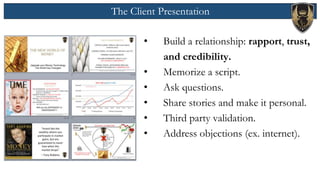
The Client Presentation
• Build a relationship: rapport, trust,
and credibility.
• Memorize a script.
• Ask questions.
• Share stories and make it personal.
• Third party validation.
• Address objections (ex. internet).
Financial Needs Analysis (FNA)
1. Coverage amount.
2. Retirement goals.
1. Contribution/Budget
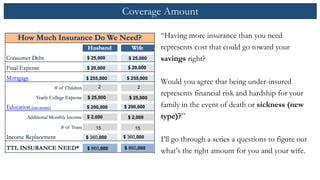
Coverage Amount
$ 25,000
$ 255,000
2
$ 20,000
$ 25,000
$ 255,000
2
$ 20,000
“Having more insurance than you need
represents cost that could go toward your
savings right?
Would you agree that being under-insured
represents financial risk and hardship for your
family in the event of death or sickness (new
type)?”
I’ll go through a series a questions to figure out
what’s the right amount for you and your wife.
$ 25,000 $ 25,000
$ 200,000 $ 200,000
$ 2,000 $ 2,000
15 15
$ 360,000 $ 360,000
$ 860,000 $ 860,000
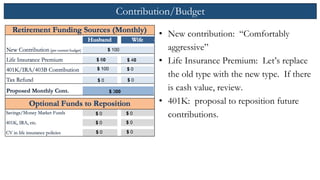
Contribution/Budget
$ 100
$ 60
$ 100
$ 40
$ 0
$ 0 $ 0
$ 300
$ 0
$ 0
$ 0
$ 0
$ 0
$ 0
• New contribution: “Comfortably
aggressive”
• Life Insurance Premium: Let’s replace
the old type with the new type. If there
is cash value, review.
• 401K: proposal to reposition future
contributions.
Retirement Goal
Retirement is not an age, it’s a financial condition – Retirement can only occur when one’s
passive income can support the standard of living one wants, needs, and deserves.
• Discuss 2 scenarios – the ideal retirement and the minimum baseline retirement.
• Explore how much of a nest egg a client may need to achieve either retirement scenario.
• Calculate the monthly savings required to create the different nest eggs per each scenario.
• This exercise is meant to highlight the reality of most people’s situation: They can’t retire
when and how they want because they aren’t saving enough.
• Share your story -- people buy on emotion and rationalize later.
$ 10,000
$ 120,000
$ 3M
$ 60,000
$ 1.5M
$ 5,000
$ 2,000 $ 1,000
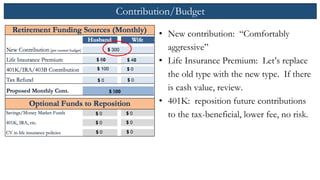
Contribution/Budget
$ 300
$ 60
$ 100
$ 40
$ 0
$ 0 $ 0
$ 500
$ 0
$ 0
$ 0
$ 0
$ 0
$ 0
• New contribution: “Comfortably
aggressive”
• Life Insurance Premium: Let’s replace
the old type with the new type. If there
is cash value, review.
• 401K: reposition future contributions
to the tax-beneficial, lower fee, no risk.
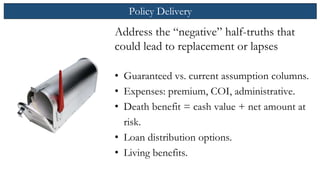
Policy Delivery
Address the “negative” half-truths that
could lead to replacement or lapses
• Guaranteed vs. current assumption columns.
• Expenses: premium, COI, administrative.
• Death benefit = cash value + net amount at
risk.
• Loan distribution options.
• Living benefits.

How to sell IUL

  • 1.
  • 2.
    1. Client presentation 2.Financial needs analysis 3. Illustrations/Application 4. Policy delivery Sales Process
  • 3.
    The Client Presentation •Build a relationship: rapport, trust, and credibility. • Memorize a script. • Ask questions. • Share stories and make it personal. • Third party validation. • Address objections (ex. internet).
  • 4.
    Financial Needs Analysis(FNA) 1. Coverage amount. 2. Retirement goals. 1. Contribution/Budget
  • 5.
    Coverage Amount $ 25,000 $255,000 2 $ 20,000 $ 25,000 $ 255,000 2 $ 20,000 “Having more insurance than you need represents cost that could go toward your savings right? Would you agree that being under-insured represents financial risk and hardship for your family in the event of death or sickness (new type)?” I’ll go through a series a questions to figure out what’s the right amount for you and your wife. $ 25,000 $ 25,000 $ 200,000 $ 200,000 $ 2,000 $ 2,000 15 15 $ 360,000 $ 360,000 $ 860,000 $ 860,000
  • 6.
    Contribution/Budget $ 100 $ 60 $100 $ 40 $ 0 $ 0 $ 0 $ 300 $ 0 $ 0 $ 0 $ 0 $ 0 $ 0 • New contribution: “Comfortably aggressive” • Life Insurance Premium: Let’s replace the old type with the new type. If there is cash value, review. • 401K: proposal to reposition future contributions.
  • 7.
    Retirement Goal Retirement isnot an age, it’s a financial condition – Retirement can only occur when one’s passive income can support the standard of living one wants, needs, and deserves. • Discuss 2 scenarios – the ideal retirement and the minimum baseline retirement. • Explore how much of a nest egg a client may need to achieve either retirement scenario. • Calculate the monthly savings required to create the different nest eggs per each scenario. • This exercise is meant to highlight the reality of most people’s situation: They can’t retire when and how they want because they aren’t saving enough. • Share your story -- people buy on emotion and rationalize later. $ 10,000 $ 120,000 $ 3M $ 60,000 $ 1.5M $ 5,000 $ 2,000 $ 1,000
  • 8.
    Contribution/Budget $ 300 $ 60 $100 $ 40 $ 0 $ 0 $ 0 $ 500 $ 0 $ 0 $ 0 $ 0 $ 0 $ 0 • New contribution: “Comfortably aggressive” • Life Insurance Premium: Let’s replace the old type with the new type. If there is cash value, review. • 401K: reposition future contributions to the tax-beneficial, lower fee, no risk.
  • 9.
    Policy Delivery Address the“negative” half-truths that could lead to replacement or lapses • Guaranteed vs. current assumption columns. • Expenses: premium, COI, administrative. • Death benefit = cash value + net amount at risk. • Loan distribution options. • Living benefits.

Editor's Notes

  • #2 Alooooha! Let’s talk about how to sell an IUL! To be clear,…there’s no one right way to sell an IUL… but I’ll share some insight and strategies that you may find value in and incorporate into your process. That said, when you set out to sell an IUL you have two fundamental objectives: Build a solid trusting agent-client relationship Educate your client on the benefits of an IUL Do these two things effectively and you’ll get the commitment by the client. And that’s really what an IUL is all about…. A long term commitment. Like a marriage or a mortgage…it’s a long term play.
  • #3 There are four phases of the sales process. the client presentation the FNA The illustration and application Policy delivery With each phase representing an interaction with a client and your opportunity to connect with and to educate your client.
  • #4 CLIENT PRESENTATION can be more than just sharing information…. it’s an opportunity to establish Rapport, trust, and credibility. Why is this important? because people will not do business with someone they don’t like, don’t trust, or don’t believe. First I’d recommend memorizing a script, because when you know what you are going to say, when you are going to say it. eliminate fumbling over your words keeps you on track and on point exude competency and confidence Also allows you to break away from presenting information and instead have a conversation. Which leads to the next two points Ask questions to Understand the Client’s situation.   probing questions followed by trial close questions. Do they have life insurance.  If not, why? if yes, what kind? Would you be interested in upgrading your policy for better benefits at potentially the same or lower cost? Do they save for retirement? 401K, IRA? How did it fare in 2008/09? Wouldn’t it have been to have a guarantee that you won’t lose money due to the performance of the market? The more you know, the more trial close yeses you get, the greater the chances of closing the sale Share stories. Facts tell, stories sell. Don’t just bombard the clients with a bunch of facts. Be personal. Tell them your own living benefits story, your own 401K story. Get their stories so they can make an emotional connection with you and the benefits of our product. Again…goes a long way to establishing rapport, trust, and credibility Third party validation. Leveraging the expertise and credibility of others to get the message across. Cite your sources: Time magazine, American heart association, Harvard medical school, tony robbins money master the game, David Mcnight the power of zero. CNBC. Your best third party validation also happens to be the best way to learn this business…. And that’s the training sale. Aligning yourself with a great trainer will ensure longevity in this business. Advice: don’t break away from training sales until you are absolutely ready Address objections. If the content of a presentation is strong, it would address the majority of peoples questions. Hopefully in the conversation you were able to draw out any other questions that the client might have. The objections to beware of are those that come after the fact from other people or other sources. You have to expect them to ask their family and friends or current agents about LB and IULs and/or they will look in the internet to do their own research. Get ahead of that by saying 2 things Most people, including insurance agents, are misinformed or don’t know about benefits of IULs or the strength of our living benefits. Do you tend to research things on line? If yes, great. If you were to google IUL, the first 7 of 10 articles make strong arguments against IULs. Read through them, highlight them, and as we move along in this process we’ll address each and every argument you’ll find that a lot of misinformation or halftruths that once addressed, you’ll have no doubts as to the benefits of the IUL. In fact, if you look at the authors of those articles many have a vested interest in the market and managed money or are insurance agents that sell other types of policies. Best presentation results in the client moving on to a next step. Educate. Emotion. Commitment to move on to FNA. I want this!!!
  • #5 Purpose of the FNA is the get the following information Coverage amount needed What their retirement goals are What’s their budget 1 and 3 is the simple FNA 2 is an advanced strategy, but I’ll highlight it’s importance
  • #6 Coverage amount is straight forward. In the set-up though you’ll want to give the client some context. “Having more insurance than you need represents cost that could go toward your savings right? “ “Would you agree that being under-insured represents financial risk and hardship for your family in the event of death or sickness (new type)?” Asking questions that build “yes momentum” I’ll go through a series a questions to figure out what’s the right amount for you and your wife.
  • #8 In the advanced strategy FNA, you explore with your client two different retirement scenarios: a plush, luxurious retirement and a “survival/worst-case scenario” retirement. The point of this exercise is to make your client see that retirement not an age it’s a financial condition. the point at which their passive income can sustain the life-style they want, need, and deserve. Get your clients to envision these two different retirement scenarios by asking questions. For example, have them describe what their future home looks like, where and how often would they travel, economy or first class? Get deep and vivid with it Then use calculators to quantify how much of a nest egg they would need for each scenario and what they must start saving now, on a monthly basis, in order to achieve either the plush or survival retirement. In the ex in the chart, One calculator show us, 40YO looking to retire at age 70, would need to save a savings target of $1,000 a month to hit their worst-case scenario retirement. More often than not, that target number is well above what they thought they needed to save. You built up their castle and then brought it crashing down. And if they don’t up the ante they are in for a world of hurt. Next empathize and share your story. “My wife and I, we made some hard choices to ensure that in the future we are not dependent on gov’t or our two boys. When faced with the choice to deal with a little sacrifice today to avoid putting financial burden on our kids, we chose to sacrifice today.
  • #9 Now when you move on to the the budget conversaton and ask the question what’s a comfortably aggressive number. The client has context. They know the stakes. More importantly they have a strong emotional understanding that they Need to save. A strong aversion to financial destitution. 500 Get the commitment. Mr. and Mrs Smith Short fall of 500. when in your current position will you be able to start to contribute that
  • #10 Policy delivery…..very important…. This is the last dance at the prom and you need to make that interaction count The goal is when you walk away from the delivery, the client understands and knows what they have. Important to address the “negative” half truths that could lead to replacement and lapses Business scenario.