1
VULNERABLE GROUPS AND
SOPS & GUIDELINES ON MISSING
CHILDREN AFTER DISASTER
Submitted to: Dr. Rizwan Riaz
Submitted by : Hamza Waheed (2015-CIV-111)
Muneeb Ahmad(2015-CIV-135)
2
Contents:
1. Vulnerable groups
 Qualitative proportion
 Impacts of disaster on Vulnerable groups
 Quantitative proportion
 Needs and concerns of vulnerable groups
2. Missing children and Unaccompanied Children
 Identification of missing children
 Interim care
 Family tracing
 Family reunification
3. Governmental policies for vulnerable groups and missing
children
 What is GCC?
 Main purpose of GCC
 National Policy Guidelines on vulnerable groups
 National Disaster management plan
 National Gender and child cell (GCC) framework
 Major Necessities of vulnerable groups and their provision
3
1.VULNERABLE GROUPS
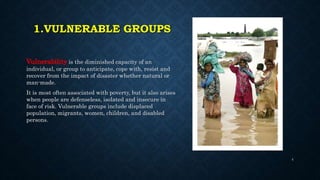
Vulnerability is the diminished capacity of an
individual, or group to anticipate, cope with, resist and
recover from the impact of disaster whether natural or
man-made.
It is most often associated with poverty, but it also arises
when people are defenseless, isolated and insecure in
face of risk. Vulnerable groups include displaced
population, migrants, women, children, and disabled
persons.
4
IMPACTS OF DISASTERS
Women are most prone to disaster due to less power and privilege, low wages and secondary
responsibilities.
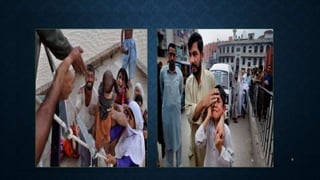
During 2005 earthquake the death troll for children was estimated to be 73000 out of which 17000
were school going children, 42000 were orphaned, and 23000 were disabled people, while 13000
women suffered due to earth quake.
5
6
QUANTITATIVE PROPORTION
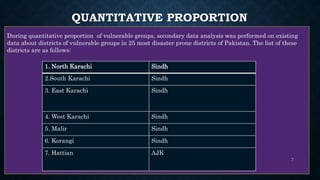
During quantitative proportion of vulnerable groups, secondary data analysis was performed on existing
data about districts of vulnerable groups in 25 most disaster prone districts of Pakistan. The list of these
districts are as follows:
1. North Karachi Sindh
2.South Karachi Sindh
3. East Karachi Sindh
4. West Karachi Sindh
5. Malir Sindh
6. Korangi Sindh
7. Hattian AJK
7
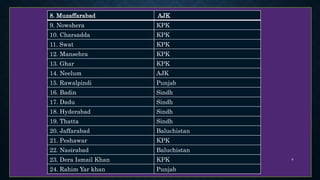
8. Muzaffarabad AJK
9. Nowshera KPK
10. Charsadda KPK
11. Swat KPK
12. Mansehra KPK
13. Ghar KPK
14. Neelum AJK
15. Rawalpindi Punjab
16. Badin Sindh
17. Dadu Sindh
18. Hyderabad Sindh
19. Thatta Sindh
20. Jaffarabad Baluchistan
21. Peshawar KPK
22. Nasirabad Baluchistan
23. Dera Ismail Khan KPK
24. Rahim Yar khan Punjab
8
25. Kashmore Sindh
The data presented in table was the contribution of following institutions.
• NADRA (citizen database)…………………………..
• NADRA (citizen disaster compensation database)
• NDMA (resource and relief data base) ……………
• Pakistan social and living standard measure survey
9
QUALITATIVE PROPORTION
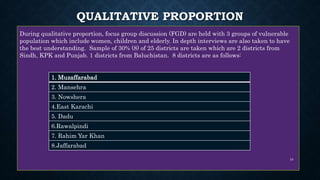
During qualitative proportion, focus group discussion (FGD) are held with 3 groups of vulnerable
population which include women, children and elderly. In depth interviews are also taken to have
the best understanding. Sample of 30% (8) of 25 districts are taken which are 2 districts from
Sindh, KPK and Punjab. 1 districts from Baluchistan. 8 districts are as follows:
1. Muzaffarabad
2. Mansehra
3. Nowshera
4.East Karachi
5. Dadu
6.Rawalpindi
7. Rahim Yar Khan
8.Jaffarabad
10
NEEDS AND CONCERNS
OF VULNERABLE GROUPS
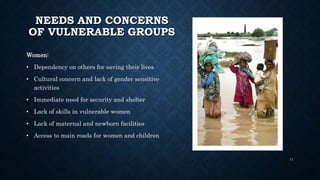
Women:
• Dependency on others for saving their lives
• Cultural concern and lack of gender sensitive
activities
• Immediate need for security and shelter
• Lack of skills in vulnerable women
• Lack of maternal and newborn facilities
• Access to main roads for women and children
11
NEEDS AND CONCERNS OF
VULNERABLE GROUPS
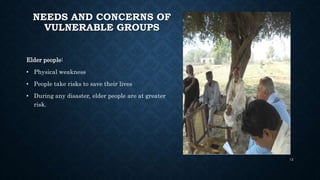
Elder people:
• Physical weakness
• People take risks to save their lives
• During any disaster, elder people are at greater
risk.
12
NEEDS AND CONCERNS OF
VULNERABLE GROUPS
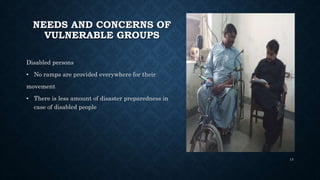
Disabled persons
• No ramps are provided everywhere for their
movement
• There is less amount of disaster preparedness in
case of disabled people
13
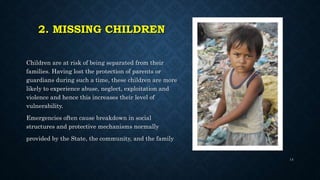
2. MISSING CHILDREN
Children are at risk of being separated from their
families. Having lost the protection of parents or
guardians during such a time, these children are more
likely to experience abuse, neglect, exploitation and
violence and hence this increases their level of
vulnerability.
Emergencies often cause breakdown in social
structures and protective mechanisms normally
provided by the State, the community, and the family
14
Missing children during a disaster can be in the below forms as:
Separated Child: Separated children are those, separated from both parents, or from their
previous legal or customary primary care-giver, but not necessarily from other relatives.
These may, therefore, include children accompanied by other adult family members.
Unaccompanied Child: Unaccompanied children are those who are separated from both
parents and are not being cared for by an adult who, by law or custom, is responsible to do
so.
Orphan: Orphans are children, both of whose parents are known to be dead. In some
countries, however, a child who has lost one parent is called an orphan.
Missing Child: A child registered as separated or unaccompanied but remains classified as
missing until identified and reunified by parents/kin. A list of missing children is generated
from reports by caregivers of their children whose whereabouts is unknown during a
disaster. The child may have died, been abducted, or received by an agency/individual for
temporary protection.
15
NDMA’s Vision for disaster management
NDMA's vision (NDMP 2012-2022)
"To achieve sustainable social, economic and environmental development in Pakistan
through reducing risks and vulnerabilities, particularly those of the poor and marginalized
groups in the country, and to enhance country's ability to manage all disasters (floods,
earthquakes, tsunamis, droughts, landslides, sediment disasters, avalanches, GLOFs,
cyclones with storm surges etc.) using a comprehensive national approach.
For missing child protection there are some guiding principles of NDMA for child protection
which are as follows:
Family unity: According to the principle of family unity (or integrity of the family) all children
have the right to a family, and families have a responsibility to care for their children.
Best interests of the child: This principle constitutes the basic standard for guiding decisions
and actions taken to help children, whether by national or international organizations, courts
of law, administrative authorities, or legislative bodies. 16
Child's opinion: A child's opinion should be listened to and given due weight in relation to the
child's age and maturity. Children must be kept informed about plans being made for them.
Do-no-harm: Care has to be given while dealing with children in emergencies in order to ensure
that no harm is done to their physiological and psychological being.
Psychosocial support: Psychosocial support is the process of meeting a person's emotional,
social, mental and spiritual needs. All of these are essential elements of positive human
development.
Special needs of girls: The special needs of girls must be taken into account throughout the
times of crises, conflict and their aftermath as well as man-made or natural disasters. They are
more vulnerable to sexual abuse and exploitation as well as facing a higher risk of negligence
when it comes to protection and aid.
17
IDENTIFICATION OF MISSING AND UNACCOMPANIED
CHILDREN
Children who should be considered as separated or unaccompanied
are:
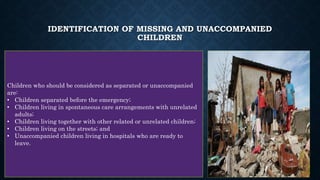
• Children separated before the emergency;
• Children living in spontaneous care arrangements with unrelated
adults;
• Children living together with other related or unrelated children;
• Children living on the streets; and
• Unaccompanied children living in hospitals who are ready to
leave.
18
Steps involved in identification of a missing child:
Registration and Documentation:
During the registration process, unaccompanied and separated children should be registered
individually keeping accountability / responsibility factor in mind, but cross-referenced to the family
they are staying with. Local authorities and field offices should keep a registry wherever a separated
and unaccompanied child is identified.
Registration:
Each identified child should be registered with key personal data i.e. full name, date and place of
birth, father's name and mother's name, former address and present location.
Documentation and Data Management:
A central database for uniformly recording the cases of separated and unaccompanied children
should be established where all the cases can be recorded with the whole background information
and tracked.
Referral System:
It can be defined as a network of all the public sector, private sector and non-profit organizations
working for the protection and provision of the rights of the children affected by the emergency and
disaster to which the child can be referred for different services. 19
INTERIM CARE & FOOD AND SHELTER
Interim Care: If it is not possible to immediately identify or reunite the child with the family, it
becomes imperative to identify interim care measures. All efforts should be made to identify a family
based care option, such as relatives, foster care-givers, or other members of the community and
should be based on the child's best interest.
The number of institutions with the capacity to provide interim care of separated and
unaccompanied children is very limited throughout the country. Most of the existing institutions are
permanent care institutions, that are not geared towards providing interim care and do not have the
protocols and guidelines available for this purpose
Food and Shelter:
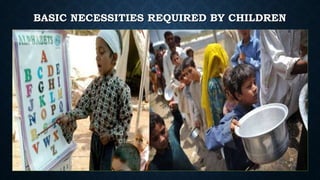
One of the basic steps involved in helping missing and unaccompanied child is food and shelter. The basic
necessities of food and shelter are fulfilled during the placement of children in camps after disaster.
20
FOSTER CARE
Foster Care:
While tracing the parents, a child should be placed with a family which would ideally be willing to
take care of the child. It must also be ensured that the foster family thereof would also be willing to
give the child back to the parents if they are located. Secure and organized fostering arrangements
are necessary if the family cannot be traced immediately. Close monitoring of the family based care
facilities and regular information on how family tracing efforts are proceeding should be carried out.
Steps to ensure while deciding for foster care:
• Ensure that any placement of children with families other than their own is consistent with
traditional child-care practices (CRC, Art. 20.3);
• Ensure that each unaccompanied child has a continuous care-giver and who meets the
developmental needs of the child; and
• As for children living with families other than their own, where an unaccompanied child is
living with someone other than a relative, the relationship should be respected if the child's
needs are being met. 21
FAMILY TRACING
Tracing is the process of searching for family members or primary legal or customary care-givers. The
term also refers to the search for children whose parents are looking for them. The objective of
tracing is reunification with parents or other close relatives. Family tracing and reunification have
been emphasized and promoted as the most important durable solution for unaccompanied and
separated children by all UN-agencies and the National Government.
For tracing of families following steps are necessary:
• Verification must always be carried out. It is a built-in protection for the tracing system. It
• checks that the person claiming the custody of child is, in reality, who they claim to be.
• It can also be used to confirm that the relatives are willing and able to take the child and that
the child wishes to be reunited with these relatives.
• Mobilize the resources at the local Point of Origin. District Coordination Officer (DCO) should
coordinate the tracing process and ensure that involvement of NGOs and CBOs in tracing
follow a prescribed guideline and reporting system.
• Social Welfare Department should be involved in the tracing and family reunification
process.
22
BASIC NECESSITIES REQUIRED BY CHILDREN
23
FAMILY REUNIFICATION
Reunification is the process of bringing together the child and family or previous care-provider for
10 the purpose of establishing or re-establishing long-term care.
Steps involved in reunification are as follows:
• Proof of Claim: It should be mandatory to verify any kind of proof/evidence such as family
• photographs or any other adequate documents (Birth Certificate or Identification
document) of the claimant.
• Photo identification by the child: The child must be involved in the reunification process and
the “best interest of the child” principles must be the guideline for reunification. If any
photograph is available, the child should be allowed to identify the family members and
reconfirm the relationships with the claimer.
• Community verification: Verify the claimer's relationships with the child. The local
community members, local police station should be involved before any reunification takes
place to ensure the security of the child.
The consent of the child is of vital importance in preparation of family reunification.
• In some cases, an assessment of the family situation should be conducted before
reunification takes place.
Upon positive verification of the claimant and consent of the child, handing over by the child
should be done in presence of DCO or Social Welfare officer or Police
24
3. GCC (GENDER AND CHILD CELL)
In 2010,NDMA created GCC (gender and child cell) which aims at prioritizing gender and
integration of needs and concerns of children and vulnerable people.
Vision of GCC:
“ To ensure needs and concerns of all vulnerable groups are addressed in all phases and in
all types of disaster”
25
NATURAL POLICY GUIDELINES ON VULNERABLE
PEOPLE
• To meet needs of various segments of population
• To ensure all interventions ARE designed with needs of specific group to safeguard equitable
access, benefits and opportunities in all response designs
• To encourage balanced and active participation of vulnerable groups in decision making
process that affect them most.
26
NATIONAL DISASTER MANAGEMENT
PLAN (NDMP.2012-2022)
This plan was formulated to translate DRM (disaster risk management) policy
imperatives into implementation framework and aims at supporting entire spectrum
of DRM to alleviate the problems of vulnerable groups.
Vision of National Disaster Management Plan:
“ To achieve sustainable social, economical, environmental development in Pakistan,
through reducing risks and vulnerabilities, particularly of poor and Vulnerable groups
by using comprehension national approach.”
27
NATIONAL GCC FRAMEWORK(2013-2016)
This is the follow up of NDMP(national disaster management plan) of GCC (gender and child cell) ,
approved by chairman NDMP. It has following outcomes.
Outcome 1:
Needs and concerns of vulnerable groups are integrated in all policies for all disaster.
Outcome 2:
Institutions are strengthened and coordinating mechanisms are developed for addressing the needs
and concerns of vulnerable groups at all levels.
28
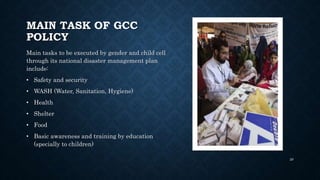
MAIN TASK OF GCC
POLICY
Main tasks to be executed by gender and child cell
through its national disaster management plan
include:
• Safety and security
• WASH (Water, Sanitation, Hygiene)
• Health
• Shelter
• Food
• Basic awareness and training by education
(specially to children)
29
RECOMMENDATIONS FOR IMPLEMENTING GCC
POLICY FOR VULNERABLE GROUPS
Based on the information gained through focus group discussions and interviews, the following
recommendations can be made to address the needs and concerns of vulnerable groups in the
most disaster prone districts of Pakistan.
1. Advocacy for providing life skill training to Women to reduce dependency on others for saving
their lives.
2. Mapping of Vulnerable population groups through community based registration system
3. Ensuring gender balance in rescue teams to provide of Gender-sensitive relief services
4. Establishment of customized Shelter designed for Women children immediately post disaster
period with necessary amenities
5. Community Involvement in relief work for vulnerable women, children, elderly and disabled
population groups
6. Ensuring responsive Maternal and Newborn health Services immediately post disaster
7. Utilizing Preferred Sources of Information During Disasters for information sharing
30
RECOMMENDATIONS FOR IMPLEMENTING
GCC POLICY FOR VULNERABLE GROUPS
8. Provision of immediate Psychological and Mental Health services to all vulnerable groups on
priority basis
9. Ensuring mobility of disabled though Physical structures like ramps and slopes in building to
move quickly
10. Elderly care needs proper geriatric services and making health services “Age-Friendly”
11. Sharing Knowledge about Organizations Working for Elderly and Disabled
12. Training Service providers Manage Needs of the vulnerable groups of elderly and disabled
31
THANK YOU !
32

How to find missing children, vulnerable groups and managing them

  • 1.
  • 2.
    VULNERABLE GROUPS AND SOPS& GUIDELINES ON MISSING CHILDREN AFTER DISASTER Submitted to: Dr. Rizwan Riaz Submitted by : Hamza Waheed (2015-CIV-111) Muneeb Ahmad(2015-CIV-135) 2
  • 3.
    Contents: 1. Vulnerable groups Qualitative proportion  Impacts of disaster on Vulnerable groups  Quantitative proportion  Needs and concerns of vulnerable groups 2. Missing children and Unaccompanied Children  Identification of missing children  Interim care  Family tracing  Family reunification 3. Governmental policies for vulnerable groups and missing children  What is GCC?  Main purpose of GCC  National Policy Guidelines on vulnerable groups  National Disaster management plan  National Gender and child cell (GCC) framework  Major Necessities of vulnerable groups and their provision 3
  • 4.
    1.VULNERABLE GROUPS Vulnerability isthe diminished capacity of an individual, or group to anticipate, cope with, resist and recover from the impact of disaster whether natural or man-made. It is most often associated with poverty, but it also arises when people are defenseless, isolated and insecure in face of risk. Vulnerable groups include displaced population, migrants, women, children, and disabled persons. 4
  • 5.
    IMPACTS OF DISASTERS Womenare most prone to disaster due to less power and privilege, low wages and secondary responsibilities. During 2005 earthquake the death troll for children was estimated to be 73000 out of which 17000 were school going children, 42000 were orphaned, and 23000 were disabled people, while 13000 women suffered due to earth quake. 5
  • 6.
  • 7.
    QUANTITATIVE PROPORTION During quantitativeproportion of vulnerable groups, secondary data analysis was performed on existing data about districts of vulnerable groups in 25 most disaster prone districts of Pakistan. The list of these districts are as follows: 1. North Karachi Sindh 2.South Karachi Sindh 3. East Karachi Sindh 4. West Karachi Sindh 5. Malir Sindh 6. Korangi Sindh 7. Hattian AJK 7
  • 8.
    8. Muzaffarabad AJK 9.Nowshera KPK 10. Charsadda KPK 11. Swat KPK 12. Mansehra KPK 13. Ghar KPK 14. Neelum AJK 15. Rawalpindi Punjab 16. Badin Sindh 17. Dadu Sindh 18. Hyderabad Sindh 19. Thatta Sindh 20. Jaffarabad Baluchistan 21. Peshawar KPK 22. Nasirabad Baluchistan 23. Dera Ismail Khan KPK 24. Rahim Yar khan Punjab 8
  • 9.
    25. Kashmore Sindh Thedata presented in table was the contribution of following institutions. • NADRA (citizen database)………………………….. • NADRA (citizen disaster compensation database) • NDMA (resource and relief data base) …………… • Pakistan social and living standard measure survey 9
  • 10.
    QUALITATIVE PROPORTION During qualitativeproportion, focus group discussion (FGD) are held with 3 groups of vulnerable population which include women, children and elderly. In depth interviews are also taken to have the best understanding. Sample of 30% (8) of 25 districts are taken which are 2 districts from Sindh, KPK and Punjab. 1 districts from Baluchistan. 8 districts are as follows: 1. Muzaffarabad 2. Mansehra 3. Nowshera 4.East Karachi 5. Dadu 6.Rawalpindi 7. Rahim Yar Khan 8.Jaffarabad 10
  • 11.
    NEEDS AND CONCERNS OFVULNERABLE GROUPS Women: • Dependency on others for saving their lives • Cultural concern and lack of gender sensitive activities • Immediate need for security and shelter • Lack of skills in vulnerable women • Lack of maternal and newborn facilities • Access to main roads for women and children 11
  • 12.
    NEEDS AND CONCERNSOF VULNERABLE GROUPS Elder people: • Physical weakness • People take risks to save their lives • During any disaster, elder people are at greater risk. 12
  • 13.
    NEEDS AND CONCERNSOF VULNERABLE GROUPS Disabled persons • No ramps are provided everywhere for their movement • There is less amount of disaster preparedness in case of disabled people 13
  • 14.
    2. MISSING CHILDREN Childrenare at risk of being separated from their families. Having lost the protection of parents or guardians during such a time, these children are more likely to experience abuse, neglect, exploitation and violence and hence this increases their level of vulnerability. Emergencies often cause breakdown in social structures and protective mechanisms normally provided by the State, the community, and the family 14
  • 15.
    Missing children duringa disaster can be in the below forms as: Separated Child: Separated children are those, separated from both parents, or from their previous legal or customary primary care-giver, but not necessarily from other relatives. These may, therefore, include children accompanied by other adult family members. Unaccompanied Child: Unaccompanied children are those who are separated from both parents and are not being cared for by an adult who, by law or custom, is responsible to do so. Orphan: Orphans are children, both of whose parents are known to be dead. In some countries, however, a child who has lost one parent is called an orphan. Missing Child: A child registered as separated or unaccompanied but remains classified as missing until identified and reunified by parents/kin. A list of missing children is generated from reports by caregivers of their children whose whereabouts is unknown during a disaster. The child may have died, been abducted, or received by an agency/individual for temporary protection. 15
  • 16.
    NDMA’s Vision fordisaster management NDMA's vision (NDMP 2012-2022) "To achieve sustainable social, economic and environmental development in Pakistan through reducing risks and vulnerabilities, particularly those of the poor and marginalized groups in the country, and to enhance country's ability to manage all disasters (floods, earthquakes, tsunamis, droughts, landslides, sediment disasters, avalanches, GLOFs, cyclones with storm surges etc.) using a comprehensive national approach. For missing child protection there are some guiding principles of NDMA for child protection which are as follows: Family unity: According to the principle of family unity (or integrity of the family) all children have the right to a family, and families have a responsibility to care for their children. Best interests of the child: This principle constitutes the basic standard for guiding decisions and actions taken to help children, whether by national or international organizations, courts of law, administrative authorities, or legislative bodies. 16
  • 17.
    Child's opinion: Achild's opinion should be listened to and given due weight in relation to the child's age and maturity. Children must be kept informed about plans being made for them. Do-no-harm: Care has to be given while dealing with children in emergencies in order to ensure that no harm is done to their physiological and psychological being. Psychosocial support: Psychosocial support is the process of meeting a person's emotional, social, mental and spiritual needs. All of these are essential elements of positive human development. Special needs of girls: The special needs of girls must be taken into account throughout the times of crises, conflict and their aftermath as well as man-made or natural disasters. They are more vulnerable to sexual abuse and exploitation as well as facing a higher risk of negligence when it comes to protection and aid. 17
  • 18.
    IDENTIFICATION OF MISSINGAND UNACCOMPANIED CHILDREN Children who should be considered as separated or unaccompanied are: • Children separated before the emergency; • Children living in spontaneous care arrangements with unrelated adults; • Children living together with other related or unrelated children; • Children living on the streets; and • Unaccompanied children living in hospitals who are ready to leave. 18
  • 19.
    Steps involved inidentification of a missing child: Registration and Documentation: During the registration process, unaccompanied and separated children should be registered individually keeping accountability / responsibility factor in mind, but cross-referenced to the family they are staying with. Local authorities and field offices should keep a registry wherever a separated and unaccompanied child is identified. Registration: Each identified child should be registered with key personal data i.e. full name, date and place of birth, father's name and mother's name, former address and present location. Documentation and Data Management: A central database for uniformly recording the cases of separated and unaccompanied children should be established where all the cases can be recorded with the whole background information and tracked. Referral System: It can be defined as a network of all the public sector, private sector and non-profit organizations working for the protection and provision of the rights of the children affected by the emergency and disaster to which the child can be referred for different services. 19
  • 20.
    INTERIM CARE &FOOD AND SHELTER Interim Care: If it is not possible to immediately identify or reunite the child with the family, it becomes imperative to identify interim care measures. All efforts should be made to identify a family based care option, such as relatives, foster care-givers, or other members of the community and should be based on the child's best interest. The number of institutions with the capacity to provide interim care of separated and unaccompanied children is very limited throughout the country. Most of the existing institutions are permanent care institutions, that are not geared towards providing interim care and do not have the protocols and guidelines available for this purpose Food and Shelter: One of the basic steps involved in helping missing and unaccompanied child is food and shelter. The basic necessities of food and shelter are fulfilled during the placement of children in camps after disaster. 20
  • 21.
    FOSTER CARE Foster Care: Whiletracing the parents, a child should be placed with a family which would ideally be willing to take care of the child. It must also be ensured that the foster family thereof would also be willing to give the child back to the parents if they are located. Secure and organized fostering arrangements are necessary if the family cannot be traced immediately. Close monitoring of the family based care facilities and regular information on how family tracing efforts are proceeding should be carried out. Steps to ensure while deciding for foster care: • Ensure that any placement of children with families other than their own is consistent with traditional child-care practices (CRC, Art. 20.3); • Ensure that each unaccompanied child has a continuous care-giver and who meets the developmental needs of the child; and • As for children living with families other than their own, where an unaccompanied child is living with someone other than a relative, the relationship should be respected if the child's needs are being met. 21
  • 22.
    FAMILY TRACING Tracing isthe process of searching for family members or primary legal or customary care-givers. The term also refers to the search for children whose parents are looking for them. The objective of tracing is reunification with parents or other close relatives. Family tracing and reunification have been emphasized and promoted as the most important durable solution for unaccompanied and separated children by all UN-agencies and the National Government. For tracing of families following steps are necessary: • Verification must always be carried out. It is a built-in protection for the tracing system. It • checks that the person claiming the custody of child is, in reality, who they claim to be. • It can also be used to confirm that the relatives are willing and able to take the child and that the child wishes to be reunited with these relatives. • Mobilize the resources at the local Point of Origin. District Coordination Officer (DCO) should coordinate the tracing process and ensure that involvement of NGOs and CBOs in tracing follow a prescribed guideline and reporting system. • Social Welfare Department should be involved in the tracing and family reunification process. 22
  • 23.
  • 24.
    FAMILY REUNIFICATION Reunification isthe process of bringing together the child and family or previous care-provider for 10 the purpose of establishing or re-establishing long-term care. Steps involved in reunification are as follows: • Proof of Claim: It should be mandatory to verify any kind of proof/evidence such as family • photographs or any other adequate documents (Birth Certificate or Identification document) of the claimant. • Photo identification by the child: The child must be involved in the reunification process and the “best interest of the child” principles must be the guideline for reunification. If any photograph is available, the child should be allowed to identify the family members and reconfirm the relationships with the claimer. • Community verification: Verify the claimer's relationships with the child. The local community members, local police station should be involved before any reunification takes place to ensure the security of the child. The consent of the child is of vital importance in preparation of family reunification. • In some cases, an assessment of the family situation should be conducted before reunification takes place. Upon positive verification of the claimant and consent of the child, handing over by the child should be done in presence of DCO or Social Welfare officer or Police 24
  • 25.
    3. GCC (GENDERAND CHILD CELL) In 2010,NDMA created GCC (gender and child cell) which aims at prioritizing gender and integration of needs and concerns of children and vulnerable people. Vision of GCC: “ To ensure needs and concerns of all vulnerable groups are addressed in all phases and in all types of disaster” 25
  • 26.
    NATURAL POLICY GUIDELINESON VULNERABLE PEOPLE • To meet needs of various segments of population • To ensure all interventions ARE designed with needs of specific group to safeguard equitable access, benefits and opportunities in all response designs • To encourage balanced and active participation of vulnerable groups in decision making process that affect them most. 26
  • 27.
    NATIONAL DISASTER MANAGEMENT PLAN(NDMP.2012-2022) This plan was formulated to translate DRM (disaster risk management) policy imperatives into implementation framework and aims at supporting entire spectrum of DRM to alleviate the problems of vulnerable groups. Vision of National Disaster Management Plan: “ To achieve sustainable social, economical, environmental development in Pakistan, through reducing risks and vulnerabilities, particularly of poor and Vulnerable groups by using comprehension national approach.” 27
  • 28.
    NATIONAL GCC FRAMEWORK(2013-2016) Thisis the follow up of NDMP(national disaster management plan) of GCC (gender and child cell) , approved by chairman NDMP. It has following outcomes. Outcome 1: Needs and concerns of vulnerable groups are integrated in all policies for all disaster. Outcome 2: Institutions are strengthened and coordinating mechanisms are developed for addressing the needs and concerns of vulnerable groups at all levels. 28
  • 29.
    MAIN TASK OFGCC POLICY Main tasks to be executed by gender and child cell through its national disaster management plan include: • Safety and security • WASH (Water, Sanitation, Hygiene) • Health • Shelter • Food • Basic awareness and training by education (specially to children) 29
  • 30.
    RECOMMENDATIONS FOR IMPLEMENTINGGCC POLICY FOR VULNERABLE GROUPS Based on the information gained through focus group discussions and interviews, the following recommendations can be made to address the needs and concerns of vulnerable groups in the most disaster prone districts of Pakistan. 1. Advocacy for providing life skill training to Women to reduce dependency on others for saving their lives. 2. Mapping of Vulnerable population groups through community based registration system 3. Ensuring gender balance in rescue teams to provide of Gender-sensitive relief services 4. Establishment of customized Shelter designed for Women children immediately post disaster period with necessary amenities 5. Community Involvement in relief work for vulnerable women, children, elderly and disabled population groups 6. Ensuring responsive Maternal and Newborn health Services immediately post disaster 7. Utilizing Preferred Sources of Information During Disasters for information sharing 30
  • 31.
    RECOMMENDATIONS FOR IMPLEMENTING GCCPOLICY FOR VULNERABLE GROUPS 8. Provision of immediate Psychological and Mental Health services to all vulnerable groups on priority basis 9. Ensuring mobility of disabled though Physical structures like ramps and slopes in building to move quickly 10. Elderly care needs proper geriatric services and making health services “Age-Friendly” 11. Sharing Knowledge about Organizations Working for Elderly and Disabled 12. Training Service providers Manage Needs of the vulnerable groups of elderly and disabled 31
  • 32.