WELCOME
To
Morning Session
TOPIC: PLACENTA PRAEVIA
Presented by:
Dr. Bijit Talukdar
Intern Doctor
Unit-III
Dept. of Obstetrics & Gynaecology
PLACENTA PRAEVIA
When the placenta is implanted partially or
completely over the lower uterine
segment, it is called placenta praevia.
CAUSES OF PLACENTA PRAEVIA:
Dropping down theory.
Persistence of chorionic activity.
Defective decidua.
Big surface area of the placenta.
PREDISPOSING FACTORS :
 Multiparity
 Maternal age: >35 years
 Race: Asian women
 Infertility treatment
 Presence of uterine scar
 Prior curettage
 Prior placenta praevia
 Multiple pregnancy
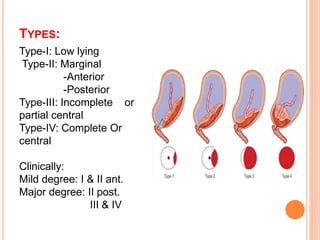
TYPES:
Type-I: Low lying
Type-II: Marginal
-Anterior
-Posterior
Type-III: Incomplete or
partial central
Type-IV: Complete Or
central
Clinically:
Mild degree: I & II ant.
Major degree: II post.
III & IV
DANGEROUS TYPE OF PLACENTA PRAEVIA
 Type II posterior placenta praevia
Cause-
1. Because of the curved birth canal major thickness
of placenta overlies the sacral promontory, thereby
diminishing the antero-posterior diameter of the
inlet & prevents engagement of the presenting
part. This hinders effective compression of the
separated placenta to stop bleeding.
2. Placenta is more likely to be compressed if
vaginal delivery is allowed.
3. More chance of cord compression or prolapse
which may produce fetal anoxia or even death.
CHARACTERISTICS OF BLEEDING
Small
Painless
Recurrent
Inevitable
CAUSE OF BLEEDING:
 Placental growth slows on later months of
pregnancy, but the lower uterine segment
progressively dilates.
 Placenta gets separated due to shearing effect.
 Maternal sinuses become open up
 Bleeding occurs
MANAGEMENT OF PLACENTA PRAEVIA
Diagnosis:
Clinical features:
Symptoms: Sudden onset , painless, apparently causeless
& recurrent bleeding.
Signs:
General examination: General condition & anaemia are
proportionate to visible blood loss.
Abdominal Examination:
Size of uterus: proportionate to the period of gestation.
Feel of uterus: Soft, relaxed & elastic without any localised area
of tenderness.
Malpresentaion: Berech or transverse or unstable lie is more
frequent.
Fetal head: High floating
FHS: Usually present
Vulval inspection:
To see whether the bleeding is still occurring or not.
Character of blood: Bright red
Investigation:
Confirmation of diagnosis: USG of Pregnancy profile
Others:
Hb%
Blood grouping & Rh typing & cross matching
RBS
TREATMENT:
Expectant treatment:
1. Hospitalization
2. Wide bore IV cannula
3. IV fluid
4. Blood transfusion after grouping & cross matching
5. Iron & folic acid
6. Catheterization
7. Close follow up
DEFINITIVE TREATMENT:
Termination of pregnancy.
According to the type of placenta praevia:
A) Type I & Type II anterior: Normal vaginal delivery (
If maternal & fetal condition is good)
B) Type II posterior, Type III & Type IV: Caesarean
section
COMPLICATIONS:
Maternal Complication:
During pregnancy:
1. APH with varying degrees of shock.
2. Malpresentation
3. Premature labour
During labour:
1. Early rupture of membrane
2. Cord prolapse
3. Intrapartum Haemorrhage
4. Post partum haemorrhage
5. Retained placenta
During Puerperium:
1. Puerperal sepsis
2. Subinvolution
3. Embolism
Fetal Complication:
1. Low birth weight
2. Fetal growth restriction
3. IUFD
4. Asphyxia
5. Birth injury
6. Congenital Malformation
THANK YOU

Placenta Praevia.pptx

  • 1.
  • 2.
    TOPIC: PLACENTA PRAEVIA Presentedby: Dr. Bijit Talukdar Intern Doctor Unit-III Dept. of Obstetrics & Gynaecology
  • 3.
    PLACENTA PRAEVIA When theplacenta is implanted partially or completely over the lower uterine segment, it is called placenta praevia.
  • 4.
    CAUSES OF PLACENTAPRAEVIA: Dropping down theory. Persistence of chorionic activity. Defective decidua. Big surface area of the placenta.
  • 5.
    PREDISPOSING FACTORS : Multiparity  Maternal age: >35 years  Race: Asian women  Infertility treatment  Presence of uterine scar  Prior curettage  Prior placenta praevia  Multiple pregnancy
  • 6.
    TYPES: Type-I: Low lying Type-II:Marginal -Anterior -Posterior Type-III: Incomplete or partial central Type-IV: Complete Or central Clinically: Mild degree: I & II ant. Major degree: II post. III & IV
  • 7.
    DANGEROUS TYPE OFPLACENTA PRAEVIA  Type II posterior placenta praevia Cause- 1. Because of the curved birth canal major thickness of placenta overlies the sacral promontory, thereby diminishing the antero-posterior diameter of the inlet & prevents engagement of the presenting part. This hinders effective compression of the separated placenta to stop bleeding. 2. Placenta is more likely to be compressed if vaginal delivery is allowed. 3. More chance of cord compression or prolapse which may produce fetal anoxia or even death.
  • 8.
  • 9.
    CAUSE OF BLEEDING: Placental growth slows on later months of pregnancy, but the lower uterine segment progressively dilates.  Placenta gets separated due to shearing effect.  Maternal sinuses become open up  Bleeding occurs
  • 10.
    MANAGEMENT OF PLACENTAPRAEVIA Diagnosis: Clinical features: Symptoms: Sudden onset , painless, apparently causeless & recurrent bleeding. Signs: General examination: General condition & anaemia are proportionate to visible blood loss. Abdominal Examination: Size of uterus: proportionate to the period of gestation. Feel of uterus: Soft, relaxed & elastic without any localised area of tenderness. Malpresentaion: Berech or transverse or unstable lie is more frequent. Fetal head: High floating FHS: Usually present
  • 11.
    Vulval inspection: To seewhether the bleeding is still occurring or not. Character of blood: Bright red Investigation: Confirmation of diagnosis: USG of Pregnancy profile Others: Hb% Blood grouping & Rh typing & cross matching RBS
  • 12.
    TREATMENT: Expectant treatment: 1. Hospitalization 2.Wide bore IV cannula 3. IV fluid 4. Blood transfusion after grouping & cross matching 5. Iron & folic acid 6. Catheterization 7. Close follow up
  • 13.
    DEFINITIVE TREATMENT: Termination ofpregnancy. According to the type of placenta praevia: A) Type I & Type II anterior: Normal vaginal delivery ( If maternal & fetal condition is good) B) Type II posterior, Type III & Type IV: Caesarean section
  • 14.
    COMPLICATIONS: Maternal Complication: During pregnancy: 1.APH with varying degrees of shock. 2. Malpresentation 3. Premature labour During labour: 1. Early rupture of membrane 2. Cord prolapse 3. Intrapartum Haemorrhage 4. Post partum haemorrhage 5. Retained placenta
  • 15.
    During Puerperium: 1. Puerperalsepsis 2. Subinvolution 3. Embolism Fetal Complication: 1. Low birth weight 2. Fetal growth restriction 3. IUFD 4. Asphyxia 5. Birth injury 6. Congenital Malformation
  • 16.