The document discusses and compares the time and space complexities of several sorting algorithms:
- Bubble sort has a time complexity of O(n^2) and space complexity of O(1).
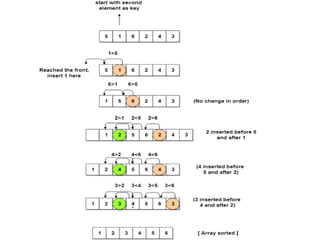
- Insertion sort also has O(n^2) average time complexity and O(1) space complexity.
- Selection sort's time complexity is O(n^2).
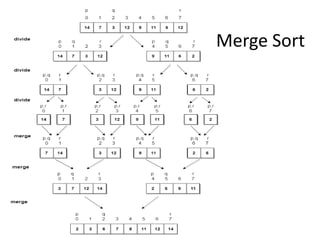
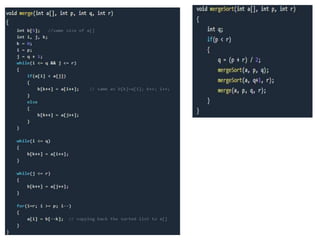
- Merge sort has the best time complexity of O(nlogn) but requires O(n) space to perform the merges.

![Bubble sort
void bubbleSort(int arr[], int n)
{
int i, j, temp;
for(i = 0; i < n; i++)
{
for(j = 0; j < n-i-1; j++)
{
if( arr[j] > arr[j+1])
{
// swap the elements
temp = arr[j];
arr[j] = arr[j+1];
arr[j+1] = temp;
}
}
}
}](https://image.slidesharecdn.com/06v7k6vseyskns6inxyh-signature-ebac220b40f52b1138ea4ecc20d36a25d7d1287fe4496571fc695452f5ae1068-poli-201021034551/85/Dsa-sorting-2-320.jpg)

![Complexity Analysis of Bubble Sort
In Bubble Sort, n-1 comparisons will be done in the 1st pass, n-2 in 2nd pass, n-3 in
3rd pass and so on. So the total number of comparisons will be,
(n-1) + (n-2) + (n-3) + ..... + 3 + 2 + 1 Sum = n(n-1)/2 i.e O(n2)
Hence the time complexity of Bubble Sort is O(n2).
The main advantage of Bubble Sort is the simplicity of the algorithm.
The space complexity for Bubble Sort is O(1), because only a single additional memory
space is required i.e. for temp variable.
Also, the best case time complexity will be O(n), it is when the list is already sorted.
Following are the Time and Space complexity for the Bubble Sort algorithm.
• Worst Case Time Complexity [ Big-O ]: O(n2)
• Best Case Time Complexity [Big-omega]: O(n)
• Average Time Complexity [Big-theta]: O(n2)
• Space Complexity: O(1)](https://image.slidesharecdn.com/06v7k6vseyskns6inxyh-signature-ebac220b40f52b1138ea4ecc20d36a25d7d1287fe4496571fc695452f5ae1068-poli-201021034551/85/Dsa-sorting-4-320.jpg)
![Insertion Sort
void insertionSort(int arr[], int length)
{
int i, j, key;
for (i = 1; i < length; i++)
{
j = i;
while (j > 0 && arr[j - 1] > arr[j])
{
key = arr[j];
arr[j] = arr[j - 1];
arr[j - 1] = key;
j--;
}
}
}](https://image.slidesharecdn.com/06v7k6vseyskns6inxyh-signature-ebac220b40f52b1138ea4ecc20d36a25d7d1287fe4496571fc695452f5ae1068-poli-201021034551/85/Dsa-sorting-5-320.jpg)

![Selection Sort
void selection_sort (int A[ ], int n)
{
int minimum;
for(int i = 0; i < n-1 ; i++)
{
minimum = i ;
for(int j = i+1; j < n ; j++ )
{
if(A[ j ] < A[ minimum ])
{
minimum = j ;
}
}
swap ( A[ minimum ], A[ i ]) ;
}
}](https://image.slidesharecdn.com/06v7k6vseyskns6inxyh-signature-ebac220b40f52b1138ea4ecc20d36a25d7d1287fe4496571fc695452f5ae1068-poli-201021034551/85/Dsa-sorting-8-320.jpg)
![Complexity of Merge Sort
we have already learned in Binary Search that whenever we divide a number into half
in every stpe, it can be represented using a logarithmic function, which is log n and
the number of steps can be represented by log n + 1(at most)
Also, we perform a single step operation to find out the middle of any subarray,
i.e. O(1).
And to merge the subarrays, made by dividing the original array of n elements, a
running time of O(n) will be required.
Hence the total time for mergeSort function will become n(log n + 1), which gives us a
time complexity of O(n*log n).
• Worst Case Time Complexity [ Big-O ]: O(n*log n)
• Best Case Time Complexity [Big-omega]: O(n*log n)
• Average Time Complexity [Big-theta]: O(n*log n)
• Space Complexity: O(n)](https://image.slidesharecdn.com/06v7k6vseyskns6inxyh-signature-ebac220b40f52b1138ea4ecc20d36a25d7d1287fe4496571fc695452f5ae1068-poli-201021034551/85/Dsa-sorting-12-320.jpg)


