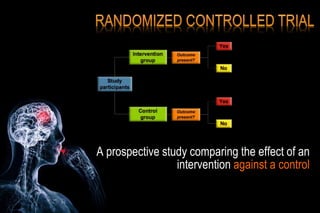
A prospective study comparing the effect of an
intervention against a control
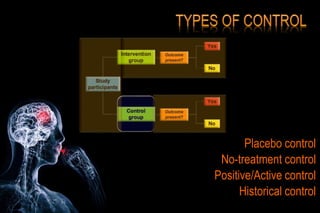
Placebo control
No-treatment control
Positive/Active control
Historical control
Show superiority to placebo
Show superiority to known effective treatment
(“active control”)
Show non-inferiority to active control
1811
An epithet to describe any medicine given more to please than
benefit the patient
1964
A placebo is expected to 1) deliberately have an effect or
2) unknowingly influence any component of the disease
2005
A placebo is a simulated or otherwise medically ineffectual
treatment for a disease or other medical condition intended to
deceive the recipient
The placebo effect is the beneficial physical or psychological
change in a person resulting from conscious or non-conscious
“beliefs” unaided by any medically active pill or procedure
A medical treatment is said to have a placebo effect if a patient’s
response to treatment depends positively on his expectations
about the value of that treatment
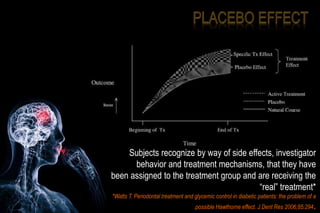
Subjects recognize by way of side effects, investigator
behavior and treatment mechanisms, that they have
been assigned to the treatment group and are receiving the
“real” treatment*
*Watts T. Periodontal treatment and glycemic control in diabetic patients: the problem of a
possible Hawthorne effect. J Dent Res 2006;85:294.
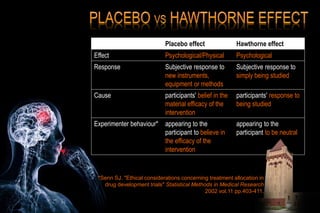
Placebo effect Hawthorne effect
Effect Psychological/Physical Psychological
Response Subjective response to
new instruments,
equipment or methods
Subjective response to
simply being studied
Cause participants' belief in the
material efficacy of the
intervention
participants' response to
being studied
Experimenter behaviour* appearing to the
participant to believe in
the efficacy of the
intervention
appearing to the
participant to be neutral
*Senn SJ. "Ethical considerations concerning treatment allocation in
drug development trials" Statistical Methods in Medical Research
2002 vol.11 pp.403-411.
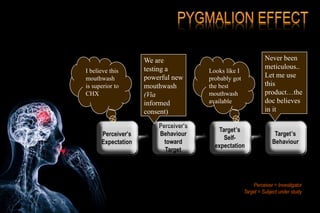
Perceiver = Investigator
Target = Subject under study
I believe this
mouthwash
is superior to
CHX
Looks like I
probably got
the best
mouthwash
available
We are
testing a
powerful new
mouthwash
(Via
informed
consent)
Never been
meticulous..
Let me use
this
product…the
doc believes
in it
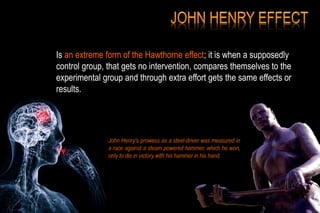
Is an extreme form of the Hawthorne effect; it is when a supposedly
control group, that gets no intervention, compares themselves to the
experimental group and through extra effort gets the same effects or
results.
John Henry's prowess as a steel-driver was measured in
a race against a steam powered hammer, which he won,
only to die in victory with his hammer in his hand.
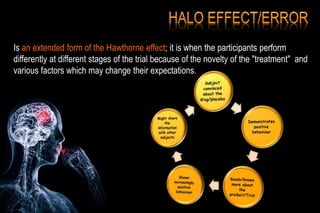
Is an extended form of the Hawthorne effect; it is when the participants perform
differently at different stages of the trial because of the novelty of the "treatment" and
various factors which may change their expectations.
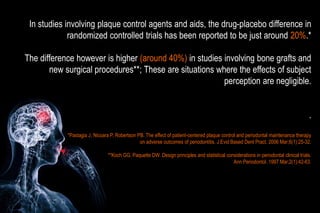
In studies involving plaque control agents and aids, the drug-placebo difference in
randomized controlled trials has been reported to be just around 20%.*
The difference however is higher (around 40%) in studies involving bone grafts and
new surgical procedures**; These are situations where the effects of subject
perception are negligible.
.
*Pastagia J, Nicoara P, Robertson PB. The effect of patient-centered plaque control and periodontal maintenance therapy
on adverse outcomes of periodontitis. J Evid Based Dent Pract. 2006 Mar;6(1):25-32.
**Koch GG, Paquette DW. Design principles and statistical considerations in periodontal clinical trials.
Ann Periodontol. 1997 Mar;2(1):42-63.
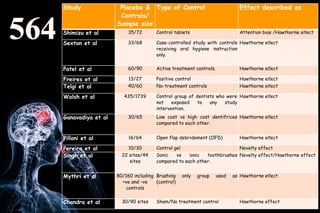
Study Placebo &
Controls/
Sample size
Type of Control Effect described as
Shimizu et al 35/72 Control tablets Attention bias /Hawthorne effect
Sexton et al 33/68 Case-controlled study with controls
receiving oral hygiene instruction
only.
Hawthorne effect
Patel et al 60/90 Active treatment controls. Hawthorne effect
Freires et al 13/27 Positive control Hawthorne effect
Telgi et al 40/60 No-treatment controls Hawthorne effect
Walsh et al 435/1739 Control group of dentists who were
not exposed to any study
intervention.
Hawthorne effect
Ganavadiya et al 30/65 Low cost vs high cost dentifrices
compared to each other.
Hawthorne effect
Pilloni et al 16/64 Open flap debridement (OFD) Hawthorne effect
Pereira et al 10/30 Control gel Novelty effect
Singh et al 22 sites/44
sites
Sonic vs ionic toothbrushes
compared to each other.
Novelty effect/Hawthorne effect
Mythri et al 80/160 including
+ve and –ve
controls
Brushing only group used as
(control)
Hawthorne effect
Chandra et al 30/90 sites Sham/No treatment control Hawthorne effect
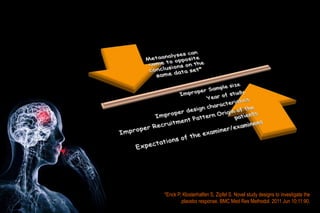
*Enck P, Klosterhalfen S, Zipfel S. Novel study designs to investigate the
placebo response. BMC Med Res Methodol. 2011 Jun 10;11:90.
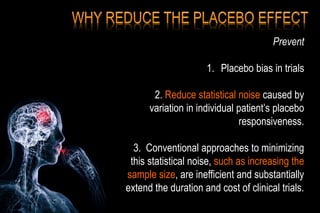
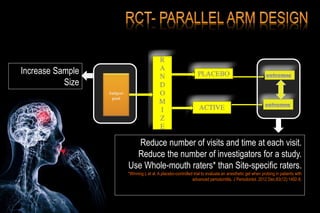
Prevent
1. Placebo bias in trials
2. Reduce statistical noise caused by
variation in individual patient’s placebo
responsiveness.
3. Conventional approaches to minimizing
this statistical noise, such as increasing the
sample size, are inefficient and substantially
extend the duration and cost of clinical trials.
Subject
pool
Reduce number of visits and time at each visit.
Reduce the number of investigators for a study.
Use Whole-mouth raters* than Site-specific raters.
*Winning L et al. A placebo-controlled trial to evaluate an anesthetic gel when probing in patients with
advanced periodontitis. J Periodontol. 2012 Dec;83(12):1492-8.
Increase Sample
Size
Subject
pool
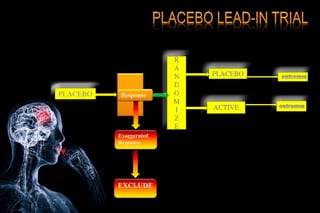
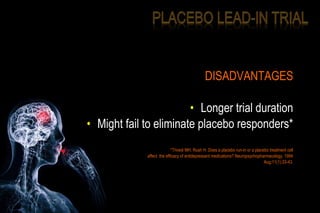
DISADVANTAGES
• Longer trial duration
• Might fail to eliminate placebo responders*
*Trivedi MH, Rush H. Does a placebo run-in or a placebo treatment cell
affect the efficacy of antidepressant medications? Neuropsychopharmacology. 1994
Aug;11(1):33-43.
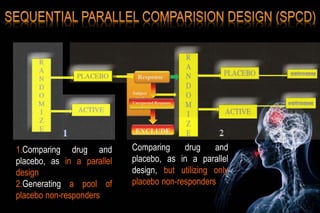
Subject
pool
1.Comparing drug and
placebo, as in a parallel
design
2.Generating a pool of
placebo non-responders
Comparing drug and
placebo, as in a parallel
design, but utilizing only
placebo non-responders
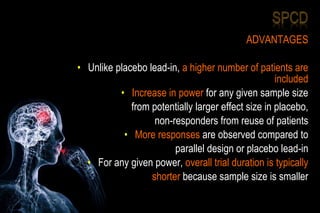
ADVANTAGES
• Unlike placebo lead-in, a higher number of patients are
included
• Increase in power for any given sample size
from potentially larger effect size in placebo,
non-responders from reuse of patients
• More responses are observed compared to
parallel design or placebo lead-in
• For any given power, overall trial duration is typically
shorter because sample size is smaller
DISADVANTAGES
• Longer trial duration for individual subjects compared
to the parallel design and placebo lead-in
• Use of placebo non-responders (as in placebo lead-in)
is well accepted for Phase III trials
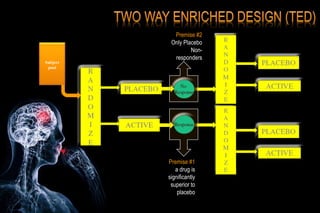
Subject
pool
Premise #1
a drug is
significantly
superior to
placebo
Premise #2
Only Placebo
Non-
responders
“IN GENERAL THIS METHODOLOGY SHOULD ONLY
BE USED IN THE ABSENCE OF EXISTING PROVEN
THERAPY”
EXCEPTION
“COMPELLING METHODOLOGICAL REASONS”
FOR ITS USE
*Carpenter WT Jr, Appelbaum PS, Levine RJ. The Declaration of Helsinki and clinical trials.
Am J Psychiatry. 2003 Feb;160(2):356-62.
No effective treatment/replacement exists
Use of placebo control entails minor risks to subjects
Other controls not yielding reliable results
*Council for International Organizations of Medical Sciences
No effective treatment exists for the population being
studied
Effective treatment involves side effects for most patients
that are highly unacceptable
New treatment & placebo control are added on to
standard treatment for all subjects
Study involves a minor ailment
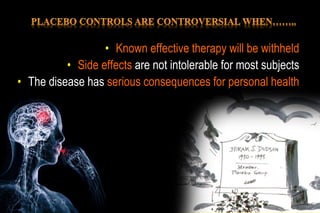
• Known effective therapy will be withheld
• Side effects are not intolerable for most subjects
• The disease has serious consequences for personal health
There are several thorny issues and
ambiguities which saturate the
understanding the placebo, particularly as
the concept of the placebo is transported
from medicine and psychotherapy to
periodontology.
Placebo effect in periodontics

Placebo effect in periodontics

  • 3.
    A prospective studycomparing the effect of an intervention against a control
  • 4.
  • 5.
    Show superiority toplacebo Show superiority to known effective treatment (“active control”) Show non-inferiority to active control
  • 6.
    1811 An epithet todescribe any medicine given more to please than benefit the patient 1964 A placebo is expected to 1) deliberately have an effect or 2) unknowingly influence any component of the disease 2005 A placebo is a simulated or otherwise medically ineffectual treatment for a disease or other medical condition intended to deceive the recipient
  • 7.
    The placebo effectis the beneficial physical or psychological change in a person resulting from conscious or non-conscious “beliefs” unaided by any medically active pill or procedure A medical treatment is said to have a placebo effect if a patient’s response to treatment depends positively on his expectations about the value of that treatment
  • 8.
    Subjects recognize byway of side effects, investigator behavior and treatment mechanisms, that they have been assigned to the treatment group and are receiving the “real” treatment* *Watts T. Periodontal treatment and glycemic control in diabetic patients: the problem of a possible Hawthorne effect. J Dent Res 2006;85:294.
  • 9.
    Placebo effect Hawthorneeffect Effect Psychological/Physical Psychological Response Subjective response to new instruments, equipment or methods Subjective response to simply being studied Cause participants' belief in the material efficacy of the intervention participants' response to being studied Experimenter behaviour* appearing to the participant to believe in the efficacy of the intervention appearing to the participant to be neutral *Senn SJ. "Ethical considerations concerning treatment allocation in drug development trials" Statistical Methods in Medical Research 2002 vol.11 pp.403-411.
  • 10.
    Perceiver = Investigator Target= Subject under study I believe this mouthwash is superior to CHX Looks like I probably got the best mouthwash available We are testing a powerful new mouthwash (Via informed consent) Never been meticulous.. Let me use this product…the doc believes in it
  • 11.
    Is an extremeform of the Hawthorne effect; it is when a supposedly control group, that gets no intervention, compares themselves to the experimental group and through extra effort gets the same effects or results. John Henry's prowess as a steel-driver was measured in a race against a steam powered hammer, which he won, only to die in victory with his hammer in his hand.
  • 12.
    Is an extendedform of the Hawthorne effect; it is when the participants perform differently at different stages of the trial because of the novelty of the "treatment" and various factors which may change their expectations.
  • 14.
    In studies involvingplaque control agents and aids, the drug-placebo difference in randomized controlled trials has been reported to be just around 20%.* The difference however is higher (around 40%) in studies involving bone grafts and new surgical procedures**; These are situations where the effects of subject perception are negligible. . *Pastagia J, Nicoara P, Robertson PB. The effect of patient-centered plaque control and periodontal maintenance therapy on adverse outcomes of periodontitis. J Evid Based Dent Pract. 2006 Mar;6(1):25-32. **Koch GG, Paquette DW. Design principles and statistical considerations in periodontal clinical trials. Ann Periodontol. 1997 Mar;2(1):42-63.
  • 15.
    Study Placebo & Controls/ Samplesize Type of Control Effect described as Shimizu et al 35/72 Control tablets Attention bias /Hawthorne effect Sexton et al 33/68 Case-controlled study with controls receiving oral hygiene instruction only. Hawthorne effect Patel et al 60/90 Active treatment controls. Hawthorne effect Freires et al 13/27 Positive control Hawthorne effect Telgi et al 40/60 No-treatment controls Hawthorne effect Walsh et al 435/1739 Control group of dentists who were not exposed to any study intervention. Hawthorne effect Ganavadiya et al 30/65 Low cost vs high cost dentifrices compared to each other. Hawthorne effect Pilloni et al 16/64 Open flap debridement (OFD) Hawthorne effect Pereira et al 10/30 Control gel Novelty effect Singh et al 22 sites/44 sites Sonic vs ionic toothbrushes compared to each other. Novelty effect/Hawthorne effect Mythri et al 80/160 including +ve and –ve controls Brushing only group used as (control) Hawthorne effect Chandra et al 30/90 sites Sham/No treatment control Hawthorne effect
  • 16.
    *Enck P, KlosterhalfenS, Zipfel S. Novel study designs to investigate the placebo response. BMC Med Res Methodol. 2011 Jun 10;11:90.
  • 17.
    Prevent 1. Placebo biasin trials 2. Reduce statistical noise caused by variation in individual patient’s placebo responsiveness. 3. Conventional approaches to minimizing this statistical noise, such as increasing the sample size, are inefficient and substantially extend the duration and cost of clinical trials.
  • 18.
    Subject pool Reduce number ofvisits and time at each visit. Reduce the number of investigators for a study. Use Whole-mouth raters* than Site-specific raters. *Winning L et al. A placebo-controlled trial to evaluate an anesthetic gel when probing in patients with advanced periodontitis. J Periodontol. 2012 Dec;83(12):1492-8. Increase Sample Size
  • 19.
  • 20.
    DISADVANTAGES • Longer trialduration • Might fail to eliminate placebo responders* *Trivedi MH, Rush H. Does a placebo run-in or a placebo treatment cell affect the efficacy of antidepressant medications? Neuropsychopharmacology. 1994 Aug;11(1):33-43.
  • 21.
    Subject pool 1.Comparing drug and placebo,as in a parallel design 2.Generating a pool of placebo non-responders Comparing drug and placebo, as in a parallel design, but utilizing only placebo non-responders
  • 22.
    ADVANTAGES • Unlike placebolead-in, a higher number of patients are included • Increase in power for any given sample size from potentially larger effect size in placebo, non-responders from reuse of patients • More responses are observed compared to parallel design or placebo lead-in • For any given power, overall trial duration is typically shorter because sample size is smaller
  • 23.
    DISADVANTAGES • Longer trialduration for individual subjects compared to the parallel design and placebo lead-in • Use of placebo non-responders (as in placebo lead-in) is well accepted for Phase III trials
  • 24.
    Subject pool Premise #1 a drugis significantly superior to placebo Premise #2 Only Placebo Non- responders
  • 26.
    “IN GENERAL THISMETHODOLOGY SHOULD ONLY BE USED IN THE ABSENCE OF EXISTING PROVEN THERAPY” EXCEPTION “COMPELLING METHODOLOGICAL REASONS” FOR ITS USE *Carpenter WT Jr, Appelbaum PS, Levine RJ. The Declaration of Helsinki and clinical trials. Am J Psychiatry. 2003 Feb;160(2):356-62.
  • 27.
    No effective treatment/replacementexists Use of placebo control entails minor risks to subjects Other controls not yielding reliable results *Council for International Organizations of Medical Sciences
  • 28.
    No effective treatmentexists for the population being studied Effective treatment involves side effects for most patients that are highly unacceptable New treatment & placebo control are added on to standard treatment for all subjects Study involves a minor ailment
  • 29.
    • Known effectivetherapy will be withheld • Side effects are not intolerable for most subjects • The disease has serious consequences for personal health
  • 30.
    There are severalthorny issues and ambiguities which saturate the understanding the placebo, particularly as the concept of the placebo is transported from medicine and psychotherapy to periodontology.