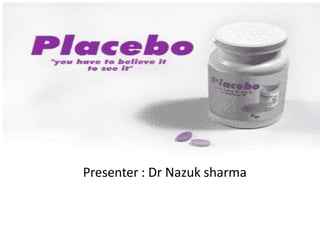
PLACEBO
Presenter : Dr Nazuk sharma
Introduction
• Definition
• History
• Incidence
• Types
• Mechanism of action
• Factors influencing placebo response
• Application
• Ethics
• Human research protection guidelines
• Problems with placebo
Definition
• Dummy medicine containing no active substance
• Latin: 'I shall please‘
• Psychodynamic > Pharmacodynamic
• Patients who respond to placebo are termed as
“Placebo responders”
• 1811 : Quincy's Lexicon-Medicum defines placebo
as 'an epithet given to any medicine adapted more
to please than to benefit the patient
• 1960s:{ Shapiro} Any therapeutic procedure which
has an effect on a patient, symptom, syndrome or
disease, but which is objectively without specific
activity for the condition being treated.
History
• Dates back to 116th psalm in Hebrew bible
( 19th verse of psalm “et ha lech” meaning I shall walk
which in latin is “placera” “I shall please” )
• 14th century: hired mourners at funerals.
• Earlier known as “Humble Humbug”
• In 1801, John Haygarth reported the results of
what may have been the first placebo controlled trial
• 1785 : Motherby’s new medical dictionary as a
“ comman-place method or medicine”
• 1795: calculated to amuse for a time , rather
than for any other purpose
• 1930: . Evans and Hoyle and Gold and
colleagues actually used the word placebo for
the inert treatment given to controls in an
experimental situation.
• In 1863, Austin Flint tried to understand whether
drugs given for articular rheumatism changed the
natural history of disease
( Flint placed 13 patients on the use of a placebo
which consisted, the tincture of quassia, very largely
diluted. Became well known placeboic remedy for
rheumatism)
Incidence
• 15 studies, carried out by Beecher (1955)
involving 1082 patients, the average placebo
response rate determined was 35.2% .
•When patients do not know they are receiving
placebos, high as 70-82%
• Angina pectoris: the use of vitamin E,ligation of the
internal mammary artery, were about 80%
effective
• Back surgery : suggested by Spangfort’s review of
long-term outcomes of 2504 “diskectomies” for
lumbar disk disease.
• Complete relief of back pain was noted in 43% of
patients who had sham surgery done
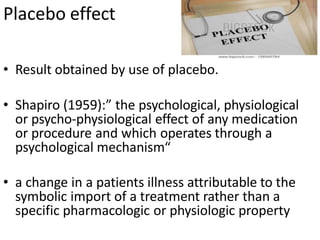
Placebo effect
• Result obtained by use of placebo.
• Shapiro (1959):” the psychological, physiological
or psycho-physiological effect of any medication
or procedure and which operates through a
psychological mechanism“
• a change in a patients illness attributable to the
symbolic import of a treatment rather than a
specific pharmacologic or physiologic property
Types
Positive Negative
Improvement
in symptoms
Symptoms
Getting
worse
Hawthorne effect
• 1930s
• Phenomenon whereby a subject’s performance
changes simply because he or she is being
studied.
Nocebo
• latin: nocero (inflicting harm)
• Opposite of placebo
• Negative psychodynamic effect evoked by the
pessimistic attitude of the patient, or loss of faith in
medication/physician
• To induce a nocebo effect, an inert substance is
administered along with negative verbal suggestions of
clinical worsening
• Mediated by receptors like CCK1 & NK1.
• Colloca et al (2008) used a nocebo procedure, in
which verbal suggestions of painful stimulation
were given to healthy volunteers before
administration of either tactile or low-intensity
painful electrical stimuli.
• This study showed that these anxiogenic verbal
suggestions were capable of turning tactile stimuli
into pain, as well as low-intensity painful stimuli
into high-intensity pain.
Types of placebo
• Inert or Pure placebos : substances that could
have no conceivable pharmacologic effect on the
patient.
Examples : Dummy pills or capsules containing
lactose or chalk
Active or Impure placebo : Have potential
pharmacological effects, though not necessarily any
specific activity for the condition under treatment.
Examples :vitamin B12 or iron in the absence of
anemia,
Antibiotics in viral infections
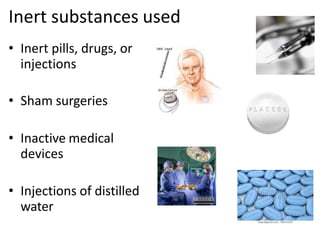
Inert substances used
• Inert pills, drugs, or
injections
• Sham surgeries
• Inactive medical
devices
• Injections of distilled
water
MECHANISM OF ACTION
MECHANISM OF ACTION
Conditioning
reflex model
Opioid
model
Expectancy
model
Conditioning reflex model
• Involuntary conditioned reflex of the patient’s body
• Arachnoiditis pain , were relieved after they
received intrathecal injections of novocaine.
But actually injected with saline rather than
novocaine
Conditions like
• Physician
• physical examination
• prescription
• Procedure
• Places
• Information obtained by reading and remarks of other
people
• Previous experience
Expectancy model
Aimed at preparing the body to anticipate an event to
better cope with it
• For example, resuming a normal daily schedule,
and negative expectations leading to its inhibition
(bootzin, 1985;bandura, 1997).
• Effects of expectations modulated by
Decrease in self-defeating thoughts.
Motivation
Expectation of Reward
• Expectations of future events modulate not only
anxiety, but they may also induce physiological
changes through reward mechanisms.
• These mechanisms are mediated by specific neuronal
circuits linking cognitive, emotional, and motor
responses.
• studied in the context of the
1. pursuit of natural (eg, food)
2. Monetary
Opioid model
• Release of endogenous opiate : endorphins &
enkephalins
• Field et all (1997) shown that placebo induced
analgesia can be reversed by naloxone
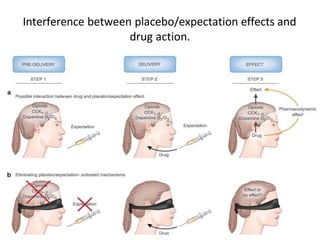
Interference between placebo/expectation effects and
drug action.
FACTORS
INFLENCING
PLACEBO
RESPONSE
Patient characteristics
Provider characteristics
Appearance of
treatment procedures
Environment
relationship
Applications
• Regression
to mean
• Natural
history of
disease
Specific
effects of
treatment
Nonspecific
effects of
treatment-
placebo
effects
Efficacy of
treatment
Application in clinical trials
• Researcher compares the results of experimental
treatment versus placebo.
• The placebo-controlled trial the gold standard for
testing the efficacy of new treatments.”
• Best evidence for new treatment come from
randomized placebo-controlled (RCT) double-blind
studies.
• placebo is used in clinical drug trials for the
following reasons:
1. Compare effects with those of the active drug
2. Comparison of active drugs validated by a placebo
3. Blind administration of two drugs that cannot be
made indistinguishable (Double Dummy
technique)
4. Wihdrawal period
5. Toxicity
6. Placebo responders to be excluded
7. Identify treatment non-compliers
Ethics
Topic of debate
• Ethical : use of placebos is essential to protect the
society from the harm that could result from the
widespread use of ineffective medical treatments.
• Unethical: Alternative study designs would produce
similar results with less risk to individual research
participants.
• Declaration of Helsinki:
“In any medical study, every patient including
those of control group, if any should be assured of the
best proven diagnostic and therapeutic methods and
no patient should suffer from unnecessary pain.”
CONTROVERSY
• Observed response to placebo in RCT may reflect
the
1. natural course of the disease
2. fluctuations in symptoms
3. regression to the mean
4. response bias with respect to the patient's
reporting of subjective symptoms and other
concurrent treatments
Clinical equipoise in placebo-controlled trials
• state where clinicians are unsure whether the new
treatment or intervention is as good as the standard
treatment.
?Violation of the therapeutic obligation of
physicians to offer optimal medical care.
• right of the patient to receive the best care possible
is compromised .
Human research protection guidelines
• The Office for Human Research Protection (OHRP)
published guidelines in 2008 for the use of placebo
• “Placebos may be used in clinical trials where there
is no known or available (i.e., FDA-approved)
alternative therapy that can be tolerated by
subjects.”
• The use of placebos in controlled clinical trials
must be justified by a positive risk-benefit
analysis
• The subjects must be fully informed of the risks
involved in the assignment to the placebo
group.
• Continued assignment of subjects to placebo is
unethical, once there is good evidence to
support the efficacy of the trial therapy
• Subjects with an increased risk of harm from non-
response may be excluded.
• Increased monitoring for deterioration of subjects
and the use of rescue medications may be
included in the protocol.
• ‘Early escape’ mechanisms and explicit withdrawal
criteria may be built in so that subjects will not
undergo prolonged placebo treatment if they are
not doing well.
• The size of the population placed on placebo may
be kept smaller than the number in the active
treatment arms.
• Some drug trials involve a period during which all
participants receive only a placebo prior to the
initiation of the study. This period is called a
‘placebo washout’.
• The purposes of a washout period include:
1. Terminating the effects of any drug the subject
may have been taking before entering the clinical
trial, so that the effects of the trial drug may be
observed.
2.Understanding whether the subjects co-operate
with instructions to take drugs.
3. Understanding which subjects are ‘placebo
responders’, in that they experience a high degree of
placebo effect.
4.In some protocols, the investigators plan to
exclude those subjects they find either poorly
compliant or highly responsive to the placebo
• The informed consent information:
1. The subjects must be informed that they may
be given a placebo.
2. A clear lay definition of the term ‘placebo’ must
be given to the subjects.
3. The rationale for using a placebo must be
explained to the subjects.
.
4. If applicable, the subjects must be informed of
any viable medical alternatives to being placed
on placebo.
5. The duration of time that a subject will be on a
placebo, degree of discomfort, and potential
effects of not receiving medication must all be
explained.
6. Any consequences of delayed active treatment
must be explained to the subjects
7. A statement in the risk section of the consent
that the condition of the subject may worsen
while on placebo should be included.
8. A discussion in the benefits section that
subjects who receive placebo will not receive
the same benefit as those who receive active
treatment if that treatment is effective should
also be included.
Problems assosciated with placebo
1. Imperfect likeness
2. Impure placebos
3. Selecting placebo nonreactors
4. Overestimation of placebo effects
Refrences
• Roy v. Roy T.Placebos: current status. Indian journal of pharmacology
2001; 33: 396-409 EDUCATIONAL FORUM
• Lichtenberg P, Heresco-Levy U,Nitzan U. The ethics of the placebo in
clinical practice.J Med Ethics 2004;30:551–554.
• Gupta U.and Verma M. Placebo in clinical trials.Perspect clin res.2013
Jan;4(1):49-52
• Anton J M, Kaptchuk O, Jan G P,Tijssen P.Placebos and placebo effects
in medicine:historical overview; JOURNAL OF THE ROYAL SOCIETY OF
MEDICINE Volume 92 October 1999
• Benedetti F,Carlino E,Pollo A. How Placebos Change the Patient’s
Brain; Neuropsychopharmacology REVIEWS (2011) 36, 339–354
Sbsbbeb e71218134012 (1).pptx

Sbsbbeb e71218134012 (1).pptx

  • 1.
  • 2.
    Introduction • Definition • History •Incidence • Types • Mechanism of action • Factors influencing placebo response • Application • Ethics • Human research protection guidelines • Problems with placebo
  • 3.
    Definition • Dummy medicinecontaining no active substance • Latin: 'I shall please‘ • Psychodynamic > Pharmacodynamic • Patients who respond to placebo are termed as “Placebo responders”
  • 4.
    • 1811 :Quincy's Lexicon-Medicum defines placebo as 'an epithet given to any medicine adapted more to please than to benefit the patient • 1960s:{ Shapiro} Any therapeutic procedure which has an effect on a patient, symptom, syndrome or disease, but which is objectively without specific activity for the condition being treated.
  • 5.
    History • Dates backto 116th psalm in Hebrew bible ( 19th verse of psalm “et ha lech” meaning I shall walk which in latin is “placera” “I shall please” ) • 14th century: hired mourners at funerals. • Earlier known as “Humble Humbug” • In 1801, John Haygarth reported the results of what may have been the first placebo controlled trial
  • 6.
    • 1785 :Motherby’s new medical dictionary as a “ comman-place method or medicine” • 1795: calculated to amuse for a time , rather than for any other purpose • 1930: . Evans and Hoyle and Gold and colleagues actually used the word placebo for the inert treatment given to controls in an experimental situation.
  • 7.
    • In 1863,Austin Flint tried to understand whether drugs given for articular rheumatism changed the natural history of disease ( Flint placed 13 patients on the use of a placebo which consisted, the tincture of quassia, very largely diluted. Became well known placeboic remedy for rheumatism)
  • 8.
    Incidence • 15 studies,carried out by Beecher (1955) involving 1082 patients, the average placebo response rate determined was 35.2% . •When patients do not know they are receiving placebos, high as 70-82% • Angina pectoris: the use of vitamin E,ligation of the internal mammary artery, were about 80% effective
  • 9.
    • Back surgery: suggested by Spangfort’s review of long-term outcomes of 2504 “diskectomies” for lumbar disk disease. • Complete relief of back pain was noted in 43% of patients who had sham surgery done
  • 10.
    Placebo effect • Resultobtained by use of placebo. • Shapiro (1959):” the psychological, physiological or psycho-physiological effect of any medication or procedure and which operates through a psychological mechanism“ • a change in a patients illness attributable to the symbolic import of a treatment rather than a specific pharmacologic or physiologic property
  • 11.
  • 12.
    Hawthorne effect • 1930s •Phenomenon whereby a subject’s performance changes simply because he or she is being studied.
  • 13.
    Nocebo • latin: nocero(inflicting harm) • Opposite of placebo • Negative psychodynamic effect evoked by the pessimistic attitude of the patient, or loss of faith in medication/physician • To induce a nocebo effect, an inert substance is administered along with negative verbal suggestions of clinical worsening • Mediated by receptors like CCK1 & NK1.
  • 14.
    • Colloca etal (2008) used a nocebo procedure, in which verbal suggestions of painful stimulation were given to healthy volunteers before administration of either tactile or low-intensity painful electrical stimuli. • This study showed that these anxiogenic verbal suggestions were capable of turning tactile stimuli into pain, as well as low-intensity painful stimuli into high-intensity pain.
  • 15.
    Types of placebo •Inert or Pure placebos : substances that could have no conceivable pharmacologic effect on the patient. Examples : Dummy pills or capsules containing lactose or chalk
  • 16.
    Active or Impureplacebo : Have potential pharmacological effects, though not necessarily any specific activity for the condition under treatment. Examples :vitamin B12 or iron in the absence of anemia, Antibiotics in viral infections
  • 17.
    Inert substances used •Inert pills, drugs, or injections • Sham surgeries • Inactive medical devices • Injections of distilled water
  • 18.
  • 19.
    MECHANISM OF ACTION Conditioning reflexmodel Opioid model Expectancy model
  • 20.
    Conditioning reflex model •Involuntary conditioned reflex of the patient’s body • Arachnoiditis pain , were relieved after they received intrathecal injections of novocaine. But actually injected with saline rather than novocaine
  • 21.
    Conditions like • Physician •physical examination • prescription • Procedure • Places • Information obtained by reading and remarks of other people • Previous experience
  • 22.
    Expectancy model Aimed atpreparing the body to anticipate an event to better cope with it • For example, resuming a normal daily schedule, and negative expectations leading to its inhibition (bootzin, 1985;bandura, 1997). • Effects of expectations modulated by Decrease in self-defeating thoughts. Motivation
  • 23.
    Expectation of Reward •Expectations of future events modulate not only anxiety, but they may also induce physiological changes through reward mechanisms. • These mechanisms are mediated by specific neuronal circuits linking cognitive, emotional, and motor responses. • studied in the context of the 1. pursuit of natural (eg, food) 2. Monetary
  • 24.
    Opioid model • Releaseof endogenous opiate : endorphins & enkephalins • Field et all (1997) shown that placebo induced analgesia can be reversed by naloxone
  • 25.
  • 26.
  • 27.
    Applications • Regression to mean •Natural history of disease Specific effects of treatment Nonspecific effects of treatment- placebo effects Efficacy of treatment
  • 28.
    Application in clinicaltrials • Researcher compares the results of experimental treatment versus placebo. • The placebo-controlled trial the gold standard for testing the efficacy of new treatments.” • Best evidence for new treatment come from randomized placebo-controlled (RCT) double-blind studies.
  • 29.
    • placebo isused in clinical drug trials for the following reasons: 1. Compare effects with those of the active drug 2. Comparison of active drugs validated by a placebo 3. Blind administration of two drugs that cannot be made indistinguishable (Double Dummy technique)
  • 30.
    4. Wihdrawal period 5.Toxicity 6. Placebo responders to be excluded 7. Identify treatment non-compliers
  • 31.
    Ethics Topic of debate •Ethical : use of placebos is essential to protect the society from the harm that could result from the widespread use of ineffective medical treatments. • Unethical: Alternative study designs would produce similar results with less risk to individual research participants.
  • 32.
    • Declaration ofHelsinki: “In any medical study, every patient including those of control group, if any should be assured of the best proven diagnostic and therapeutic methods and no patient should suffer from unnecessary pain.”
  • 33.
    CONTROVERSY • Observed responseto placebo in RCT may reflect the 1. natural course of the disease 2. fluctuations in symptoms 3. regression to the mean 4. response bias with respect to the patient's reporting of subjective symptoms and other concurrent treatments
  • 34.
    Clinical equipoise inplacebo-controlled trials • state where clinicians are unsure whether the new treatment or intervention is as good as the standard treatment. ?Violation of the therapeutic obligation of physicians to offer optimal medical care. • right of the patient to receive the best care possible is compromised .
  • 35.
    Human research protectionguidelines • The Office for Human Research Protection (OHRP) published guidelines in 2008 for the use of placebo • “Placebos may be used in clinical trials where there is no known or available (i.e., FDA-approved) alternative therapy that can be tolerated by subjects.”
  • 36.
    • The useof placebos in controlled clinical trials must be justified by a positive risk-benefit analysis • The subjects must be fully informed of the risks involved in the assignment to the placebo group. • Continued assignment of subjects to placebo is unethical, once there is good evidence to support the efficacy of the trial therapy
  • 37.
    • Subjects withan increased risk of harm from non- response may be excluded. • Increased monitoring for deterioration of subjects and the use of rescue medications may be included in the protocol. • ‘Early escape’ mechanisms and explicit withdrawal criteria may be built in so that subjects will not undergo prolonged placebo treatment if they are not doing well. • The size of the population placed on placebo may be kept smaller than the number in the active treatment arms.
  • 38.
    • Some drugtrials involve a period during which all participants receive only a placebo prior to the initiation of the study. This period is called a ‘placebo washout’. • The purposes of a washout period include: 1. Terminating the effects of any drug the subject may have been taking before entering the clinical trial, so that the effects of the trial drug may be observed.
  • 39.
    2.Understanding whether thesubjects co-operate with instructions to take drugs. 3. Understanding which subjects are ‘placebo responders’, in that they experience a high degree of placebo effect. 4.In some protocols, the investigators plan to exclude those subjects they find either poorly compliant or highly responsive to the placebo
  • 40.
    • The informedconsent information: 1. The subjects must be informed that they may be given a placebo. 2. A clear lay definition of the term ‘placebo’ must be given to the subjects. 3. The rationale for using a placebo must be explained to the subjects. .
  • 41.
    4. If applicable,the subjects must be informed of any viable medical alternatives to being placed on placebo. 5. The duration of time that a subject will be on a placebo, degree of discomfort, and potential effects of not receiving medication must all be explained. 6. Any consequences of delayed active treatment must be explained to the subjects
  • 42.
    7. A statementin the risk section of the consent that the condition of the subject may worsen while on placebo should be included. 8. A discussion in the benefits section that subjects who receive placebo will not receive the same benefit as those who receive active treatment if that treatment is effective should also be included.
  • 43.
    Problems assosciated withplacebo 1. Imperfect likeness 2. Impure placebos 3. Selecting placebo nonreactors 4. Overestimation of placebo effects
  • 44.
    Refrences • Roy v.Roy T.Placebos: current status. Indian journal of pharmacology 2001; 33: 396-409 EDUCATIONAL FORUM • Lichtenberg P, Heresco-Levy U,Nitzan U. The ethics of the placebo in clinical practice.J Med Ethics 2004;30:551–554. • Gupta U.and Verma M. Placebo in clinical trials.Perspect clin res.2013 Jan;4(1):49-52 • Anton J M, Kaptchuk O, Jan G P,Tijssen P.Placebos and placebo effects in medicine:historical overview; JOURNAL OF THE ROYAL SOCIETY OF MEDICINE Volume 92 October 1999 • Benedetti F,Carlino E,Pollo A. How Placebos Change the Patient’s Brain; Neuropsychopharmacology REVIEWS (2011) 36, 339–354