PLA/PALs and PLA Design
Optimization

Shantanu Dutt
Electerical and Computer Engr.
Univ. of Illinois at Chicago
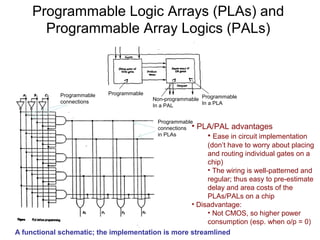
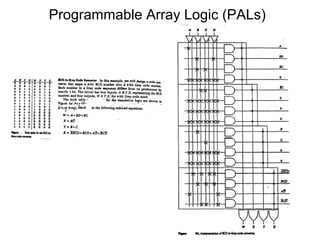
Programmable Logic Arrays (PLAs) and
Programmable Array Logics (PALs)

Programmable
connections

Programmable

Non-programmable Programmable
In a PLA
In a PAL
Programmable
connections •
in PLAs

PLA/PAL advantages
• Ease in circuit implementation

(don’t have to worry about placing
and routing individual gates on a
chip)
• The wiring is well-patterned and
regular; thus easy to pre-estimate
delay and area costs of the
PLAs/PALs on a chip
• Disadvantage:
• Not CMOS, so higher power
consumption (esp. when o/p = 0)
A functional schematic; the implementation is more streamlined
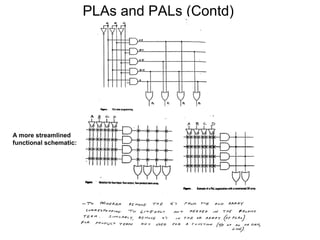
PLAs and PALs (Contd)

A more streamlined
functional schematic:
PLAs (Contd)

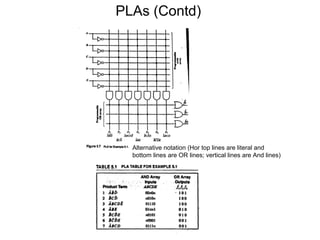
Alternative notation (Hor top lines are literal and
bottom lines are OR lines; vertical lines are And lines)
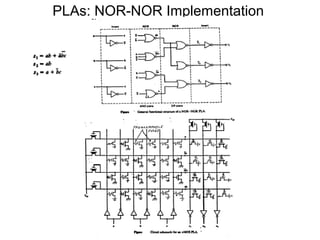
PLAs: NOR-NOR Implementation
PLAs (Contd)
PLAs (Contd)
Programmable Array Logic (PALs)
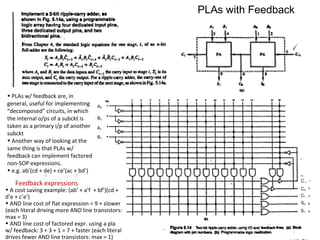
PLAs with Feedback

• PLAs w/ feedback are, in
general, useful for implementing
“decomposed” circuits, in which
the internal o/ps of a subckt is
taken as a primary i/p of another
subckt
• Another way of looking at the
same thing is that PLAs w/
feedback can implement factored
non-SOP expressions.
• e.g. ab’(cd + de) + ce’(ac + bd’)

Feedback expressions

A0
B0
A1
B1

• A cost saving example: (ab’ + a’f + bf’)(cd +
d’e + c’e’)
• AND line cost of flat expression = 9 + slower
(each literal driving more AND line transistors:
max = 3)
• AND line cost of factored expr. using a pla
w/ feedback: 3 + 3 + 1 = 7 + faster (each literal
drives fewer AND line transistors: max = 1)

C-1
C0
C1
S0
S1
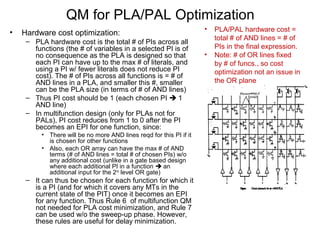
QM for PLA/PAL Optimization
•

Hardware cost optimization:
– PLA hardware cost is the total # of PIs across all
functions (the # of variables in a selected PI is of
no consequence as the PLA is designed so that
each PI can have up to the max # of literals, and
using a PI w/ fewer literals does not reduce PI
cost). The # of PIs across all functions is = # of
AND lines in a PLA, and smaller this #, smaller
can be the PLA size (in terms of # of AND lines)
– Thus PI cost should be 1 (each chosen PI  1
AND line)
– In multifunction design (only for PLAs not for
PALs), PI cost reduces from 1 to 0 after the PI
becomes an EPI for one function, since:
• There will be no more AND lines reqd for this PI if it
is chosen for other functions
• Also, each OR array can have the max # of AND
terms (# of AND lines = total # of chosen PIs) w/o
any additional cost (unlike in a gate based design
where each additional PI in a function  an
additional input for the 2nd level OR gate)

– It can thus be chosen for each function for which it
is a PI (and for which it covers any MTs in the
current state of the PIT) once it becomes an EPI
for any function. Thus Rule 6 of multifunction QM
not needed for PLA cost minimization, and Rule 7
can be used w/o the sweep-up phase. However,
these rules are useful for delay minimization.

•
•

PLA/PAL hardware cost =
total # of AND lines = # of
PIs in the final expression.
Note: # of OR lines fixed
by # of funcs., so cost
optimization not an issue in
the OR plane
PLA/PAL Delay

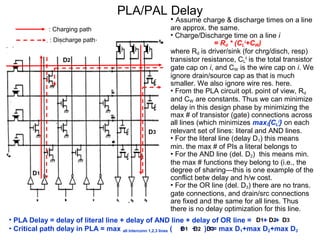
• Assume charge & discharge times on a line

: Charging path
: Discharge path
D2

D3

D1

are approx. the same.
• Charge/Discharge time on a line i
= Rd * (CLi+CW)
where Rd is driver/sink (for chrg/disch, resp)
transistor resistance, CLi is the total transistor
gate cap on i, and CW is the wire cap on i. We
ignore drain/source cap as that is much
smaller. We also ignore wire res. here.
• From the PLA circuit opt. point of view, Rd
and CW are constants. Thus we can minimize
delay in this design phase by minimizing the
max # of transistor (gate) connections across
all lines (which minimizes maxi{CLi} on each
relevant set of lines: literal and AND lines.
• For the literal line (delay D1) this means
min. the max # of PIs a literal belongs to
• For the AND line (del. D2) this means min.
the max # functions they belong to (i.e., the
degree of sharing—this is one example of the
conflict betw delay and h/w cost.
• For the OR line (del. D3) there are no trans.
gate connections, and drain/src connections
are fixed and the same for all lines. Thus
there is no delay optimization for this line.

• PLA Delay = delay of literal line + delay of AND line + delay of OR line = D1+ D2+ D3
• Critical path delay in PLA = max all interconn 1,2,3 lines ( + 1 + 2 )D3 max D1+max D2+max D3
D D
<=
Delay optimization (Initial Cost Formulation): QM for PLA Hardware (H/W) + Delay Opt.
•PLA delay = max(delay from any input literal to an o/p)
•Each literal signal incurs a delay (D 1) that is proportional to the # of
transistors it drives. It is thus important to balance the # of transistors
driven by each literal  min(max # of chosen PIs that each literal is in)
•Each PI signal’s delay on the AND line (D 2) is also similarly
proportional to the # of transistors in the OR array that it drives (i.e., on
the # of functions it belongs to). So this delay can be minimized by
min(max # of functions each PI is in). ). However, PI sharing is useful
for cost min.  so we ignore this aspect of delay here. (Can we
augment QM to consider extra delay on AND line when PI is shared,
and tradeoff delay w/ cost as we do below for literal lines?)
•But either Rule 6 or Rule 7 followed by the sweep-up phase should be
used to reduce unnecessary sharing, as the latter can increase the PI
signal’s delay.
•Thus for combined h/w & delay (D 1 only) min., start w/ a PI cost = 1
(for h/w cost; this will min # of AND lines). After a PI g is chosen,
increase the cost of each PI h by w if g and h share at least 1 common
literal that currently is in the largest # of chosen PIs so far. Otherwise, f(A,B,C,D) = Σ m(1,3,5,7,9) + Σ d(2,6,12,13)
Ex:
there is no increase in g’s cost.
MSBs
AB
•This is done, since such literals in g will drive an additional transistor
CD
00
01
11
10
gate if g is subsequently chosen, thus increasing the D 1 delay. It is
4
12 x
8
should thus be “expensive” to choose a PI such as g.
00 0
LSBs
•w is the ``norm. weight’’ of the importance of delay compared to
5 1 13 x 9 1
01 1 1
hardware cost (AND lines). E.g., w = 0.2  we can sacrifice delay by
CD
3 1
7 1 15
11
up to (1/0.2)*a = 5α units in order to save 1 AND line, where α <= 1 is
the estimated fraction of the contribution of D 1 to the total PLA/PAL
11
AD
delay. On the other hand, w = 2  we can sacrifice a delay increase of
6 x
14
10
10 2 x
up to (1/2)*a = 0.5α units to save 1 AND line or conversely, we can
AC
sacrifice up to 1 AND line to not incur a delay increase of 0.5α units.
•
cost(C’D) = 1 + 0.2 = cost(A’D) = cost(A’C) (w =
•The covering rule can be applied taking this cost into consideration
0.2)
(e.g., for two PIs that cover each other, delete the higher-cost one, and • C’D is an EPI  choose it  cost(A’D) incr. to
1.2 + 0.2 (due to common literal D driving max
by not deleting a lower-cost covered PI—either PI-pair based covering
so far)
or least cost/MTs based heur. can be used to break such a “pseudo- • trans. [1] covers = 1.4A’D bad covers A’C 
A’C good
A’D,
cyclic” table)
delete A’D  A’C is a p-EPI  choose A’C
•

Final soln: f = C’D + A’C has a smaller delay in a
PLA than the alternate soln. of C’D + A’D
Delay optimization (Initial Cost Formulation): QM for PLA Hardware (H/W) + Delay Opt.
•PLA delay = max(delay from any input literal to an o/p)
•Each literal signal incurs a delay (D 1) that is proportional to the # of
transistors it drives. It is thus important to balance the # of transistors
driven by each literal  min(max # of chosen PIs that each literal is in)
•Each PI signal’s delay on the AND line (D 2) is also similarly
proportional to the # of transistors in the OR array that it drives (i.e., on
the # of functions it belongs to). So this delay can be minimized by
min(max # of functions each PI is in). However, PI sharing is useful for
cost min.  so we ignore this aspect of delay here. (Can we augment
QM to consider extra delay on AND line when PI is shared, and
tradeoff delay w/ cost as we do below for literal lines?)
•But either Rule 6 or Rule 7 followed by the sweep-up phase should be
used to reduce unnecessary sharing, as the latter can increase the PI
signal’s delay.
•Thus for combined h/w & delay (D 1 only) min., start w/ a PI cost = 1
(for h/w cost; this will min # of AND lines). After a PI g is chosen,
increase the cost of each PI h by w if g and h share at least 1 common
literal that currently is in the largest # of chosen PIs so far. Otherwise, • An alternate cost is to have the cost grow
there is no increase in g’s cost.
slowly as opposed to being binary w/ a sharp
•This is done, since such literals in g will drive an additional transistor step (go from 0 to 1 as soon as a literal goes
gate if g is subsequently chosen, thus increasing the D 1 delay. It is
from being in max-1 to max # of PIs so far).
should thus be “expensive” to choose a PI such as g.
• So when PI g is selected, for every PI h that g
has common literal(s) with, determine among
•w is the ``norm. weight’’ of the importance of delay compared to
hardware cost (AND lines). E.g., w = 0.2  we can sacrifice delay by these literals, the max. # k of chosen PIs they
up to (1/0.2)*a = 5α units in order to save 1 AND line, where α <= 1 is occur in
the estimated fraction of the contribution of D 1 to the total PLA/PAL
• E.g., incr. cost by w*(e/(e-1))*(1-e-(k/kmax) )) OR
delay. On the other hand, w = 2  we can sacrifice a delay increase of w(e-(1-[k/kmax]) )) OR w*k/kmax, where kmax is the
up to (1/2)*a = 0.5α units to save 1 AND line or conversely, we can
globally max. # of chosen PIs that a literal (a
sacrifice up to 1 AND line to not incur a delay increase of 0.5α units.
critical literal) is currently present in.
• This allows us to “anticipate” and consider
•The covering rule can be applied taking this cost into consideration
(e.g., for two PIs that cover each other, delete the higher-cost one, and costs of literals that can get critical in the nearby not deleting a lower-cost covered PI—either PI-pair based covering future in the QM opt. process.
or least cost/MTs based heur. can be used to break such a “pseudo- • But this does not do “look-ahead” (check
cyclic” table)
what PIs are remaining and for each literal
estimate how many it belongs to will be
chosen. What is a good look-ahead estimate?

Pla pal-and-pla-optimization

  • 1.
    PLA/PALs and PLADesign Optimization Shantanu Dutt Electerical and Computer Engr. Univ. of Illinois at Chicago
  • 2.
    Programmable Logic Arrays(PLAs) and Programmable Array Logics (PALs) Programmable connections Programmable Non-programmable Programmable In a PLA In a PAL Programmable connections • in PLAs PLA/PAL advantages • Ease in circuit implementation (don’t have to worry about placing and routing individual gates on a chip) • The wiring is well-patterned and regular; thus easy to pre-estimate delay and area costs of the PLAs/PALs on a chip • Disadvantage: • Not CMOS, so higher power consumption (esp. when o/p = 0) A functional schematic; the implementation is more streamlined
  • 3.
    PLAs and PALs(Contd) A more streamlined functional schematic:
  • 4.
    PLAs (Contd) Alternative notation(Hor top lines are literal and bottom lines are OR lines; vertical lines are And lines)
  • 5.
  • 6.
  • 7.
  • 8.
  • 9.
    PLAs with Feedback •PLAs w/ feedback are, in general, useful for implementing “decomposed” circuits, in which the internal o/ps of a subckt is taken as a primary i/p of another subckt • Another way of looking at the same thing is that PLAs w/ feedback can implement factored non-SOP expressions. • e.g. ab’(cd + de) + ce’(ac + bd’) Feedback expressions A0 B0 A1 B1 • A cost saving example: (ab’ + a’f + bf’)(cd + d’e + c’e’) • AND line cost of flat expression = 9 + slower (each literal driving more AND line transistors: max = 3) • AND line cost of factored expr. using a pla w/ feedback: 3 + 3 + 1 = 7 + faster (each literal drives fewer AND line transistors: max = 1) C-1 C0 C1 S0 S1
  • 10.
    QM for PLA/PALOptimization • Hardware cost optimization: – PLA hardware cost is the total # of PIs across all functions (the # of variables in a selected PI is of no consequence as the PLA is designed so that each PI can have up to the max # of literals, and using a PI w/ fewer literals does not reduce PI cost). The # of PIs across all functions is = # of AND lines in a PLA, and smaller this #, smaller can be the PLA size (in terms of # of AND lines) – Thus PI cost should be 1 (each chosen PI  1 AND line) – In multifunction design (only for PLAs not for PALs), PI cost reduces from 1 to 0 after the PI becomes an EPI for one function, since: • There will be no more AND lines reqd for this PI if it is chosen for other functions • Also, each OR array can have the max # of AND terms (# of AND lines = total # of chosen PIs) w/o any additional cost (unlike in a gate based design where each additional PI in a function  an additional input for the 2nd level OR gate) – It can thus be chosen for each function for which it is a PI (and for which it covers any MTs in the current state of the PIT) once it becomes an EPI for any function. Thus Rule 6 of multifunction QM not needed for PLA cost minimization, and Rule 7 can be used w/o the sweep-up phase. However, these rules are useful for delay minimization. • • PLA/PAL hardware cost = total # of AND lines = # of PIs in the final expression. Note: # of OR lines fixed by # of funcs., so cost optimization not an issue in the OR plane
  • 11.
    PLA/PAL Delay • Assumecharge & discharge times on a line : Charging path : Discharge path D2 D3 D1 are approx. the same. • Charge/Discharge time on a line i = Rd * (CLi+CW) where Rd is driver/sink (for chrg/disch, resp) transistor resistance, CLi is the total transistor gate cap on i, and CW is the wire cap on i. We ignore drain/source cap as that is much smaller. We also ignore wire res. here. • From the PLA circuit opt. point of view, Rd and CW are constants. Thus we can minimize delay in this design phase by minimizing the max # of transistor (gate) connections across all lines (which minimizes maxi{CLi} on each relevant set of lines: literal and AND lines. • For the literal line (delay D1) this means min. the max # of PIs a literal belongs to • For the AND line (del. D2) this means min. the max # functions they belong to (i.e., the degree of sharing—this is one example of the conflict betw delay and h/w cost. • For the OR line (del. D3) there are no trans. gate connections, and drain/src connections are fixed and the same for all lines. Thus there is no delay optimization for this line. • PLA Delay = delay of literal line + delay of AND line + delay of OR line = D1+ D2+ D3 • Critical path delay in PLA = max all interconn 1,2,3 lines ( + 1 + 2 )D3 max D1+max D2+max D3 D D <=
  • 12.
    Delay optimization (InitialCost Formulation): QM for PLA Hardware (H/W) + Delay Opt. •PLA delay = max(delay from any input literal to an o/p) •Each literal signal incurs a delay (D 1) that is proportional to the # of transistors it drives. It is thus important to balance the # of transistors driven by each literal  min(max # of chosen PIs that each literal is in) •Each PI signal’s delay on the AND line (D 2) is also similarly proportional to the # of transistors in the OR array that it drives (i.e., on the # of functions it belongs to). So this delay can be minimized by min(max # of functions each PI is in). ). However, PI sharing is useful for cost min.  so we ignore this aspect of delay here. (Can we augment QM to consider extra delay on AND line when PI is shared, and tradeoff delay w/ cost as we do below for literal lines?) •But either Rule 6 or Rule 7 followed by the sweep-up phase should be used to reduce unnecessary sharing, as the latter can increase the PI signal’s delay. •Thus for combined h/w & delay (D 1 only) min., start w/ a PI cost = 1 (for h/w cost; this will min # of AND lines). After a PI g is chosen, increase the cost of each PI h by w if g and h share at least 1 common literal that currently is in the largest # of chosen PIs so far. Otherwise, f(A,B,C,D) = Σ m(1,3,5,7,9) + Σ d(2,6,12,13) Ex: there is no increase in g’s cost. MSBs AB •This is done, since such literals in g will drive an additional transistor CD 00 01 11 10 gate if g is subsequently chosen, thus increasing the D 1 delay. It is 4 12 x 8 should thus be “expensive” to choose a PI such as g. 00 0 LSBs •w is the ``norm. weight’’ of the importance of delay compared to 5 1 13 x 9 1 01 1 1 hardware cost (AND lines). E.g., w = 0.2  we can sacrifice delay by CD 3 1 7 1 15 11 up to (1/0.2)*a = 5α units in order to save 1 AND line, where α <= 1 is the estimated fraction of the contribution of D 1 to the total PLA/PAL 11 AD delay. On the other hand, w = 2  we can sacrifice a delay increase of 6 x 14 10 10 2 x up to (1/2)*a = 0.5α units to save 1 AND line or conversely, we can AC sacrifice up to 1 AND line to not incur a delay increase of 0.5α units. • cost(C’D) = 1 + 0.2 = cost(A’D) = cost(A’C) (w = •The covering rule can be applied taking this cost into consideration 0.2) (e.g., for two PIs that cover each other, delete the higher-cost one, and • C’D is an EPI  choose it  cost(A’D) incr. to 1.2 + 0.2 (due to common literal D driving max by not deleting a lower-cost covered PI—either PI-pair based covering so far) or least cost/MTs based heur. can be used to break such a “pseudo- • trans. [1] covers = 1.4A’D bad covers A’C  A’C good A’D, cyclic” table) delete A’D  A’C is a p-EPI  choose A’C • Final soln: f = C’D + A’C has a smaller delay in a PLA than the alternate soln. of C’D + A’D
  • 13.
    Delay optimization (InitialCost Formulation): QM for PLA Hardware (H/W) + Delay Opt. •PLA delay = max(delay from any input literal to an o/p) •Each literal signal incurs a delay (D 1) that is proportional to the # of transistors it drives. It is thus important to balance the # of transistors driven by each literal  min(max # of chosen PIs that each literal is in) •Each PI signal’s delay on the AND line (D 2) is also similarly proportional to the # of transistors in the OR array that it drives (i.e., on the # of functions it belongs to). So this delay can be minimized by min(max # of functions each PI is in). However, PI sharing is useful for cost min.  so we ignore this aspect of delay here. (Can we augment QM to consider extra delay on AND line when PI is shared, and tradeoff delay w/ cost as we do below for literal lines?) •But either Rule 6 or Rule 7 followed by the sweep-up phase should be used to reduce unnecessary sharing, as the latter can increase the PI signal’s delay. •Thus for combined h/w & delay (D 1 only) min., start w/ a PI cost = 1 (for h/w cost; this will min # of AND lines). After a PI g is chosen, increase the cost of each PI h by w if g and h share at least 1 common literal that currently is in the largest # of chosen PIs so far. Otherwise, • An alternate cost is to have the cost grow there is no increase in g’s cost. slowly as opposed to being binary w/ a sharp •This is done, since such literals in g will drive an additional transistor step (go from 0 to 1 as soon as a literal goes gate if g is subsequently chosen, thus increasing the D 1 delay. It is from being in max-1 to max # of PIs so far). should thus be “expensive” to choose a PI such as g. • So when PI g is selected, for every PI h that g has common literal(s) with, determine among •w is the ``norm. weight’’ of the importance of delay compared to hardware cost (AND lines). E.g., w = 0.2  we can sacrifice delay by these literals, the max. # k of chosen PIs they up to (1/0.2)*a = 5α units in order to save 1 AND line, where α <= 1 is occur in the estimated fraction of the contribution of D 1 to the total PLA/PAL • E.g., incr. cost by w*(e/(e-1))*(1-e-(k/kmax) )) OR delay. On the other hand, w = 2  we can sacrifice a delay increase of w(e-(1-[k/kmax]) )) OR w*k/kmax, where kmax is the up to (1/2)*a = 0.5α units to save 1 AND line or conversely, we can globally max. # of chosen PIs that a literal (a sacrifice up to 1 AND line to not incur a delay increase of 0.5α units. critical literal) is currently present in. • This allows us to “anticipate” and consider •The covering rule can be applied taking this cost into consideration (e.g., for two PIs that cover each other, delete the higher-cost one, and costs of literals that can get critical in the nearby not deleting a lower-cost covered PI—either PI-pair based covering future in the QM opt. process. or least cost/MTs based heur. can be used to break such a “pseudo- • But this does not do “look-ahead” (check cyclic” table) what PIs are remaining and for each literal estimate how many it belongs to will be chosen. What is a good look-ahead estimate?