Safety Talk
Husky Refinery(US), FCC Explosion and
Resultant Asphalt Fire
O
x
y
g
e
n
H
e
a
t
Fuel
Presented by: Hemant Agrawal
CGM(TS)- Panipat Refinery
Date: 24th
Sept’25
The Incident: 26 April 2018 Location: “Husky Superior Refinery”,
Superior, Wisconsin, US at FCC Unit
05:40hrs
Unit taken into Shutdown for Repair and maintenance
1
2 10:00hrs
Explosion occurs in Gascon section due to explosive
hydrocarbon-air mixture
3
12:00hrs
Secondary asphalt fire ignited after metallic debris
punctured storage tank Late Evening
Fire fully extinguished after extensive emergency response
efforts
4
36
Injuries
Personnel affected
with no fatalities
$110 M
Offsite damage
Community and
Environmental impact
Summery of incident
$550 M
Onsite damage
Direct repair cost
Damage Assessment impact
The primary explosion in the
Gascon section's absorber towers
created a cascading series of
events. The force was sufficient to
launch heavy metallic debris
across significant distances,
ultimately causing secondary
damage to critical storage
infrastructure.
This demonstrates how initial
process upsets can rapidly
escalate into major incidents
when multiple safety barriers fail
simultaneously.
Tank Penetration
Metallic debris punctured
the storage tank shell,
creating an immediate
release pathway for 2400
KL of hot asphalt material.
Ignition Source
Hot surfaces and potential
electrical equipment
provided ignition for the
massive secondary fire that
developed hours after the
initial explosion.
The secondary fire proved more challenging to extinguish than the
initial explosion, requiring specialized foam application and extended
emergency response efforts throughout the evening hours.
Secondary Fire: Asphalt Storage Tank Failure
Chronology of the events
Chronology
of the
events
Unit Feed out. Feed to riser introduced
RCSV closed at 05:45
SCSV Closed
MAB and Auxiliary air blower was kept rolling to cool down the catalyst
Riser steam was reduced to 85%.
The operator observed the catalyst level in reactor was decreasing and SCSV was
closed manually.
Reactor catalyst level was showing nil. Operator assumed it is false indication
however in actual SCSV was later found badly passing due to erosion.
MAB Stopped. Only Auxiliary air blower kept running
Regenerator Pressure lower than reactor Pressure. Air pressure increased
Explosion in Primary and sponge Absorbers. Puncture in Hot Asphalt tank
05:40hrs
05:45hrs
05:48hrs
05:58hrs
06:05hrs
06:05hrs
09:09hrs
09:14hrs
09:58hrs
12:00hrs
Late evening Fire brought under control
Spilled Asphalt catches fire probably due ignition source from electrical fittings
Timelines
 During normal operation,
Regenerator is kept at
higher pressure than the
reactor.
 In FCC unit, air inside the
regenerator is typically
separated from flammable
hydrocarbon inside the
reactor by pressure
differences created during
catalyst circulation.
Reactor
section
operation
RX-RG: Single stage regenerator, Licensor UOP
UOP Designed unit Commissioned in 1960
MF/
Gascon
Operation
post
Feedout
Simple PFD of MF Gascon section
 The sponge absorber pressure control valve was kept in manual and only
opened if pressure goes beyond 175 psi( 12.3 kg/cm2g)
 Refinery’s shutdown procedure instructed operators to “always keep the
regenerator pressure a couple pounds higher than the reactor pressure”
when closing the spent catalyst slide valve.
System
Pressure
and Flows
As per the Husky Oil SOP, following pressure profile was maintained during SD
From Feed out till explosion for ~4 hours, reactor pressure operated at about one psi
higher than MF column overhead receiver pressure and regenerator pressure was higher
than reactor pressure almost the entire time
System
Pressure
and Flows
System Pressure post unit shutdown
Analysis of the incident
1
Slides valves erodes
in between every
Turnaround beyond
accepted range of
1/8”
Catalyst level could be
not maintained in
Reactor
Air from Regenerator
flowed continuously
through SCSV and
RCSV for 4 hours
Refinery had
ability to use fuel
gas purge to
dilute air in MF
Column.
Written
procedures did
not mention this
safeguard
2 3
Key Facts- What went Wrong
With no
hydrocarbons to
dilute air, O2
accumulated in
Gascon Section
To minimize
flaring, WGC
planned to
remain operating
until just before
Rx Vapor Blind
installation
Pyrophoric
materials on
walls of Primary
and Sponge
Absorber
O2 likely
reacted with
pyrophoric
deposits
generating heat
and providing
ignition source
4
Flammable
mixture in
Primary and
Sponge
Absorber
ignited, causing
the explosion
5
Prior to 2018, during shutdown after
steam was introduced into the reactor,
some of the MF content vented out
directly to atmosphere
Due to new pollution control rule of US,
venting to atmosphere was stopped
during 2018 shutdown
Lead to Husky’s practice of running WGC
until last minute
In previous shutdowns
Possible some oxygen entered the Main Column
Vented to atmosphere or flare rather than
running WGC
Key Facts- Procedure in previous Shutdowns
Faulty SOP: RX-RG
Pressure profile
Reactor and Main Column
were connected as per
normal Operational
philosophy during purge
out operation during SD
Regenerator pressure
maintained higher than
Reactor. Steam to
Reactor was cut to 85%
after feed out.
Key Facts- What went Wrong
Eroded Slide Valves
Due to passing of SCSV and
higher Regenerator pressure,
Air flowed from Regenerator to
Reactor to MF Column
Steam condensed in Main
column Overhead and air
continued to move to Gascon
section via the WGC.
SOP not as per Licensor Slide valve erosion Overlooked
Faulty SOP: MF Purge
Refinery had ability to use fuel
gas purge to dilute air in MF
Column.
WGC was kept running without
using any FG makeup to ensure
3-5% opening of control valve
to flare at all times
SOP not defined
HUSKy’s
SOP
UOP’s
SOP
Key Facts- What went Wrong
Key Facts- Catastrophic vessel failure after explosion
 Primary Absorber
• A-212 Grade B (per UOP spec)
 Sponge Absorber
• A-201 Grade B (UOP spec Grade A)
 Failure was "brittle fracture"
• Many fragments
 Since 1967, ASTM recommends A-516/A-
515
• More ductile material expected to
reduce fragmentation risk
 If modern, more ductile metallurgy (A-516) used:
• Explosion would cause fish mouth rupture (like a zipper)
• Less fragmentation and fewer dangerous projectiles © Asphalt leak almost certainly would
not have occurred
 Rebuild is using A-516 steel
Key Facts- Catastrophic vessel failure after explosion
Manage FCC Unit
Pressures During
Transients
During startup, standby,
and shutdown, FCC
reactor must be the
highest-pressure
Prevents air-
hydrocarbon mixing
that can lead to
explosions
Operators must manage
pressure and flow
control diligently.
Avoid Relying on
Catalyst Slide Valves
for Safety
FCC slide valves are
not gas-tight.
Do not treat them as
an independent
safety layer.
Use pressure
management and
purge systems for
protection
Use Steam Barriers
and Gas Purges
Maintain reactor
steam barrier and
main column gas
purge. These help
prevent oxygen
ingress and
manage vessel
pressure
differences.
Essential during
transitions
between operating
states.
Audit Process Safety
Information
Regularly
Even mature
procedures can
become outdated
Conduct periodic
audits by subject
matter experts
(SMEs).
Check for alignment
with current best
practices and
industry standards.
Lessons Learnt
Expand PHAs to
Cover Transient
Operations
Most PHAs focus on
normal operation
only.
Most of the
incidents occur
during startups &
shutdown.
Perform targeted
PHAs for these
critical modes using
interdisciplinary
teams
CSB Conclusions
CSB Conclusions
CSB Conclusions
CSB Recommednations
Safety Talk on Husky Refinery(US), FCC
Explosion and Resultant Asphalt Fire
Safety Talk
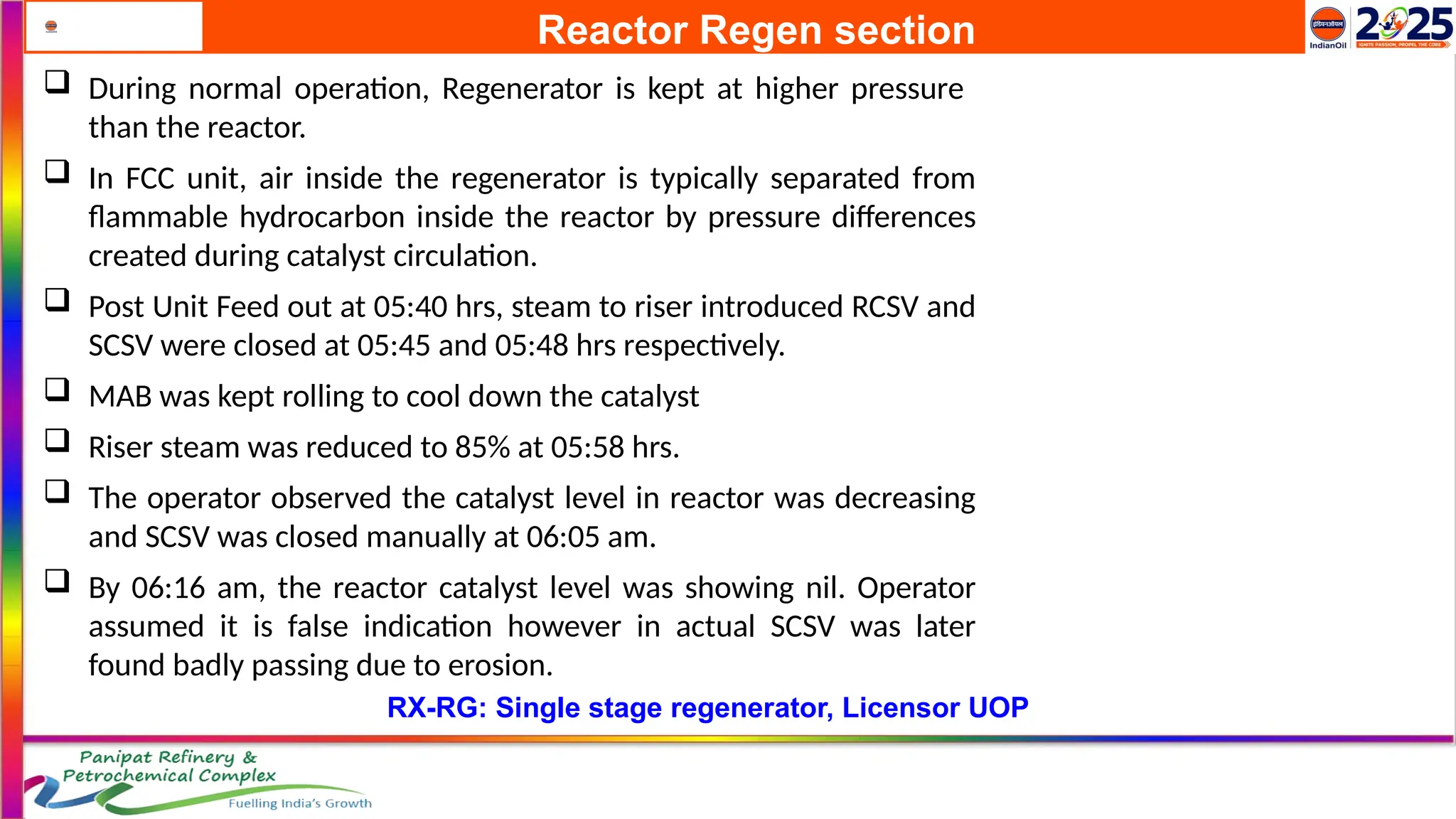
Reactor Regen section
 During normal operation, Regenerator is kept at higher pressure
than the reactor.
 In FCC unit, air inside the regenerator is typically separated from
flammable hydrocarbon inside the reactor by pressure differences
created during catalyst circulation.
 Post Unit Feed out at 05:40 hrs, steam to riser introduced RCSV and
SCSV were closed at 05:45 and 05:48 hrs respectively.
 MAB was kept rolling to cool down the catalyst
 Riser steam was reduced to 85% at 05:58 hrs.
 The operator observed the catalyst level in reactor was decreasing
and SCSV was closed manually at 06:05 am.
 By 06:16 am, the reactor catalyst level was showing nil. Operator
assumed it is false indication however in actual SCSV was later
found badly passing due to erosion.
RX-RG: Single stage regenerator, Licensor UOP
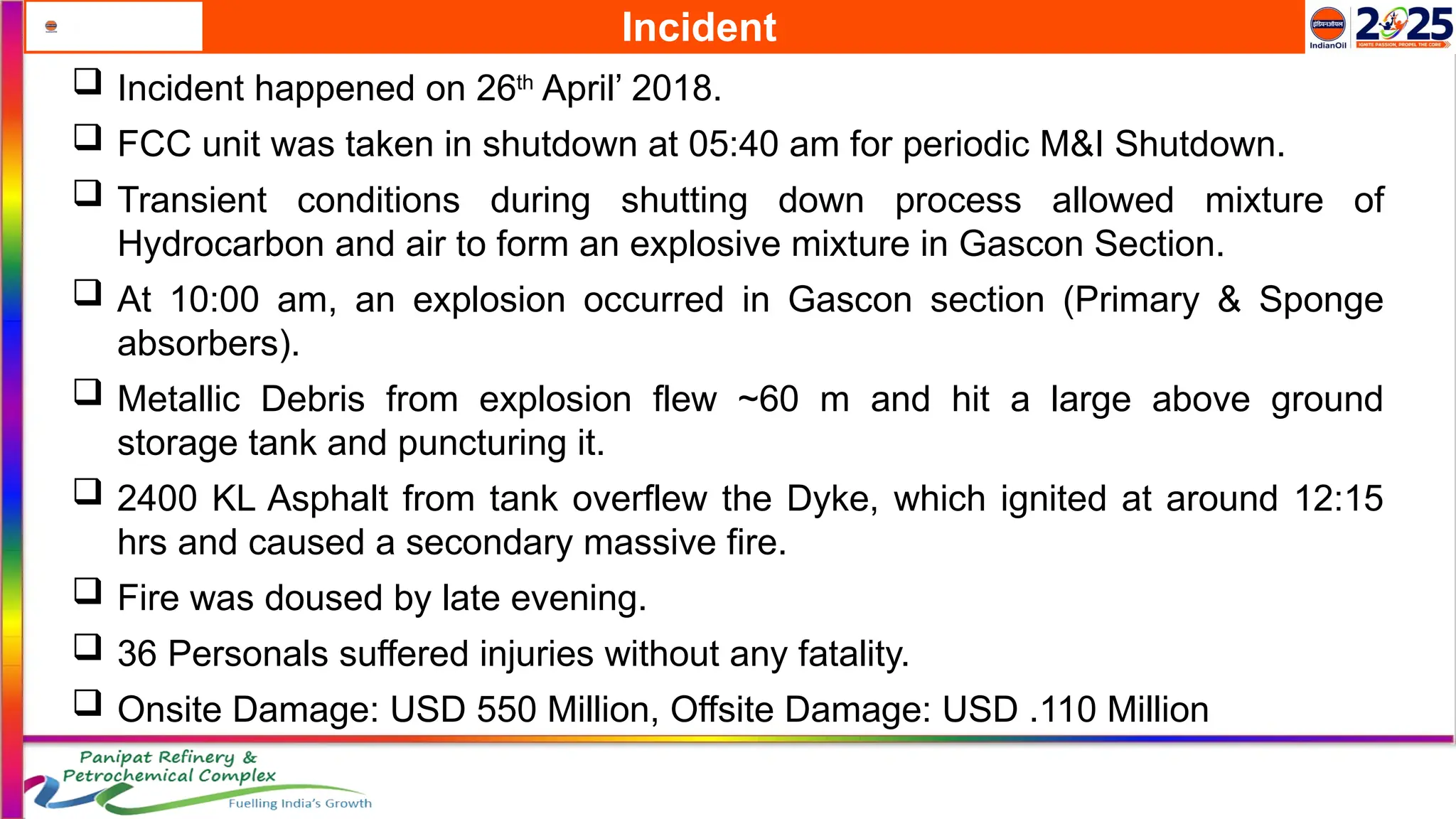
Incident
 Incident happened on 26th
April’ 2018.
 FCC unit was taken in shutdown at 05:40 am for periodic M&I Shutdown.
 Transient conditions during shutting down process allowed mixture of
Hydrocarbon and air to form an explosive mixture in Gascon Section.
 At 10:00 am, an explosion occurred in Gascon section (Primary & Sponge
absorbers).
 Metallic Debris from explosion flew ~60 m and hit a large above ground
storage tank and puncturing it.
 2400 KL Asphalt from tank overflew the Dyke, which ignited at around 12:15
hrs and caused a secondary massive fire.
 Fire was doused by late evening.
 36 Personals suffered injuries without any fatality.
 Onsite Damage: USD 550 Million, Offsite Damage: USD .110 Million
 Refinery operators followed their written protocol
 Procedures deviated from UOP (and FCC industry)
Key Facts
“3. Cut Steam to Riser to 85% open, keep Main Column Receiver Pressure 1 pound lower than
the Regenerator pressure.”
“4. After 15 minutes of catalyst circulation with steam, close the Regenerated Slide Valve, put
on manual control, take Slide Valve off hydraulic control, put on hand-wheel, and close valve.”
“5. Close Spent Slide Valve, put it on manual if you haven't already done so.”
NOTE: When doing # 5, always keep the regenerator pressure a couple pounds higher than the reactor
pressure. You may have to have some catalyst in the reactor stripper to hold a seal across the spent slide
valve. A sharp temperature rise in the reactor will indicate a reversal.
Excerpt from the shutdown procedure used on the day of the incident. (Credit Husky
Superior Refinery with annotations by CSB)
RX-RG
Section
Photographs Post Explosion

Husky Refinery FCC Explosion- Safety Talk.pptx

  • 1.
    Safety Talk Husky Refinery(US),FCC Explosion and Resultant Asphalt Fire O x y g e n H e a t Fuel Presented by: Hemant Agrawal CGM(TS)- Panipat Refinery Date: 24th Sept’25
  • 2.
    The Incident: 26April 2018 Location: “Husky Superior Refinery”, Superior, Wisconsin, US at FCC Unit 05:40hrs Unit taken into Shutdown for Repair and maintenance 1 2 10:00hrs Explosion occurs in Gascon section due to explosive hydrocarbon-air mixture 3 12:00hrs Secondary asphalt fire ignited after metallic debris punctured storage tank Late Evening Fire fully extinguished after extensive emergency response efforts 4 36 Injuries Personnel affected with no fatalities $110 M Offsite damage Community and Environmental impact Summery of incident $550 M Onsite damage Direct repair cost
  • 3.
    Damage Assessment impact Theprimary explosion in the Gascon section's absorber towers created a cascading series of events. The force was sufficient to launch heavy metallic debris across significant distances, ultimately causing secondary damage to critical storage infrastructure. This demonstrates how initial process upsets can rapidly escalate into major incidents when multiple safety barriers fail simultaneously.
  • 4.
    Tank Penetration Metallic debrispunctured the storage tank shell, creating an immediate release pathway for 2400 KL of hot asphalt material. Ignition Source Hot surfaces and potential electrical equipment provided ignition for the massive secondary fire that developed hours after the initial explosion. The secondary fire proved more challenging to extinguish than the initial explosion, requiring specialized foam application and extended emergency response efforts throughout the evening hours. Secondary Fire: Asphalt Storage Tank Failure
  • 5.
  • 6.
    Chronology of the events Unit Feedout. Feed to riser introduced RCSV closed at 05:45 SCSV Closed MAB and Auxiliary air blower was kept rolling to cool down the catalyst Riser steam was reduced to 85%. The operator observed the catalyst level in reactor was decreasing and SCSV was closed manually. Reactor catalyst level was showing nil. Operator assumed it is false indication however in actual SCSV was later found badly passing due to erosion. MAB Stopped. Only Auxiliary air blower kept running Regenerator Pressure lower than reactor Pressure. Air pressure increased Explosion in Primary and sponge Absorbers. Puncture in Hot Asphalt tank 05:40hrs 05:45hrs 05:48hrs 05:58hrs 06:05hrs 06:05hrs 09:09hrs 09:14hrs 09:58hrs 12:00hrs Late evening Fire brought under control Spilled Asphalt catches fire probably due ignition source from electrical fittings Timelines
  • 7.
     During normaloperation, Regenerator is kept at higher pressure than the reactor.  In FCC unit, air inside the regenerator is typically separated from flammable hydrocarbon inside the reactor by pressure differences created during catalyst circulation. Reactor section operation RX-RG: Single stage regenerator, Licensor UOP
  • 8.
    UOP Designed unitCommissioned in 1960 MF/ Gascon Operation post Feedout Simple PFD of MF Gascon section
  • 9.
     The spongeabsorber pressure control valve was kept in manual and only opened if pressure goes beyond 175 psi( 12.3 kg/cm2g)  Refinery’s shutdown procedure instructed operators to “always keep the regenerator pressure a couple pounds higher than the reactor pressure” when closing the spent catalyst slide valve. System Pressure and Flows As per the Husky Oil SOP, following pressure profile was maintained during SD
  • 10.
    From Feed outtill explosion for ~4 hours, reactor pressure operated at about one psi higher than MF column overhead receiver pressure and regenerator pressure was higher than reactor pressure almost the entire time System Pressure and Flows System Pressure post unit shutdown
  • 11.
  • 12.
    1 Slides valves erodes inbetween every Turnaround beyond accepted range of 1/8” Catalyst level could be not maintained in Reactor Air from Regenerator flowed continuously through SCSV and RCSV for 4 hours Refinery had ability to use fuel gas purge to dilute air in MF Column. Written procedures did not mention this safeguard 2 3 Key Facts- What went Wrong With no hydrocarbons to dilute air, O2 accumulated in Gascon Section To minimize flaring, WGC planned to remain operating until just before Rx Vapor Blind installation Pyrophoric materials on walls of Primary and Sponge Absorber O2 likely reacted with pyrophoric deposits generating heat and providing ignition source 4 Flammable mixture in Primary and Sponge Absorber ignited, causing the explosion 5
  • 13.
    Prior to 2018,during shutdown after steam was introduced into the reactor, some of the MF content vented out directly to atmosphere Due to new pollution control rule of US, venting to atmosphere was stopped during 2018 shutdown Lead to Husky’s practice of running WGC until last minute In previous shutdowns Possible some oxygen entered the Main Column Vented to atmosphere or flare rather than running WGC Key Facts- Procedure in previous Shutdowns
  • 14.
    Faulty SOP: RX-RG Pressureprofile Reactor and Main Column were connected as per normal Operational philosophy during purge out operation during SD Regenerator pressure maintained higher than Reactor. Steam to Reactor was cut to 85% after feed out. Key Facts- What went Wrong Eroded Slide Valves Due to passing of SCSV and higher Regenerator pressure, Air flowed from Regenerator to Reactor to MF Column Steam condensed in Main column Overhead and air continued to move to Gascon section via the WGC. SOP not as per Licensor Slide valve erosion Overlooked Faulty SOP: MF Purge Refinery had ability to use fuel gas purge to dilute air in MF Column. WGC was kept running without using any FG makeup to ensure 3-5% opening of control valve to flare at all times SOP not defined
  • 15.
  • 16.
    Key Facts- Catastrophicvessel failure after explosion  Primary Absorber • A-212 Grade B (per UOP spec)  Sponge Absorber • A-201 Grade B (UOP spec Grade A)  Failure was "brittle fracture" • Many fragments  Since 1967, ASTM recommends A-516/A- 515 • More ductile material expected to reduce fragmentation risk
  • 17.
     If modern,more ductile metallurgy (A-516) used: • Explosion would cause fish mouth rupture (like a zipper) • Less fragmentation and fewer dangerous projectiles © Asphalt leak almost certainly would not have occurred  Rebuild is using A-516 steel Key Facts- Catastrophic vessel failure after explosion
  • 18.
    Manage FCC Unit PressuresDuring Transients During startup, standby, and shutdown, FCC reactor must be the highest-pressure Prevents air- hydrocarbon mixing that can lead to explosions Operators must manage pressure and flow control diligently. Avoid Relying on Catalyst Slide Valves for Safety FCC slide valves are not gas-tight. Do not treat them as an independent safety layer. Use pressure management and purge systems for protection Use Steam Barriers and Gas Purges Maintain reactor steam barrier and main column gas purge. These help prevent oxygen ingress and manage vessel pressure differences. Essential during transitions between operating states. Audit Process Safety Information Regularly Even mature procedures can become outdated Conduct periodic audits by subject matter experts (SMEs). Check for alignment with current best practices and industry standards. Lessons Learnt Expand PHAs to Cover Transient Operations Most PHAs focus on normal operation only. Most of the incidents occur during startups & shutdown. Perform targeted PHAs for these critical modes using interdisciplinary teams
  • 19.
  • 20.
  • 21.
  • 22.
  • 24.
    Safety Talk onHusky Refinery(US), FCC Explosion and Resultant Asphalt Fire Safety Talk
  • 26.
    Reactor Regen section During normal operation, Regenerator is kept at higher pressure than the reactor.  In FCC unit, air inside the regenerator is typically separated from flammable hydrocarbon inside the reactor by pressure differences created during catalyst circulation.  Post Unit Feed out at 05:40 hrs, steam to riser introduced RCSV and SCSV were closed at 05:45 and 05:48 hrs respectively.  MAB was kept rolling to cool down the catalyst  Riser steam was reduced to 85% at 05:58 hrs.  The operator observed the catalyst level in reactor was decreasing and SCSV was closed manually at 06:05 am.  By 06:16 am, the reactor catalyst level was showing nil. Operator assumed it is false indication however in actual SCSV was later found badly passing due to erosion. RX-RG: Single stage regenerator, Licensor UOP
  • 27.
    Incident  Incident happenedon 26th April’ 2018.  FCC unit was taken in shutdown at 05:40 am for periodic M&I Shutdown.  Transient conditions during shutting down process allowed mixture of Hydrocarbon and air to form an explosive mixture in Gascon Section.  At 10:00 am, an explosion occurred in Gascon section (Primary & Sponge absorbers).  Metallic Debris from explosion flew ~60 m and hit a large above ground storage tank and puncturing it.  2400 KL Asphalt from tank overflew the Dyke, which ignited at around 12:15 hrs and caused a secondary massive fire.  Fire was doused by late evening.  36 Personals suffered injuries without any fatality.  Onsite Damage: USD 550 Million, Offsite Damage: USD .110 Million
  • 28.
     Refinery operatorsfollowed their written protocol  Procedures deviated from UOP (and FCC industry) Key Facts “3. Cut Steam to Riser to 85% open, keep Main Column Receiver Pressure 1 pound lower than the Regenerator pressure.” “4. After 15 minutes of catalyst circulation with steam, close the Regenerated Slide Valve, put on manual control, take Slide Valve off hydraulic control, put on hand-wheel, and close valve.” “5. Close Spent Slide Valve, put it on manual if you haven't already done so.” NOTE: When doing # 5, always keep the regenerator pressure a couple pounds higher than the reactor pressure. You may have to have some catalyst in the reactor stripper to hold a seal across the spent slide valve. A sharp temperature rise in the reactor will indicate a reversal. Excerpt from the shutdown procedure used on the day of the incident. (Credit Husky Superior Refinery with annotations by CSB)
  • 29.
  • 30.