[PIN]ferences

the power of reading in between the lines

what do you think this presentation will be about?
Warm-Up Activity
Pair up with a person who sits across the room. Utilizing one computer, head
to the link below. When you have reached the page, choose five
examples/questions that you and your partner will answer through a
comment. Make sure you put your names before the comment so we know
who said what!

Pinference!
*For this activity, I would have created an entirely new gmail account or an account with the school e-mail I was given. This could
be a resource for the class for the entire year.
The art of Inferring
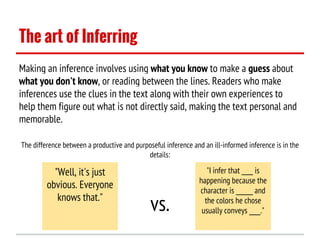
Making an inference involves using what you know to make a guess about
what you don't know, or reading between the lines. Readers who make
inferences use the clues in the text along with their own experiences to
help them figure out what is not directly said, making the text personal and
memorable.
The difference between a productive and purposeful inference and an ill-informed inference is in the
details:

"Well, it's just
obvious. Everyone
knows that."

vs.

"I infer that ____ is
happening because the
character is ______ and
the colors he chose
usually conveys ____."
Why is this important?
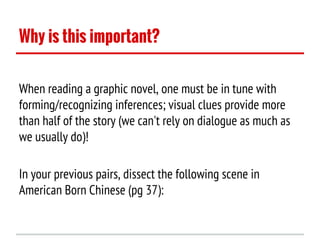
When reading a graphic novel, one must be in tune with
forming/recognizing inferences; visual clues provide more
than half of the story (we can't rely on dialogue as much as
we usually do)!
In your previous pairs, dissect the following scene in
American Born Chinese (pg 37):
Inferences in American Born Chinese
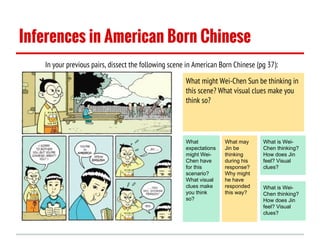
In your previous pairs, dissect the following scene in American Born Chinese (pg 37):
What might Wei-Chen Sun be thinking in
this scene? What visual clues make you
think so?

What
expectations
might WeiChen have
for this
scenario?
What visual
clues make
you think
so?

What may
Jin be
thinking
during his
response?
Why might
he have
responded
this way?

What is WeiChen thinking?
How does Jin
feel? Visual
clues?

What is WeiChen thinking?
How does Jin
feel? Visual
clues?
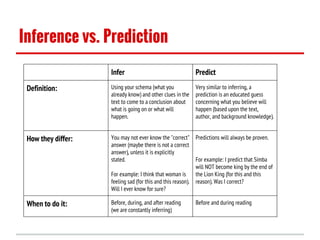
Inference vs. Prediction
Infer

Predict

Definition:

Using your schema (what you
already know) and other clues in the
text to come to a conclusion about
what is going on or what will
happen.

Very similar to inferring, a
prediction is an educated guess
concerning what you believe will
happen (based upon the text,
author, and background knowledge).

How they differ:

You may not ever know the "correct" Predictions will always be proven.
answer (maybe there is not a correct
answer), unless it is explicitly
stated.
For example: I predict that Simba
will NOT become king by the end of
For example: I think that woman is
the Lion King (for this and this
feeling sad (for this and this reason). reason). Was I correct?
Will I ever know for sure?

When to do it:

Before, during, and after reading
(we are constantly inferring)

Before and during reading
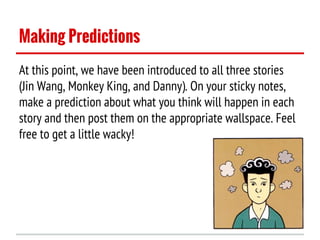
Making Predictions
At this point, we have been introduced to all three stories
(Jin Wang, Monkey King, and Danny). On your sticky notes,
make a prediction about what you think will happen in each
story and then post them on the appropriate wallspace. Feel
free to get a little wacky!
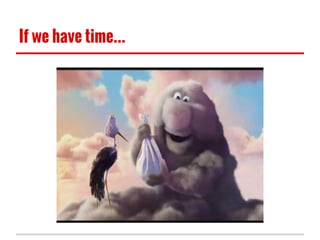
If we have time...
Sources
Cowan, Mrs. Prediction and Inference: A Reading Strategy. http://free-ppt.org/e/evaluation-a-readingstrategy---welcome-to-mrs-cowans-class-website-w3484-ppt.ppt
Inferences. http://www.teachervision.fen.com/skill-builder/reading-comprehension/48611.html
Neibauer, Adrian. American Born Chinese. http://www.graphicclassroom.org/2011/10/american-bornchinese.html

Pinferences

  • 1.
    [PIN]ferences the power ofreading in between the lines what do you think this presentation will be about?
  • 2.
    Warm-Up Activity Pair upwith a person who sits across the room. Utilizing one computer, head to the link below. When you have reached the page, choose five examples/questions that you and your partner will answer through a comment. Make sure you put your names before the comment so we know who said what! Pinference! *For this activity, I would have created an entirely new gmail account or an account with the school e-mail I was given. This could be a resource for the class for the entire year.
  • 3.
    The art ofInferring Making an inference involves using what you know to make a guess about what you don't know, or reading between the lines. Readers who make inferences use the clues in the text along with their own experiences to help them figure out what is not directly said, making the text personal and memorable. The difference between a productive and purposeful inference and an ill-informed inference is in the details: "Well, it's just obvious. Everyone knows that." vs. "I infer that ____ is happening because the character is ______ and the colors he chose usually conveys ____."
  • 4.
    Why is thisimportant? When reading a graphic novel, one must be in tune with forming/recognizing inferences; visual clues provide more than half of the story (we can't rely on dialogue as much as we usually do)! In your previous pairs, dissect the following scene in American Born Chinese (pg 37):
  • 5.
    Inferences in AmericanBorn Chinese In your previous pairs, dissect the following scene in American Born Chinese (pg 37): What might Wei-Chen Sun be thinking in this scene? What visual clues make you think so? What expectations might WeiChen have for this scenario? What visual clues make you think so? What may Jin be thinking during his response? Why might he have responded this way? What is WeiChen thinking? How does Jin feel? Visual clues? What is WeiChen thinking? How does Jin feel? Visual clues?
  • 6.
    Inference vs. Prediction Infer Predict Definition: Usingyour schema (what you already know) and other clues in the text to come to a conclusion about what is going on or what will happen. Very similar to inferring, a prediction is an educated guess concerning what you believe will happen (based upon the text, author, and background knowledge). How they differ: You may not ever know the "correct" Predictions will always be proven. answer (maybe there is not a correct answer), unless it is explicitly stated. For example: I predict that Simba will NOT become king by the end of For example: I think that woman is the Lion King (for this and this feeling sad (for this and this reason). reason). Was I correct? Will I ever know for sure? When to do it: Before, during, and after reading (we are constantly inferring) Before and during reading
  • 7.
    Making Predictions At thispoint, we have been introduced to all three stories (Jin Wang, Monkey King, and Danny). On your sticky notes, make a prediction about what you think will happen in each story and then post them on the appropriate wallspace. Feel free to get a little wacky!
  • 8.
    If we havetime...
  • 9.
    Sources Cowan, Mrs. Predictionand Inference: A Reading Strategy. http://free-ppt.org/e/evaluation-a-readingstrategy---welcome-to-mrs-cowans-class-website-w3484-ppt.ppt Inferences. http://www.teachervision.fen.com/skill-builder/reading-comprehension/48611.html Neibauer, Adrian. American Born Chinese. http://www.graphicclassroom.org/2011/10/american-bornchinese.html