Inferring and Drawing Conclusions
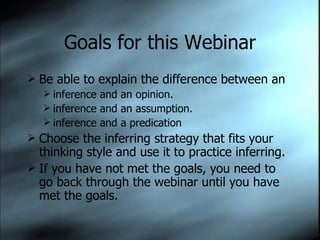
Goals for this Webinar Be able to explain the difference between an  inference and an opinion. inference and an assumption. inference and a predication Choose the inferring strategy that fits your thinking style and use it to practice inferring.
Inference -vs- Opinion Opinion - what you think about a text.  This is based on your experiences and understanding. Inference - figuring out what the author thinks of a topic.  It is based on the information the author gives you as well as your own personal understanding. Educated guess not just an opinion
Example Snow White Evidence that the witch is an antagonist, a bad character Poisonous apple, evil plans for Snow White, wears black, wants to be the “fairest”, goes nuts when she is not the “fairest.” If I think that all people who wear black are bad, I am expressing an opinion.  It is not based on fact.
Inference -vs- Assumption An assumption is an inference not based on facts in the text.  It is a random inference.  It is not consider the clues or information the author gives. An inference is a based on the evidence from the text and, to a lesser extent, on your background knowledge. Too many novice readers base inferences totally on what they know and ignore the author’s information.
Example When reading the story about the professor offering a B for not taking the test you assumed, The B was a good deal How lucky the students were How stupid those students who remained to take the test really were This was not based on clues given by the author.  It was an assumption based on your personal experience.
Inference -vs- Prediction A predication is a specific type of inference.  Making a prediction infers what will happen next  based on what has already happened .  Think: “What am I reading to find out?” Predications need to be adjusted based on what does happen. Too many readers make outlandish predictions based on “what could happen.” These are not wise predication. Predications need to be confirmed to help your reading.
Examples of Logical Predictions Based on Text. If there is a  question , predict you find an answer. If there is a  subheading , predict there will be information about that topic. If “ therefore ” is used the author is telling you his or her conclusion.  Pay attention to it.
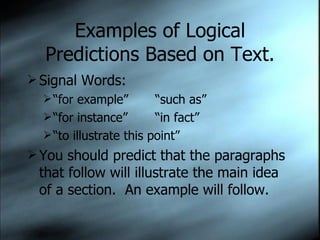
Examples of Logical Predictions Based on Text. Signal Words: “ for example” “such as” “ for instance” “in fact” “ to illustrate this point” You should predict that the paragraphs that follow will illustrate the main idea of a section.  An example will follow.
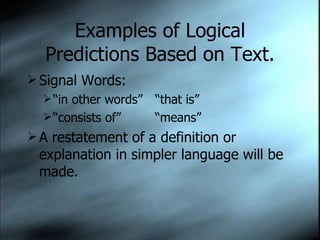
Examples of Logical Predictions Based on Text. Signal Words: “ in other words” “that is” “ consists of” “means” A restatement of a definition or explanation in simpler language will be made.
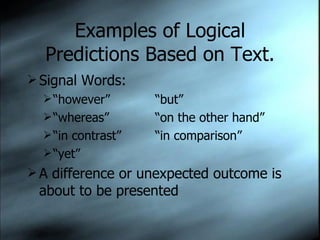
Examples of Logical Predictions Based on Text. Signal Words: “ however” “but” “ whereas” “on the other hand” “ in contrast” “in comparison” “ yet” A difference or unexpected outcome is about to be presented
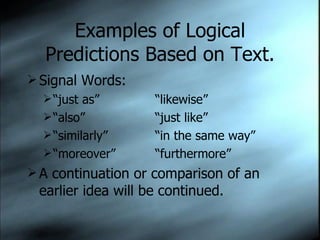
Examples of Logical Predictions Based on Text. Signal Words: “ just as” “likewise” “ also” “just like” “ similarly” “in the same way” “ moreover” “furthermore” A continuation or comparison of an earlier idea will be continued.
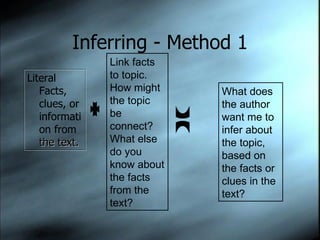
Inferring - Method 1 Literal Facts, clues, or information from  the text. + Link facts to topic. How might the topic be connect?  What else do you know about the facts from the text? = What does the author want me to infer about the topic, based on the facts or clues in the text?
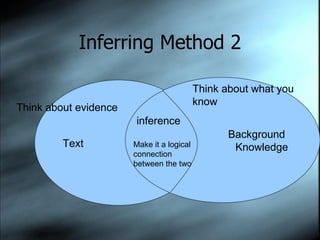
Inferring Method 2 Text Background  Knowledge inference Think about evidence Think about what you know Make it a logical connection  between the two
Goals for this Webinar Be able to explain the difference between an  inference and an opinion. inference and an assumption. inference and a predication Choose the inferring strategy that fits your thinking style and use it to practice inferring. If you have not met the goals, you need to go back through the webinar until you have met the goals.

Inferring

  • 1.
  • 2.
    Goals for thisWebinar Be able to explain the difference between an inference and an opinion. inference and an assumption. inference and a predication Choose the inferring strategy that fits your thinking style and use it to practice inferring.
  • 3.
    Inference -vs- OpinionOpinion - what you think about a text. This is based on your experiences and understanding. Inference - figuring out what the author thinks of a topic. It is based on the information the author gives you as well as your own personal understanding. Educated guess not just an opinion
  • 4.
    Example Snow WhiteEvidence that the witch is an antagonist, a bad character Poisonous apple, evil plans for Snow White, wears black, wants to be the “fairest”, goes nuts when she is not the “fairest.” If I think that all people who wear black are bad, I am expressing an opinion. It is not based on fact.
  • 5.
    Inference -vs- AssumptionAn assumption is an inference not based on facts in the text. It is a random inference. It is not consider the clues or information the author gives. An inference is a based on the evidence from the text and, to a lesser extent, on your background knowledge. Too many novice readers base inferences totally on what they know and ignore the author’s information.
  • 6.
    Example When readingthe story about the professor offering a B for not taking the test you assumed, The B was a good deal How lucky the students were How stupid those students who remained to take the test really were This was not based on clues given by the author. It was an assumption based on your personal experience.
  • 7.
    Inference -vs- PredictionA predication is a specific type of inference. Making a prediction infers what will happen next based on what has already happened . Think: “What am I reading to find out?” Predications need to be adjusted based on what does happen. Too many readers make outlandish predictions based on “what could happen.” These are not wise predication. Predications need to be confirmed to help your reading.
  • 8.
    Examples of LogicalPredictions Based on Text. If there is a question , predict you find an answer. If there is a subheading , predict there will be information about that topic. If “ therefore ” is used the author is telling you his or her conclusion. Pay attention to it.
  • 9.
    Examples of LogicalPredictions Based on Text. Signal Words: “ for example” “such as” “ for instance” “in fact” “ to illustrate this point” You should predict that the paragraphs that follow will illustrate the main idea of a section. An example will follow.
  • 10.
    Examples of LogicalPredictions Based on Text. Signal Words: “ in other words” “that is” “ consists of” “means” A restatement of a definition or explanation in simpler language will be made.
  • 11.
    Examples of LogicalPredictions Based on Text. Signal Words: “ however” “but” “ whereas” “on the other hand” “ in contrast” “in comparison” “ yet” A difference or unexpected outcome is about to be presented
  • 12.
    Examples of LogicalPredictions Based on Text. Signal Words: “ just as” “likewise” “ also” “just like” “ similarly” “in the same way” “ moreover” “furthermore” A continuation or comparison of an earlier idea will be continued.
  • 13.
    Inferring - Method1 Literal Facts, clues, or information from the text. + Link facts to topic. How might the topic be connect? What else do you know about the facts from the text? = What does the author want me to infer about the topic, based on the facts or clues in the text?
  • 14.
    Inferring Method 2Text Background Knowledge inference Think about evidence Think about what you know Make it a logical connection between the two
  • 15.
    Goals for thisWebinar Be able to explain the difference between an inference and an opinion. inference and an assumption. inference and a predication Choose the inferring strategy that fits your thinking style and use it to practice inferring. If you have not met the goals, you need to go back through the webinar until you have met the goals.