Presented by: Engr. ZF Czora, ChE, ATSC
Background:
 Licensed Chemical Engineer – USC- TC graduate, Batch
1991
 Assessment Advice (International Professional Register)-
Has been admitted to the International Register in the class
of Licentiate and is entitled to use the designatory letters
ATSC (Associate of Technology of Surface Coatings)(2015)
 Assessment Advice (Skills Recognition Support
Services)Government of South Australia Department of
Further Education, Employment, Science and Technology -
Comparable to the educational level of an Australian
Bachelor Degree, on the basis of assessment guidelines
published by the National Office of Overseas Skills and
Recognition (AEI-NOOSR) in the Country Education
Profiles for Philippines (2006)
Demonstrated Skills & Abilities
 Technical expertise in coating product development
and formulation, products accreditation and
certification
 Specialize in product development and formulation of
architectural coatings, texture coatings, membrane
/elastomeric coatings, cementitious & LAM
waterproofing systems, tile adhesives & grouts and has
vast knowledge in formulating wood coatings,
performance floor coatings, automotive, industrial and
marine coatings
 29 years of work experience in paint/coating industry
What is Paint?
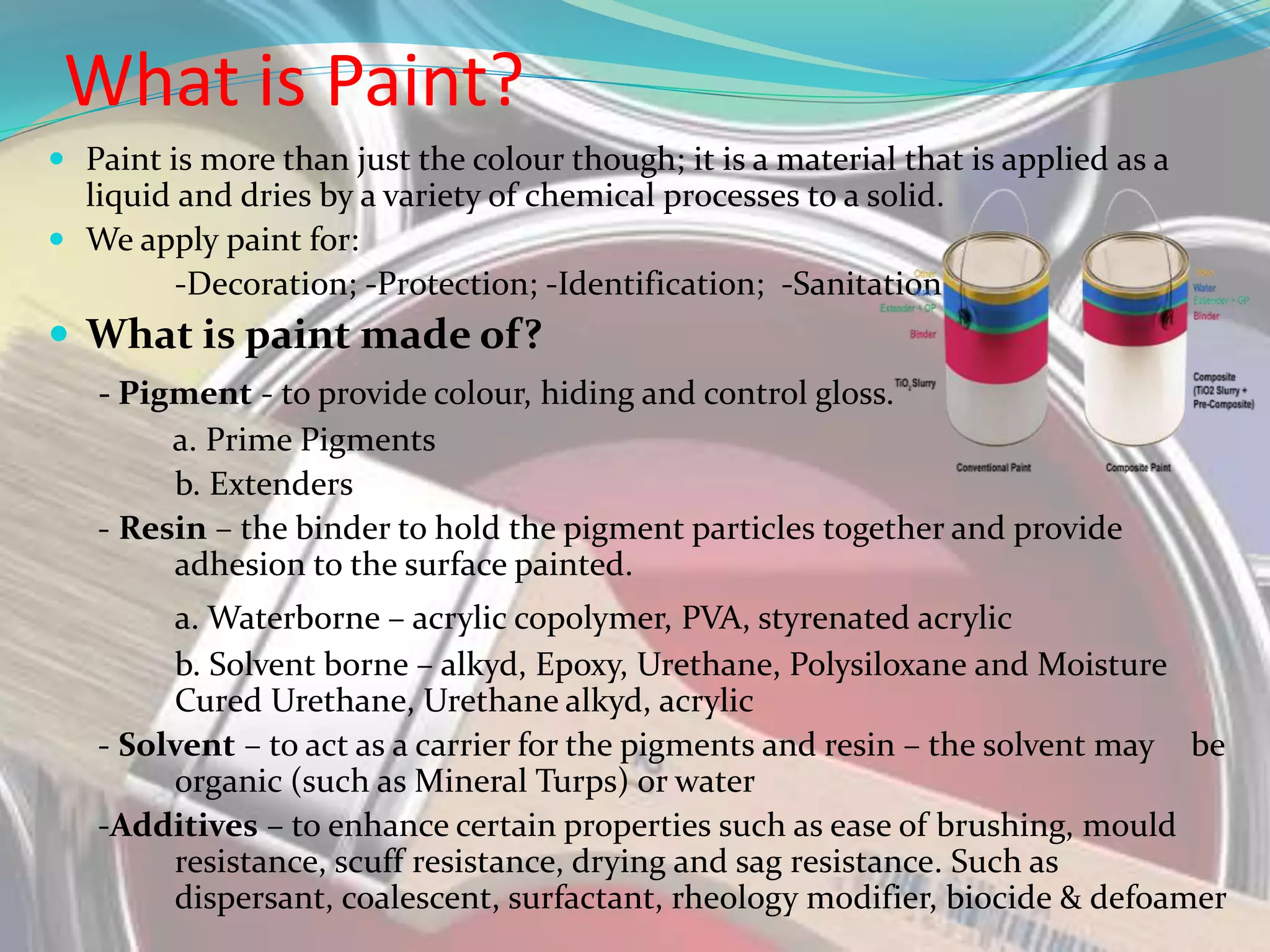
 Paint is more than just the colour though; it is a material that is applied as a
liquid and dries by a variety of chemical processes to a solid.
 We apply paint for:
-Decoration; -Protection; -Identification; -Sanitation
 What is paint made of?
- Pigment - to provide colour, hiding and control gloss.
a. Prime Pigments
b. Extenders
- Resin – the binder to hold the pigment particles together and provide
adhesion to the surface painted.
a. Waterborne – acrylic copolymer, PVA, styrenated acrylic
b. Solvent borne – alkyd, Epoxy, Urethane, Polysiloxane and Moisture
Cured Urethane, Urethane alkyd, acrylic
- Solvent – to act as a carrier for the pigments and resin – the solvent may be
organic (such as Mineral Turps) or water
-Additives – to enhance certain properties such as ease of brushing, mould
resistance, scuff resistance, drying and sag resistance. Such as
dispersant, coalescent, surfactant, rheology modifier, biocide & defoamer
How is it made?
 Simple blending:  Dispersing process:
Process Challenges Overview
 Process Challenge #1 – Quality Consistent Recipe
Formulation
Repeatable, consistent batches of paint
 Process Challenge #2 – Consistently Accurate Filling
(Throughput)
the accurate filling of paint containers is still a
critical manufacturing step
 Process Challenge #3 – Material Accounting/Cost
Many of the ingredients used in the manufacturing
of paint are expensive. Accounting for material usage and
inventory is critical to determining both profitability as well
as yield and process efficiencies.
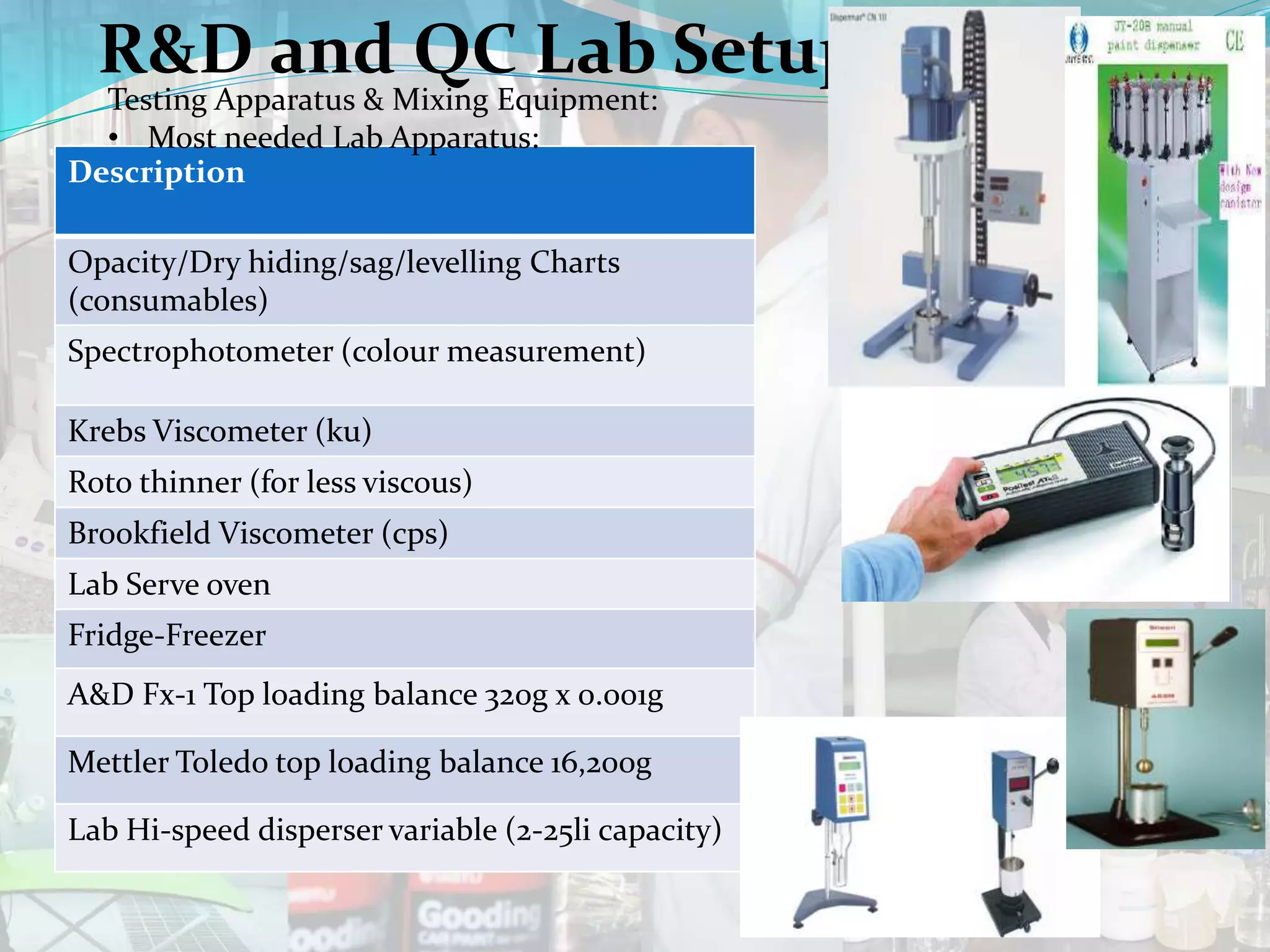
R&D and QC Lab Setup
Testing Apparatus & Mixing Equipment:
 Most needed Lab Apparatus:
Description
Density Cup
Grind gauge
Wet film thickness gauge, 25 -200 um , 100 – 2000 um
Levelling/Sagging Tester
Wire-wound rod film applicator set of 4 (25,50, 100, 150,
200)
Pencil Hardness Tester
Cross-cut adhesion Test Kit
Positest Pull-off adhesion Tester
Glossmeter
Gloss Std/reference tiles
pH meter with probes
Tinting machine
Description
Opacity/Dry hiding/sag/levelling Charts
(consumables)
Spectrophotometer (colour measurement)
Krebs Viscometer (ku)
Roto thinner (for less viscous)
Brookfield Viscometer (cps)
Lab Serve oven
Fridge-Freezer
A&D Fx-1 Top loading balance 320g x 0.001g
Mettler Toledo top loading balance 16,200g
Lab Hi-speed disperser variable (2-25li capacity)
R&D and QC Lab Setup
Testing Apparatus & Mixing Equipment:
• Most needed Lab Apparatus:
Recommended Lab Testing Equipment
Description
Dow Latex Applicator
Dew Point Meter
Permeability cup
Drying time Recorder
Abrasion/Scrub Tester
Hi-shear Cap viscometer ( Cone & Plate)
Minimum Film forming temperature apparatus
Q-lab Weathering Cabinet
Thermo hydrograph
Instron tensile tester
Production Equipment
Description
Ohaus Industrial Scale
Hydraulic Lift Hi_speed variable Mixer 50 hP
Hydraulic Lift Hi-speed variable mixer 25hP
Impeller blades ( consumables)
Mixing Tank, stainless steel 200li
Mixing Tank, stainless steel 500li
Mixing tank, stainless steel 1000li
Sack Truck/trolley
Drum lifter (hydraulic Handdrum forklift)
Raw Materials
Raw Materials
Binders : Acrylic, styrene emulsion
Titanium Dioxide
Calcium carbonate
Film Biocides
In-can biocides
pH regulator/stabiliser/
Surfactants
Dispersants
Defoamer
Thickeners/Rheology modifiers
Co-solvent/coalescent/wet-edge extender
Pre-dispersed pigments/colorants
Extenders: Talc, Kaolin clay, Calcined clay
Specialty additives
Functional Pigments
Other Factors to be considered
 Manpower:
 2 Paintmakers – 1 should be trained to colour match
 1 QC technician/Lab assistant - conducts product testing and
assist lab experimentation
 Chemist – handles day to day production and batch adjustments and assist product
developments
 Water Usage
 Electricity Usage
 Safety, Health & Environment
 Storage and Stock flow
 Other Overhead Expenses
 Plant Maintenance
 Independent Product Testing
 Standard Compliance
 Waste Management
 Handling Complaints
Standard Premium Paint Products
Product Type
Sealer/ Primer/ Undercoat
Water based Primer
High Alkaline Resistance Primer/Sealer
One coat Ceiling/Wall Paint flat
Interior Wall Gloss Paint
Interior Wall Low-sheen Wall Paint
Anti-mould Interior Wall/Ceiling Paint
One coat Exterior Wall Paint
Ceiling/Wall Flat Paint
Elastomeric Wall Coating
Water based Enamel Coating
Pilot Scale Of Paint Manufacturing

Pilot Scale Of Paint Manufacturing

  • 1.
    Presented by: Engr.ZF Czora, ChE, ATSC
  • 2.
    Background:  Licensed ChemicalEngineer – USC- TC graduate, Batch 1991  Assessment Advice (International Professional Register)- Has been admitted to the International Register in the class of Licentiate and is entitled to use the designatory letters ATSC (Associate of Technology of Surface Coatings)(2015)  Assessment Advice (Skills Recognition Support Services)Government of South Australia Department of Further Education, Employment, Science and Technology - Comparable to the educational level of an Australian Bachelor Degree, on the basis of assessment guidelines published by the National Office of Overseas Skills and Recognition (AEI-NOOSR) in the Country Education Profiles for Philippines (2006)
  • 4.
    Demonstrated Skills &Abilities  Technical expertise in coating product development and formulation, products accreditation and certification  Specialize in product development and formulation of architectural coatings, texture coatings, membrane /elastomeric coatings, cementitious & LAM waterproofing systems, tile adhesives & grouts and has vast knowledge in formulating wood coatings, performance floor coatings, automotive, industrial and marine coatings  29 years of work experience in paint/coating industry
  • 5.
    What is Paint? Paint is more than just the colour though; it is a material that is applied as a liquid and dries by a variety of chemical processes to a solid.  We apply paint for: -Decoration; -Protection; -Identification; -Sanitation  What is paint made of? - Pigment - to provide colour, hiding and control gloss. a. Prime Pigments b. Extenders - Resin – the binder to hold the pigment particles together and provide adhesion to the surface painted. a. Waterborne – acrylic copolymer, PVA, styrenated acrylic b. Solvent borne – alkyd, Epoxy, Urethane, Polysiloxane and Moisture Cured Urethane, Urethane alkyd, acrylic - Solvent – to act as a carrier for the pigments and resin – the solvent may be organic (such as Mineral Turps) or water -Additives – to enhance certain properties such as ease of brushing, mould resistance, scuff resistance, drying and sag resistance. Such as dispersant, coalescent, surfactant, rheology modifier, biocide & defoamer
  • 6.
    How is itmade?  Simple blending:  Dispersing process:
  • 7.
    Process Challenges Overview Process Challenge #1 – Quality Consistent Recipe Formulation Repeatable, consistent batches of paint  Process Challenge #2 – Consistently Accurate Filling (Throughput) the accurate filling of paint containers is still a critical manufacturing step  Process Challenge #3 – Material Accounting/Cost Many of the ingredients used in the manufacturing of paint are expensive. Accounting for material usage and inventory is critical to determining both profitability as well as yield and process efficiencies.
  • 8.
    R&D and QCLab Setup Testing Apparatus & Mixing Equipment:  Most needed Lab Apparatus: Description Density Cup Grind gauge Wet film thickness gauge, 25 -200 um , 100 – 2000 um Levelling/Sagging Tester Wire-wound rod film applicator set of 4 (25,50, 100, 150, 200) Pencil Hardness Tester Cross-cut adhesion Test Kit Positest Pull-off adhesion Tester Glossmeter Gloss Std/reference tiles pH meter with probes Tinting machine
  • 9.
    Description Opacity/Dry hiding/sag/levelling Charts (consumables) Spectrophotometer(colour measurement) Krebs Viscometer (ku) Roto thinner (for less viscous) Brookfield Viscometer (cps) Lab Serve oven Fridge-Freezer A&D Fx-1 Top loading balance 320g x 0.001g Mettler Toledo top loading balance 16,200g Lab Hi-speed disperser variable (2-25li capacity) R&D and QC Lab Setup Testing Apparatus & Mixing Equipment: • Most needed Lab Apparatus:
  • 10.
    Recommended Lab TestingEquipment Description Dow Latex Applicator Dew Point Meter Permeability cup Drying time Recorder Abrasion/Scrub Tester Hi-shear Cap viscometer ( Cone & Plate) Minimum Film forming temperature apparatus Q-lab Weathering Cabinet Thermo hydrograph Instron tensile tester
  • 11.
    Production Equipment Description Ohaus IndustrialScale Hydraulic Lift Hi_speed variable Mixer 50 hP Hydraulic Lift Hi-speed variable mixer 25hP Impeller blades ( consumables) Mixing Tank, stainless steel 200li Mixing Tank, stainless steel 500li Mixing tank, stainless steel 1000li Sack Truck/trolley Drum lifter (hydraulic Handdrum forklift)
  • 12.
    Raw Materials Raw Materials Binders: Acrylic, styrene emulsion Titanium Dioxide Calcium carbonate Film Biocides In-can biocides pH regulator/stabiliser/ Surfactants Dispersants Defoamer Thickeners/Rheology modifiers Co-solvent/coalescent/wet-edge extender Pre-dispersed pigments/colorants Extenders: Talc, Kaolin clay, Calcined clay Specialty additives Functional Pigments
  • 13.
    Other Factors tobe considered  Manpower:  2 Paintmakers – 1 should be trained to colour match  1 QC technician/Lab assistant - conducts product testing and assist lab experimentation  Chemist – handles day to day production and batch adjustments and assist product developments  Water Usage  Electricity Usage  Safety, Health & Environment  Storage and Stock flow  Other Overhead Expenses  Plant Maintenance  Independent Product Testing  Standard Compliance  Waste Management  Handling Complaints
  • 14.
    Standard Premium PaintProducts Product Type Sealer/ Primer/ Undercoat Water based Primer High Alkaline Resistance Primer/Sealer One coat Ceiling/Wall Paint flat Interior Wall Gloss Paint Interior Wall Low-sheen Wall Paint Anti-mould Interior Wall/Ceiling Paint One coat Exterior Wall Paint Ceiling/Wall Flat Paint Elastomeric Wall Coating Water based Enamel Coating