B. PHARMACY 7 SEM
INDUSTRAIL PHARMACY – II
(BP702T)
DR. KAMINEE SAHU
PROFESSOR
GGITS, JABALPUR M.P.
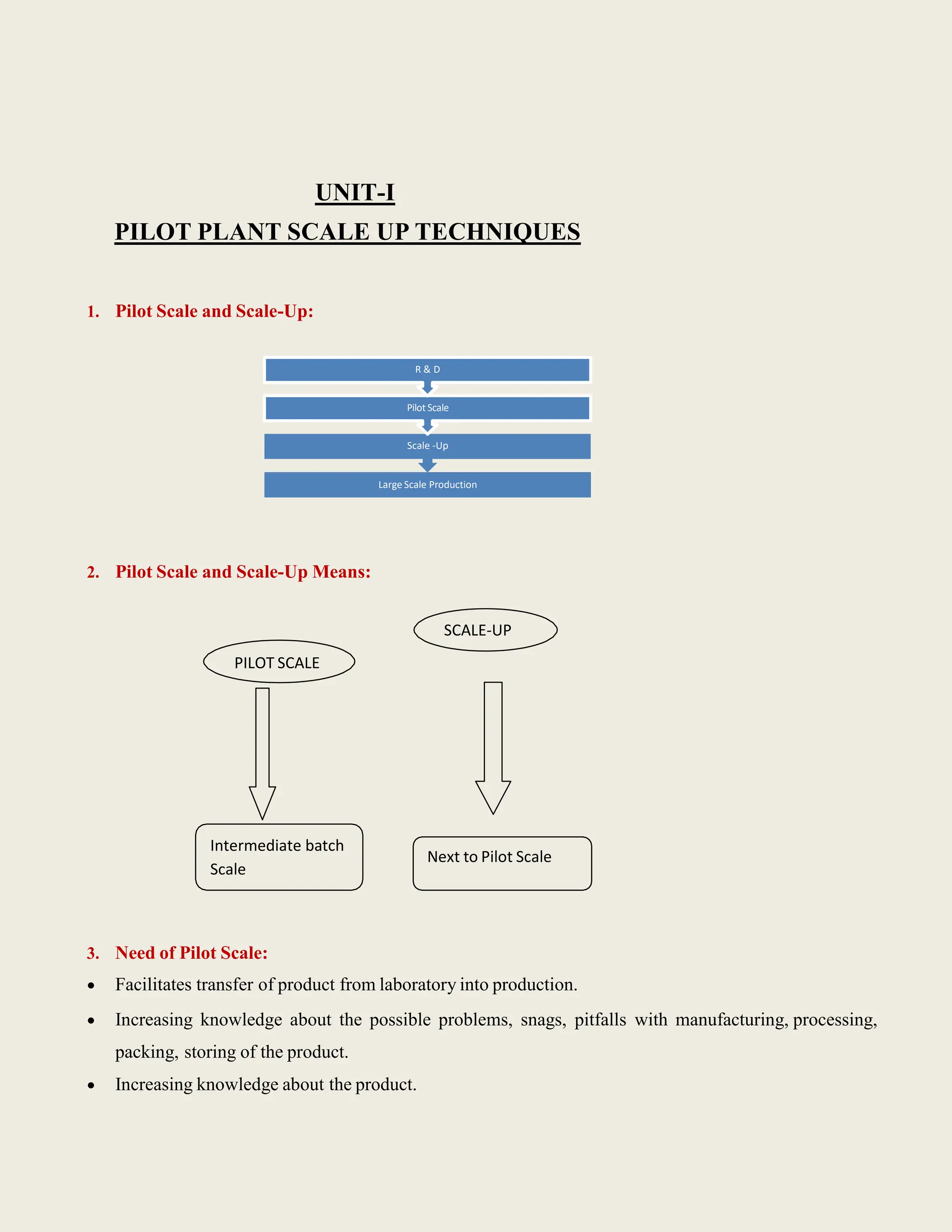
R & D
Pilot Scale
Scale -Up
Large Scale Production
UNIT-I
PILOT PLANT SCALE UP TECHNIQUES
1. Pilot Scale and Scale-Up:
2. Pilot Scale and Scale-Up Means:
3. Need of Pilot Scale:
 Facilitates transfer of product from laboratory into production.
 Increasing knowledge about the possible problems, snags, pitfalls with manufacturing, processing,
packing, storing of the product.
 Increasing knowledge about the product.
PILOT SCALE
Intermediate batch
Scale
SCALE-UP
Next to Pilot Scale
 Bench studies, animal studies, clinical studies etc.
4. Need of Scale-up:
 Scale –Up is necessary to determine the effect of scale on product quality.
 Processes behave differently on small scale and on a large scale.
 Processes are scale dependent.
 A perfect product in laboratory and pilot plant.
 A well defined process.
5. Objectives of the Scale-Up:
 Formulation related: Identification and Control of critical components & other variables.
 Equipment related: Identification and Control of critical parameters and operating ranges.
 Production & Process related: Evaluation, validation, and finalization of controls.
 Product related: Development and validation of reprocessing procedures.
 Documentation: Records and Reports according to cGMP.
6. Pilot Plant design:
 Formulation & process development
 Clinical supply manufacture
 Technology evaluation, scale-up and transfer
7. Attributes required:
 cGMP compliance
 Equipment at multiple scales based on similarly operating principles to those in production
(Intermediate and full sized equipment)
 A flexible highly trained staff
 Equipment to support multiple dosage form development
 Portable equipment
 Multipurpose rooms
 Restricted access, regulated personnel flow and material flow
 Low maintenance and operating cost
8. Pilot plant operation:
 Process & manufacturing activities
 Material control
 Maintenance & calibration
 Validation
 Inventory, orders & labeling
 Training
 Engineering support
 QA & QC
9. Requirements for Pilot scale and Scale –Up:
 Personnel requirements
 Equipment requirements
 Space requirements
 Process evaluation
 Preparation of Master Manufacturing Procedures
 GMP considerations
10. Scale-Up Considerations for Tablets:
 Material/Powder handling
 Avoiding segregation
 Dry blending
 Granulation
 Fluidized Bed Granulations
 Drying
 Particle size reduction
 Blending
 Specialized Granulation procedures
 Granulation handling & Feed system
 Compression
 Tablet coating (Film Coating): Pan coating & Fluidized bed coating
11.Scale-Up Considerations for Liquid Dosage Forms:SOLUTION:
 Tank size (diameter)
 Impeller type
 Impeller diameter
 Rotational speed of the impeller
 Number of the impellers
 Number of baffles
 Mixing capability of impeller
 Clearance between impeller blades & wall of the mixing tank
 Height of the filled volume in the tank
 Filtration equipment
 Transfer system
 Passivation of stainless steel
SUSPENSION:
 Addition & dispersion of suspending agents
 Hydration & wetting of suspending agent
 Time & Temperature required for hydration of suspending agent
 Mixing speed
 Selection of the equipment according to batch size
 Versat or (to avoid air entrapment)
 Mesh size
EMULSION:
 Temperature
 Mixing equipment
 Homogenizing equipment
 In process or final product filters
 Screens, pumps & filling equipment
 Phase volumes
 Phase viscosities
 Phase densities
11. Scale-Up Considerations for Semi-Solid Products:
 Mixing equipment
 Motors
 Mixing speed
 Component homogenization
 Heating & cooling process
 Addition of active ingredients
 Product transfer
 Working temperature range
 Shear during handling & transfer
 Transfer pumps
 Size & type of pump: Product viscosity, Pumping rate, Product compatibility with the pumpsurface &
Pump pressure.
12. SUPAC [Scale -Up & Post Approval Changes]:
 In the process of developing a new product, the batch size used in earliest human studies issmall.
 The size of the batch is gradually increased (Scale up).
 The scale up and the changes made after approval in the composition, manufacturing process,
manufacturing equipment & change of site have known as Scale up & Post Approval changes
(SUPAC).
 The FDA has issued various guidelines for SUPAC changes as:
1. SUPAC- IR [Immediate release solid oral dosage forms]
2. SUPAC-MR [ Modified release solid oral dosage forms]
3. SUPAC- SS [For non sterile semisolid dosage form]
13. SUPAC GUIDELINES –DEFINE:
 Level of changes : Minor changes, Moderate changes & Major changes
 Filing: Annual report, Changes being affected supplement & Prior approval supplement
 Tests: Application/Compendial tests, In-vitro dissolution/release & in-vivo.
14. Introduction to platform technology:
 Platform technologies are considered a valuable tool to improve efficiency & quality in drug product
development.
 A platform, in combination with a risk- based approach, is the most systematic method to leverage
prior knowledge for a given new molecule.
 Platform technology enables a continuous improvement by adding data for every new molecule
developed by this approach, increasing the robustness of the platform.
Learning Outcome:
To Know the process of pilot plant and scale up of pharmaceutical dosage forms.
Important questions:
[Two marks questions]
1. Define Plant.
2. Define Pilot plant.
3. What is scale –up?
4. What is SUPAC?
[Five marks questions]
1. Write about SUPAC guidelines.
2. Discuss the scale up considerations for solid dosage forms.
3. Discuss the scale up considerations for liquid dosage forms.
4. Discuss the scale up considerations for semi solid dosage forms.
5. Explain platform technology in detail.
[Ten marks questions]
1. Explain the scale up considerations for tablets and capsules.
2. Explain in detail the scale up considerations for solutions, suspensions and emulsions.
3. Discuss the scale up considerations for ointments and creams.
Pilot plant scaleup techniques | unit 1 | Industrial pharmacy

Pilot plant scaleup techniques | unit 1 | Industrial pharmacy

  • 1.
    B. PHARMACY 7SEM INDUSTRAIL PHARMACY – II (BP702T) DR. KAMINEE SAHU PROFESSOR GGITS, JABALPUR M.P.
  • 2.
    R & D PilotScale Scale -Up Large Scale Production UNIT-I PILOT PLANT SCALE UP TECHNIQUES 1. Pilot Scale and Scale-Up: 2. Pilot Scale and Scale-Up Means: 3. Need of Pilot Scale:  Facilitates transfer of product from laboratory into production.  Increasing knowledge about the possible problems, snags, pitfalls with manufacturing, processing, packing, storing of the product.  Increasing knowledge about the product. PILOT SCALE Intermediate batch Scale SCALE-UP Next to Pilot Scale
  • 3.
     Bench studies,animal studies, clinical studies etc.
  • 4.
    4. Need ofScale-up:  Scale –Up is necessary to determine the effect of scale on product quality.  Processes behave differently on small scale and on a large scale.  Processes are scale dependent.  A perfect product in laboratory and pilot plant.  A well defined process. 5. Objectives of the Scale-Up:  Formulation related: Identification and Control of critical components & other variables.  Equipment related: Identification and Control of critical parameters and operating ranges.  Production & Process related: Evaluation, validation, and finalization of controls.  Product related: Development and validation of reprocessing procedures.  Documentation: Records and Reports according to cGMP. 6. Pilot Plant design:  Formulation & process development  Clinical supply manufacture  Technology evaluation, scale-up and transfer 7. Attributes required:  cGMP compliance  Equipment at multiple scales based on similarly operating principles to those in production (Intermediate and full sized equipment)  A flexible highly trained staff  Equipment to support multiple dosage form development  Portable equipment
  • 5.
     Multipurpose rooms Restricted access, regulated personnel flow and material flow  Low maintenance and operating cost 8. Pilot plant operation:  Process & manufacturing activities  Material control  Maintenance & calibration  Validation  Inventory, orders & labeling  Training  Engineering support  QA & QC 9. Requirements for Pilot scale and Scale –Up:  Personnel requirements  Equipment requirements  Space requirements  Process evaluation  Preparation of Master Manufacturing Procedures  GMP considerations 10. Scale-Up Considerations for Tablets:  Material/Powder handling  Avoiding segregation  Dry blending
  • 6.
     Granulation  FluidizedBed Granulations  Drying  Particle size reduction  Blending  Specialized Granulation procedures  Granulation handling & Feed system  Compression  Tablet coating (Film Coating): Pan coating & Fluidized bed coating 11.Scale-Up Considerations for Liquid Dosage Forms:SOLUTION:  Tank size (diameter)  Impeller type  Impeller diameter  Rotational speed of the impeller  Number of the impellers  Number of baffles  Mixing capability of impeller  Clearance between impeller blades & wall of the mixing tank  Height of the filled volume in the tank  Filtration equipment  Transfer system  Passivation of stainless steel SUSPENSION:  Addition & dispersion of suspending agents  Hydration & wetting of suspending agent  Time & Temperature required for hydration of suspending agent
  • 7.
     Mixing speed Selection of the equipment according to batch size  Versat or (to avoid air entrapment)  Mesh size EMULSION:  Temperature  Mixing equipment  Homogenizing equipment  In process or final product filters  Screens, pumps & filling equipment  Phase volumes  Phase viscosities  Phase densities 11. Scale-Up Considerations for Semi-Solid Products:  Mixing equipment  Motors  Mixing speed  Component homogenization  Heating & cooling process  Addition of active ingredients  Product transfer  Working temperature range  Shear during handling & transfer  Transfer pumps
  • 8.
     Size &type of pump: Product viscosity, Pumping rate, Product compatibility with the pumpsurface & Pump pressure. 12. SUPAC [Scale -Up & Post Approval Changes]:  In the process of developing a new product, the batch size used in earliest human studies issmall.  The size of the batch is gradually increased (Scale up).  The scale up and the changes made after approval in the composition, manufacturing process, manufacturing equipment & change of site have known as Scale up & Post Approval changes (SUPAC).  The FDA has issued various guidelines for SUPAC changes as: 1. SUPAC- IR [Immediate release solid oral dosage forms] 2. SUPAC-MR [ Modified release solid oral dosage forms] 3. SUPAC- SS [For non sterile semisolid dosage form] 13. SUPAC GUIDELINES –DEFINE:  Level of changes : Minor changes, Moderate changes & Major changes  Filing: Annual report, Changes being affected supplement & Prior approval supplement  Tests: Application/Compendial tests, In-vitro dissolution/release & in-vivo. 14. Introduction to platform technology:  Platform technologies are considered a valuable tool to improve efficiency & quality in drug product development.  A platform, in combination with a risk- based approach, is the most systematic method to leverage prior knowledge for a given new molecule.  Platform technology enables a continuous improvement by adding data for every new molecule developed by this approach, increasing the robustness of the platform.
  • 9.
    Learning Outcome: To Knowthe process of pilot plant and scale up of pharmaceutical dosage forms. Important questions: [Two marks questions] 1. Define Plant. 2. Define Pilot plant. 3. What is scale –up? 4. What is SUPAC? [Five marks questions] 1. Write about SUPAC guidelines. 2. Discuss the scale up considerations for solid dosage forms. 3. Discuss the scale up considerations for liquid dosage forms. 4. Discuss the scale up considerations for semi solid dosage forms. 5. Explain platform technology in detail. [Ten marks questions] 1. Explain the scale up considerations for tablets and capsules. 2. Explain in detail the scale up considerations for solutions, suspensions and emulsions. 3. Discuss the scale up considerations for ointments and creams.