PILOT PLANT SCALE UP
TECHNIQUES
Dr. Mahesh Kumar Kataria
Professor and Head, Department of Pharmaceutics,
Seth G. L. Bihani S. D. College of Technical
Education, Sri Ganganagar
Email: kataria.pharmacy@gmail.com
Dr. Mahesh Kumar Kataria 1
PILOT PLANT SCALE UP TECHNIQUES
Pilot plant:
“A part of the pharmaceutical industry where a lab scale
formula is transformed into a viable product by the
development of liable practical procedure for manufacture.”
• Pre-commercial production system.
• knowledge obtained used for design of full-scale production.
• Non-technical purposes- public support for new technologies
and government regulations.
• Pilot plant studies include-
Close examination of formula to withstand batch scale,
Process modifications,
Availability of raw materials meeting the specification of
product.
Production and process control-evaluated, validated and
finalized.
Dr. Mahesh Kumar Kataria 2
Need of Pilot Plant Studies:
• Investigation of product and process on an intermediate
scale production.
• Not possible to design a large scale complex processing
plant.
Application of pilot plant:
• Evaluation of results from laboratory studies,
• Producing small quantities for sensory, chemical,
microbiological evaluations, limited market testing or
furnishing samples to potential customers, shelf-live and
storage stability studies.
• Determining possible salable by-products or waste stream.
• Providing data to decide to proceed or not for full-scale
production.
• If proceeding - designing and constructing a full-size plant
or modifying an existing plant.Dr. Mahesh Kumar Kataria 3
Considerations in pilot plant development
• Kind and size –evaluating product and process by producing
samples
• Location: near R&D or existing plant? Close liaison between
R&D and pilot plant staff.
• Labor requirements and costs: engineering staff, skilled
operations and maintenance staff- pilot plant costs may
exceed.
• The pilot plant may be used for training personnel for a full-
scale plant.
Dr. Mahesh Kumar Kataria 4
Objective
• To try process on proposed model before investing large
money.
• Examination of the formula withstanding Batch-scale
• Evaluation and validation for process and equipments.
• To identify the critical features of the process
• Guidelines for production and process controls.
• To provide master manufacturing formula with instructions.
• To avoid the scale-up problems.
Dr. Mahesh Kumar Kataria 5
Significance/Importance of Pilot Plant
• Standardization of formulae.
• Review of range of relevant processing equipments.
• Optimization and control of production rate.
• Identification of critical features to maintain quality of a
product.
• Appropriate records and reports to support GMP
Dr. Mahesh Kumar Kataria 6
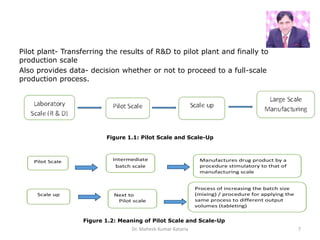
Pilot plant- Transferring the results of R&D to pilot plant and finally to
production scale
Also provides data- decision whether or not to proceed to a full-scale
production process.
Figure 1.1: Pilot Scale and Scale-Up
Figure 1.2: Meaning of Pilot Scale and Scale-Up
Dr. Mahesh Kumar Kataria 7
Pilot Scale Intermediate
batch scale
Manufactures drug product by a
procedure stimulatory to that of
manufacturing scale
Scale up Next to
Pilot scale
Process of increasing the batch size
(mixing) / procedure for applying the
same process to different output
volumes (tableting)
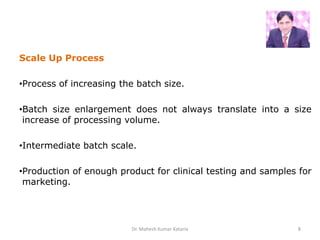
Scale Up Process
•Process of increasing the batch size.
•Batch size enlargement does not always translate into a size
increase of processing volume.
•Intermediate batch scale.
•Production of enough product for clinical testing and samples for
marketing.
Dr. Mahesh Kumar Kataria 8
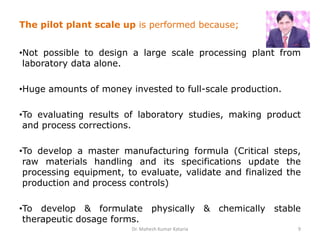
The pilot plant scale up is performed because;
•Not possible to design a large scale processing plant from
laboratory data alone.
•Huge amounts of money invested to full-scale production.
•To evaluating results of laboratory studies, making product
and process corrections.
•To develop a master manufacturing formula (Critical steps,
raw materials handling and its specifications update the
processing equipment, to evaluate, validate and finalized the
production and process controls)
•To develop & formulate physically & chemically stable
therapeutic dosage forms.
Dr. Mahesh Kumar Kataria 9

Pilot plant scale up techniques: Basics

  • 1.
    PILOT PLANT SCALEUP TECHNIQUES Dr. Mahesh Kumar Kataria Professor and Head, Department of Pharmaceutics, Seth G. L. Bihani S. D. College of Technical Education, Sri Ganganagar Email: kataria.pharmacy@gmail.com Dr. Mahesh Kumar Kataria 1
  • 2.
    PILOT PLANT SCALEUP TECHNIQUES Pilot plant: “A part of the pharmaceutical industry where a lab scale formula is transformed into a viable product by the development of liable practical procedure for manufacture.” • Pre-commercial production system. • knowledge obtained used for design of full-scale production. • Non-technical purposes- public support for new technologies and government regulations. • Pilot plant studies include- Close examination of formula to withstand batch scale, Process modifications, Availability of raw materials meeting the specification of product. Production and process control-evaluated, validated and finalized. Dr. Mahesh Kumar Kataria 2
  • 3.
    Need of PilotPlant Studies: • Investigation of product and process on an intermediate scale production. • Not possible to design a large scale complex processing plant. Application of pilot plant: • Evaluation of results from laboratory studies, • Producing small quantities for sensory, chemical, microbiological evaluations, limited market testing or furnishing samples to potential customers, shelf-live and storage stability studies. • Determining possible salable by-products or waste stream. • Providing data to decide to proceed or not for full-scale production. • If proceeding - designing and constructing a full-size plant or modifying an existing plant.Dr. Mahesh Kumar Kataria 3
  • 4.
    Considerations in pilotplant development • Kind and size –evaluating product and process by producing samples • Location: near R&D or existing plant? Close liaison between R&D and pilot plant staff. • Labor requirements and costs: engineering staff, skilled operations and maintenance staff- pilot plant costs may exceed. • The pilot plant may be used for training personnel for a full- scale plant. Dr. Mahesh Kumar Kataria 4
  • 5.
    Objective • To tryprocess on proposed model before investing large money. • Examination of the formula withstanding Batch-scale • Evaluation and validation for process and equipments. • To identify the critical features of the process • Guidelines for production and process controls. • To provide master manufacturing formula with instructions. • To avoid the scale-up problems. Dr. Mahesh Kumar Kataria 5
  • 6.
    Significance/Importance of PilotPlant • Standardization of formulae. • Review of range of relevant processing equipments. • Optimization and control of production rate. • Identification of critical features to maintain quality of a product. • Appropriate records and reports to support GMP Dr. Mahesh Kumar Kataria 6
  • 7.
    Pilot plant- Transferringthe results of R&D to pilot plant and finally to production scale Also provides data- decision whether or not to proceed to a full-scale production process. Figure 1.1: Pilot Scale and Scale-Up Figure 1.2: Meaning of Pilot Scale and Scale-Up Dr. Mahesh Kumar Kataria 7 Pilot Scale Intermediate batch scale Manufactures drug product by a procedure stimulatory to that of manufacturing scale Scale up Next to Pilot scale Process of increasing the batch size (mixing) / procedure for applying the same process to different output volumes (tableting)
  • 8.
    Scale Up Process •Processof increasing the batch size. •Batch size enlargement does not always translate into a size increase of processing volume. •Intermediate batch scale. •Production of enough product for clinical testing and samples for marketing. Dr. Mahesh Kumar Kataria 8
  • 9.
    The pilot plantscale up is performed because; •Not possible to design a large scale processing plant from laboratory data alone. •Huge amounts of money invested to full-scale production. •To evaluating results of laboratory studies, making product and process corrections. •To develop a master manufacturing formula (Critical steps, raw materials handling and its specifications update the processing equipment, to evaluate, validate and finalized the production and process controls) •To develop & formulate physically & chemically stable therapeutic dosage forms. Dr. Mahesh Kumar Kataria 9