PILED FOUNDATIONPILED FOUNDATION
DESIGN & CONSTRUCTIONDESIGN & CONSTRUCTION
By Ir. Dr. Gue See Sew &
Ir. Chow Chee Meng
http://www.gnpgeo.com.my
ContentsContents
Overview
Preliminary Study
Site Visit & SI Planning
Pile Design
Pile Installation Methods
Types of Piles
Contents (ContContents (Cont’’d)d)
Piling Supervision
Pile Damage
Piling Problems
Typical Design and Construction Issues
Myths in Piling
Case Histories
Conclusions
Overview
What is a Pile Foundation
It is a foundation system that
transfers loads to a deeper
and competent soil layer.
When To Use Pile Foundations
• Inadequate Bearing Capacity of Shallow
Foundations
• To Prevent Uplift Forces
• To Reduce Excessive Settlement
PILE CLASSIFICATIONPILE CLASSIFICATION
Friction Pile
– Load Bearing Resistance derived mainly
from skin friction
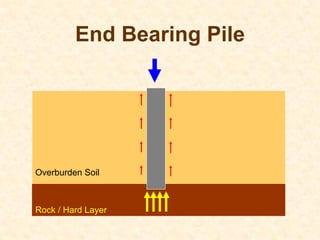
End Bearing Pile
– Load Bearing Resistance derived mainly
from base
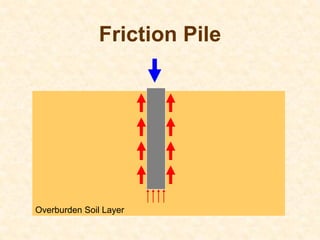
Friction Pile
Overburden Soil Layer
End Bearing Pile
Rock / Hard Layer
Overburden Soil
Preliminary Study
Preliminary StudyPreliminary Study
Type & Requirements of Superstructure
Proposed Platform Level (ie CUT or FILL)
Geology of Area
Previous Data or Case Histories
Subsurface Investigation Planning
Selection of Types & Size of Piles
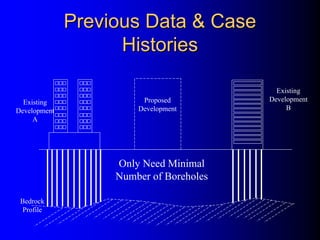
Previous Data & CasePrevious Data & Case
HistoriesHistories
Bedrock
Profile
Existing
Development
A
Existing
Development
B
Proposed
Development
Only Need Minimal
Number of Boreholes
Challenge The Norm Thru
Innovation To Excel
SELECTION OF PILESSELECTION OF PILES
Factors Influencing Pile Selection
– Types of Piles Available in Market (see Fig. 1)
– Installation Method
– Contractual Requirements
– Ground Conditions (eg Limestone, etc)
– Site Conditions & Constraints (eg Accessibility)
– Type and Magnitude of Loading
– Development Program & Cost
– etc
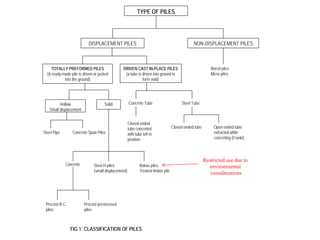
TYPE OF PILES
DISPLACEMENT PILES NON-DISPLACEMENT PILES
TOTALLY PREFORMED PILES
(A ready-made pile is driven or jacked
into the ground)
DRIVEN CAST IN-PLACE PILES
(a tube is driven into ground to
form void)
Bored piles
Micro piles
Hollow
Small displacement
Solid
Steel Pipe Concrete Spun Piles
Concrete Tube
Closed ended
tube concreted
with tube left in
position
Closed ended tube
Steel Tube
Open ended tube
extracted while
concreting (Franki)
Concrete Steel H-piles
(small displacement)
Bakau piles
Treated timber pile
Precast R.C.
piles
Precast prestressed
piles
FIG 1: CLASSIFICATION OF PILES
Restricted use due to
environmental
considerations
BAKAUPILES
TIMPERPILES
RCPILES
PSCPILES
SPUNPILES
STEELHPILES
STEELPIPEPILES
JACKEDPILES
<100 KN a a a ? ? ? ? a x ? a
100-300 a a a ? ? a a a x a a
300-600 ? a a a a a a a a a a
600-1100 x ? a a a a a ? a a ?
1100-2000 x ? a a a a a ? a a ?
2000-5000 x x a a a a a ? a a ?
5000-10000 x x a a a a a x a a x
>10000 x x ? a a a a x a ? x
<5m ? ? ? ? ? ? ? x a a ?
5-10m a a a a a a a ? a a a
10-20m ? ? a a a a a a a a a
20-30m x x a a a a a a a a a
30-60m x x a a a a a a a ? a
a a a a a ? a a a ? a
a a a a a a a a a ? a
? ? ? ? ? a a a ? a a
x x a a a a a ? a a ?
x x ? ? ? a a ? a a ?
x ? a a a a a a a a a
a a a a a a a a a ? a
a a a a a a a a a a a
? a a a a a a a a a a
x ? a a a a a a a a a
a a a a a a a a a a a
? a a a a a a a a a a
x ? a a a a a a a a a
V. DENSE SPT > 50 x x a a a a a ? a a ?
S < 100 mm x ? a a a a a a a a ?
100-1000mm x x ? ? ? a a ? a a x
1000-3000mm x x ? ? ? ? ? ? ? a x
>3000mm x x ? ? ? ? ? ? ? a x
a a a a a a a a a a a
x a a a a a a a a a a
a a ? ? ? ? ? a a a a
? ? ? ? ? ? ? a ? a a
1-2 0.5-2 1.5-3 1-2.5
AUGEREDPILES
COMPRESSIVE LOAD PER COLUMN
SCALEOFLOAD
(STRUCTURAL)
1.0-3.5
PREVENTION OF EFFECTS ON ADJOINING
STRUCTURES
(SUPPLY & INSTALL) RM/TON/M 0.5-2.5 0.3-2.0
LOOSE SPT < 10
UNIT COST
GROUND
WATER
TYPEOFINTERMEDIATELAYER
GEOTECHNICAL
TYPEOF
BEARING
LAYER
BEARINGTYPE
ENVIRONME
NT
MICROPILES
BOREDPILES
PREFORMED PILES
M. DENSE SPT = 10 - 30
MAINLY END -BEARING
(D=Anticipated depth of bearing)
PARTLY FRICTION + PARTLY END BEARING
MAINLY FRICTION
LIMESTON FORMATION
M. STIFF SPT = 4 - 15
V. STIFF SPT = 15 - 32
HARD SPT > 32
DENSE / VERY DENSE SAND
SOFT SPT < 4
WEATHERED ROCK / SOFT ROCK
NOISE + VIBRATION; COUNTER MEASURES
REQUIRED
BELOW PILE CAP
ROCK (RQD > 70%)
DENSE SPT = 30 - 50
COHESIVE SOIL
COHESIVELESS SOIL
SOIL WITH SOME BOULDERS /
COBBLES (S=SIZE)
ABOVE PILE CAP
DESIGN
CONSIDERATIONS
TYPE OF PILE
LEGEND :
8
x
?
INDICATES THAT THE PILE TYPE IS
SUITABLE
INDICATES THAT THE PILE TYPE IS
NOT SUITABLE
INDICATES THAT THE USE OF PILE
TYPE IS DOUBTFUL OR NOT COST
EFFECTIVE UNLESS ADDITIONAL
MEASURES TAKEN
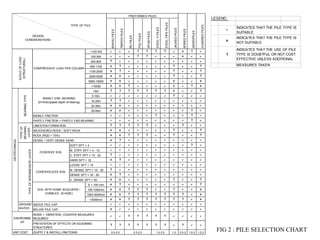
FIG 2 : PILE SELECTION CHART
Site Visit and SI Planning
Site VisitSite Visit
Things To Look For …
Accessibility & Constraints of Site
Adjacent Structures/Slopes, Rivers,
Boulders, etc
Adjacent Activities (eg excavation)
Confirm Topography & Site Conditions
Any Other Observations that may affect
Design and Construction of Foundation
Subsurface Investigation (SI)Subsurface Investigation (SI)
PlanningPlanning
Provide Sufficient Boreholes to get Subsoil Profile
Collect Rock Samples for Strength Tests (eg UCT)
In-Situ Tests to get consistency of ground (eg SPT)
Classification Tests to Determine Soil Type
Profile
Soil Strength Tests (eg CIU)
Chemical Tests (eg Chlorine, Sulphate, etc)
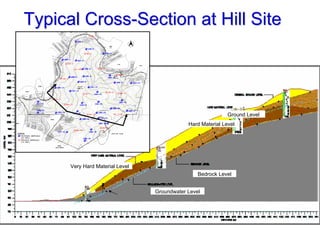
Typical CrossTypical Cross--Section at Hill SiteSection at Hill Site
Ground Level
Bedrock Level
Very Hard Material Level
Hard Material Level
Groundwater Level
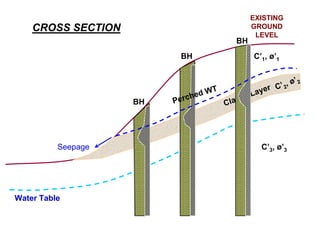
EXISTING
GROUND
LEVEL
Water Table
C’2
, ø’2
Clayey Layer
C’3, ø’3
C’1, ø’1
BH
BH
BH Perched WT
Seepage
CROSS SECTION
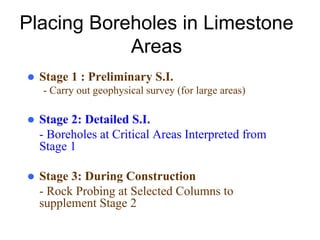
Placing Boreholes in Limestone
Areas
Stage 1 : Preliminary S.I.
- Carry out geophysical survey (for large areas)
Stage 2: Detailed S.I.
- Boreholes at Critical Areas Interpreted from
Stage 1
Stage 3: During Construction
- Rock Probing at Selected Columns to
supplement Stage 2
Pile Design
PILE DESIGNPILE DESIGN
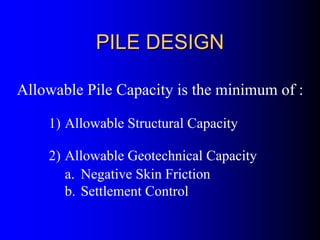
Allowable Pile Capacity is the minimum of :
1) Allowable Structural Capacity
2) Allowable Geotechnical Capacity
a. Negative Skin Friction
b. Settlement Control
PILE DESIGNPILE DESIGN
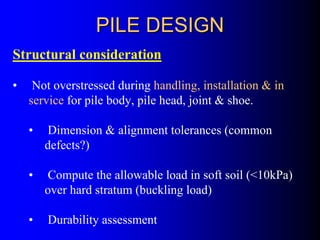
Structural consideration
• Not overstressed during handling, installation & in
service for pile body, pile head, joint & shoe.
• Dimension & alignment tolerances (common
defects?)
• Compute the allowable load in soft soil (<10kPa)
over hard stratum (buckling load)
• Durability assessment
Pile Capacity DesignPile Capacity Design
Structural CapacityStructural Capacity
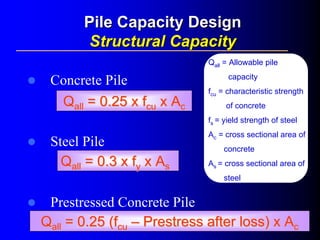
Concrete Pile
Steel Pile
Prestressed Concrete Pile
QQallall = 0.25 x= 0.25 x ffcucu x Ax Acc
QQallall = 0.3 x= 0.3 x ffyy x Ax Ass
QQallall = 0.25 (= 0.25 (ffcucu –– PrestressPrestress after loss) x Aafter loss) x Acc
Qall = Allowable pile
capacity
fcu = characteristic strength
of concrete
fs = yield strength of steel
Ac = cross sectional area of
concrete
As = cross sectional area of
steel
SPT Blow Count per 300mm Penetration
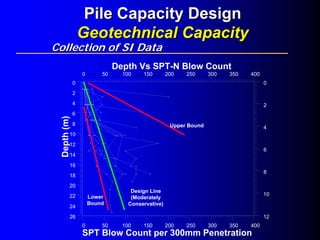
Collection of SI DataCollection of SI Data
Pile Capacity DesignPile Capacity Design
Geotechnical CapacityGeotechnical Capacity
4000 50 100 150 200 250 300 350
26
24
22
20
18
16
14
12
10
8
6
4
2
0
12
10
8
6
4
2
0
0 50 100 150 200 250 300 350 400
Depth(m)
Upper Bound
Lower
Bound
Design Line
(Moderately
Conservative)
Depth Vs SPT-N Blow Count
0 50 100 150 200 250 300 350 400
26
24
22
20
18
16
14
12
10
8
6
4
2
0
12
10
8
6
4
2
0
0 50 100 150 200 250 300 350 400
0 50 100 150 200 250 300 350 400
26
24
22
20
18
16
14
12
10
8
6
4
2
0
12
10
8
6
4
2
0
0 50 100 150 200 250 300 350 400
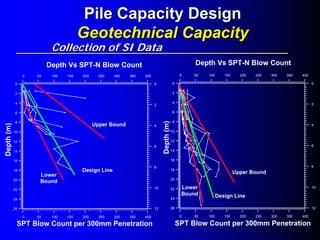
Upper Bound
Lower
Bound
Design Line Upper Bound
Lower
Bound Design Line
Depth(m)
Depth Vs SPT-N Blow Count
SPT Blow Count per 300mm Penetration
Depth(m)
Depth Vs SPT-N Blow Count
SPT Blow Count per 300mm Penetration
Collection of SI DataCollection of SI Data
Pile Capacity DesignPile Capacity Design
Geotechnical CapacityGeotechnical Capacity
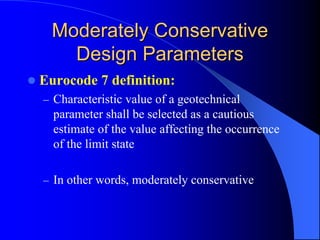
Moderately ConservativeModerately Conservative
Design ParametersDesign Parameters
Eurocode 7 definition:
– Characteristic value of a geotechnical
parameter shall be selected as a cautious
estimate of the value affecting the occurrence
of the limit state
– In other words, moderately conservative
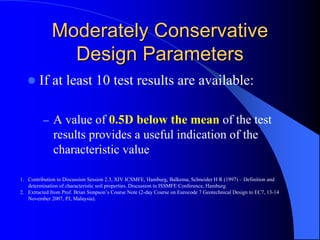
Moderately ConservativeModerately Conservative
Design ParametersDesign Parameters
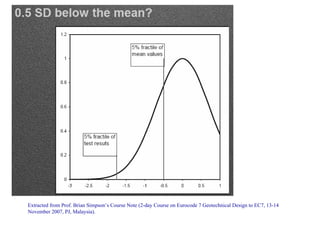
If at least 10 test results are available:
– A value of 0.5D below the mean of the test
results provides a useful indication of the
characteristic value
1. Contribution to Discussion Session 2.3, XIV ICSMFE, Hamburg, Balkema, Schneider H R (1997) – Definition and
determination of characteristic soil properties. Discussion to ISSMFE Conference, Hamburg.
2. Extracted from Prof. Brian Simpson’s Course Note (2-day Course on Eurocode 7 Geotechnical Design to EC7, 13-14
November 2007, PJ, Malaysia).
Extracted from Prof. Brian Simpson’s Course Note (2-day Course on Eurocode 7 Geotechnical Design to EC7, 13-14
November 2007, PJ, Malaysia).
•• Piles installed in a group may fail:Piles installed in a group may fail:
• Individually
• As a block
Pile Capacity DesignPile Capacity Design
Geotechnical CapacityGeotechnical Capacity
• Piles fail individually
• When installed at large spacing
Pile Capacity DesignPile Capacity Design
Geotechnical CapacityGeotechnical Capacity
• Piles fail as a block
• When installed at close spacing
Pile Capacity DesignPile Capacity Design
Geotechnical CapacityGeotechnical Capacity
Pile Capacity DesignPile Capacity Design
Single Pile CapacitySingle Pile Capacity
Pile Capacity DesignPile Capacity Design
Factor of Safety (FOS)Factor of Safety (FOS)
Factor of Safety (FOS) is required
for
Natural variations in soil strength &variations in soil strength &
compressibilitycompressibility
Pile Capacity DesignPile Capacity Design
Factor of Safety (FOS)Factor of Safety (FOS)
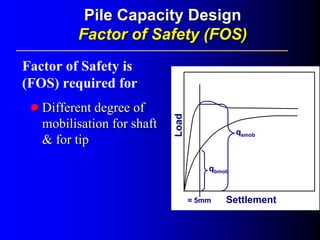
Factor of Safety is
(FOS) required for
Different degree ofDifferent degree of
mobilisationmobilisation for shaftfor shaft
& for tip& for tip
Load
Settlement≈ 5mm
qsmob
qbmob
Load
Settlement≈ 5mm
qsmob
qbmob
Pile Capacity DesignPile Capacity Design
Factor of Safety (FOS)Factor of Safety (FOS)
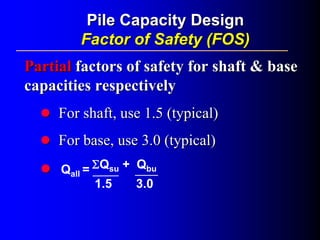
PartialPartial factors of safety for shaft & basefactors of safety for shaft & base
capacities respectivelycapacities respectively
For shaft, use 1.5 (typical)For shaft, use 1.5 (typical)
For base, use 3.0 (typical)For base, use 3.0 (typical)
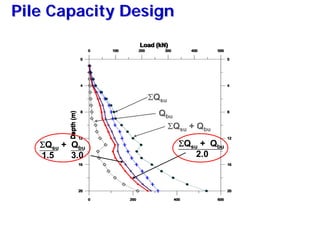
ΣQsu + Qbu
1.5 3.0
Qall =
Pile Capacity DesignPile Capacity Design
Factor of Safety (FOS)Factor of Safety (FOS)
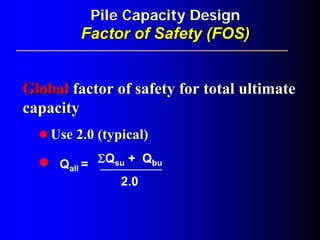
GlobalGlobal factor of safety for total ultimatefactor of safety for total ultimate
capacitycapacity
Use 2.0 (typical)Use 2.0 (typical)
ΣQsu + Qbu
2.0
Qall =
Pile Capacity DesignPile Capacity Design
Factor of Safety (FOS)Factor of Safety (FOS)
Calculate usingCalculate using BOTHBOTH approachesapproaches
(Partial & Global)(Partial & Global)
Choose theChoose the lowerlower of theof the QQallall valuesvalues
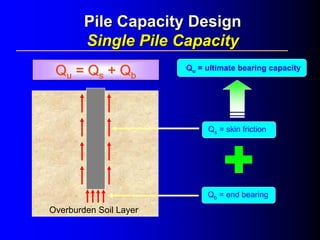
QQuu = Q= Qss ++ QQbb
Overburden Soil Layer
Qs = skin friction
Qb = end bearing
Qu = ultimate bearing capacity
Pile Capacity DesignPile Capacity Design
Single Pile CapacitySingle Pile Capacity
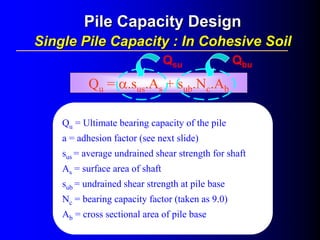
Qu = α.sus.As + sub.Nc.Ab
Qsu Qbu
Qu = Ultimate bearing capacity of the pile
a = adhesion factor (see next slide)
sus = average undrained shear strength for shaft
As = surface area of shaft
sub = undrained shear strength at pile base
Nc = bearing capacity factor (taken as 9.0)
Ab = cross sectional area of pile base
Pile Capacity DesignPile Capacity Design
Single Pile Capacity : In Cohesive SoilSingle Pile Capacity : In Cohesive Soil
Pile Capacity DesignPile Capacity Design
Single Pile Capacity:Single Pile Capacity: In Cohesive SoilIn Cohesive Soil
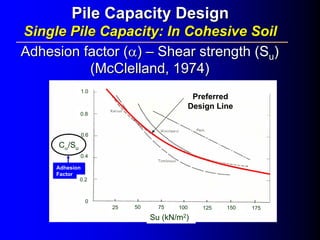
Adhesion factor (Adhesion factor (αα)) –– Shear strength (SShear strength (Suu))
(McClelland, 1974)(McClelland, 1974)
Adhesion
Factor
Su (kN/m2)
25 75 100 125 150 17550
0
0.6
0.2
0.4
0.8
1.0
Cα/Su
Preferred
Design Line
Meyerhof Fukuoka
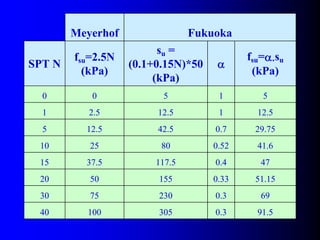
SPT N
fsu=2.5N
(kPa)
su =
(0.1+0.15N)*50
(kPa)
α
fsu=α.su
(kPa)
0 0 5 1 5
1 2.5 12.5 1 12.5
5 12.5 42.5 0.7 29.75
10 25 80 0.52 41.6
15 37.5 117.5 0.4 47
20 50 155 0.33 51.15
30 75 230 0.3 69
40 100 305 0.3 91.5
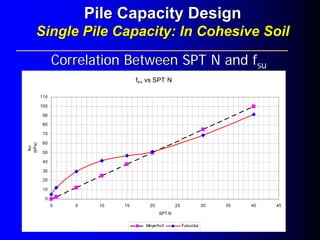
Correlation Between SPT N andCorrelation Between SPT N and ffsusu
fsu vs SPT N
0
10
20
30
40
50
60
70
80
90
100
110
0 5 10 15 20 25 30 35 40 45
SPT N
fsu
(kPa)
Meyerhof Fukuoka
Pile Capacity DesignPile Capacity Design
Single Pile Capacity:Single Pile Capacity: In Cohesive SoilIn Cohesive Soil
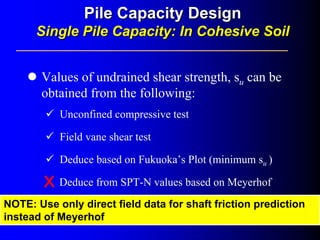
Values of undrained shear strength, su can be
obtained from the following:
Unconfined compressive test
Field vane shear test
Deduce based on Fukuoka’s Plot (minimum su )
Deduce from SPT-N values based on Meyerhof
Pile Capacity DesignPile Capacity Design
Single Pile Capacity:Single Pile Capacity: In Cohesive SoilIn Cohesive Soil
NOTE: Use only direct field data for shaft friction prediction
instead of Meyerhof
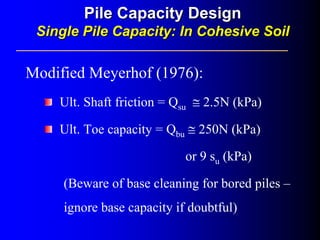
Modified Meyerhof (1976):
Ult. Shaft friction = Qsu ≅ 2.5N (kPa)
Ult. Toe capacity = Qbu ≅ 250N (kPa)
or 9 su (kPa)
(Beware of base cleaning for bored piles –
ignore base capacity if doubtful)
Pile Capacity DesignPile Capacity Design
Single Pile Capacity:Single Pile Capacity: In Cohesive SoilIn Cohesive Soil
Modified Meyerhof (1976):Modified Meyerhof (1976):
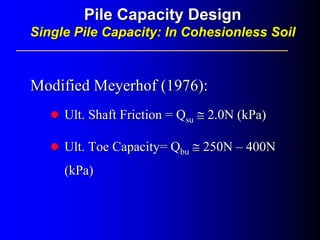
UltUlt. Shaft Friction =. Shaft Friction = QQsusu ≅≅ 2.0N (2.0N (kPakPa))
UltUlt. Toe Capacity=. Toe Capacity= QQbubu ≅≅ 250N250N –– 400N400N
((kPakPa))
Pile Capacity DesignPile Capacity Design
Single Pile Capacity:Single Pile Capacity: InIn CohesionlessCohesionless SoilSoil
0 200 400 600
20
16
12
8
4
0
Depth(m)
0 100 200 300 400 500
Load (kN)
20
16
12
8
4
0
Pile Capacity DesignPile Capacity Design
ΣQsu
Qbu
ΣQsu + Qbu
0 200 400 600
20
16
12
8
4
0
Depth(m)
0 100 200 300 400 500
Load (kN)
20
16
12
8
4
0
0 200 400 600
20
16
12
8
4
0
Depth(m)
0 100 200 300 400 500
Load (kN)
20
16
12
8
4
0
0 200 400 600
20
16
12
8
4
0
Depth(m)
0 100 200 300 400 500
Load (kN)
20
16
12
8
4
0
ΣQsu + Qbu
2.0
0 200 400 600
20
16
12
8
4
0
Depth(m)
0 100 200 300 400 500
Load (kN)
20
16
12
8
4
0
ΣQsu + Qbu
1.5 3.0
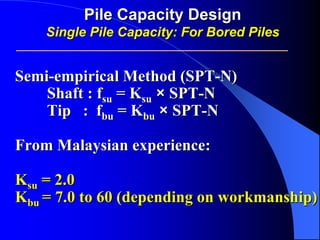
SemiSemi--empirical Method (SPTempirical Method (SPT--N)N)
Shaft :Shaft : ffsusu == KKsusu ×× SPTSPT--NN
TipTip :: ffbubu == KKbubu ×× SPTSPT--NN
From Malaysian experience:From Malaysian experience:
KKsusu = 2.0= 2.0
KKbubu = 7.0 to 60 (depending on workmanship)= 7.0 to 60 (depending on workmanship)
Pile Capacity DesignPile Capacity Design
Single Pile Capacity:Single Pile Capacity: For Bored PilesFor Bored Piles
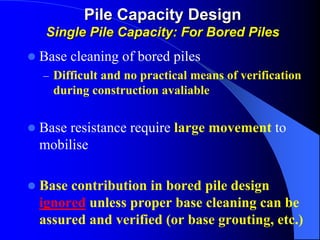
Base cleaning of bored piles
– Difficult and no practical means of verification
during construction avaliable
Base resistance require large movement to
mobilise
Base contribution in bored pile design
ignored unless proper base cleaning can be
assured and verified (or base grouting, etc.)
Pile Capacity DesignPile Capacity Design
Single Pile Capacity:Single Pile Capacity: For Bored PilesFor Bored Piles
Rock Socket DesignRock Socket Design
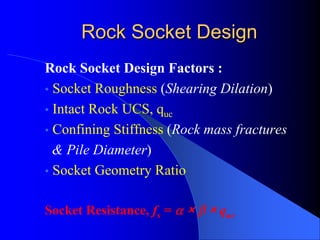
Rock Socket Design Factors :
• Socket Roughness (Shearing Dilation)
• Intact Rock UCS, quc
• Confining Stiffness (Rock mass fractures
& Pile Diameter)
• Socket Geometry Ratio
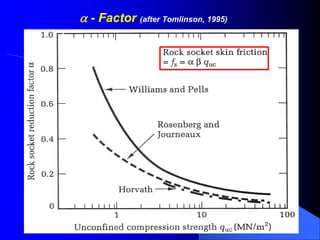
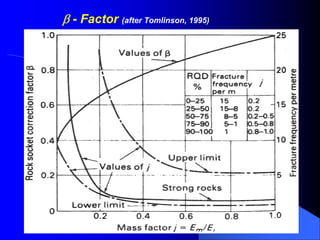
Socket Resistance, fs = α × β × quc
α - Factor (after Tomlinson, 1995)
β - Factor (after Tomlinson, 1995)
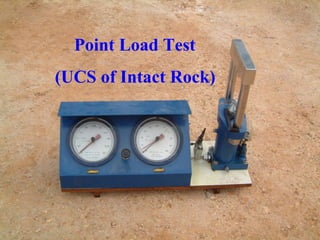
Point Load Test
(UCS of Intact Rock)
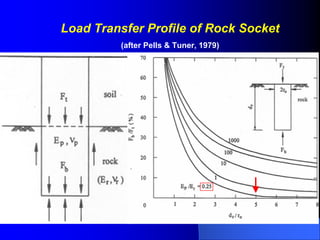
Load Transfer Profile of Rock Socket
(after Pells & Tuner, 1979)
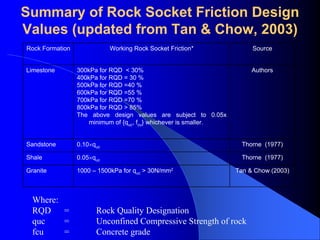
Summary of Rock Socket Friction Design
Values (updated from Tan & Chow, 2003)
Rock Formation Working Rock Socket Friction* Source
Limestone 300kPa for RQD < 30%
400kPa for RQD = 30 %
500kPa for RQD =40 %
600kPa for RQD =55 %
700kPa for RQD =70 %
800kPa for RQD > 85%
The above design values are subject to 0.05x
minimum of {quc, fcu} whichever is smaller.
Authors
Sandstone 0.10×quc Thorne (1977)
Shale 0.05×quc Thorne (1977)
Granite 1000 – 1500kPa for quc > 30N/mm2 Tan & Chow (2003)
Where:
RQD = Rock Quality Designation
quc = Unconfined Compressive Strength of rock
fcu = Concrete grade
End Bearing Design in RockEnd Bearing Design in Rock
Only designed when
• Dry Hole
• Base Cleaning & Inspection are possible
Pile Capacity DesignPile Capacity Design
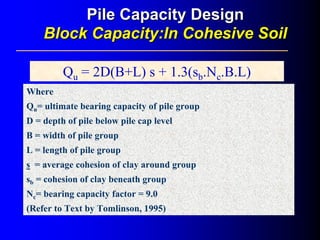
Block CapacityBlock Capacity
Qu = 2D(B+L) s + 1.3(sb.Nc.B.L)
Where
Qu= ultimate bearing capacity of pile group
D = depth of pile below pile cap level
B = width of pile group
L = length of pile group
s = average cohesion of clay around group
sb = cohesion of clay beneath group
Nc= bearing capacity factor = 9.0
(Refer to Text by Tomlinson, 1995)
Pile Capacity DesignPile Capacity Design
BlockBlock Capacity:InCapacity:In Cohesive SoilCohesive Soil
No risk of group failure
if FOS of individual pile is
adequate
Pile Capacity DesignPile Capacity Design
Block Capacity:Block Capacity: InIn CohesionlessCohesionless SoilSoil
No risk of block failure
if the piles are properly
seated in the rock
formation
Pile Capacity DesignPile Capacity Design
Block Capacity:Block Capacity: On RockOn Rock
Pile Capacity DesignPile Capacity Design
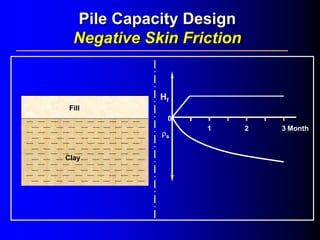
Negative Skin Friction (NSF)Negative Skin Friction (NSF)
Compressible soil layer consolidates
with time due to:
Surcharge of fill
Lowering of groundwater table
Pile Capacity DesignPile Capacity Design
Negative Skin FrictionNegative Skin Friction
Clay
Fill
OGL
1 2 3
0
Hf
ρs
Month
Pile Capacity DesignPile Capacity Design
Negative Skin FrictionNegative Skin Friction
Pile to length (floating pile)
Pile settles with consolidating soil
NO NSF
Pile Capacity DesignPile Capacity Design
Negative Skin FrictionNegative Skin Friction
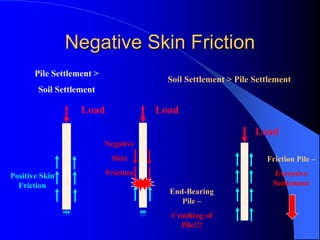
Pile to set at hard stratum (end-
bearing pile)
Consolidation causes downdrag forces on
piles as soil settles more than the pile
Pile Capacity DesignPile Capacity Design
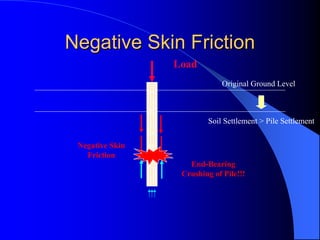
Negative Skin FrictionNegative Skin Friction
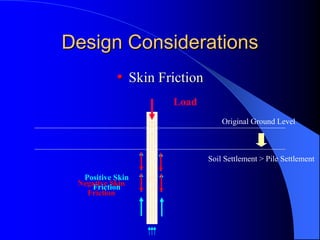
Design ConsiderationsDesign Considerations
•• Skin FrictionSkin Friction
Load
Soil Settlement > Pile Settlement
Positive Skin
FrictionNegative Skin
Friction
Original Ground Level
Negative Skin FrictionNegative Skin Friction
Soil Settlement > Pile Settlement
Load
Negative Skin
Friction
Original Ground Level
End-Bearing
Crushing of Pile!!!
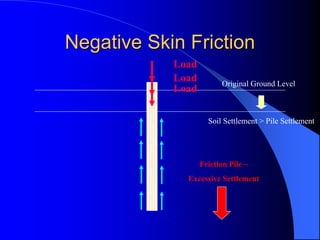
Negative Skin FrictionNegative Skin Friction
Soil Settlement > Pile Settlement
Load
Original Ground Level
Load
Load
Friction Pile –
Excessive Settlement
Load
Load
Friction Pile –
Excessive
Settlement
Load
End-Bearing
Pile –
Crushing of
Pile!!!
Positive Skin
Friction
Pile Settlement >
Soil Settlement
Soil Settlement > Pile Settlement
Negative Skin FrictionNegative Skin Friction
Negative
Skin
Friction
WARNING:
No free fill by the contractor to avoid
NSF
Pile Capacity DesignPile Capacity Design
Negative Skin FrictionNegative Skin Friction
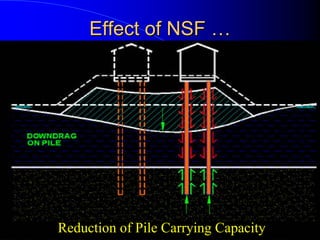
Effect of NSFEffect of NSF ……
Reduction of Pile Carrying Capacity
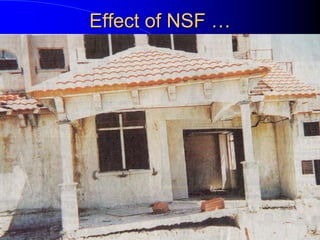
Effect of NSFEffect of NSF ……
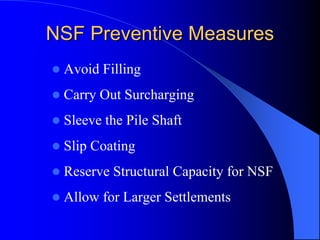
NSF Preventive MeasuresNSF Preventive Measures
Avoid Filling
Carry Out Surcharging
Sleeve the Pile Shaft
Slip Coating
Reserve Structural Capacity for NSF
Allow for Larger Settlements
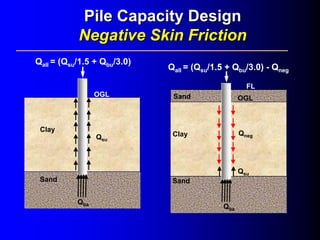
Clay
Sand
OGL
Qba
Qneg
Sand
FL
Clay
Sand
OGL
Qba
Qsu
Qall = (Qsu/1.5 + Qbu/3.0) - Qneg
Qsu
Qall = (Qsu/1.5 + Qbu/3.0)
Pile Capacity DesignPile Capacity Design
Negative Skin FrictionNegative Skin Friction
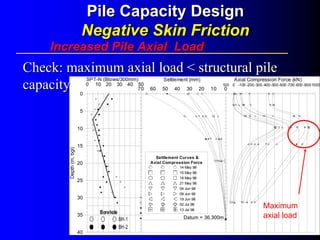
70 60 50 40 30 20 10 0
Settlement (mm)
100 0 -100 -200-300-400-500-600 -700 -800 -900-1000
Axial Compression Force (kN)
Settlement Curves &
Axial Compression Force
14 May 98
15 May 98
18 May 98
21 May 98
04 Jun 98
09 Jun 98
19 Jun 98
02 Jul 98
13 Jul 98
0 10 20 30 40 50
SPT-N (Blows/300mm)
Borehole
BH-1
BH-2
Datum = 36.300m
40
35
30
25
20
15
10
5
0
Depth(m,bgl)
Increased Pile Axial LoadIncreased Pile Axial Load
Check: maximum axial load < structural pileCheck: maximum axial load < structural pile
capacitycapacity
Pile Capacity DesignPile Capacity Design
Negative Skin FrictionNegative Skin Friction
Maximum
axial load
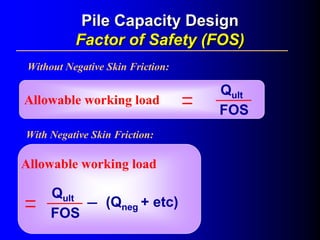
Allowable working load
Qult
FOS
Pile Capacity DesignPile Capacity Design
Factor of Safety (FOS)Factor of Safety (FOS)
Allowable working load
Qult
FOS
(Qneg + etc)
Without Negative Skin Friction:
With Negative Skin Friction:
Pile Capacity DesignPile Capacity Design
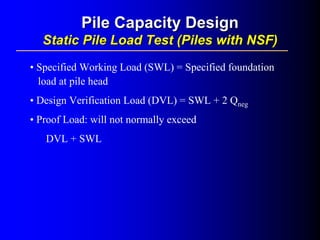
Static Pile Load Test (Piles with NSF)Static Pile Load Test (Piles with NSF)
• Specified Working Load (SWL) = Specified foundation
load at pile head
• Design Verification Load (DVL) = SWL + 2 Qneg
• Proof Load: will not normally exceed
DVL + SWL
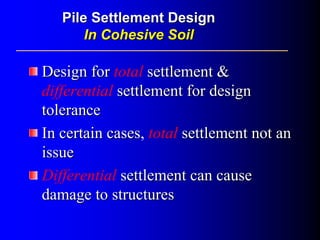
Pile Settlement DesignPile Settlement Design
In Cohesive SoilIn Cohesive Soil
Design forDesign for total settlement &settlement &
differential settlement for designsettlement for design
tolerancetolerance
In certain casesIn certain cases, total settlement not ansettlement not an
issueissue
Differential settlement can causesettlement can cause
damage to structuresdamage to structures
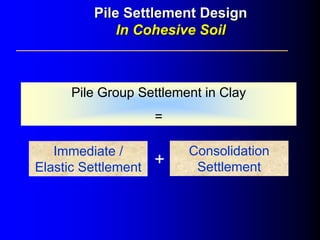
Pile Group Settlement in Clay
=
Immediate /
Elastic Settlement +
Consolidation
Settlement
Pile Settlement DesignPile Settlement Design
In Cohesive SoilIn Cohesive Soil
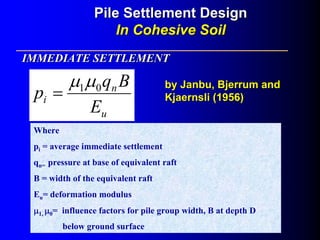
Where
pi = average immediate settlement
qn= pressure at base of equivalent raft
B = width of the equivalent raft
Eu= deformation modulus
μ1, μ0= influence factors for pile group width, B at depth D
below ground surface
byby JanbuJanbu,, BjerrumBjerrum andand
KjaernsliKjaernsli (1956)(1956)
IMMEDIATE SETTLEMENTIMMEDIATE SETTLEMENT
Pile Settlement DesignPile Settlement Design
In Cohesive SoilIn Cohesive Soil
u
n
i
E
Bq
p 01μμ
=
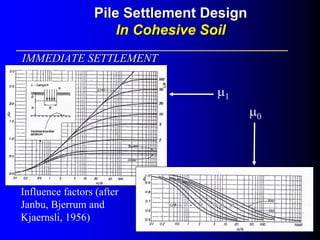
μ1
μ0
Influence factors (after
Janbu, Bjerrum and
Kjaernsli, 1956)
IMMEDIATE SETTLEMENTIMMEDIATE SETTLEMENT
Pile Settlement DesignPile Settlement Design
In Cohesive SoilIn Cohesive Soil
As per footing (references given later)
CONSOLIDATION SETTLEMENTCONSOLIDATION SETTLEMENT
Pile Settlement DesignPile Settlement Design
In Cohesive SoilIn Cohesive Soil
No risk of excessive
settlement
Pile Settlement DesignPile Settlement Design
On RockOn Rock
Pile Installation Methods
PILE INSTALLATIONPILE INSTALLATION
METHODSMETHODS
•Diesel / Hydraulic / Drop Hammer
Driving
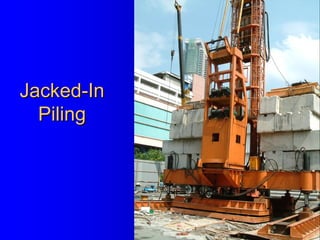
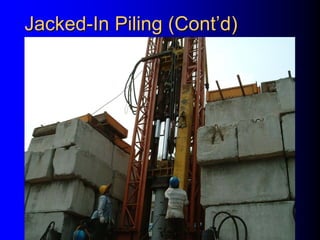
•Jacked-In
•Prebore Then Drive
•Prebore Then Jacked In
•Cast-In-Situ Pile
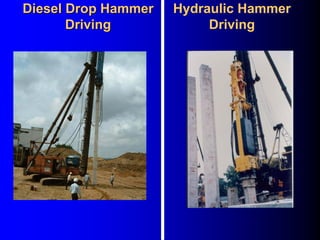
Diesel Drop Hammer
Driving
Diesel Drop HammerDiesel Drop Hammer
DrivingDriving
Hydraulic Hammer
Driving
Hydraulic HammerHydraulic Hammer
DrivingDriving
JackedJacked--InIn
PilingPiling
JackedJacked--In Piling (ContIn Piling (Cont’’d)d)
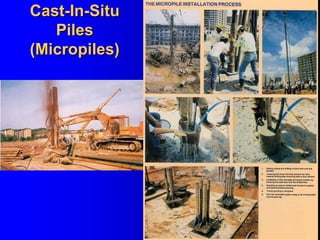
Cast-In-Situ
Piles
(Micropiles)
CastCast--InIn--SituSitu
PilesPiles
((MicropilesMicropiles))
Types of Piles
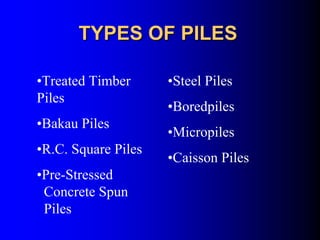
TYPES OF PILESTYPES OF PILES
•Treated Timber
Piles
•Bakau Piles
•R.C. Square Piles
•Pre-Stressed
Concrete Spun
Piles
•Steel Piles
•Boredpiles
•Micropiles
•Caisson Piles
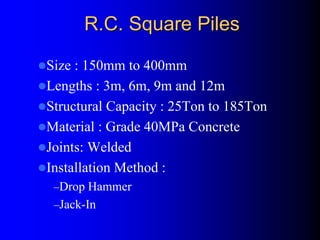
R.C. Square PilesR.C. Square Piles
Size : 150mm to 400mm
Lengths : 3m, 6m, 9m and 12m
Structural Capacity : 25Ton to 185Ton
Material : Grade 40MPa Concrete
Joints: Welded
Installation Method :
–Drop Hammer
–Jack-In
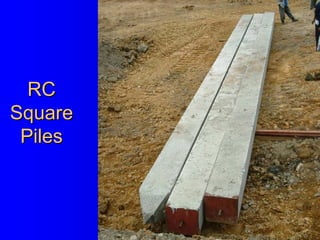
RCRC
SquareSquare
PilesPiles
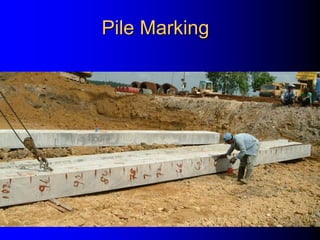
Pile MarkingPile Marking
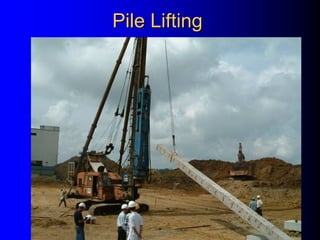
Pile LiftingPile Lifting
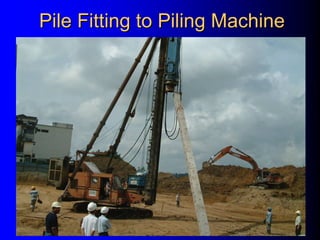
Pile Fitting to Piling MachinePile Fitting to Piling Machine
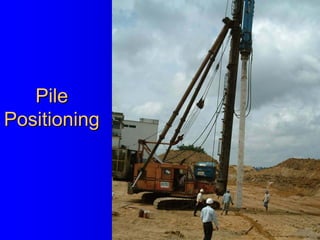
PilePile
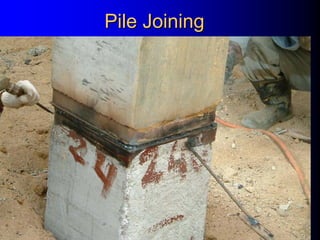
PositioningPositioning
Pile JoiningPile Joining
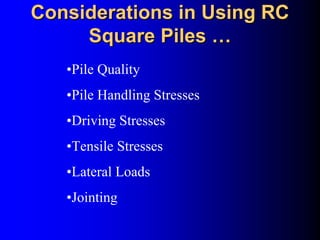
Considerations in Using RCConsiderations in Using RC
Square PilesSquare Piles ……
•Pile Quality
•Pile Handling Stresses
•Driving Stresses
•Tensile Stresses
•Lateral Loads
•Jointing
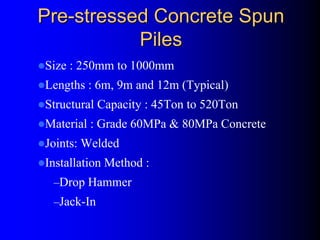
PrePre--stressed Concrete Spunstressed Concrete Spun
PilesPiles
Size : 250mm to 1000mm
Lengths : 6m, 9m and 12m (Typical)
Structural Capacity : 45Ton to 520Ton
Material : Grade 60MPa & 80MPa Concrete
Joints: Welded
Installation Method :
–Drop Hammer
–Jack-In
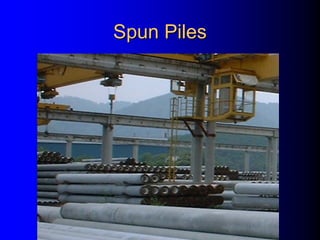
Spun PilesSpun Piles
Spun PilesSpun Piles vsvs RC Square PilesRC Square Piles
Spun Piles have …
•Better Bending Resistance
•Higher Axial Capacity
•Better Manufacturing Quality
•Able to Sustain Higher Driving Stresses
•Higher Tensile Capacity
•Easier to Check Integrity of Pile
•Similar cost as RC Square Piles
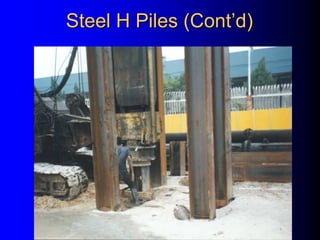
Steel H PilesSteel H Piles
Size : 200mm to 400m
Lengths : 6m and 12m
Structural Capacity : 40Ton to 1,000Ton
Material : 250N/mm2 to 410N/mm2 Steel
Joints: Welded
Installation Method :
–Hydraulic Hammer
–Jack-In
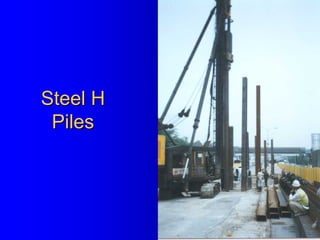
Steel HSteel H
PilesPiles
Steel H Piles (ContSteel H Piles (Cont’’d)d)
Steel H Piles NotesSteel H Piles Notes……
•Corrosion Rate
•Fatigue
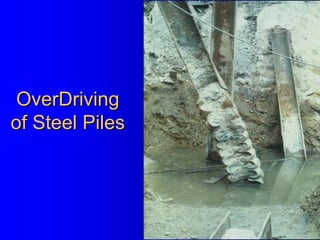
•OverDriving
OverDrivingOverDriving
of Steel Pilesof Steel Piles
Large Diameter CastLarge Diameter Cast--InIn--SituSitu
Piles (Bored Piles)Piles (Bored Piles)
Size : 450mm to 2m
(Up to 3.0m for special case)
Lengths : Varies
Structural Capacity : 80Ton to 2,300Tons
Concrete Grade : 20MPa to 35MPa (Tremie)
Joints : None
Installation Method : Drill then Cast-In-Situ
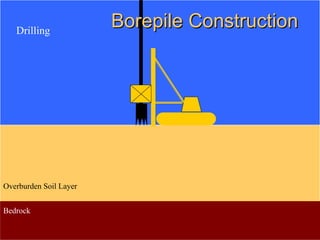
Overburden Soil Layer
Bedrock
Drilling
BorepileBorepile ConstructionConstruction
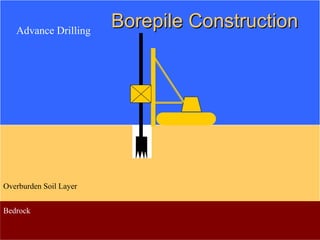
Overburden Soil Layer
Bedrock
Advance Drilling
BorepileBorepile ConstructionConstruction
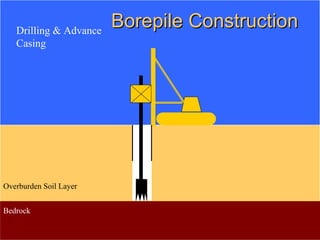
Overburden Soil Layer
Bedrock
Drilling & Advance
Casing
BorepileBorepile ConstructionConstruction
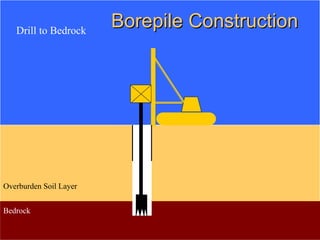
Overburden Soil Layer
Bedrock
Drill to Bedrock
BorepileBorepile ConstructionConstruction
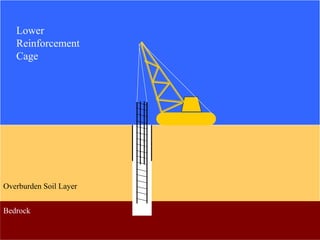
Overburden Soil Layer
Bedrock
Lower
Reinforcement
Cage
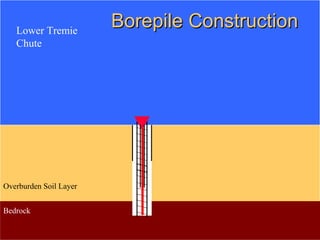
Overburden Soil Layer
Bedrock
BorepileBorepile ConstructionConstructionLower Tremie
Chute
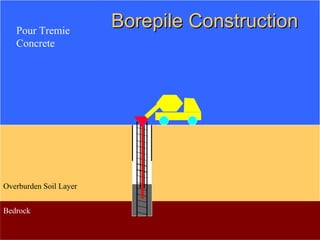
Overburden Soil Layer
Bedrock
Pour Tremie
Concrete
BorepileBorepile ConstructionConstruction
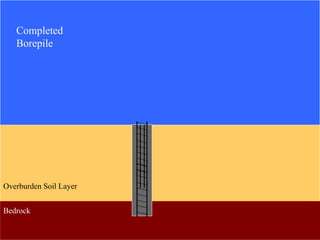
Overburden Soil Layer
Bedrock
Completed
Borepile
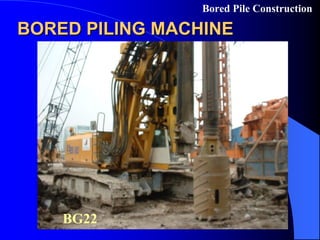
BORED PILING MACHINEBORED PILING MACHINE
Bored Pile Construction
BG22
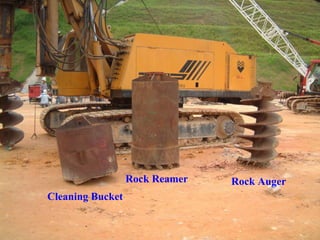
Cleaning Bucket
Rock Reamer Rock Auger
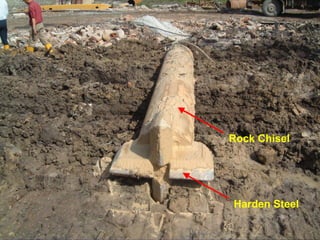
Harden Steel
Rock Chisel
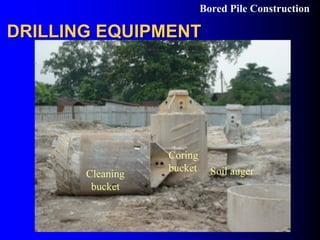
DRILLING EQUIPMENTDRILLING EQUIPMENT
Bored Pile Construction
Soil auger
Coring
bucket
Cleaning
bucket
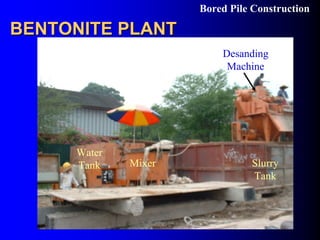
BENTONITE PLANTBENTONITE PLANT
Bored Pile Construction
Mixer
Water
Tank Slurry
Tank
Desanding
Machine
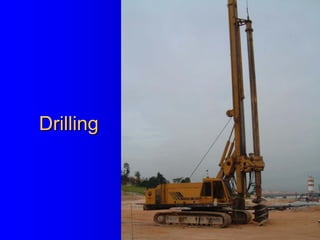
DrillingDrilling
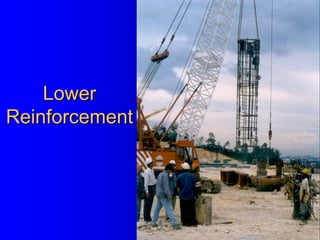
LowerLower
ReinforcementReinforcement
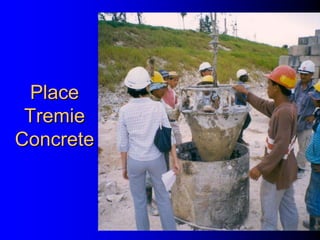
PlacePlace
TremieTremie
ConcreteConcrete
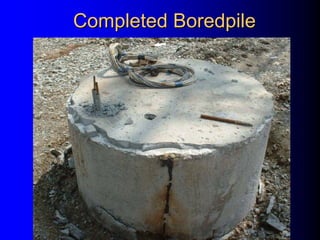
CompletedCompleted BoredpileBoredpile
BorepileBorepile CosiderationsCosiderations……
•Borepile Base Difficult to Clean
•Bulging / Necking
•Collapse of Sidewall
•Dispute on Level of Weathered Rock
MicropilesMicropiles
Size : 100mm to 350mm Diameter
Lengths : Varies
Structural Capacity : 20Ton to 250Ton
Material : Grade 25MPa to 35MPa Grout
N80 API Pipe as Reinforcement
Joints: None
Installation Method :
–Drill then Cast-In-Situ
–Percussion Then Cast-In-Situ
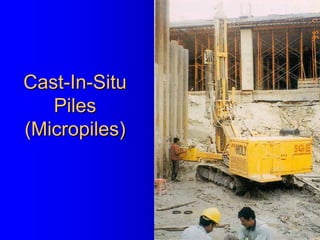
CastCast--InIn--SituSitu
PilesPiles
((MicropilesMicropiles))
TYPES OF PILE SHOESTYPES OF PILE SHOES
•Flat Ended Shoe
•Oslo Point
•Cast-Iron Pointed Tip
•Cross Fin Shoe
•H-Section
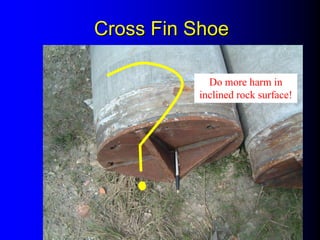
Cross Fin ShoeCross Fin Shoe
Do more harm in
inclined rock surface!
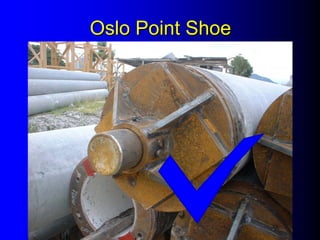
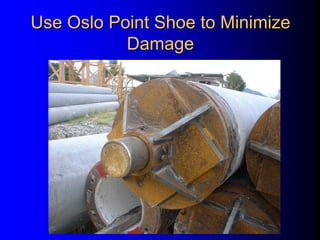
Oslo Point ShoeOslo Point Shoe
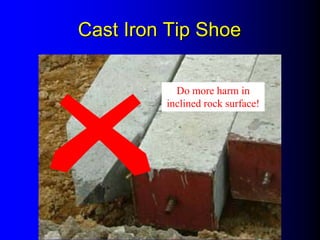
Cast Iron Tip ShoeCast Iron Tip Shoe
Do more harm in
inclined rock surface!
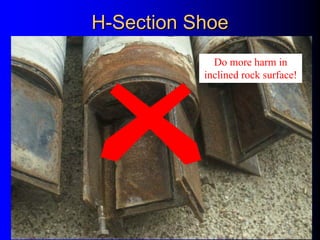
HH--Section ShoeSection Shoe
Do more harm in
inclined rock surface!
Piling Supervision
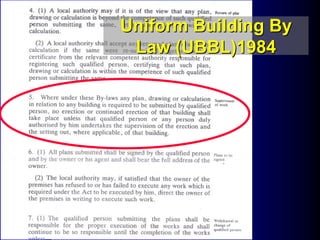
Uniform Building ByUniform Building By
Law (UBBL)1984Law (UBBL)1984
PILING SUPERVISIONPILING SUPERVISION
•Ensure That Piles Are Stacked Properly
•Ensure that Piles are Vertical During Driving
•Keep Proper Piling Records
•Ensure Correct Pile Types and Sizes are Used
•Ensure that Pile Joints are Properly Welded with
NO GAPS
•Ensure Use of Correct Hammer Weights and Drop
Heights
PILING SUPERVISIONPILING SUPERVISION
(Cont(Cont’’d)d)
•Ensure that Proper Types of Pile Shoes are Used.
•Check Pile Quality
•Ensure that the Piles are Driven to the Required
Lengths
•Monitor Pile Driving
FAILURE OF PILINGFAILURE OF PILING
SUPERVISIONSUPERVISION
Failing to Provide Proper Supervision
WILL Result in
Higher Instances of Pile Damage
& Wastage
Pile Damage
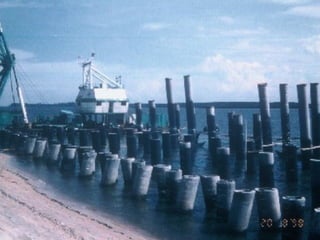
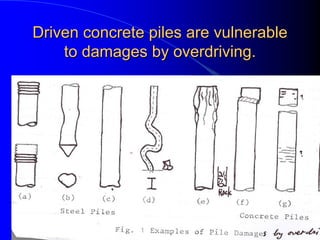
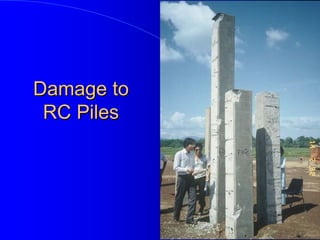
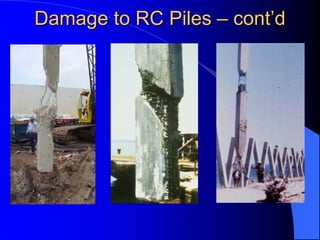
Driven concrete piles are vulnerableDriven concrete piles are vulnerable
to damages by overdriving.to damages by overdriving.
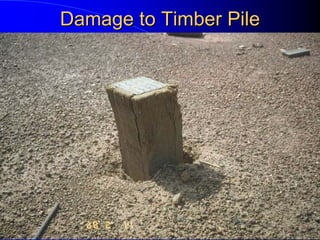
Damage to Timber PileDamage to Timber Pile
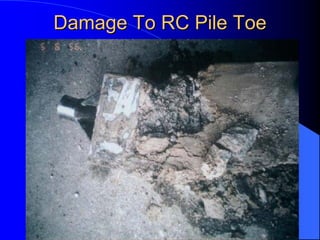
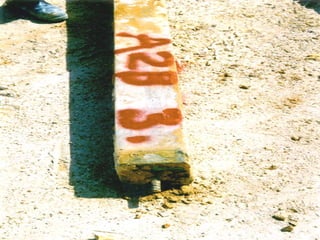
Damage To RC Pile ToeDamage To RC Pile Toe
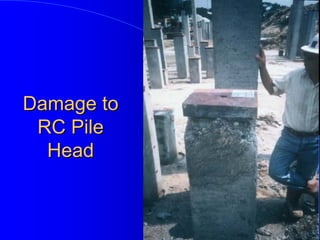
Damage toDamage to
RC PileRC Pile
HeadHead
Damage toDamage to
RC PilesRC Piles
Damage to RC PilesDamage to RC Piles –– contcont’’dd
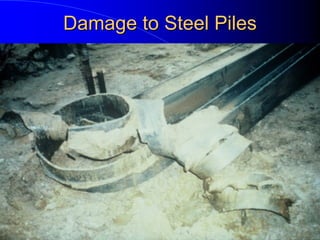
Damage to Steel PilesDamage to Steel Piles
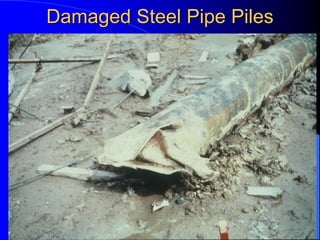
Damaged Steel Pipe PilesDamaged Steel Pipe Piles
Piling Problems
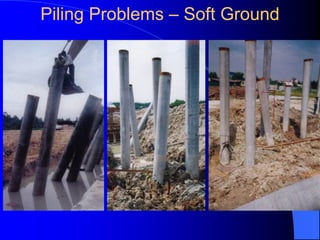
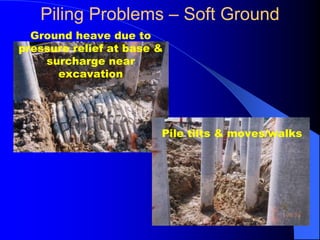
Piling Problems – Soft Ground
Ground heave due to
pressure relief at base &
surcharge near
excavation
Pile tilts & moves/walks
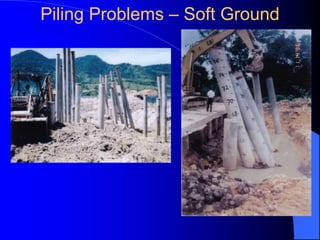
Piling Problems – Soft Ground
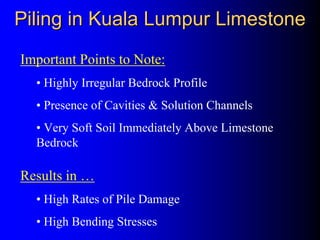
Piling in Kuala Lumpur LimestonePiling in Kuala Lumpur Limestone
Important Points to Note:
• Highly Irregular Bedrock Profile
• Presence of Cavities & Solution Channels
• Very Soft Soil Immediately Above Limestone
Bedrock
Results in …
• High Rates of Pile Damage
• High Bending Stresses
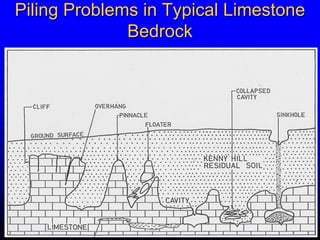
Piling Problems in Typical LimestonePiling Problems in Typical Limestone
BedrockBedrock
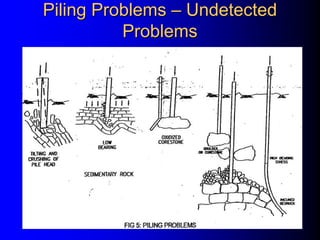
Piling ProblemsPiling Problems –– UndetectedUndetected
ProblemsProblems
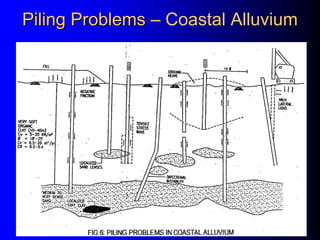
Piling ProblemsPiling Problems – Coastal Alluvium
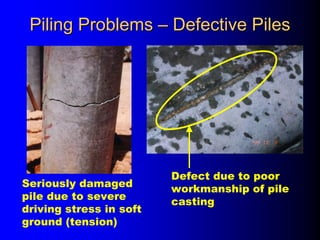
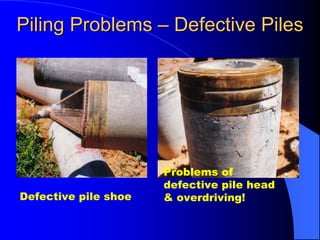
Piling ProblemsPiling Problems –– Defective PilesDefective Piles
Seriously damaged
pile due to severe
driving stress in soft
ground (tension)
Defect due to poor
workmanship of pile
casting
Defective pile shoe
Problems of
defective pile head
& overdriving!
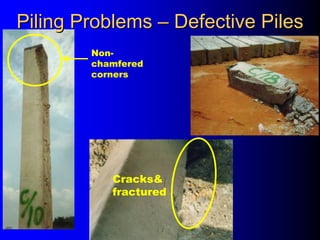
Piling ProblemsPiling Problems –– Defective PilesDefective Piles
Cracks&
fractured
Non-
chamfered
corners
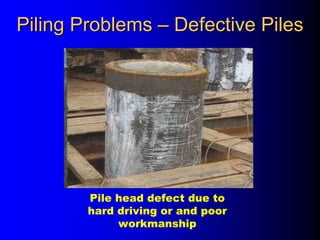
Piling ProblemsPiling Problems –– Defective PilesDefective Piles
Pile head defect due to
hard driving or and poor
workmanship
Piling ProblemsPiling Problems –– Defective PilesDefective Piles
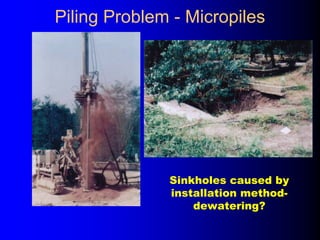
Piling Problem - Micropiles
Sinkholes caused by
installation method-
dewatering?
Piling in Fill GroundPiling in Fill Ground
Important Points to Note:
•High Consolidation Settlements If Original Ground is
Soft
•Uneven Settlement Due to Uneven Fill Thickness
•Collapse Settlement of Fill Layer If Not Compacted
Properly
Results in …
•Negative Skin Friction (NSF) & Crushing of Pile Due
to High Compressive Stresses
•Uneven Settlements
Typical Design andTypical Design and
Construction Issues #1Construction Issues #1
Pile Toe Slippage Due to Steep Incline Bedrock
Use Oslo Point Shoe To Minimize Pile Damage
Issue #1
Solution #1
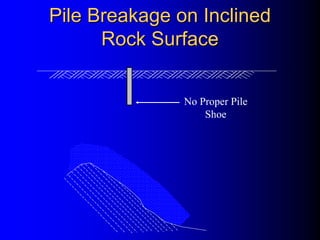
Pile Breakage on InclinedPile Breakage on Inclined
Rock SurfaceRock Surface
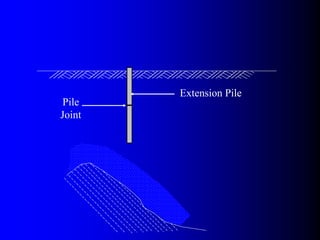
No Proper Pile
Shoe
Extension Pile
Pile
Joint
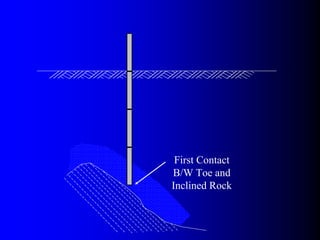
First Contact
B/W Toe and
Inclined Rock
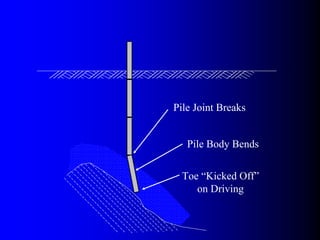
Toe “Kicked Off”
on Driving
Pile Body Bends
Pile Joint Breaks
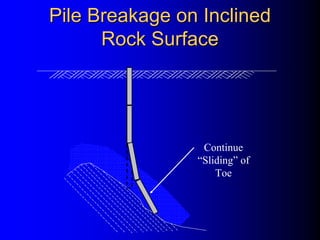
Pile Breakage on InclinedPile Breakage on Inclined
Rock SurfaceRock Surface
Continue
“Sliding” of
Toe
Use Oslo Point Shoe to MinimizeUse Oslo Point Shoe to Minimize
DamageDamage
Design and ConstructionDesign and Construction
Issues #2Issues #2
Presence of Cavity
Detect Cavities through Cavity Probing then
perform Compaction Grouting
Issue #2
Solution #2
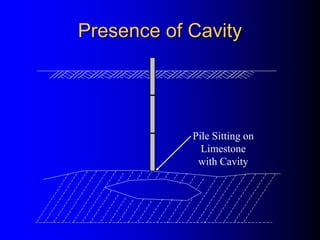
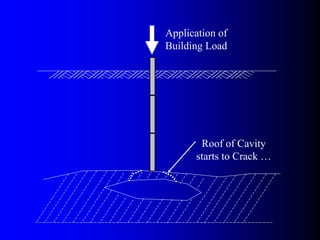
Presence of CavityPresence of Cavity
Pile Sitting on
Limestone
with Cavity
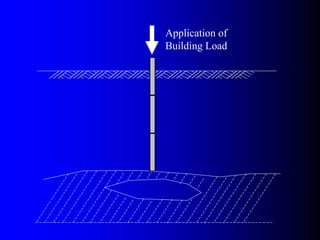
Application of
Building Load
Application of
Building Load
Roof of Cavity
starts to Crack …
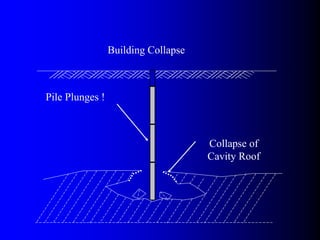
Collapse of
Cavity Roof
Pile Plunges !
Building Collapse
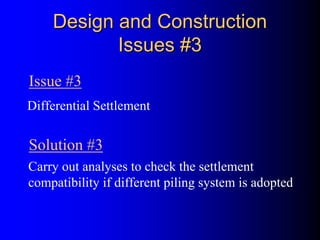
Design and ConstructionDesign and Construction
Issues #3Issues #3
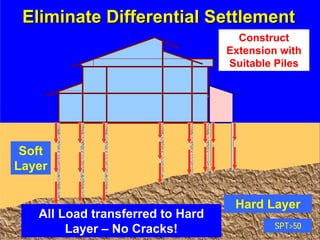
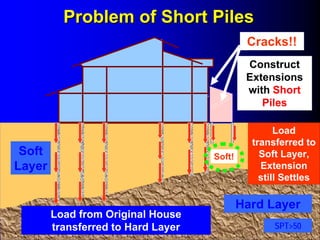
Differential Settlement
Carry out analyses to check the settlement
compatibility if different piling system is adopted
Issue #3
Solution #3
Piling in Progress
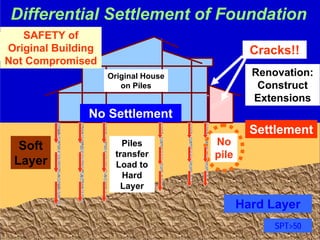
Differential Settlement of Foundation
Original House
on Piles
Hard Layer
SPT>50
Cracks!!
No
pile
Settlement
Soft
Layer
Link House
Construction
Renovation:
Construct
Extensions
Piles
transfer
Load to
Hard
Layer
No Settlement
SAFETY of
Original Building
Not Compromised
Piling in Progress
Eliminate Differential SettlementEliminate Differential Settlement
Hard Layer
SPT>50
Soft
Layer
Construct
Extension with
Suitable Piles
All Load transferred to Hard
Layer – No Cracks!
Piling in Progress
Problem of Short PilesProblem of Short Piles
Hard Layer
SPT>50
Soft
Layer
Load from Original House
transferred to Hard Layer
Cracks!!
Soft!
Load
transferred to
Soft Layer,
Extension
still Settles
Construct
Extensions
with Short
Piles
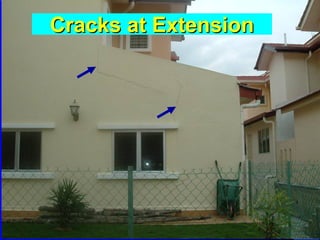
Cracks at ExtensionCracks at Extension
Typical Design andTypical Design and
Construction Issues #4Construction Issues #4
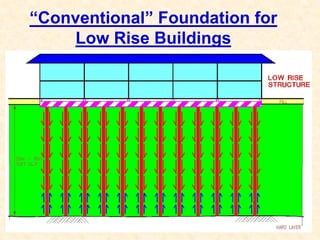
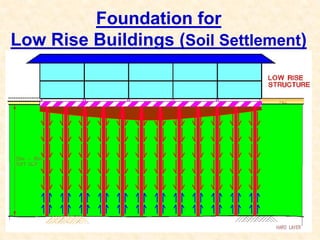
Costly conventional piling design – piled to set to
deep layer in soft ground
-Strip footings / Raft
-Floating Piles
Issue #4
Solution #4
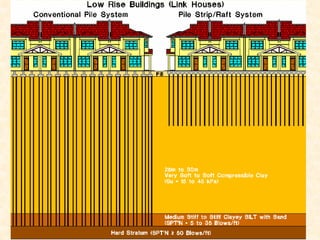
“Conventional” Foundation for
Low Rise Buildings
Foundation for
Low Rise Buildings (Soil Settlement)
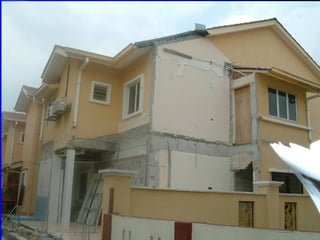
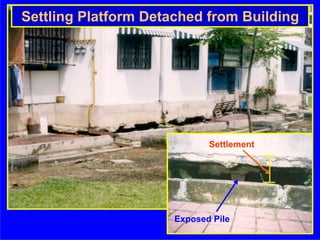
Exposed Pile
Settlement
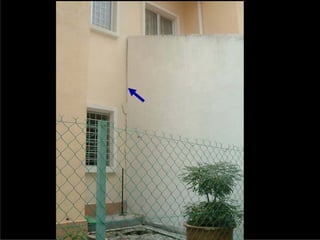
Settling Platform Detached from Building
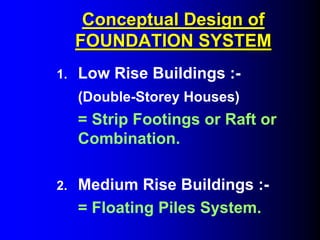
Conceptual Design ofConceptual Design of
FOUNDATION SYSTEMFOUNDATION SYSTEM
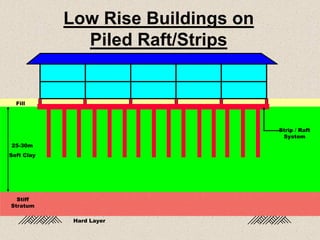
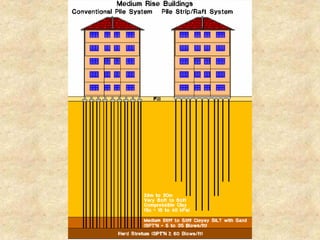
1. Low Rise Buildings :-
(Double-Storey Houses)
= Strip Footings or Raft or
Combination.
2. Medium Rise Buildings :-
= Floating Piles System.
Low Rise Buildings on
Piled Raft/Strips
Strip / Raft
System
Stiff
Stratum
Hard Layer
Fill
25-30m
Soft Clay
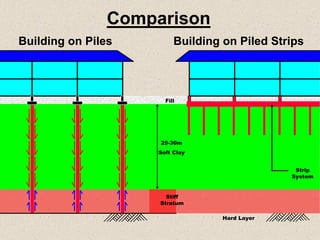
Comparison
Strip
System
Stiff
Stratum
Hard Layer
Fill
25-30m
Soft Clay
Building on Piles Building on Piled Strips
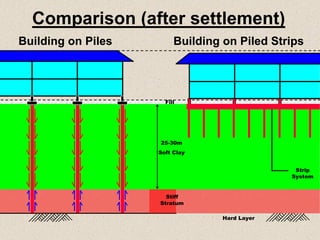
Comparison (after settlement)
Building on Piles Building on Piled Strips
Strip
System
Stiff
Stratum
Hard Layer
Fill
25-30m
Soft Clay
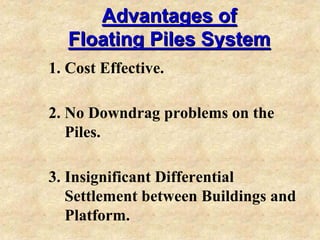
Advantages ofAdvantages of
Floating Piles SystemFloating Piles System
1. Cost Effective.
2. No Downdrag problems on the
Piles.
3. Insignificant Differential
Settlement between Buildings and
Platform.
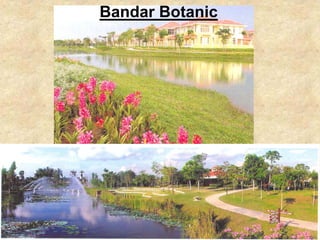
Bandar Botanic
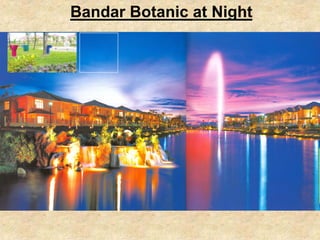
Bandar Botanic at Night
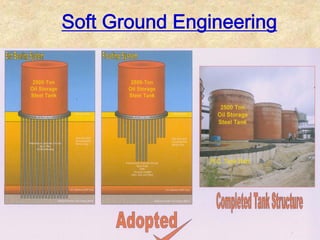
Soft Ground Engineering
Typical Design andTypical Design and
Construction Issues #5Construction Issues #5
Load test results far below predicted pile capacity
-Modifications to test set-up
-Change of pile installation method
-Adequate soil plug to prevent toe softening
Issue #5
Solution #5
Testing SetTesting Set--up Using Reactionup Using Reaction
PilesPiles
Testing SetTesting Set--upup
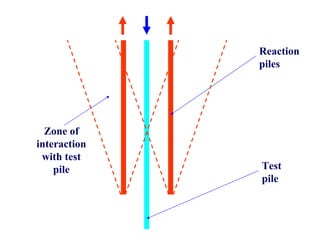
Long reaction piles at close spacing
used
Case histories:
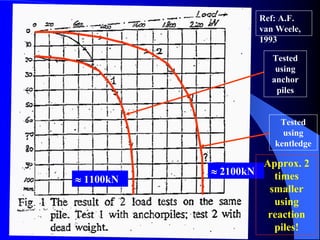
– Load tests using reaction piles give
ERRATIC results
– Reference: Weele (1993)
≈ 1100kN
Tested
using
anchor
piles
≈ 2100kN
Tested
using
kentledge
Approx. 2
times
smaller
using
reaction
piles!
Ref: A.F.
van Weele,
1993
Reaction
piles
Test
pile
Zone of
interaction
with test
pile
Testing SetTesting Set--upup
Latest version of ASTM D1143
Published April 2007
Testing SetTesting Set--upup
ASTM D1143
– Clear distance of at least 5 times
the maximum diameter
– Caution on factors influencing
results:
“Possible interaction ……….from
anchor piles……..”
Drilling to the Casing TipDrilling to the Casing Tip
to Formto Form ““Bored PileBored Pile””
Drilling to FormDrilling to Form ““Bored PileBored Pile””
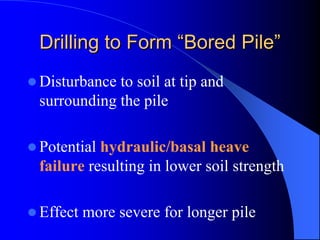
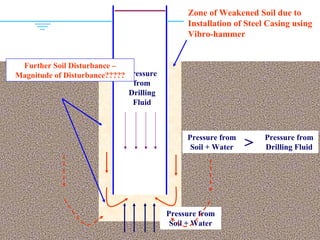
Disturbance to soil at tip and
surrounding the pile
Potential hydraulic/basal heave
failure resulting in lower soil strength
Effect more severe for longer pile
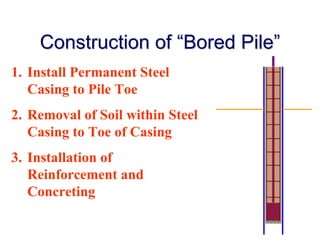
Construction ofConstruction of ““Bored PileBored Pile””
1. Install Permanent Steel
Casing to Pile Toe
2. Removal of Soil within Steel
Casing to Toe of Casing
3. Installation of
Reinforcement and
Concreting
Drilling to FormDrilling to Form ““Bored PileBored Pile””
Pile behaviour COMPLICATED!
– Influenced by steel casing which behave
like DRIVEN PILE
– Influenced by soil removal which behave
like BORED PILE
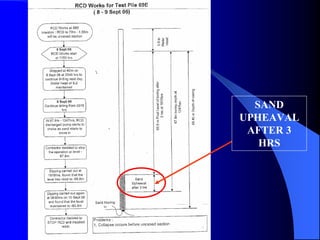
SAND
UPHEAVAL
AFTER 3
HRS
Zone of Weakened Soil due to
Installation of Steel Casing using
Vibro-hammer
Pressure
from
Drilling
Fluid
Pressure from
Soil + Water
Pressure from
Soil + Water > Pressure from
Drilling Fluid
Further Soil Disturbance –
Magnitude of Disturbance?????
Probable causes of erratic and
unpredictable pile capacities:
– Testing set-up using reaction piles
– Drilling to the casing tip to form “bored pile”
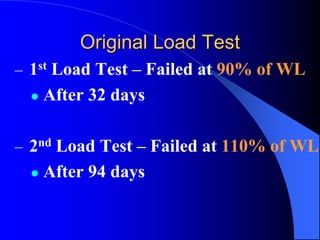
Original Load TestOriginal Load Test
– 1st Load Test – Failed at 90% of WL
After 32 days
– 2nd Load Test – Failed at 110% of WL
After 94 days
Recommendations:
– Open-ended spun pile or steel pipe pile with
adequate soil plug
– Use of impact hammer instead of vibro-
hammer
– Trial piles for correlation between static load
test and high strain dynamic load test
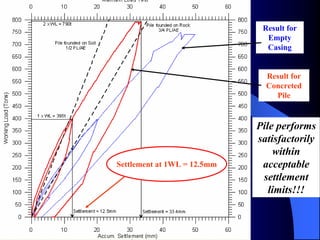
Result for
Concreted
Pile
Result for
Empty
Casing
Pile performs
satisfactorily
within
acceptable
settlement
limits!!!
Settlement at 1WL = 12.5mm
Load Test Results at P52WLoad Test Results at P52W
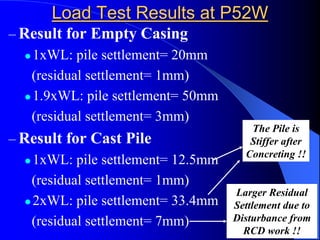
– Result for Empty Casing
1xWL: pile settlement= 20mm
(residual settlement= 1mm)
1.9xWL: pile settlement= 50mm
(residual settlement= 3mm)
– Result for Cast Pile
1xWL: pile settlement= 12.5mm
(residual settlement= 1mm)
2xWL: pile settlement= 33.4mm
(residual settlement= 7mm)
The Pile is
Stiffer after
Concreting !!
Larger Residual
Settlement due to
Disturbance from
RCD work !!
Load Test Results at P52WLoad Test Results at P52W
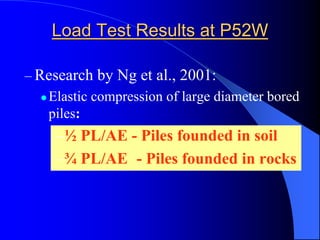
– Research by Ng et al., 2001:
Elastic compression of large diameter bored
piles:
–½ PL/AE - Piles founded in soil
–¾ PL/AE - Piles founded in rocks
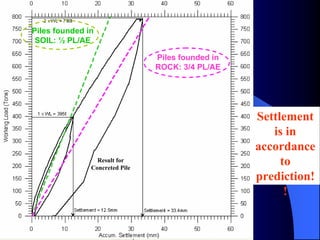
Result for
Concreted Pile
Piles founded in
SOIL: ½ PL/AE
Piles founded in
ROCK: 3/4 PL/AE
Settlement
is in
accordance
to
prediction!
!
Depends on:
– E – Elastic Modulus of Pile Material
– A – Cross-sectional Area of Pile
– L – Pile Length
Elastic Compression = f (PL / AE)
Therefore, after concreting of pile:
- A increased significantly (composite E due to
steel and concrete reduced slightly)
- Elastic compression will reduce
ELASTIC COMPRESSION OF PILEELASTIC COMPRESSION OF PILE
Pile Settlement CriteriaPile Settlement Criteria
Pile settlement criteria depends on
– Pile Size
– Pile Material (e.g. steel, concrete, etc.)
– Pile Length
Unrealistic to adopt same settlement
criteria (e.g. 12mm) for all piles (regardless
of length, size, etc.)
Myths in Piling
MYTHS IN PILING #1MYTHS IN PILING #1
Dynamic Formulae such as Hiley’s Formula
Tells us the Capacity of the Pile
Pile Capacity can only be verified by using:
(i) Maintained (Static) Load Tests
(ii)Pile Dynamic Analyser (PDA) Tests
Myth:
Truth:
MYTHS IN PILING #2MYTHS IN PILING #2
Pile Achieves Capacity When It is Set.
Myth:
Truth:
Pile May Only “Set” on Intermediate Hard
Layer BUT May Still Not Achieve Required
Capacity within Allowable Settlement.
MYTHS IN PILING #3MYTHS IN PILING #3
Pile settlement at 2 times working load must
be less than certain magnitude (e.g. 38mm)
Myth:
Truth:
Pile designed to Factor of Safety of 2.0.
Therefore, at 2 times working load:
Pile expected to fail unless capacity under-
predicted significantly
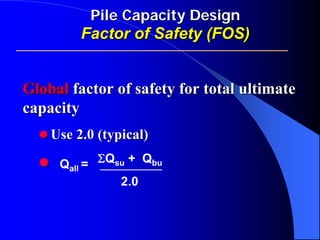
Pile Capacity DesignPile Capacity Design
Factor of Safety (FOS)Factor of Safety (FOS)
GlobalGlobal factor of safety for total ultimatefactor of safety for total ultimate
capacitycapacity
Use 2.0 (typical)Use 2.0 (typical)
ΣQsu + Qbu
2.0
Qall =
CASE HISTORIESCASE HISTORIES
Case 1: Structural distortion & distresses
Case 2: Distresses at houses
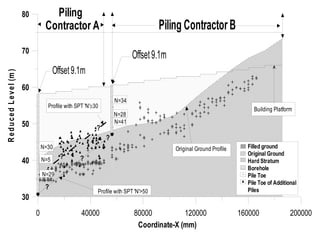
CASE HISTORY 1CASE HISTORY 1
Max. 20m Bouldery Fill on
Undulating Terrain
Platform Settlement
Short Piling Problems
Downdrag on Piles
Distortion & Distresses on 40
Single/ 70 Double Storey Houses
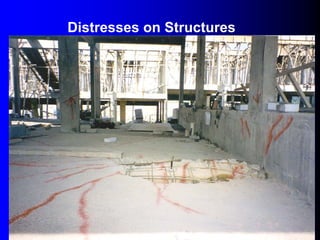
Distresses on Structures
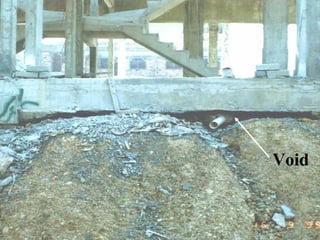
Void
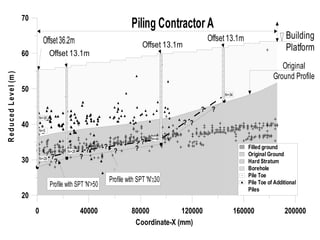
0 40000 80000 120000 160000 200000
Coordinate-X (mm)
20
30
40
50
60
70
ReducedLevel(m)
Profile with SPT 'N'>50
Filled ground
Original Ground
Hard Stratum
Borehole
Pile Toe
Pile Toe of Additional
Piles
Original
Ground Profile
Building
PlatformOffset 13.1m
Offset 13.1m
N=25
N=40
N=34
Profile with SPT 'N'≅30
Offset 13.1m
N=29
N=30
N=5
Offset36.2m
?
?
?
?
?
?
?
?
?
?
?
?
Piling Contractor A
0 40000 80000 120000 160000 200000
Coordinate-X (mm)
30
40
50
60
70
80
ReducedLevel(m)
Filled ground
Original Ground
Hard Stratum
Borehole
Pile Toe
Pile Toe of Additional
PilesProfile with SPT 'N'>50
Building Platform
Original Ground ProfileN=30
N=34
N=28
N=41
N=5
N=29
Profile with SPT 'N'≅30
Offset9.1m
Offset9.1m
?
?
?
? ?
Piling
Contractor A Piling ContractorB
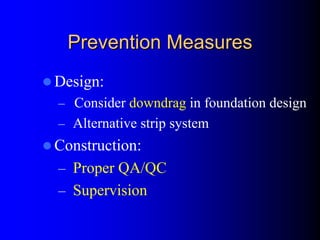
Prevention MeasuresPrevention Measures
Design:
– Consider downdrag in foundation design
– Alternative strip system
Construction:
– Proper QA/QC
– Supervision
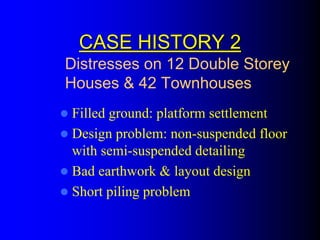
CASE HISTORY 2CASE HISTORY 2
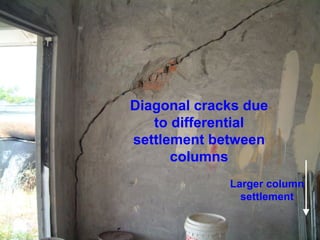
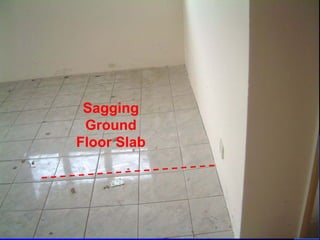
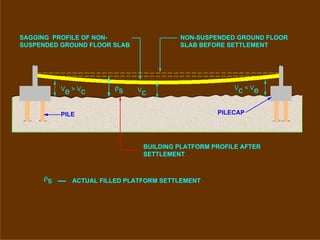
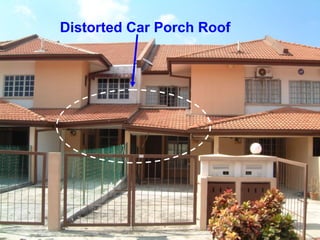
Filled ground: platform settlement
Design problem: non-suspended floor
with semi-suspended detailing
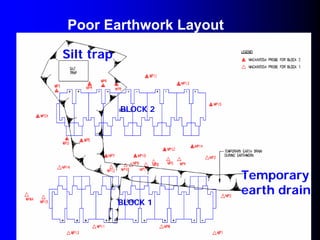
Bad earthwork & layout design
Short piling problem
Distresses on 12 Double Storey
Houses & 42 Townhouses
Diagonal cracks due
to differential
settlement between
columns
Larger column
settlement
Sagging
Ground
Floor Slab
SAGGING PROFILE OF NON-
SUSPENDED GROUND FLOOR SLAB
NON-SUSPENDED GROUND FLOOR
SLAB BEFORE SETTLEMENT
BUILDING PLATFORM PROFILE AFTER
SETTLEMENT
PILE PILECAP
V
e > V
c V
c < V
eV
c
ρs
ρs ACTUAL FILLED PLATFORM SETTLEMENT
Distorted Car Porch Roof
BLOCK 2
BLOCK 1
Silt trap
Temporary
earth drain
Poor Earthwork Layout
Prevention MeasuresPrevention Measures
Planning:
– Proper building layout planning to suit terrain
(eg. uniform fill thickness)
– Sufficient SI
Design:
– Consider filled platform settlement
– Earthwork layout
Construction:
– Supervision on earthwork & piling
SUMMARYSUMMARY
Importance of Preliminary Study
Understanding the Site Geology
Carry out Proper Subsurface Investigation
that Suits the Terrain & Subsoil
Selection of Suitable Pile
Pile Design Concepts
SUMMARYSUMMARY
Importance of Piling Supervision
Typical Piling Problems Encountered
Present Some Case Histories
FERRARI ‘S PITSTOP WAS COMPLETED BY
15 MECHANICS (FUEL AND TYRES) IN 6.0
SECONDS FLAT.
54 PEOPLE TOOK PART IN THIS
CONCERTED ACROBATIC JUMP.
Pile foundation

Pile foundation

  • 1.
    PILED FOUNDATIONPILED FOUNDATION DESIGN& CONSTRUCTIONDESIGN & CONSTRUCTION By Ir. Dr. Gue See Sew & Ir. Chow Chee Meng http://www.gnpgeo.com.my
  • 2.
    ContentsContents Overview Preliminary Study Site Visit& SI Planning Pile Design Pile Installation Methods Types of Piles
  • 3.
    Contents (ContContents (Cont’’d)d) PilingSupervision Pile Damage Piling Problems Typical Design and Construction Issues Myths in Piling Case Histories Conclusions
  • 4.
  • 5.
    What is aPile Foundation It is a foundation system that transfers loads to a deeper and competent soil layer.
  • 6.
    When To UsePile Foundations • Inadequate Bearing Capacity of Shallow Foundations • To Prevent Uplift Forces • To Reduce Excessive Settlement
  • 8.
    PILE CLASSIFICATIONPILE CLASSIFICATION FrictionPile – Load Bearing Resistance derived mainly from skin friction End Bearing Pile – Load Bearing Resistance derived mainly from base
  • 9.
  • 10.
    End Bearing Pile Rock/ Hard Layer Overburden Soil
  • 11.
  • 12.
    Preliminary StudyPreliminary Study Type& Requirements of Superstructure Proposed Platform Level (ie CUT or FILL) Geology of Area Previous Data or Case Histories Subsurface Investigation Planning Selection of Types & Size of Piles
  • 13.
    Previous Data &CasePrevious Data & Case HistoriesHistories Bedrock Profile Existing Development A Existing Development B Proposed Development Only Need Minimal Number of Boreholes
  • 14.
    Challenge The NormThru Innovation To Excel
  • 15.
    SELECTION OF PILESSELECTIONOF PILES Factors Influencing Pile Selection – Types of Piles Available in Market (see Fig. 1) – Installation Method – Contractual Requirements – Ground Conditions (eg Limestone, etc) – Site Conditions & Constraints (eg Accessibility) – Type and Magnitude of Loading – Development Program & Cost – etc
  • 16.
    TYPE OF PILES DISPLACEMENTPILES NON-DISPLACEMENT PILES TOTALLY PREFORMED PILES (A ready-made pile is driven or jacked into the ground) DRIVEN CAST IN-PLACE PILES (a tube is driven into ground to form void) Bored piles Micro piles Hollow Small displacement Solid Steel Pipe Concrete Spun Piles Concrete Tube Closed ended tube concreted with tube left in position Closed ended tube Steel Tube Open ended tube extracted while concreting (Franki) Concrete Steel H-piles (small displacement) Bakau piles Treated timber pile Precast R.C. piles Precast prestressed piles FIG 1: CLASSIFICATION OF PILES Restricted use due to environmental considerations
  • 17.
    BAKAUPILES TIMPERPILES RCPILES PSCPILES SPUNPILES STEELHPILES STEELPIPEPILES JACKEDPILES <100 KN aa a ? ? ? ? a x ? a 100-300 a a a ? ? a a a x a a 300-600 ? a a a a a a a a a a 600-1100 x ? a a a a a ? a a ? 1100-2000 x ? a a a a a ? a a ? 2000-5000 x x a a a a a ? a a ? 5000-10000 x x a a a a a x a a x >10000 x x ? a a a a x a ? x <5m ? ? ? ? ? ? ? x a a ? 5-10m a a a a a a a ? a a a 10-20m ? ? a a a a a a a a a 20-30m x x a a a a a a a a a 30-60m x x a a a a a a a ? a a a a a a ? a a a ? a a a a a a a a a a ? a ? ? ? ? ? a a a ? a a x x a a a a a ? a a ? x x ? ? ? a a ? a a ? x ? a a a a a a a a a a a a a a a a a a ? a a a a a a a a a a a a ? a a a a a a a a a a x ? a a a a a a a a a a a a a a a a a a a a ? a a a a a a a a a a x ? a a a a a a a a a V. DENSE SPT > 50 x x a a a a a ? a a ? S < 100 mm x ? a a a a a a a a ? 100-1000mm x x ? ? ? a a ? a a x 1000-3000mm x x ? ? ? ? ? ? ? a x >3000mm x x ? ? ? ? ? ? ? a x a a a a a a a a a a a x a a a a a a a a a a a a ? ? ? ? ? a a a a ? ? ? ? ? ? ? a ? a a 1-2 0.5-2 1.5-3 1-2.5 AUGEREDPILES COMPRESSIVE LOAD PER COLUMN SCALEOFLOAD (STRUCTURAL) 1.0-3.5 PREVENTION OF EFFECTS ON ADJOINING STRUCTURES (SUPPLY & INSTALL) RM/TON/M 0.5-2.5 0.3-2.0 LOOSE SPT < 10 UNIT COST GROUND WATER TYPEOFINTERMEDIATELAYER GEOTECHNICAL TYPEOF BEARING LAYER BEARINGTYPE ENVIRONME NT MICROPILES BOREDPILES PREFORMED PILES M. DENSE SPT = 10 - 30 MAINLY END -BEARING (D=Anticipated depth of bearing) PARTLY FRICTION + PARTLY END BEARING MAINLY FRICTION LIMESTON FORMATION M. STIFF SPT = 4 - 15 V. STIFF SPT = 15 - 32 HARD SPT > 32 DENSE / VERY DENSE SAND SOFT SPT < 4 WEATHERED ROCK / SOFT ROCK NOISE + VIBRATION; COUNTER MEASURES REQUIRED BELOW PILE CAP ROCK (RQD > 70%) DENSE SPT = 30 - 50 COHESIVE SOIL COHESIVELESS SOIL SOIL WITH SOME BOULDERS / COBBLES (S=SIZE) ABOVE PILE CAP DESIGN CONSIDERATIONS TYPE OF PILE LEGEND : 8 x ? INDICATES THAT THE PILE TYPE IS SUITABLE INDICATES THAT THE PILE TYPE IS NOT SUITABLE INDICATES THAT THE USE OF PILE TYPE IS DOUBTFUL OR NOT COST EFFECTIVE UNLESS ADDITIONAL MEASURES TAKEN FIG 2 : PILE SELECTION CHART
  • 18.
    Site Visit andSI Planning
  • 19.
    Site VisitSite Visit ThingsTo Look For … Accessibility & Constraints of Site Adjacent Structures/Slopes, Rivers, Boulders, etc Adjacent Activities (eg excavation) Confirm Topography & Site Conditions Any Other Observations that may affect Design and Construction of Foundation
  • 20.
    Subsurface Investigation (SI)SubsurfaceInvestigation (SI) PlanningPlanning Provide Sufficient Boreholes to get Subsoil Profile Collect Rock Samples for Strength Tests (eg UCT) In-Situ Tests to get consistency of ground (eg SPT) Classification Tests to Determine Soil Type Profile Soil Strength Tests (eg CIU) Chemical Tests (eg Chlorine, Sulphate, etc)
  • 21.
    Typical CrossTypical Cross--Sectionat Hill SiteSection at Hill Site Ground Level Bedrock Level Very Hard Material Level Hard Material Level Groundwater Level
  • 22.
    EXISTING GROUND LEVEL Water Table C’2 , ø’2 ClayeyLayer C’3, ø’3 C’1, ø’1 BH BH BH Perched WT Seepage CROSS SECTION
  • 23.
    Placing Boreholes inLimestone Areas Stage 1 : Preliminary S.I. - Carry out geophysical survey (for large areas) Stage 2: Detailed S.I. - Boreholes at Critical Areas Interpreted from Stage 1 Stage 3: During Construction - Rock Probing at Selected Columns to supplement Stage 2
  • 24.
  • 25.
    PILE DESIGNPILE DESIGN AllowablePile Capacity is the minimum of : 1) Allowable Structural Capacity 2) Allowable Geotechnical Capacity a. Negative Skin Friction b. Settlement Control
  • 26.
    PILE DESIGNPILE DESIGN Structuralconsideration • Not overstressed during handling, installation & in service for pile body, pile head, joint & shoe. • Dimension & alignment tolerances (common defects?) • Compute the allowable load in soft soil (<10kPa) over hard stratum (buckling load) • Durability assessment
  • 27.
    Pile Capacity DesignPileCapacity Design Structural CapacityStructural Capacity Concrete Pile Steel Pile Prestressed Concrete Pile QQallall = 0.25 x= 0.25 x ffcucu x Ax Acc QQallall = 0.3 x= 0.3 x ffyy x Ax Ass QQallall = 0.25 (= 0.25 (ffcucu –– PrestressPrestress after loss) x Aafter loss) x Acc Qall = Allowable pile capacity fcu = characteristic strength of concrete fs = yield strength of steel Ac = cross sectional area of concrete As = cross sectional area of steel
  • 28.
    SPT Blow Countper 300mm Penetration Collection of SI DataCollection of SI Data Pile Capacity DesignPile Capacity Design Geotechnical CapacityGeotechnical Capacity 4000 50 100 150 200 250 300 350 26 24 22 20 18 16 14 12 10 8 6 4 2 0 12 10 8 6 4 2 0 0 50 100 150 200 250 300 350 400 Depth(m) Upper Bound Lower Bound Design Line (Moderately Conservative) Depth Vs SPT-N Blow Count
  • 29.
    0 50 100150 200 250 300 350 400 26 24 22 20 18 16 14 12 10 8 6 4 2 0 12 10 8 6 4 2 0 0 50 100 150 200 250 300 350 400 0 50 100 150 200 250 300 350 400 26 24 22 20 18 16 14 12 10 8 6 4 2 0 12 10 8 6 4 2 0 0 50 100 150 200 250 300 350 400 Upper Bound Lower Bound Design Line Upper Bound Lower Bound Design Line Depth(m) Depth Vs SPT-N Blow Count SPT Blow Count per 300mm Penetration Depth(m) Depth Vs SPT-N Blow Count SPT Blow Count per 300mm Penetration Collection of SI DataCollection of SI Data Pile Capacity DesignPile Capacity Design Geotechnical CapacityGeotechnical Capacity
  • 30.
    Moderately ConservativeModerately Conservative DesignParametersDesign Parameters Eurocode 7 definition: – Characteristic value of a geotechnical parameter shall be selected as a cautious estimate of the value affecting the occurrence of the limit state – In other words, moderately conservative
  • 31.
    Moderately ConservativeModerately Conservative DesignParametersDesign Parameters If at least 10 test results are available: – A value of 0.5D below the mean of the test results provides a useful indication of the characteristic value 1. Contribution to Discussion Session 2.3, XIV ICSMFE, Hamburg, Balkema, Schneider H R (1997) – Definition and determination of characteristic soil properties. Discussion to ISSMFE Conference, Hamburg. 2. Extracted from Prof. Brian Simpson’s Course Note (2-day Course on Eurocode 7 Geotechnical Design to EC7, 13-14 November 2007, PJ, Malaysia).
  • 32.
    Extracted from Prof.Brian Simpson’s Course Note (2-day Course on Eurocode 7 Geotechnical Design to EC7, 13-14 November 2007, PJ, Malaysia).
  • 33.
    •• Piles installedin a group may fail:Piles installed in a group may fail: • Individually • As a block Pile Capacity DesignPile Capacity Design Geotechnical CapacityGeotechnical Capacity
  • 34.
    • Piles failindividually • When installed at large spacing Pile Capacity DesignPile Capacity Design Geotechnical CapacityGeotechnical Capacity
  • 35.
    • Piles failas a block • When installed at close spacing Pile Capacity DesignPile Capacity Design Geotechnical CapacityGeotechnical Capacity
  • 36.
    Pile Capacity DesignPileCapacity Design Single Pile CapacitySingle Pile Capacity
  • 37.
    Pile Capacity DesignPileCapacity Design Factor of Safety (FOS)Factor of Safety (FOS) Factor of Safety (FOS) is required for Natural variations in soil strength &variations in soil strength & compressibilitycompressibility
  • 38.
    Pile Capacity DesignPileCapacity Design Factor of Safety (FOS)Factor of Safety (FOS) Factor of Safety is (FOS) required for Different degree ofDifferent degree of mobilisationmobilisation for shaftfor shaft & for tip& for tip Load Settlement≈ 5mm qsmob qbmob Load Settlement≈ 5mm qsmob qbmob
  • 39.
    Pile Capacity DesignPileCapacity Design Factor of Safety (FOS)Factor of Safety (FOS) PartialPartial factors of safety for shaft & basefactors of safety for shaft & base capacities respectivelycapacities respectively For shaft, use 1.5 (typical)For shaft, use 1.5 (typical) For base, use 3.0 (typical)For base, use 3.0 (typical) ΣQsu + Qbu 1.5 3.0 Qall =
  • 40.
    Pile Capacity DesignPileCapacity Design Factor of Safety (FOS)Factor of Safety (FOS) GlobalGlobal factor of safety for total ultimatefactor of safety for total ultimate capacitycapacity Use 2.0 (typical)Use 2.0 (typical) ΣQsu + Qbu 2.0 Qall =
  • 41.
    Pile Capacity DesignPileCapacity Design Factor of Safety (FOS)Factor of Safety (FOS) Calculate usingCalculate using BOTHBOTH approachesapproaches (Partial & Global)(Partial & Global) Choose theChoose the lowerlower of theof the QQallall valuesvalues
  • 42.
    QQuu = Q=Qss ++ QQbb Overburden Soil Layer Qs = skin friction Qb = end bearing Qu = ultimate bearing capacity Pile Capacity DesignPile Capacity Design Single Pile CapacitySingle Pile Capacity
  • 43.
    Qu = α.sus.As+ sub.Nc.Ab Qsu Qbu Qu = Ultimate bearing capacity of the pile a = adhesion factor (see next slide) sus = average undrained shear strength for shaft As = surface area of shaft sub = undrained shear strength at pile base Nc = bearing capacity factor (taken as 9.0) Ab = cross sectional area of pile base Pile Capacity DesignPile Capacity Design Single Pile Capacity : In Cohesive SoilSingle Pile Capacity : In Cohesive Soil
  • 44.
    Pile Capacity DesignPileCapacity Design Single Pile Capacity:Single Pile Capacity: In Cohesive SoilIn Cohesive Soil Adhesion factor (Adhesion factor (αα)) –– Shear strength (SShear strength (Suu)) (McClelland, 1974)(McClelland, 1974) Adhesion Factor Su (kN/m2) 25 75 100 125 150 17550 0 0.6 0.2 0.4 0.8 1.0 Cα/Su Preferred Design Line
  • 45.
    Meyerhof Fukuoka SPT N fsu=2.5N (kPa) su= (0.1+0.15N)*50 (kPa) α fsu=α.su (kPa) 0 0 5 1 5 1 2.5 12.5 1 12.5 5 12.5 42.5 0.7 29.75 10 25 80 0.52 41.6 15 37.5 117.5 0.4 47 20 50 155 0.33 51.15 30 75 230 0.3 69 40 100 305 0.3 91.5
  • 46.
    Correlation Between SPTN andCorrelation Between SPT N and ffsusu fsu vs SPT N 0 10 20 30 40 50 60 70 80 90 100 110 0 5 10 15 20 25 30 35 40 45 SPT N fsu (kPa) Meyerhof Fukuoka Pile Capacity DesignPile Capacity Design Single Pile Capacity:Single Pile Capacity: In Cohesive SoilIn Cohesive Soil
  • 47.
    Values of undrainedshear strength, su can be obtained from the following: Unconfined compressive test Field vane shear test Deduce based on Fukuoka’s Plot (minimum su ) Deduce from SPT-N values based on Meyerhof Pile Capacity DesignPile Capacity Design Single Pile Capacity:Single Pile Capacity: In Cohesive SoilIn Cohesive Soil NOTE: Use only direct field data for shaft friction prediction instead of Meyerhof
  • 48.
    Modified Meyerhof (1976): Ult.Shaft friction = Qsu ≅ 2.5N (kPa) Ult. Toe capacity = Qbu ≅ 250N (kPa) or 9 su (kPa) (Beware of base cleaning for bored piles – ignore base capacity if doubtful) Pile Capacity DesignPile Capacity Design Single Pile Capacity:Single Pile Capacity: In Cohesive SoilIn Cohesive Soil
  • 49.
    Modified Meyerhof (1976):ModifiedMeyerhof (1976): UltUlt. Shaft Friction =. Shaft Friction = QQsusu ≅≅ 2.0N (2.0N (kPakPa)) UltUlt. Toe Capacity=. Toe Capacity= QQbubu ≅≅ 250N250N –– 400N400N ((kPakPa)) Pile Capacity DesignPile Capacity Design Single Pile Capacity:Single Pile Capacity: InIn CohesionlessCohesionless SoilSoil
  • 50.
    0 200 400600 20 16 12 8 4 0 Depth(m) 0 100 200 300 400 500 Load (kN) 20 16 12 8 4 0 Pile Capacity DesignPile Capacity Design ΣQsu Qbu ΣQsu + Qbu 0 200 400 600 20 16 12 8 4 0 Depth(m) 0 100 200 300 400 500 Load (kN) 20 16 12 8 4 0 0 200 400 600 20 16 12 8 4 0 Depth(m) 0 100 200 300 400 500 Load (kN) 20 16 12 8 4 0 0 200 400 600 20 16 12 8 4 0 Depth(m) 0 100 200 300 400 500 Load (kN) 20 16 12 8 4 0 ΣQsu + Qbu 2.0 0 200 400 600 20 16 12 8 4 0 Depth(m) 0 100 200 300 400 500 Load (kN) 20 16 12 8 4 0 ΣQsu + Qbu 1.5 3.0
  • 51.
    SemiSemi--empirical Method (SPTempiricalMethod (SPT--N)N) Shaft :Shaft : ffsusu == KKsusu ×× SPTSPT--NN TipTip :: ffbubu == KKbubu ×× SPTSPT--NN From Malaysian experience:From Malaysian experience: KKsusu = 2.0= 2.0 KKbubu = 7.0 to 60 (depending on workmanship)= 7.0 to 60 (depending on workmanship) Pile Capacity DesignPile Capacity Design Single Pile Capacity:Single Pile Capacity: For Bored PilesFor Bored Piles
  • 52.
    Base cleaning ofbored piles – Difficult and no practical means of verification during construction avaliable Base resistance require large movement to mobilise Base contribution in bored pile design ignored unless proper base cleaning can be assured and verified (or base grouting, etc.) Pile Capacity DesignPile Capacity Design Single Pile Capacity:Single Pile Capacity: For Bored PilesFor Bored Piles
  • 53.
    Rock Socket DesignRockSocket Design Rock Socket Design Factors : • Socket Roughness (Shearing Dilation) • Intact Rock UCS, quc • Confining Stiffness (Rock mass fractures & Pile Diameter) • Socket Geometry Ratio Socket Resistance, fs = α × β × quc
  • 54.
    α - Factor(after Tomlinson, 1995)
  • 55.
    β - Factor(after Tomlinson, 1995)
  • 56.
    Point Load Test (UCSof Intact Rock)
  • 57.
    Load Transfer Profileof Rock Socket (after Pells & Tuner, 1979)
  • 58.
    Summary of RockSocket Friction Design Values (updated from Tan & Chow, 2003) Rock Formation Working Rock Socket Friction* Source Limestone 300kPa for RQD < 30% 400kPa for RQD = 30 % 500kPa for RQD =40 % 600kPa for RQD =55 % 700kPa for RQD =70 % 800kPa for RQD > 85% The above design values are subject to 0.05x minimum of {quc, fcu} whichever is smaller. Authors Sandstone 0.10×quc Thorne (1977) Shale 0.05×quc Thorne (1977) Granite 1000 – 1500kPa for quc > 30N/mm2 Tan & Chow (2003) Where: RQD = Rock Quality Designation quc = Unconfined Compressive Strength of rock fcu = Concrete grade
  • 59.
    End Bearing Designin RockEnd Bearing Design in Rock Only designed when • Dry Hole • Base Cleaning & Inspection are possible
  • 60.
    Pile Capacity DesignPileCapacity Design Block CapacityBlock Capacity
  • 61.
    Qu = 2D(B+L)s + 1.3(sb.Nc.B.L) Where Qu= ultimate bearing capacity of pile group D = depth of pile below pile cap level B = width of pile group L = length of pile group s = average cohesion of clay around group sb = cohesion of clay beneath group Nc= bearing capacity factor = 9.0 (Refer to Text by Tomlinson, 1995) Pile Capacity DesignPile Capacity Design BlockBlock Capacity:InCapacity:In Cohesive SoilCohesive Soil
  • 62.
    No risk ofgroup failure if FOS of individual pile is adequate Pile Capacity DesignPile Capacity Design Block Capacity:Block Capacity: InIn CohesionlessCohesionless SoilSoil
  • 63.
    No risk ofblock failure if the piles are properly seated in the rock formation Pile Capacity DesignPile Capacity Design Block Capacity:Block Capacity: On RockOn Rock
  • 64.
    Pile Capacity DesignPileCapacity Design Negative Skin Friction (NSF)Negative Skin Friction (NSF)
  • 65.
    Compressible soil layerconsolidates with time due to: Surcharge of fill Lowering of groundwater table Pile Capacity DesignPile Capacity Design Negative Skin FrictionNegative Skin Friction
  • 66.
    Clay Fill OGL 1 2 3 0 Hf ρs Month PileCapacity DesignPile Capacity Design Negative Skin FrictionNegative Skin Friction
  • 67.
    Pile to length(floating pile) Pile settles with consolidating soil NO NSF Pile Capacity DesignPile Capacity Design Negative Skin FrictionNegative Skin Friction
  • 68.
    Pile to setat hard stratum (end- bearing pile) Consolidation causes downdrag forces on piles as soil settles more than the pile Pile Capacity DesignPile Capacity Design Negative Skin FrictionNegative Skin Friction
  • 69.
    Design ConsiderationsDesign Considerations ••Skin FrictionSkin Friction Load Soil Settlement > Pile Settlement Positive Skin FrictionNegative Skin Friction Original Ground Level
  • 70.
    Negative Skin FrictionNegativeSkin Friction Soil Settlement > Pile Settlement Load Negative Skin Friction Original Ground Level End-Bearing Crushing of Pile!!!
  • 71.
    Negative Skin FrictionNegativeSkin Friction Soil Settlement > Pile Settlement Load Original Ground Level Load Load Friction Pile – Excessive Settlement
  • 72.
    Load Load Friction Pile – Excessive Settlement Load End-Bearing Pile– Crushing of Pile!!! Positive Skin Friction Pile Settlement > Soil Settlement Soil Settlement > Pile Settlement Negative Skin FrictionNegative Skin Friction Negative Skin Friction
  • 73.
    WARNING: No free fillby the contractor to avoid NSF Pile Capacity DesignPile Capacity Design Negative Skin FrictionNegative Skin Friction
  • 74.
    Effect of NSFEffectof NSF …… Reduction of Pile Carrying Capacity
  • 75.
    Effect of NSFEffectof NSF ……
  • 76.
    NSF Preventive MeasuresNSFPreventive Measures Avoid Filling Carry Out Surcharging Sleeve the Pile Shaft Slip Coating Reserve Structural Capacity for NSF Allow for Larger Settlements
  • 77.
    Clay Sand OGL Qba Qneg Sand FL Clay Sand OGL Qba Qsu Qall = (Qsu/1.5+ Qbu/3.0) - Qneg Qsu Qall = (Qsu/1.5 + Qbu/3.0) Pile Capacity DesignPile Capacity Design Negative Skin FrictionNegative Skin Friction
  • 78.
    70 60 5040 30 20 10 0 Settlement (mm) 100 0 -100 -200-300-400-500-600 -700 -800 -900-1000 Axial Compression Force (kN) Settlement Curves & Axial Compression Force 14 May 98 15 May 98 18 May 98 21 May 98 04 Jun 98 09 Jun 98 19 Jun 98 02 Jul 98 13 Jul 98 0 10 20 30 40 50 SPT-N (Blows/300mm) Borehole BH-1 BH-2 Datum = 36.300m 40 35 30 25 20 15 10 5 0 Depth(m,bgl) Increased Pile Axial LoadIncreased Pile Axial Load Check: maximum axial load < structural pileCheck: maximum axial load < structural pile capacitycapacity Pile Capacity DesignPile Capacity Design Negative Skin FrictionNegative Skin Friction Maximum axial load
  • 79.
    Allowable working load Qult FOS PileCapacity DesignPile Capacity Design Factor of Safety (FOS)Factor of Safety (FOS) Allowable working load Qult FOS (Qneg + etc) Without Negative Skin Friction: With Negative Skin Friction:
  • 80.
    Pile Capacity DesignPileCapacity Design Static Pile Load Test (Piles with NSF)Static Pile Load Test (Piles with NSF) • Specified Working Load (SWL) = Specified foundation load at pile head • Design Verification Load (DVL) = SWL + 2 Qneg • Proof Load: will not normally exceed DVL + SWL
  • 81.
    Pile Settlement DesignPileSettlement Design
  • 82.
    Pile Settlement DesignPileSettlement Design In Cohesive SoilIn Cohesive Soil Design forDesign for total settlement &settlement & differential settlement for designsettlement for design tolerancetolerance In certain casesIn certain cases, total settlement not ansettlement not an issueissue Differential settlement can causesettlement can cause damage to structuresdamage to structures
  • 83.
    Pile Group Settlementin Clay = Immediate / Elastic Settlement + Consolidation Settlement Pile Settlement DesignPile Settlement Design In Cohesive SoilIn Cohesive Soil
  • 84.
    Where pi = averageimmediate settlement qn= pressure at base of equivalent raft B = width of the equivalent raft Eu= deformation modulus μ1, μ0= influence factors for pile group width, B at depth D below ground surface byby JanbuJanbu,, BjerrumBjerrum andand KjaernsliKjaernsli (1956)(1956) IMMEDIATE SETTLEMENTIMMEDIATE SETTLEMENT Pile Settlement DesignPile Settlement Design In Cohesive SoilIn Cohesive Soil u n i E Bq p 01μμ =
  • 85.
    μ1 μ0 Influence factors (after Janbu,Bjerrum and Kjaernsli, 1956) IMMEDIATE SETTLEMENTIMMEDIATE SETTLEMENT Pile Settlement DesignPile Settlement Design In Cohesive SoilIn Cohesive Soil
  • 86.
    As per footing(references given later) CONSOLIDATION SETTLEMENTCONSOLIDATION SETTLEMENT Pile Settlement DesignPile Settlement Design In Cohesive SoilIn Cohesive Soil
  • 87.
    No risk ofexcessive settlement Pile Settlement DesignPile Settlement Design On RockOn Rock
  • 88.
  • 89.
    PILE INSTALLATIONPILE INSTALLATION METHODSMETHODS •Diesel/ Hydraulic / Drop Hammer Driving •Jacked-In •Prebore Then Drive •Prebore Then Jacked In •Cast-In-Situ Pile
  • 90.
    Diesel Drop Hammer Driving DieselDrop HammerDiesel Drop Hammer DrivingDriving Hydraulic Hammer Driving Hydraulic HammerHydraulic Hammer DrivingDriving
  • 91.
  • 92.
    JackedJacked--In Piling (ContInPiling (Cont’’d)d)
  • 93.
  • 94.
  • 95.
    TYPES OF PILESTYPESOF PILES •Treated Timber Piles •Bakau Piles •R.C. Square Piles •Pre-Stressed Concrete Spun Piles •Steel Piles •Boredpiles •Micropiles •Caisson Piles
  • 96.
    R.C. Square PilesR.C.Square Piles Size : 150mm to 400mm Lengths : 3m, 6m, 9m and 12m Structural Capacity : 25Ton to 185Ton Material : Grade 40MPa Concrete Joints: Welded Installation Method : –Drop Hammer –Jack-In
  • 97.
  • 98.
  • 99.
  • 100.
    Pile Fitting toPiling MachinePile Fitting to Piling Machine
  • 101.
  • 102.
  • 103.
    Considerations in UsingRCConsiderations in Using RC Square PilesSquare Piles …… •Pile Quality •Pile Handling Stresses •Driving Stresses •Tensile Stresses •Lateral Loads •Jointing
  • 104.
    PrePre--stressed Concrete SpunstressedConcrete Spun PilesPiles Size : 250mm to 1000mm Lengths : 6m, 9m and 12m (Typical) Structural Capacity : 45Ton to 520Ton Material : Grade 60MPa & 80MPa Concrete Joints: Welded Installation Method : –Drop Hammer –Jack-In
  • 105.
  • 106.
    Spun PilesSpun Pilesvsvs RC Square PilesRC Square Piles Spun Piles have … •Better Bending Resistance •Higher Axial Capacity •Better Manufacturing Quality •Able to Sustain Higher Driving Stresses •Higher Tensile Capacity •Easier to Check Integrity of Pile •Similar cost as RC Square Piles
  • 107.
    Steel H PilesSteelH Piles Size : 200mm to 400m Lengths : 6m and 12m Structural Capacity : 40Ton to 1,000Ton Material : 250N/mm2 to 410N/mm2 Steel Joints: Welded Installation Method : –Hydraulic Hammer –Jack-In
  • 108.
  • 109.
    Steel H Piles(ContSteel H Piles (Cont’’d)d)
  • 110.
    Steel H PilesNotesSteel H Piles Notes…… •Corrosion Rate •Fatigue •OverDriving
  • 111.
  • 112.
    Large Diameter CastLargeDiameter Cast--InIn--SituSitu Piles (Bored Piles)Piles (Bored Piles) Size : 450mm to 2m (Up to 3.0m for special case) Lengths : Varies Structural Capacity : 80Ton to 2,300Tons Concrete Grade : 20MPa to 35MPa (Tremie) Joints : None Installation Method : Drill then Cast-In-Situ
  • 113.
  • 114.
    Overburden Soil Layer Bedrock AdvanceDrilling BorepileBorepile ConstructionConstruction
  • 115.
    Overburden Soil Layer Bedrock Drilling& Advance Casing BorepileBorepile ConstructionConstruction
  • 116.
    Overburden Soil Layer Bedrock Drillto Bedrock BorepileBorepile ConstructionConstruction
  • 117.
    BorepileBorepile ConstructionConstruction Overburden SoilLayer Bedrock Lower Reinforcement Cage
  • 118.
    Overburden Soil Layer Bedrock BorepileBorepileConstructionConstructionLower Tremie Chute
  • 119.
    Overburden Soil Layer Bedrock PourTremie Concrete BorepileBorepile ConstructionConstruction
  • 120.
  • 121.
    BORED PILING MACHINEBOREDPILING MACHINE Bored Pile Construction BG22
  • 122.
  • 123.
  • 124.
    DRILLING EQUIPMENTDRILLING EQUIPMENT BoredPile Construction Soil auger Coring bucket Cleaning bucket
  • 125.
    BENTONITE PLANTBENTONITE PLANT BoredPile Construction Mixer Water Tank Slurry Tank Desanding Machine
  • 126.
  • 127.
  • 128.
  • 129.
  • 130.
    BorepileBorepile CosiderationsCosiderations…… •Borepile BaseDifficult to Clean •Bulging / Necking •Collapse of Sidewall •Dispute on Level of Weathered Rock
  • 131.
    MicropilesMicropiles Size : 100mmto 350mm Diameter Lengths : Varies Structural Capacity : 20Ton to 250Ton Material : Grade 25MPa to 35MPa Grout N80 API Pipe as Reinforcement Joints: None Installation Method : –Drill then Cast-In-Situ –Percussion Then Cast-In-Situ
  • 132.
  • 133.
    TYPES OF PILESHOESTYPES OF PILE SHOES •Flat Ended Shoe •Oslo Point •Cast-Iron Pointed Tip •Cross Fin Shoe •H-Section
  • 134.
    Cross Fin ShoeCrossFin Shoe Do more harm in inclined rock surface!
  • 135.
  • 136.
    Cast Iron TipShoeCast Iron Tip Shoe Do more harm in inclined rock surface!
  • 137.
    HH--Section ShoeSection Shoe Domore harm in inclined rock surface!
  • 138.
  • 139.
    Uniform Building ByUniformBuilding By Law (UBBL)1984Law (UBBL)1984
  • 140.
    PILING SUPERVISIONPILING SUPERVISION •EnsureThat Piles Are Stacked Properly •Ensure that Piles are Vertical During Driving •Keep Proper Piling Records •Ensure Correct Pile Types and Sizes are Used •Ensure that Pile Joints are Properly Welded with NO GAPS •Ensure Use of Correct Hammer Weights and Drop Heights
  • 141.
    PILING SUPERVISIONPILING SUPERVISION (Cont(Cont’’d)d) •Ensurethat Proper Types of Pile Shoes are Used. •Check Pile Quality •Ensure that the Piles are Driven to the Required Lengths •Monitor Pile Driving
  • 144.
    FAILURE OF PILINGFAILUREOF PILING SUPERVISIONSUPERVISION Failing to Provide Proper Supervision WILL Result in Higher Instances of Pile Damage & Wastage
  • 145.
  • 146.
    Driven concrete pilesare vulnerableDriven concrete piles are vulnerable to damages by overdriving.to damages by overdriving.
  • 147.
    Damage to TimberPileDamage to Timber Pile
  • 148.
    Damage To RCPile ToeDamage To RC Pile Toe
  • 149.
    Damage toDamage to RCPileRC Pile HeadHead
  • 150.
    Damage toDamage to RCPilesRC Piles
  • 151.
    Damage to RCPilesDamage to RC Piles –– contcont’’dd
  • 152.
    Damage to SteelPilesDamage to Steel Piles
  • 153.
    Damaged Steel PipePilesDamaged Steel Pipe Piles
  • 154.
  • 155.
  • 156.
    Ground heave dueto pressure relief at base & surcharge near excavation Pile tilts & moves/walks Piling Problems – Soft Ground
  • 157.
  • 158.
    Piling in KualaLumpur LimestonePiling in Kuala Lumpur Limestone Important Points to Note: • Highly Irregular Bedrock Profile • Presence of Cavities & Solution Channels • Very Soft Soil Immediately Above Limestone Bedrock Results in … • High Rates of Pile Damage • High Bending Stresses
  • 159.
    Piling Problems inTypical LimestonePiling Problems in Typical Limestone BedrockBedrock
  • 160.
    Piling ProblemsPiling Problems–– UndetectedUndetected ProblemsProblems
  • 161.
    Piling ProblemsPiling Problems– Coastal Alluvium
  • 162.
    Piling ProblemsPiling Problems–– Defective PilesDefective Piles Seriously damaged pile due to severe driving stress in soft ground (tension) Defect due to poor workmanship of pile casting
  • 163.
    Defective pile shoe Problemsof defective pile head & overdriving! Piling ProblemsPiling Problems –– Defective PilesDefective Piles
  • 164.
  • 165.
    Pile head defectdue to hard driving or and poor workmanship Piling ProblemsPiling Problems –– Defective PilesDefective Piles
  • 166.
    Piling Problem -Micropiles Sinkholes caused by installation method- dewatering?
  • 167.
    Piling in FillGroundPiling in Fill Ground Important Points to Note: •High Consolidation Settlements If Original Ground is Soft •Uneven Settlement Due to Uneven Fill Thickness •Collapse Settlement of Fill Layer If Not Compacted Properly Results in … •Negative Skin Friction (NSF) & Crushing of Pile Due to High Compressive Stresses •Uneven Settlements
  • 168.
    Typical Design andTypicalDesign and Construction Issues #1Construction Issues #1 Pile Toe Slippage Due to Steep Incline Bedrock Use Oslo Point Shoe To Minimize Pile Damage Issue #1 Solution #1
  • 169.
    Pile Breakage onInclinedPile Breakage on Inclined Rock SurfaceRock Surface No Proper Pile Shoe
  • 170.
  • 171.
    First Contact B/W Toeand Inclined Rock
  • 172.
    Toe “Kicked Off” onDriving Pile Body Bends Pile Joint Breaks
  • 173.
    Pile Breakage onInclinedPile Breakage on Inclined Rock SurfaceRock Surface Continue “Sliding” of Toe
  • 174.
    Use Oslo PointShoe to MinimizeUse Oslo Point Shoe to Minimize DamageDamage
  • 175.
    Design and ConstructionDesignand Construction Issues #2Issues #2 Presence of Cavity Detect Cavities through Cavity Probing then perform Compaction Grouting Issue #2 Solution #2
  • 176.
    Presence of CavityPresenceof Cavity Pile Sitting on Limestone with Cavity
  • 177.
  • 178.
    Application of Building Load Roofof Cavity starts to Crack …
  • 179.
    Collapse of Cavity Roof PilePlunges ! Building Collapse
  • 180.
    Design and ConstructionDesignand Construction Issues #3Issues #3 Differential Settlement Carry out analyses to check the settlement compatibility if different piling system is adopted Issue #3 Solution #3
  • 181.
    Piling in Progress DifferentialSettlement of Foundation Original House on Piles Hard Layer SPT>50 Cracks!! No pile Settlement Soft Layer Link House Construction Renovation: Construct Extensions Piles transfer Load to Hard Layer No Settlement SAFETY of Original Building Not Compromised
  • 182.
    Piling in Progress EliminateDifferential SettlementEliminate Differential Settlement Hard Layer SPT>50 Soft Layer Construct Extension with Suitable Piles All Load transferred to Hard Layer – No Cracks!
  • 183.
    Piling in Progress Problemof Short PilesProblem of Short Piles Hard Layer SPT>50 Soft Layer Load from Original House transferred to Hard Layer Cracks!! Soft! Load transferred to Soft Layer, Extension still Settles Construct Extensions with Short Piles
  • 184.
  • 188.
    Typical Design andTypicalDesign and Construction Issues #4Construction Issues #4 Costly conventional piling design – piled to set to deep layer in soft ground -Strip footings / Raft -Floating Piles Issue #4 Solution #4
  • 190.
  • 191.
    Foundation for Low RiseBuildings (Soil Settlement)
  • 192.
  • 193.
    Conceptual Design ofConceptualDesign of FOUNDATION SYSTEMFOUNDATION SYSTEM 1. Low Rise Buildings :- (Double-Storey Houses) = Strip Footings or Raft or Combination. 2. Medium Rise Buildings :- = Floating Piles System.
  • 194.
    Low Rise Buildingson Piled Raft/Strips Strip / Raft System Stiff Stratum Hard Layer Fill 25-30m Soft Clay
  • 195.
  • 196.
    Comparison (after settlement) Buildingon Piles Building on Piled Strips Strip System Stiff Stratum Hard Layer Fill 25-30m Soft Clay
  • 197.
    Advantages ofAdvantages of FloatingPiles SystemFloating Piles System 1. Cost Effective. 2. No Downdrag problems on the Piles. 3. Insignificant Differential Settlement between Buildings and Platform.
  • 198.
  • 199.
  • 201.
  • 202.
    Typical Design andTypicalDesign and Construction Issues #5Construction Issues #5 Load test results far below predicted pile capacity -Modifications to test set-up -Change of pile installation method -Adequate soil plug to prevent toe softening Issue #5 Solution #5
  • 203.
    Testing SetTesting Set--upUsing Reactionup Using Reaction PilesPiles
  • 204.
    Testing SetTesting Set--upup Longreaction piles at close spacing used Case histories: – Load tests using reaction piles give ERRATIC results – Reference: Weele (1993)
  • 205.
    ≈ 1100kN Tested using anchor piles ≈ 2100kN Tested using kentledge Approx.2 times smaller using reaction piles! Ref: A.F. van Weele, 1993
  • 206.
  • 207.
    Testing SetTesting Set--upup Latestversion of ASTM D1143 Published April 2007
  • 208.
    Testing SetTesting Set--upup ASTMD1143 – Clear distance of at least 5 times the maximum diameter – Caution on factors influencing results: “Possible interaction ……….from anchor piles……..”
  • 209.
    Drilling to theCasing TipDrilling to the Casing Tip to Formto Form ““Bored PileBored Pile””
  • 210.
    Drilling to FormDrillingto Form ““Bored PileBored Pile”” Disturbance to soil at tip and surrounding the pile Potential hydraulic/basal heave failure resulting in lower soil strength Effect more severe for longer pile
  • 211.
    Construction ofConstruction of““Bored PileBored Pile”” 1. Install Permanent Steel Casing to Pile Toe 2. Removal of Soil within Steel Casing to Toe of Casing 3. Installation of Reinforcement and Concreting
  • 212.
    Drilling to FormDrillingto Form ““Bored PileBored Pile”” Pile behaviour COMPLICATED! – Influenced by steel casing which behave like DRIVEN PILE – Influenced by soil removal which behave like BORED PILE
  • 213.
  • 214.
    Zone of WeakenedSoil due to Installation of Steel Casing using Vibro-hammer Pressure from Drilling Fluid Pressure from Soil + Water Pressure from Soil + Water > Pressure from Drilling Fluid Further Soil Disturbance – Magnitude of Disturbance?????
  • 215.
    Probable causes oferratic and unpredictable pile capacities: – Testing set-up using reaction piles – Drilling to the casing tip to form “bored pile”
  • 216.
    Original Load TestOriginalLoad Test – 1st Load Test – Failed at 90% of WL After 32 days – 2nd Load Test – Failed at 110% of WL After 94 days
  • 217.
    Recommendations: – Open-ended spunpile or steel pipe pile with adequate soil plug – Use of impact hammer instead of vibro- hammer – Trial piles for correlation between static load test and high strain dynamic load test
  • 218.
    Result for Concreted Pile Result for Empty Casing Pileperforms satisfactorily within acceptable settlement limits!!! Settlement at 1WL = 12.5mm
  • 219.
    Load Test Resultsat P52WLoad Test Results at P52W – Result for Empty Casing 1xWL: pile settlement= 20mm (residual settlement= 1mm) 1.9xWL: pile settlement= 50mm (residual settlement= 3mm) – Result for Cast Pile 1xWL: pile settlement= 12.5mm (residual settlement= 1mm) 2xWL: pile settlement= 33.4mm (residual settlement= 7mm) The Pile is Stiffer after Concreting !! Larger Residual Settlement due to Disturbance from RCD work !!
  • 220.
    Load Test Resultsat P52WLoad Test Results at P52W – Research by Ng et al., 2001: Elastic compression of large diameter bored piles: –½ PL/AE - Piles founded in soil –¾ PL/AE - Piles founded in rocks
  • 221.
    Result for Concreted Pile Pilesfounded in SOIL: ½ PL/AE Piles founded in ROCK: 3/4 PL/AE Settlement is in accordance to prediction! !
  • 222.
    Depends on: – E– Elastic Modulus of Pile Material – A – Cross-sectional Area of Pile – L – Pile Length Elastic Compression = f (PL / AE) Therefore, after concreting of pile: - A increased significantly (composite E due to steel and concrete reduced slightly) - Elastic compression will reduce ELASTIC COMPRESSION OF PILEELASTIC COMPRESSION OF PILE
  • 223.
    Pile Settlement CriteriaPileSettlement Criteria Pile settlement criteria depends on – Pile Size – Pile Material (e.g. steel, concrete, etc.) – Pile Length Unrealistic to adopt same settlement criteria (e.g. 12mm) for all piles (regardless of length, size, etc.)
  • 224.
  • 225.
    MYTHS IN PILING#1MYTHS IN PILING #1 Dynamic Formulae such as Hiley’s Formula Tells us the Capacity of the Pile Pile Capacity can only be verified by using: (i) Maintained (Static) Load Tests (ii)Pile Dynamic Analyser (PDA) Tests Myth: Truth:
  • 226.
    MYTHS IN PILING#2MYTHS IN PILING #2 Pile Achieves Capacity When It is Set. Myth: Truth: Pile May Only “Set” on Intermediate Hard Layer BUT May Still Not Achieve Required Capacity within Allowable Settlement.
  • 227.
    MYTHS IN PILING#3MYTHS IN PILING #3 Pile settlement at 2 times working load must be less than certain magnitude (e.g. 38mm) Myth: Truth: Pile designed to Factor of Safety of 2.0. Therefore, at 2 times working load: Pile expected to fail unless capacity under- predicted significantly
  • 228.
    Pile Capacity DesignPileCapacity Design Factor of Safety (FOS)Factor of Safety (FOS) GlobalGlobal factor of safety for total ultimatefactor of safety for total ultimate capacitycapacity Use 2.0 (typical)Use 2.0 (typical) ΣQsu + Qbu 2.0 Qall =
  • 229.
    CASE HISTORIESCASE HISTORIES Case1: Structural distortion & distresses Case 2: Distresses at houses
  • 230.
    CASE HISTORY 1CASEHISTORY 1 Max. 20m Bouldery Fill on Undulating Terrain Platform Settlement Short Piling Problems Downdrag on Piles Distortion & Distresses on 40 Single/ 70 Double Storey Houses
  • 231.
  • 232.
  • 233.
    0 40000 80000120000 160000 200000 Coordinate-X (mm) 20 30 40 50 60 70 ReducedLevel(m) Profile with SPT 'N'>50 Filled ground Original Ground Hard Stratum Borehole Pile Toe Pile Toe of Additional Piles Original Ground Profile Building PlatformOffset 13.1m Offset 13.1m N=25 N=40 N=34 Profile with SPT 'N'≅30 Offset 13.1m N=29 N=30 N=5 Offset36.2m ? ? ? ? ? ? ? ? ? ? ? ? Piling Contractor A
  • 234.
    0 40000 80000120000 160000 200000 Coordinate-X (mm) 30 40 50 60 70 80 ReducedLevel(m) Filled ground Original Ground Hard Stratum Borehole Pile Toe Pile Toe of Additional PilesProfile with SPT 'N'>50 Building Platform Original Ground ProfileN=30 N=34 N=28 N=41 N=5 N=29 Profile with SPT 'N'≅30 Offset9.1m Offset9.1m ? ? ? ? ? Piling Contractor A Piling ContractorB
  • 236.
    Prevention MeasuresPrevention Measures Design: –Consider downdrag in foundation design – Alternative strip system Construction: – Proper QA/QC – Supervision
  • 237.
    CASE HISTORY 2CASEHISTORY 2 Filled ground: platform settlement Design problem: non-suspended floor with semi-suspended detailing Bad earthwork & layout design Short piling problem Distresses on 12 Double Storey Houses & 42 Townhouses
  • 238.
    Diagonal cracks due todifferential settlement between columns Larger column settlement
  • 239.
  • 240.
    SAGGING PROFILE OFNON- SUSPENDED GROUND FLOOR SLAB NON-SUSPENDED GROUND FLOOR SLAB BEFORE SETTLEMENT BUILDING PLATFORM PROFILE AFTER SETTLEMENT PILE PILECAP V e > V c V c < V eV c ρs ρs ACTUAL FILLED PLATFORM SETTLEMENT
  • 241.
  • 242.
    BLOCK 2 BLOCK 1 Silttrap Temporary earth drain Poor Earthwork Layout
  • 243.
    Prevention MeasuresPrevention Measures Planning: –Proper building layout planning to suit terrain (eg. uniform fill thickness) – Sufficient SI Design: – Consider filled platform settlement – Earthwork layout Construction: – Supervision on earthwork & piling
  • 244.
    SUMMARYSUMMARY Importance of PreliminaryStudy Understanding the Site Geology Carry out Proper Subsurface Investigation that Suits the Terrain & Subsoil Selection of Suitable Pile Pile Design Concepts
  • 245.
    SUMMARYSUMMARY Importance of PilingSupervision Typical Piling Problems Encountered Present Some Case Histories
  • 247.
    FERRARI ‘S PITSTOPWAS COMPLETED BY 15 MECHANICS (FUEL AND TYRES) IN 6.0 SECONDS FLAT. 54 PEOPLE TOOK PART IN THIS CONCERTED ACROBATIC JUMP.